Crumbs, the Canaanite woman is a faith leader!

11th Sunday after Trinity

It’s the Canaanite woman who catches the eye of the church on the 11th Sunday after Trinity (A). “Crumbs!” was what I said when I read the story from Matthew 15 as if for the first time. So Crumbs remains the title for this reflection/sermon.

Crumbs

On the one hand there’s the bread from the feeding of the 5000 (12 baskets worth) and on the other hand there’s the bread from the feeding of the 4000 (7 baskets worth) and between there are the crumbs that are more than enough for the Canaanite woman in this morning’s gospel. 
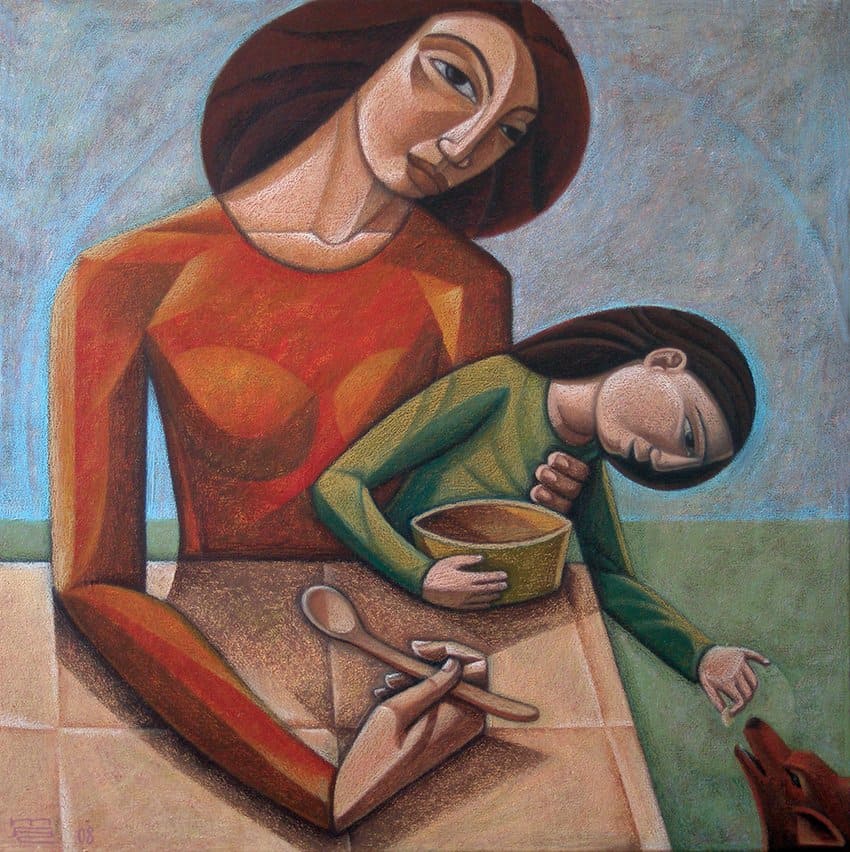
Today’s gospel, showing the growing tension between Jesus and the Pharisees and the great faith of the Canaanite woman is sandwiched between the feeding of the 5000 and the feeding of the 4000.

“Woman, great is your faith” is what Jesus finally notices about the Canaanite woman the disciples wanted to silence, send away and have nothing to do with. She may have only been a dog in the pecking order but she knew that she would be satisfied with the crumbs that fell from the table. Great is her faith in any crumb that falls from the hand of Jesus.

In contrast the disciples thought that they would never have enough to feed the five thousand (as well as women and children) or the four thousand (as well as women and children). They say before the feeding of the 5000: “We have nothing here but five loaves and two fish”. And before the feeding of the 4000 they want to know “where are we to get enough bread in the desert to feed so great a crowd?” Jesus had to show them. They would never have believed that there would be 12 baskets left over from feeding 5000, or 7 baskets left over from feeding 4000.

I dare say that most of us fall into the same boat as those first disciples. Common sense is enough to know that five loaves and two fish are never going to be enough for 5000, and seven loaves and few small fish are never going to be enough for 4000. Can we ever believe that so little can go so far?

We perhaps have little faith in such miracles.

In the same boat, when the storm was blowing a gale, Jesus notes the “small faith” of his disciples. “Why are you afraid, you of little faith?” (Matthew 8:26).  Seemingly they had such little faith in him that they thought they were all going to drown together. It almost seems as if this is what Jesus called his disciples; “You of little faith”.

In the sermon on the mount, Jesus said “if God so clothes the grass of the field, which is alive today and tomorrow is thrown into the oven, will he not much more clothe you – you of little faith?” (Matthew 6:30)

When Peter realised he wasn’t walking on water Jesus reaching out to rescue him said, “You of little faith, why did you doubt?”

When the disciples were worried that they had forgotten to take bread with them Jesus said, “You of little faith, why are you talking about having no bread?” (Matthew 16:8)

You might expect those first disciples to have great faith but they remain the ones of little faith. They have “little faith” and are slow to understand. In today’s gospel Jesus asks Peter, “Are you still without understanding?

As for the religious leaders, it would be reasonable to expect that they would have great faith. These are the religious leaders of Israel we are talking about. But they have no faith in Jesus at all. “Blind guides” and “hypocrites” is what Jesus calls them. Their concern was the keeping of rules – all 613 of them were to be kept at any cost. They were offended by Jesus’ attitude toward washing hands before eating and were more concerned about what came out of people’s bottoms than mouths. (If everyone had to wash their hands before eating then the 5000, the 4000 (plus women and children) would have remained starving. The feeding would have been impossible.)

The only faith the Pharisees had was in a god who demanded obedience and required people to do x, y and z and follow every letter of the law. They had no faith in a gracious God. They looked for offences. Tragically there are still religious leaders who have no faith in a gracious God and who are looking for offences. They too are blind guides and hypocrites. And they are frightening.

Jesus had to go a long way to find great faith. He had to leave Israel. He left that place and went away to the district of Tyre and Sidon. Tyre and Sidon are a long way out. They’re in what is now known as Lebanon. They were beyond the pale. Jesus probably went there with his disciples to get away from the pressure building from the Pharisees – he was wanting some space.

And then this Canaanite woman came to him.
She knew precisely who he was and she knew exactly what he could do.
He was the Lord and son of David.
He was the one who would show her mercy.
He was the one to help her daughter.

But she was a woman.
She was a foreign woman, a despised Canaanite.

And she shouted.

The disciples wanted Jesus to send her away.
They didn’t want to hear anything from her. 

What a good job Jesus resisted, because otherwise he would never have discovered her great faith. 

And nor would we.

It was only through what some people now call “radical listening” that Jesus found what he probably wasn’t expecting to find. Radical listening is a discipline which allows the other person their say and hearing. The discipline involves removing our personal biases which bias us to listen to the people we are most used to hearing, and like hearing from. It’s about giving the mic to those who are often silenced and taking it away from those who jealously guard it.

Jesus allowed her the mic, and Matthew’s gospel provides the amplifier, amplifying her “great faith”. This Canaanite woman was a faith leader for Jesus and for Matthew. I wonder why she hasn’t remained so. Her “great faith” is what Jesus was working towards for his disciples as he continued to teach them about the way of faith and the graciousness of God.

Her “great faith” is such a contrast to those “of little faith” and those who had no faith in Jesus. She echoes the prophetic voice which insists that no faith is to be found where it is expected – for example, in the Temple, or the religious leaders, the Pharisees and scribes and the keepers of tradition. No “great faith” is to be found in Israel. Only some “little faith” – which little faith is carefully nurtured by Jesus.

Great faith is found elsewhere, where it is not expected, beyond the pale, in foreign bodies. It is found through radical listening which shushes our biases so that we hear the voice of others (perhaps for the first time), their stories, their journeys, their faith. We might be outraged like the disciples (those of little faith). That woman did SHOUT, but people need to shout if they’re not being heard, particularly when they so need help. They often need to get their rage out, which may come across as outrageous. 

At our moment in history it is refugees who are shouting and struggling to be heard. It is the planet which is shouting, struggling to be heard – their claims being too easily dismissed as outrageous, their voices being too easily silenced. We need to be disciplined to hear those made to suffer in silence.

The Canaanite woman, our great faith leader, is key to the door that opens up mission everywhere. Matthew lets his gospel rest with the great commission to go and make disciples of people everywhere, baptising them in the name of the Father, the Son and the Holy Spirit, and opening the way of faith to them. 

The mission of God has always been a mission to overcome boundaries. We’ve heard that this morning from our reading from the prophet Isaiah in the promise to bring all the foreigners who join themselves to the Lord to the holy mountain, to make them joyful in the house of prayer, which will be forever known as a house of prayer for all people, says the one who gathers those cast out by Israel.

The story of the Canaanite woman is sandwiched between the feeding of the 5000 and the feeding of the 4000, between the feeding of the 5000 tired, radical listeners and the crowd of 4000 including the lame, maimed, blind and mute on whom Jesus had compassion.
She was prepared to eat the crumbs which fell from the table.
In communion we join her, her great faith.
In communion we join her to the 5000 and the 4000.
In communion we join her great faith even with the little faith we may have in the gracious God Jesus is showing us.

Isaiah 56:1, 6-8
Thus says the Lord:
maintain justice, and do what is right,
for soon my salvation will come,
And my deliverance be revealed.
And the foreigners who join themselves to the Lord,
to minister to him, to love the name of the Lord,
and to be his servants,
all who keep the sabbath and do not profane it,
and hold fast my covenant –
these I will bring to my holy mountain,
and make them joyful in my house of prayer;
their burnt-offerings and their sacrifices
will be accepted on my altar;
for my house shall be called a house of prayer
for all peoples.
This says the Lord God,
who gathers the outcasts of Israel,
I will gather others to them
besides those already gathered.

Matthew 15:10-20, 21-28

Then he called the crowd to him and said to them, ‘Listen and understand. It is not what goes into the mouth that defiles a person, but it is what comes out the mouth that defiles.’ Then the disciples approached and said to him, ‘Do you know that the Pharisees took offence when they heard what you said?’ He answered, ‘Every plant that my heavenly Father has not planted will be uprooted. Let them alone; they are blind guides of the blind. And if one blind person guides another, both will fall into a pit.’ 
But Peter said to him, ‘Explain this parable to us.’
Then he said, ‘Are you still without understanding? Do you not see that whatever goes into the mouth enters the stomach, and goes into the sewer? But what comes out of the mouth proceeds from the heart, and this is what defiles. For out of the mouth come evil intentions, murder, adultery, fornication, theft, false witness, slander. These are what defile a person, but to eat with unwashed hands does not defile.’

Jesus left that place and went away to the district of Tyre and Sidon.
Just then a Canaanite woman from that region came out and started shouting, ‘Have mercy on me, Lord, Son of David, my daughter is tormented by a demon.’ But he did not answer her at all. And his disciples came and urged him, saying, ‘Send her away, for she keeps shouting after us.’ He answered, ‘I was sent only to the lost sheep of Israel.’ But she came and knelt before him, saying, ‘Lord, help me.’ He answered, ‘It is not fair to take the children’s food and throw it to the dogs.’ She said, ‘Yes, Lord, yet even the dogs eat the crumbs that fall from their master’s table.’ Then Jesus answered her, ‘Woman, great is your faith! Let it be done for you as you wish.’ And her daughter was healed instantly.

Image credit: Michael Cook, “Crumbs of Love” http://www.hallowed-art.co.uk/twelve-mysteries-2/

Dealing with weeds and digging the seeds of Jesus’s teaching

This is a sermon for the 7th Sunday after Trinity, inspired by Jesus’s so-called parable of the weeds, which is also his second parable of the sower. The text, Matthew 13:24-30, 36-43, is at the foot of this post.

The Sower at Sunset by Van Gogh. He painted over 30 pictures of The Sower. As a missionary he perhaps saw himself as a sower. He loved the land, its people and their commitment to their toil in soil. These parables meant a lot to him.

There isn’t a word of today’s gospel which is impossible for us to understand, is there? Jesus is talking to Jewish peasants as a Jewish peasant of things they knew well. This is the second parable of a sower and one of several parables about seeds. 

Last Sunday’s gospel was the parable of the sower who sowed seed – even as we heard the gospel, some of it will have fallen on stony ground, some among thorns, and some in good soil where it might have rooted through the week. Come next week and we will be celebrating the gospel where the kingdom of heaven is likened to a mustard seed, the smallest of all the seeds in the mind of Jesus. 

The language is simple, and the meaning is simple. Jesus explains: the sower is the Son of Man, the field is the world, the good seed are the people of the kingdom, the weeds are the people of the evil one and the evil one is the devil. That is how Jesus explained it then. 

Van Gogh’s Sower in the background. He painted over 30 pictures of The Sower. As a missionary he perhaps saw himself as a sower. He loved the land, its people and their commitment and love of the daily toil. These parables meant a lot to him.

These parables are simple – and small. They’re for us to dig into.

The sower might be anyone who sows the seeds of faith, hope and love. The field could be more specifically our field of work, or our field of study. The field could be anything, anything we are folded into, society, family etc (fold and field are the same word). 

The enemy could be anyone – even our very selves. Sometimes our biggest enemy is ourselves. We get the word enemy from a Latin root – the en of enemy means not, and the –emy ending is where we get the name Amy, meaning friend. So the enemy is anyone who is not friendly, the unfriendly

The weeds may be the enemies’ effect. Those weeds may be injustices, insults, prejudice, condemnation, curse – anything that nips hope in the bud. They may be temptations and cravings, or the unfriendly voices we replay in our minds, or the way of thinking we return to when we are tired or have worn ourselves out. It could be pain we suffer. It could be personal assault or it could be something more systemic and societal like the phobias such as xenophobia which affect our attitudes to the extent we become the un-friendly ones. The weeds may be so many things. They grow around us and they grow within us.

It is so hard living like this, particularly when we are hard pressed on every side, and particularly when so many weeds grow within us. There is never a time when we are not vulnerable. 

It is hard being, as it were, the seed planted by the sower in a field where the weeds threaten to overwhelm and throttle us. And it’s hard for any sower to see weeds growing where they have planted so carefully. So much so, that the perennial question is “what shall we do about the weeds?”.

The weeds are the big question at the heart of the parable. What are the weeds? Where did they come from? What should we do about them? This simple parable goes to the heart of what we find most difficult. How can we live with our enemies? How can we live with such unfriendliness? How can we live with these weeds?

This parable may be simple, but the challenge Jesus makes is so difficult and demanding and so countercultural.

What shall we do about the weeds? In our world, where nothing is perfect, where there is so much wrong, where we have so little control, where we are exhausted – how shall we live like this? What shall we do with the weeds to ensure a crop yield of hope, dignity and righteousness?

What is the gardener’s answer? It is interesting that our scriptures begin in a garden, and here we are in a garden with Jesus hearing the question, what shall we do with the weeds?

The gardener’s answer is surely, “get rid of them”, “pull them up”,  “poison them”, “cut them down”, “kill them”. Our default position is to cut the enemy out of our lives, to hate them and have nothing to do with them.

But Jesus’s answer is to leave them, because killing them may uproot the good seed. His concern is to protect the roots of the good seed, the people of the kingdom of heaven. If you listen carefully to the language of the gardener it is all violent – poison, cut, kill, eliminate.  It is actually the language and practice of the terrorist, and all those who want to make a short cut to their final solution. 

Jesus is teaching us to live with trouble, at a time we have little control, when we are surrounded by the effects of so much that is un-friendly. This has always been the way. God’s people, God’s seed, have always been in the world where there is so much wrong, cohabiting with weeds of unfriendliness. Sheep amongst wolves, Jesus described us. Jesus’s teaching was only ever for the poor and the poor in spirit – for the good seed planted in a field of unfriendliness and the effects of enmity.

And he wants to protect us, his seed, so that we develop strong roots of righteousness and grow a harvest of blessing. He is teaching us to live with enemies including the many times when the enemy turns out to be ourselves.

The violence of “poison, cut and kill” not only makes victims of our enemies, but also undermines the roots of righteousness. Jesus is teaching another way. That way he stated plainly in the Sermon on the Mount: “You have heard that it was said, ‘Love your neighbour and hate your enemy. But I tell you, love your enemies and pray for those who persecute you, that you may be children of your Father in heaven.” (Matthew 5:42-45). He exemplified it on the cross when he prayed for those who were killing him.

Jesus is teaching us a new way to live with our enemies.

Another teacher, and another example of the good seed planted in a field: 

Howard Thurman was a black American preacher born in Florida a year after Van Gogh painted The Sower – in the heyday of white supremacist rule. He had a profound effect in the civil rights movement. In that sense he was “good seed” – a person of the kingdom. He was brought up by his grandmother, Nancy Ambrose. She had been a slave on a plantation in Madison County, Florida. She was a woman of great faith and a member of Mount Bethel Baptist Church. Good seed again. But listen to how the seed was planted in her and how she planted the seed in her grandson – and listen to the language of farming in what Thurman wrote:

Thurman’s whole life was dedicated to those “whose backs were against the wall”, as one whose back was against the wall. He says that the question of all those whose backs are against the wall, whose life and identity has been stolen, is “Who am I? What am I?” His awareness of being a child of God was drilled into him (notice the language of seed drilling) by his grandmother. 

“The idea was given to her [planted] by a slave minister who held secret religious meetings with his fellow slaves. How everything quivered in me with the pulsing tremor of raw energy when, in her recital, she would come to the triumphant climax of the minister: “You – you are not niggers. You – you are not slaves. You are God’s children.”

That’s how that man found out who he truly was in the eyes of God. It was drilled into him by his grandmother who had the idea planted in her by other good seed in that slave plantation of hostile racial bigotry. And roots of righteousness grew, and spread through the words and teaching of Thurman, through the seeds he transplanted to the book I have just quoted – a book which Martin Luther King always carried with him because of the good seed it contained.

Who can measure whether the seed of the slave minister, Nancy Ambrose, Howard Thurman, Martin Luther King and all their seeding yielded a crop hundred times, sixty times or thirty times what was sown?

Have you noticed how small everything is that Jesus uses to teach his disciples? He keeps using seeds, which even by his own admission can be choked and lost, probably thinking all the time of his own life and the lives of his disciples which could at any time be choked and lost. He is simply teaching us the hardest lesson of all, about how to live with enemies.

And he uses seeds to do that. In a world ripping itself apart in an arms race, where we are dominated by size, Jesus is pointing us to a new way of being – small. That’s the way. It’s not by acting big. The people of God don’t kill their way out of trouble. They don’t do away with the enemy. They live vulnerably with the enemy, all the time growing roots of righteousness and discernment.

This parable is like a seed planted in a field. It has so much energy to grow. It’s not about weakness. It’s about strengthening disciples for their life in the field. It’s not about submission, but is preparation for mission of those, like good seed planted in a field.

Matthew 13:24-30, 36-43
Jesus told them another parable: “The kingdom of heaven is like a man who sowed good seed in his field. But while everyone was sleeping, his enemy came and sowed weeds among the wheat, and went away. When the wheat sprouted and formed heads, then the weeds also appeared.
“The owner’s servants came to him and said, ‘Sir, didn’t you sow good seed in your field? Where then did the weeds come from?’
“‘An enemy did this,’ he replied.
“The servants asked him, ‘Do you want us to go and pull them up?’
“‘No,’ he answered, ‘because while you are pulling the weeds, you may uproot the wheat with them. Let both grow together until the harvest. At that time I will tell the harvesters: First collect the weeds and tie them in bundles to be burned; then gather the wheat and bring it into my barn.’”
Then he left the crowd and went into the house. His disciples came to him and said, “Explain to us the parable of the weeds in the field.”
He answered, “The one who sowed the good seed is the Son of Man. The field is the world, and the good seed stands for the people of the kingdom. The weeds are the people of the evil one, and the enemy who sows them is the devil. The harvest is the end of the age, and the harvesters are angels. “As the weeds are pulled up and burned in the fire, so it will be at the end of the age. The Son of Man will send out his angels, and they will weed out of his kingdom everything that causes sin and all who do evil. They will throw them into the blazing furnace, where there will be weeping and gnashing of teeth. Then the righteous will shine like the sun in the kingdom of their Father. Whoever has ears, let them hear.

Taking up the cross. What on earth does that mean?

This is what I emerged with by way of a sermon for Trinity 3A. The gospel from Matthew 10:24-39 was a tricky one. The sparrows caught my eye when I was preparing. So often in his teaching Jesus picks up on what is seemingly worthless and what usually goes unnoticed by others. I wanted us to explore this in relation to Jesus’s mission and the way disciples join his mission by taking up the cross. My exploration took me to the heart of brokenness and all that is wrong in the world. The text of the gospel is at the foot of this page.

The Sermon:

Has anyone got a penny? Long gone is the penny bazaar. You can’t even spend a penny when you’re desperate, when you’ve got everything crossed. A penny for your thoughts. You wouldn’t even give me the time of day for a penny. What’s the point of a penny?

The point of a penny is that it is the price of worthlessness. Way back in the day, before even the pound in your pocket was something, Jesus took up worthlessness when he took up the cross.

Are not two sparrows sold for a penny?

I imagine Jesus at the market, casting his eyes around the stalls and finding someone so poor that all they had to sell was pairs of sparrows. Two-a-penny. You could get them anywhere – and who wants them anyway? 

Jesus here is talking poverty. His own family was poor. Tradition had it that after the birth of a first born the mother would offer a lamb to the priest as a burnt offering. This was the law, and it applied to both boys and girls. The exception was for those who couldn’t afford a sheep – then it was to be two turtle doves or two pigeons. That is what Mary offered when Jesus was born according to Luke’s gospel (Luke 2:24). They couldn’t afford a sheep.

Are not two sparrows sold for a penny? They’re ridiculously cheep! Put it another way. The cost of sparrows on the open market is nothing, zilch, nada. 

Jesus has an eye for the worthless, for what the world doesn’t even bother counting or noticing, and he uses that in his teaching, like in the parable of the mustard seed and the parable of the leaven. He also picks strands of hair. Nobody counts strands of hair unless they’re folically challenged. Even the hairs of your head are counted.

The point of this passage is not about how precious the sparrow is but about the importance to God of every part of creation, particularly those people overlooked by the powers that be. It’s about those who don’t fit in ……. It’s about those who become “lost” in the system, or the gas chamber, or at sea, those who get lost through the carelessness of others. Most particularly, in this passage, it is about “the lost sheep of Israelall those lost by the religious leaders who were supposed to be good shepherds loving everyone dear to God, but didn’t. It’s about those who count for nothing in the world.

And it’s about the disciples themselves. Jesus is aware of the cost of discipleship – that the disciples will be humiliated, flogged, imprisoned, betrayed (even by members of their families), even killed. This is what Jesus’ talk about the sparrows and the hair is leading up to – the encouragement to the disciples not to be afraid of the opposition which will want to discredit and reduce them to nothing.

Jesus stands at the heart of poverty and there gives his life. This becomes his mission and the consequences are the same for him as for those who live at the heart of poverty and brokenness: rejection, betrayal, humiliation and even death. This is the mission, (and the consequences), he is preparing the 12 for in this morning’s gospel, and this is the mission he would love us to join.

We can summarise the mission of Jesus (and the mission of God) as taking up the cross.

One of the questions that has bugged me while I was preparing this sermon is what this means for us. What does it mean for us to take up the cross? It sounds like it is a lot easier for us to be part of Jesus’ mission than it was for those first disciples, or for Christians who continue to live with the threat of persecution, humiliation and hatred. By and large, we live in a society where Christianity has been a dominating culture. I suspect that none of us imagine being persecuted, imprisoned or killed for joining Jesus’ mission taking up the cross.

So what does it mean for us to be taking up the cross in Jesus’ mission?

I played with the word “cross”. I discovered that it is “the cross” in our gospel this morning. It is not “your cross”. Reading “your cross” gives rise to the expression “everyone has their cross to bear”, which might not be true, and which might lead some to think that they’ve got enough to bear carrying their own cross that they’re not going to help carry anyone else’s. If it’s “your cross” it becomes your own bubble of trouble – individualised, almost self-centred. 

No, Jesus’ mission is to “take up the cross”, and anyone taking up the cross is worthy of him. Ever since God became the God of the Hebrew slaves in Egypt God has been “taking up the cross” – as it were.

So I played with the word cross. I did a word search of my imagination, and I remembered all the crosses marking my homework and the failure they denoted.

I thought about the crossings out we do and was reminded of those who are crossed out for being who they are, for being wrong – the wrong ethnicity, the wrong race, the wrong gender, the wrong sexuality. 

Probably because it was the 75th anniversary of the Windrush landing on Thursday, and probably because it was World Refugee Day on Tuesday, and probably because of the sinking of the boat carrying hundreds of refugees and migrants off the west coast of Greece, I thought of crossings – and the bravery, and the desperation and the exploitation of those who make dangerous crossings.

Already I see the wrong (and who says anyone is wrong?), the wronged, the displaced and the misplaced in the cross. And I see that there is not one cross, with one victim (the object of our worship), but that there are so many crosses and so many for whom Jesus dies to live for in this mission to “take up the cross”.

Black theologians are helping us to understand the folly of not using our imaginations when joining Jesus’ mission of taking up the cross. One of them, James Cone, an American, wonders how ever we managed to divorce the cross from the “lynching tree”. James Cone was a black American theologian. He died in 2018. 

It didn’t take much imagination for him to link the cross to the lynching tree. In the lynching era, between 1880 and 1940, white Christians lynched nearly 5000 black men and women in a manner with echoes of the Roman crucifixion of Jesus. Cone’s comment on this is that these white Christians didn’t see any irony or contradiction in what they were doing. 

Cone writes: “during the course of 2000 years of Christian history, this symbol of salvation [the cross] has been detached from any reference to the ongoing suffering and oppression of human beings – those whom Ignacio Ellacuria, the Salvadoran martyr, called “the crucified peoples of history””.

He continues: “The cross and the lynching tree interpret each other. Both were public spectacles, shameful events, instruments of punishment reserved for the most despised people in society. Any genuine theology and any genuine preaching of the Christian gospel must be measured against the test of the scandal of the cross and the lynching tree.”

I carried on with my wordsearch – my play with the word cross and I remembered that that is how we vote. We put a cross by what we are voting for. And I park that idea – the cross being election and choice. We are free to choose to take up the cross, or we can vote another way.

Then I got my sourdough out of the fridge and got it ready for baking in the oven. Those who have the sourdough baking bug know that you have to score the dough before putting it in the oven. If you don’t score the dough the steam will find the weakest point in the loaf to make its escape. The scoring provides a controlled escape for letting off steam. I score with the cross – and the cross-score becomes the way out, the release, the exodus, as well as the lines along which I would break the bread for sharing with those who are hungry.

And I remember the sign we use for kisses, the cross we choose to show our love for others, and how far we are prepared to go to honour the pledge of our commitment – even to the extent of taking up the cross in our love for them

So, what does it mean to “take up the cross”?  Is it something like this?

To choose (elect) to be at the heart of the age-old brokenness of the world with those bearing the burden of that brokenness? Is it to be there with long-suffering love? Is it to be at the broken heart of creation as typified by all Jesus predicted for the 12 (and suffered in his own person) – flogging, imprisonment, humiliation, betrayal?

This is where we’re at, in the midst of brokenness, grief, pain – at the heart of a poverty where life can be so cheap, and when not enough are held dear, where so many are undervalued and so much taken for granted. There is so much wrong. This is where God wants us to be – at the heart of this brokenness and the forefront of his mission.

But just being there is not enough, because those who follow Jesus in taking up the cross are taking up the cross of Jesus which becomes the gateway to resurrection and the new heart of life. Taking up the cross of Jesus is taking up the promise of deliverance – it is trusting that God is at the heart of brokenness, that he is always with us as light and love in the darkness, and that God gives God’s life in the mission he invites us to join. Taking up the cross means taking up the cross in faith, trusting God who sees his people through terrible times of trauma.

So, here we are, as “sheep among wolves”, just like Jesus called those first disciples. He refers to sheep again when he talks about a judgement (Matthew 25:31-46). He divides people into sheep and goats. The sheep are the righteous. They have fed the hungry, given water to the thirsty, welcomed the stranger, clothed the naked, taken care of the sick and visited the prisoner. 

The difference between sheep and goats is that goats go their own way, leading the goatherd. The sheep, on the other hand follow the shepherd, just as Jesus encourages his disciples to join him in giving their lives in the brokenness and wrong of the world.

Matthew 10:24-39
“A disciple is not above the teacher, nor a slave above the master. It is enough for the disciple to be like the teacher and the slave like the master. If they have called the master of the house Beelzebul, how much more will they malign those of his household! So have no fear of them, for nothing is covered up that will not be uncovered, and nothing secret that will not become known. What I say to you in the dark, tell in the light, and what you hear whispered, proclaim from the housetops. Do not fear those who kill the body but cannot kill the soul, rather fear him who can destroy both soul and body in hell.
Are not two sparrows sold for a penny? Yet not one of them will fall to the ground unperceived by your Father. And even the hairs of your head are all counted. So do not be afraid, you are of more value than many sparrows.
Everyone therefore who acknowledges me before others, I also will acknowledge before my Father in heaven, but whoever denies me before others, I also will deny before my Father in heaven.
Do not think that I have come to bring peace to the earth, I have not come to bring peace, but a sword.
For I have come to set a man against his father, and a daughter against her mother, and a daughter-in-law against her mother-in-law and one’s foes will be members of one’s own household.
Whoever loves father or mother more than me is not worthy of me, and whoever loves son or daughter more than me is not worthy of me, and whoever does not take up the cross and follow me is not worthy of me. Those who find their life will lose it and those who lose their life for my sake will find it.

Mission that ends ends: preaching from Ascension to Pentecost

This is a sermon preached at Holy Trinity, Leamington for Easter 7(A), the Sunday between Ascension and Pentecost. (I am hoping it will be the first in a series of reflections inspired by readings from the Book of Acts.)

The text is Acts 1:6-14.

When we were finding our way round, when we moved to Leamington nearly two years ago, people kept telling us, “you don’t want to go to Coventry”. 

Apologies to those of you who live in Coventry. Never mind. People will be flocking to Coventry if they beat Luton in the play off final next Saturday, possibly taking the place of my team in the Premier League.

It was a punishment to be “sent to Coventry*. Being sent to Coventry meant people turned their back on you, refused to talk to you, shunned you. 

The origin of the sentence probably dates back to the 1640’s to the English Civil War. Royalist troops captured in Birmingham were taken as prisoners to Coventry which was a parliamentarian stronghold. They were not received warmly by the locals. That’s what happened when they were sent to Coventry.

Samaria from this morning’s reading is the Coventry of its day. “You don’t want to go to Samaria” would have been the equivalent for the Jewish people who found a way round Samaria rather than going through it. Part of the power of the parable of the Good Samaritan is that the hero is a Samaritan and that there was a Samaritan that could be called good.

But Jesus puts Samaria on the mission map, along with everywhere else that was considered off limits.

According to Luke, these are the last words of Jesus before his ascension: You will receive power when the Holy Spirit comes on you; and you will be my witnesses in Jerusalem, and in all Judea and Samaria, and to the ends of the earth.

Yes – to Samaria, and to the ends of the earth!

Before this, the disciples ask Jesus this question: Lord, is this the time when you will restore the kingdom to Israel? Jesus refuses to give a direct answer. It was an old question, reflecting the old troubles of nationalism brought on by too narrow a view of God’s love. 

Instead of a direct answer to their question, Jesus gives them his last word: a promise of power as witnesses, not just in Jerusalem and Judea, but even in Samaria, and to the ends of the earth.

These last words of Jesus are the first words in the beginning of the church’s missionary journey, a journey which takes us further that we could ever imagine, and a journey which undermines any boundaries which prevent God’s love reaching where God desires, to the ends of the earth.

To the ends of the earth – that is beyond the boundaries, the borders and margins of our current imaginations, undermining any attachment to nationalism, undermining the certainties and conservatism of our belief systems. Guy Garvey of Elbow sings (in Come On, Blue), love transcends anything that ever ends. Love transcends anything that ever ends, including the ends, limits, boundaries set by our imaginations and culture. 

Jesus’s words, to the ends of the earth, would be far too one-dimensional if we were only to think geographically about the extent of God’s mission, as if the first disciples had a map of the world at their disposal.

To the ends of the earth is about love’s reach. Think sociologically, think psychologically, not just geographically, think musically, think any way you can – to the ends of the earth, as far as your eye can see, and further – that is where the love of God goes, that is where the love of God comes again and again.

Think psychologically about the ends of the earth, those who are on the very edge, those in the darkest places, those in self harm’s way, those bombarded with cruel internal voices – this is where God’s love goes.

Think as peacemakers – or, better, live as peacemakers. Who have we made enemies? This is where God’s love takes us.

Think socio-economically about the ends of the earth. Who are in the margins? Who’s all at sea unable to make safety on land? To the ends of the earth – encompassing all ages, including children and young people (and it was good to hear about our partnership with Thrive from Ryan last Sunday), including those in their dying days. To the ends of the earth – encompassing enemies, strangers and those we’ve thought beyond the pale. Think the extent from cradle to grave, from prison cell to hospice bed, from palace to hovel, this is where God’s love goes.

To the ends of the earth is the scope of God’s love and the measure of God’s desire. Love isn’t just for Israel but for everyone in God’s creation. Love reaches far beyond our borders and boundaries, undermining those borders and boundaries, challenging wherever we draw the line between who’s ruled in and who’s ruled out, who’s right and who’s wrong.

The Book of Acts is often described as a book of beginnings. Our reading comes from the beginning of this book of beginnings. They are Jesus’ last words which become the first words of mission. To the ends of the earth – anything less doesn’t do justice to the desire and power of God. These are Jesus’ last words which last till the end of time, to the ends of the earth.

Acts reports the early days of mission, on the troubles Jesus’ followers got into on this journey. In the beginnings of this mission Luke shows us all the old certainties being cast to the wind, to the violent wind of Pentecost. He excitedly shows us people of all sorts being joined by the Holy Spirit, their differences and disputes being resolved by the wisdom and love which constitute God’s mission. 

He shows us what these first words of mission means as he spotlights the boundaries undermined by God’s mission and those affected by them. These include boundaries of gender, sexuality, ethnicity, class and religion.

Love still struggles against the same borders and boundaries we see beginning to be undermined in Acts, which is why I suggest these days of our lives are still the first days of mission. 

This is the beginning where we have to cast our old certainties to the wind, one of the old certainties being that we aren’t fit for such a tall order of mission. Who am I for such a thing? We are bound by the voices which say we’re not good enough, we’re not clever enough and we know we’re not confident enough.

BUT. Luke tells the story of two men in white who ask the disciples, “why do you stand here looking at the sky”. The disciples had seen Jesus ascend, they’d seen him go. But they kept on looking where he’d gone, where he was no more. The two men in white redirect the gaze of the church. They’re saying, don’t look where he’s disappeared, look for where he comes again.

It’s seeing where he comes again which encourages us and heartens us. 

It is when we see him coming again as we break bread together, as we listen for his word in preaching, teaching and prayer, as we see the wonderful work of reconciliation that we become inspired for the joy of mission, and joined by

the Spirit who makes herself known as the strengthener, the encourager and the comforter, empowering us to reach beyond our comfort zone.

We never know how we are going to be turned out. There isn’t one way of joining mission. There’s no stereotype. 

Paraphrasing Paul, there’s a whole variety of gifts, there’s a whole variety of services, there’s a whole range of activities in the mission of God so some of us will turn out to be wise counsellors, others will become healers, others will have gifts for administration, some will become great encouragers, some will become teachers, or nurses, or the sort of heartening person we are always delighted to meet on our streets, or the shy person who thinks deeply and critically about the way things are. 

When praying in God’s mission none of us ever knows who we are going to turn out to be.

Going back to Coventry. The night of November 14th/15th 1940 must have seemed like the end of the world as 30,000 incendiary bombs were dropped on Coventry, destroying 43,000 homes, 71 factories, the city centre, 2 hospitals, 2 churches, killing 560 people and injuring over 1000 more. 

The Provost of the ruined cathedral, Richard Howard, witnessed Jesus’ words as he chalked his words Father, forgive them on the Cathedral’s sanctuary walls. 

He can’t have known how that would turn out to open up a whole ministry of reconciliation with what happened in Coventry as its capital. Nor could he have known that his words, (Jesus’ words) would be the first words of a missionary journey that has taken the Coventry Cross of Nails to the ends of the earth, to so many situations of conflict.

In those days, the days of prayer between Ascension and Pentecost, the disciples, the men and women gathered together, didn’t know how they were going to be turned out, and how their mission would turn out. Neither did Provost Howard. Neither do we as we wait and pray, with our eyes trained not on where Jesus has disappeared, but on where he comes again in the triumphs of love as well as our falls from grace.

Acts 1:6-14
So when they had come together, they asked him, “Lord, is this the time when you will restore the kingdom to Israel?” He replied, “It is not for you to know the times or periods that the Father has set by his own authority. But you will receive power when the Holy Spirit has come upon you, and you will be my witnesses in Jerusalem, in all Judea and Samaria, and to the ends of the earth.” When he had said this, as they were watching, he was lifted up, and a cloud took him out of their sight. 10 While he was going and they were gazing up toward heaven, suddenly two men in white robes stood by them. 11 They said, “Men of Galilee, why do you stand looking up toward heaven? This Jesus, who has been taken up from you into heaven, will come in the same way as you saw him go into heaven.”
12 Then they returned to Jerusalem from the mount called Olivet, which is near Jerusalem, a Sabbath day’s journey away. 13 When they had entered the city, they went to the room upstairs where they were staying: Peter, and John, and James, and Andrew, Philip and Thomas, Bartholomew and Matthew, James son of Alphaeus, and Simon the Zealot, and Judas son of[a] James. 14 All these were constantly devoting themselves to prayer, together with certain women, including Mary the mother of Jesus, as well as his brothers.

Note: Acts 1:1-11 is read in churches on Ascension Day and Acts 1:6-14 is read on the 7th Sunday of Easter (Year A)

Some thoughts on Exile and the Dislocated Bones of Ezekiel’s Imagination

Ezekiel is ecstatic in his prophecy. His visions are psychadelic. I wonder if it is this that brings his prophecy home to his fellow exiles – themselves ecstatic in the sense that they are far from home, removed from their stasis. His colourful language in response to God’s call and the suffering of their exile even resonates with us. For example, Ezekiel gives us the image of wheels within wheels which is the phrase often used to describe the powers that be. And, of course, it is Ezekiel who has given us the singalong Dry Bones as he explored the exile experience of dislocation and displacement and their eventual revival and replacement through the image of those dry bones.

(Here’s the Delta Rhythm Boys singing Dry Bones.)

Ezekiel sees the hand of God in exile. According to Ezekiel, it is God who drove Ezekiel and his fellow exiles out, for the sake of their safety. He sees the glory of God moving with them, abandoning the old place and travelling with them to their many places. Far and wide they are scattered and dispersed, becoming a diaspora. God is the scatterer rather than the perpetrators of violence and occupation and he scatters them to save them from the violence and occupation.

Ezekiel’s message would have created a very different horizon for the exiles. Maybe they thought that they were exiled because of their enemies or because of their shame and guilt. But here, Ezekiel is reframing their experience. For those who would listen there is the message of hope – that love is the reason for their exile, a concern for their safety, that God’s glory remains with them, and that that glory will give them fresh heart which will lead to their return.

“Those [the exiles] of whom the inhabitants of Jerusalem have said ‘They have gone far from the Lord; to us this land is given for a possession.’ Say to them: Thus says the Lord God: Though I removed them [the exiles] far away mong the nations, ad though I scattered them among the countries, yet I have been a sanctuary to them for a little while in the countries where they have gone. Therefore say [to the exiles]: Thus says the Lord God: I will gather you from the peoples and assemble you out of the countries where you have been scattered … I will give them one heart, and put a new spirit within them.”

Ezekiel 11

I wonder how many exiles see God as the cause of their exile, and how many see the glory of God travelling with them. Certainly xenophobic communities don’t see exiled refugees in that light as they tighten their borders against them. But let’s imagine what happens when, in the words of Warsan Shire’s poem Home, “home is the mouth of a shark”, when home is a place that is too dangerous, too dangerous to be called home, when home is no place for our gods, when they become god forsaken. The God of Exodus never settles – always ready to move in with us and move out with us. Have we got the theological imagination of Ezekiel to imagine God leading the abused, the tortured from one place of extreme danger to places of sanctuary? Have we got the imagination to see the light of God’s love in our coastal waters guiding exiles to safe havens?

no one leaves home unless
home is the mouth of a shark
you only run for the border
when you see the whole city running as well
Warsan Shire

According to Ezekiel’s ecstatic imagination the diaspora is God’s doing. It is his dislocation and dispersal. This dispersal is reenacted in our liturgy. At God’s word we go, “in peace to love and serve the world”. We are scattered far and wide like seed. We are made exiles because, in other imaginations of scripture, we are in the world but not of the world (John 17:6), sheep amongst wolves (Matthew 10:16), living in cities while calling another city home (Hebrews 11:10), praying for a kingdom like nothing on earth (Matthew 6:9-13).

Here’s Jamila Lyiscott reading Warsan Shire’s Home.

70 or 72? Do numbers count in Luke 10?

Is is 70 or 72, that is the question? I’m quite fascinated by numbers. Chapter’ 10 in Luke’s Gospel recounts the number Jesus sent out “like lambs in the midst of wolves” with “no purse, bag or sandals” with the greeting “peace to this house”.

Were there 70 or 72? I am just asking for a friend.

Of course, the answer begins with 7. Anything beginning with 7 is the right answer because 7 marks all our time. We have 7 days in a week – as God took 7 days for creation, 6 days work, then a day’s rest. 7 carries with it the meaning of perfection and completion.

According to some texts the answer is 70 – and there is good reason that there should be 70 because there were thought to be 70 nations – the descendants of Noah’s children who settled the earth after the flood. Is then the sending of the 70 the Godsend to all people who on earth do dwell? (And Jesus did send out the “70” two by two, didn’t he?)

According to other ancient texts the answer is 72. And there seems to be good reason for that as well. If there were 72 Luke 10 would read “after this the Lord appointed 72 others”. What is the “after this” referring to, and who are the others? The previous chapter (Luke 9:1-6) recounts Jesus calling “the twelve” together and sending them out with no staff, bag, bread, money. I am putting 2 and 2 together here and thinking that Luke might have intended “72”, because 72 plus the others (12 of them) makes 84.

84=7×12. There is the 7 again, that number signifying completion and satisfaction. But there is also 12, the number of the apostles, the number of the tribes of Israel (because of the number of Jacob’s sons). 84 is mentioned elsewhere by Luke – as the age of Anna the prophetess, who prayed in the temple night and day and who spoke about the child Jesus “to all who were looking for the redemption of Jerusalem”. (Luke 2:36-40). Anna’s age adds further significance to the number 84. It becomes a number of wisdom and proclamation.

If 72+12 = all the people of God, this becomes a passage not just about the sending out of 72, but the sending out of the whole people of God, you and me, sent out two by two.

If the answer is 70 then this become a passage about the destiny of peace’s greeting. “Peace to this house” then becomes a greeting for the whole world.

Is it 70 or 72? I’m just asking for a friend (to whom it matters).

Or do we treasure the happy ambiguity presuming that Jesus and Luke meant both: that the good news of the coming of peace should and would be carried to all nations, and that all God’s people are commissioned to be bearers of peace, even as lambs amongst wolves, even eschewing all the usual self defences?

Preparing for responsible companionship

Theological perspectives have changed. Tonight I am meeting with our “Readers’ Council” to hear their concerns about their “Continuing Ministerial (Professional) Development”.These changes in theological perspective will be very much on my mind.

Reader ministry in the Church of England was “revived” in 1561 and in 1866 to minister in poorer parishes “destitute of an incumbent” and to cope with the population explosion in cities in the early 19th century. They had a different point of view from the clergy. The Bishop of Bangor (in 1894) saw the advantage of “Christian men who can bridge the gap between the different classes of society” – And the Dean of Manchester  recognised that most Readers were “more in unison with the masses with whom they mixed”. Although the Diocesan Readers came from the professions, the Parochial Readers were described as ‘the better educated from among the uneducated’. Nowadays Readers and clergy train together both before and after licensing and ordination. I have been ordained long enough to remember that this was not always so, and to remember that the idea that Readers and clergy could train together seemed preposterous. Now we take it for granted and appreciate the advantages of learning together.

This movement of theology is reflected in many of our traditions. From a Roman Catholic perspective, Ilia Delio traces the development of theology from the preserve of the priest in his academic study to a vast lay, creative and inter-disciplinary movement. This huge paradigm shift is dated back as recently as the 1970’s when only 5% of theologians were non-priests. That figure has grown to over 60%. Theological education is now well beyond the control of the institutional church. Diarmuid O’Murchu lists features of this shift in his book Adult Faith:

  1. Theology is no longer reserved to the academic domain.
  2. Theology has gone global, even beyond the boundaries acknowledged in multi-faith dialogue.
  3. Theology has become quite multi-disciplinary and interdisciplinary. “The contemporary lay theologian seeks to address the here-and-now of evolutionary creation … [casting] a wide net within a contextual landscape … [seeking] dialogue with partners in various fields of learning, transcending wherever possible the dualistic distinction between the sacred and the secular” (O’Murchu, p66f).
  4. Lay theologians do theology in a vastly different way from their clerical counterparts, who “prioritise the church, its traditions, teachings and expectations” (O’Murchu, p119)
  5. Christian theology has become radicalised as theologians “sought to realign Christian faith with one pervasive theme of the Christian Gospels: the New Reign of God”. (O’Murchu). Christian life is increasingly seen as “empowerment” and “called to be a counterculture to all forms of destructive power … facilitated not by some new benign form of hierarchical mediation, but by dynamic creative communities.” (O’Murchu).

For O’Murchu the “Kingdom of God” is “the companionship of empowerment” with theology being the “servant wisdom” of that companionship, so that “theology once more becomes a subversive dangerous memory, unambiguously committed to liberty from all oppressions and to empowerment for that fullness of life to which all creatures are called.” (O’Murchu, p65).

Theology has changed. In many traditions theology was thought to have been the preserve of the clergy. Readers and other lay ministers helped to open those boundaries, but their tendency remains to “prioritise the church, its traditions, teachings and expectations.” Now we increasingly realise that theology goes beyond the church (why has that taken so long?). Our shared “ministerial development” is to realise this, to overcome the tendency to prioritise the church and to engage with the “companionship of empowerment” wherever that is found.

On death and mission

All that our society has to say suggests that death is the great enemy who will finally get the better of us against our will and desire. But thus perceived, life is little more than a losing battle, a hopeless struggle, a journey of despair. ……. Even though I often give in to the many fears and warnings of my world, I still believe deeply that our few years on this earth are part of a much larger event that stretches out far beyond the boundaries of our birth and death. I think of it as a mission into time, a mission that is very exhilirating and even exciting, mostly because the One who sent me on the mission is waiting for me to come home and tell the story of what I have learned.

Am I afraid to die? I am every time I let myself ber seduced by the noisy voices of my world telling me that ‘my little life’is all I have and advising me to cling to it with all my might. But when I let these voices move to the background of my life and listen to that still small voice calling me the beloved, I know that there is nothing to fear and that dying is the greatest act of love, the act that leads me into the eternal embrace of my God whose love is everlasting.

Henri Nouwen – Life of the Beloved