Hope Before Dawn: An Advent Imagination

Live for that day when God’s peace is all in all.
Love for that day when God’s light leaves no shadows.

These are the darkest days of our lives.
December draws a long shadow,
and we find ourselves longing for light.

These days seem to go on without end.

These are the days Isaiah fought through and hoped through
3000 years ago:
the same old, the same old.
the dark ages all over again.
This is the mean time.

This is the time to cherish those who’ve kindled hope,
those we’ve bound in scripture
who hoped in God when the world felt just as heavy as ours.
This is the time to pray.
This is the time to keep watch.
This is the time to live for another day,
to love towards another day
when the times will finally be a-changing.

These are very mean days
when nations make war on nations,
There may be no world war,
But there are too many wars
for us to call this peace.
The world is at war,
and we are all caught up
in a global propaganda war.

These are very mean days when dark forces
create a hostile environment for those seeking asylum and sanctuary,
days which leave so many children hungry
and too many families poor, 

when budget after budget
miss the opportunity to make things better.

These days, however bright the weather may be,
are dark days to too many people.

And so –
these are the very days to keep hope alive,
to pray for the day when God’s kingdom comes on earth, as it is in heaven,
to live for the day when God’s word settles disputes;
to love for the day when nation will not take up sword against nation,
and nor will we need to train for war any more.

Imagine that.
Imagine the difference
when the weapons of war,
the resources of war,
become tools for farming and feeding and healing.

Imagine the difference
if the resources of war were turned to farming.
Not just in the fields of our own villages,
but in Gaza’s broken orchards,
in Ukraine’s shelled wheatlands,
in every place where the soil has been scorched,
and the hands that sow can no longer harvest.

Isaiah’s dream has dirt under its nails.
It is a farmer’s dream,
a peacemaker’s dream –
swords hammered into ploughshares,
spears repurposed as pruning hooks,
the earth tended again.

And here’s another theme none of us can avoid,
if we care about justice and peace:
we need to be prepared in these days of darkness.
Advent comes with a wake up call.
The time has come for us to wake up, says Paul, (Romans 13)
and be ready for the Day of the Lord –
the day we live for,
the day we pray for,
the day we love for.

For Advent I’ve downloaded an app which notifies me of Fajr –
the prayer Muslims offer from dawn to sunrise.
So, this morning, at 6.05,
my phone buzzed to tell me it was time to pray,
and I was reminded of all those
who rise while the world is still dark
to end the night and hope for the day.

First they wash,
then raise their hands to acknowledge the greatness of God.
They then recite the Surah:

In the name of Allah – the Most Compassionate, Most Merciful.
All praise is for Allah – Lord of all worlds.
the Most Compassionate, Most Merciful,
Master of the Day of Judgment.
You ‘alone’ we worship and You ‘alone’ we ask for help.
Guide us along the Straight Path
the Path of those you have blessed
– not those You are displeased with, or those who are astray.


Then they bow
They stand and say, “God hears the one who praises him.”
They prostrate themselves, grounding their forehead, palms, knees and toes on the earth –
and from the ground they praise God.
They finish by turning their head
to the right and to the left
with a prayer of peace in both directions.
Then they are ready for the day
(and, dare I say, they’ve given themselves a good work out!).

There is something holy about any people
who pray before the sun comes up.
They remind us what Advent is for:
ending the night,
and hoping for the day.

And we are among those holy people
imagining that day which will end all days of wrongdoing,
when God’s word is truly heard.

That is why our time of prayer
is taken up with praying for the coming of God’s kingdom,
on earth, as it is in heaven.
Christians will always use their prayer time for that –
It’s what Jesus taught us.

It is a prayer of imagination.
It is a prayer for dawn in the dark.
It is a prayer for the day when ….
the day God’s peace is all in all,
the day God’s light leaves no shadows.

And so we live for that day —
when, as Revelation imagines,
there will be no more mourning, crying or pain,
the day that will see an end to night.

Until that day
we keep watch,
keep warm,
and keep hope alive
these dark days.

Crossing the Lines of Division

Sermon for Proper 7C – Trinity 1
Readings: Galatians 3:23–end and Luke 8:26–39

Every generation lives with conflict. Sometimes it shocks us; other times, it simply exhausts us. We ask, again and again, “Why can’t people just get on?” But our scriptures don’t hide the truth: division runs deep — in history, in systems, in souls. This sermon explores how Paul names those divisions, how Jesus crosses them, and what happens when grace refuses to stay on its side of the line. In a world chained by difference, Christ brings the freedom of unity — not by erasing our stories, but by re-membering us into something new.

Here we go again — at the risk of repeating myself…
I love preaching that brings scripture back to life, and I hope you do too.
I say this often, but it bears repeating: when we open scripture together, we are not just reading words,
we are bringing them back to life.
And we’re bringing them to life in a world of division.

There are times when the world feels more dangerous than ever.
This week has been one of them: Israel launches missiles at Iran, Iran retaliates, and then Donald Trump gets himself involved — in his customary statesmanlike manner.
And those of us on the fringes wonder, “Why can’t people just get on?”
It’s a question many of us have asked all our adult lives, as one conflict after another flashes across our screens.

It’s as if we’re surprised when conflict breaks out,
even though our scriptures describe human history as full of it.
From the moment Adam and Eve grew up enough to blame each other,
and as for their children; Cain grew jealous of Abel and killed him.

This is the backdrop of scripture: a history full of conflict, grievance and wrong.
And that shouldn’t surprise us.
Human nature leans toward grievance and defence.
We feel a moral obligation to address what’s been done to us.
We shouldn’t be surprised when we don’t get along.
The real surprise is that we ever do.
In spite of our differences, it’s astonishing how often we manage peace.

This is the human reality Paul addresses when he writes to the Galatians.
We often skip to the famous bit: “There is neither Jew nor Gentile, slave nor free, male nor female…”
And we instinctively expand it: neither young nor old, gay nor straight, rich nor poor.

But we often miss the phrase just before: “We were held in custody under the law… we were locked up.”

We were locked into divisions. Bound by binaries.
And those divisions still exist — even in the church.
There has been one law for the gay and another for the straight.
One law for men (they could be ordained), and another for women (they could not).
There was a time when it mattered whether you were married or divorced.
These divisions weren’t just opinions — they were rules.
“This is the law,” people said. “These are the boundaries.”

But Paul names these laws for what they are: temporary, partial, and not the final word.
These binaries are unequal — and unequal binaries breed resentment, not reconciliation.
The good news is that in Christ, those old structures no longer define us.
The new reality is that all who are baptised into Christ are clothed with Christ. We are one.

So what does that actually look like?
What does it look like when someone, long bound by division, is finally set free?

That’s the power of the story in Luke’s Gospel.

Here is someone completely undone by division — fragmented and chained, living among the tombs.
They call him “Legion,” which isn’t his real name.
It’s a name that suggests occupation: a Roman military unit.
Empire has invaded his soul.
He is not just possessed — he is colonised.
He has become the embodiment of a fractured, binary-riddled world.

He’s been locked up — like those Paul was writing to.
Chained hand and foot by the law of empire.
He had broken the chains, yes — but the people still kept him out.
They feared him. He had to be driven away, kept apart.

And that’s where Jesus meets him.

Jesus crosses over — not just a lake, but boundaries of culture, class, purity, power.
He goes where the pigs are, among the tombs — all unclean territory for a devout Jew.
But this is how far Jesus is willing to go to restore a life.
To say: no one is beyond healing.
He crosses all the boundary lines, the enemy lines.
No one is so divided that they can’t be made whole.

And when the man is healed,
when he is clothed and in his right mind,
sitting at Jesus’ feet,
the people are afraid.
They’re afraid by the healing.
They’re afraid of what it might mean if the old boundaries don’t hold.
If he is restored, what does that mean for the system we’ve built?

They send Jesus away.

But before he goes, Jesus sends the man home.
And notice — he is no longer called Legion.
He is “the man”. A person. A human being.
He’s been re-membered — brought back into the body, into community.
He’s been clothed not only with literal garments, but in the language of Paul, clothed in Christ.

And this rehumanised man becomes a witness.
His life, restored, is a sign that another world is possible,
a world in which division doesn’t get the last word.

Because this is what the kingdom of God looks like.
Not just healing wounds, but undoing the whole system that caused them.
Not just restoring one man, but revealing that the lines we’ve drawn,
between the first and the last, the worthy and the broken,
don’t stand in the light of Christ.

In God’s kingdom, the last become first.
The one known as Legion, the one cast out,
becomes the first to preach the good news of Jesus to his people.
The law that once divided is replaced by a love that restores.

So today, let’s stop being surprised by conflict.
Conflict and division is the rule, the law, the norm (these days)
as it always has been. That’s what we’re locked in to
and what we’re locked in by.
So let’s stop being surprised by conflict
And instead start being amazed by grace
and the freedom that is made possible in Christ
who crosses the boundaries that divide us
to help us find our peace.
No longer divided, we are made one.
That changes everything.

I’d love to hear your thoughts — how do you see these lines being crossed in your own life or community?

Nostalgia never wins the day: there’s fights to fight and victories still to win

A reflection for VE Day for the 3rd Sunday of Easter. Readings for the day: Acts 9:1-6, Psalm 30 and John 21:1-19

I love preaching that brings Scripture to life—and that brings Scripture back to life, and I hope you do too. That’s a reminder that every time we open scripture together we are bringing it back to life.

Our readings today are those appointed for the 3rd Sunday of Easter (year C) – and they’re a perfect fit for this week when we celebrate the 80th anniversary of VE Day on Thursday, May 8th. How do these readings, Acts 9:1-6, Psalm 30 and John 21:1-19 reflect the experience of victory in Europe, what it meant then in 1945 and what it means now in 2025?

Psalm 30 may well be a reflection on war – and more specifically, a reflection on surviving and winning a war.
You didn’t let my foes triumph over me …
You brought me up from the dead … from among those who go down to the Pit.”

That was God’s doing.
But how many have gone through the hell of war and not survived?
How many were herded into the hell of concentration camps?
How many Jews, Roma, LGBTQ+ people?
How many people were killed resisting evil?
How many families shattered, communities broken, bodies and spirits scarred for life?

And yet …
“You have turned my mourning into dancing;
you have taken off my sackcloth and clothed me with joy.” (verse 11)

Verse 5 may say it best:
Heaviness may endure for a night,
But joy comes in the morning.

That was VE Day – a dawn after a long, dark night.

Then we heard what scripture has to say about Saul before he became Paul (Acts 9:1-6).
Make no mistake. Saul was an absolute tyrant “breathing out murderous threats” against Jesus’s followers.
He was an architect of hell.
He had legal letters giving him power to arrest followers of Jesus.
Earlier in Acts (8:1-4) we are told that after Saul’s involvement in Stephen’s martyrdom Saul ravaged the church, going house after house, dragging men and women off to.
Here was a tyrant, a religious stormtrooper.
He needed to be stopped.
It was a light from heaven that flashed around him that did it.
It blinded him. He was never able to see the same way again.
When he got his sight back, he saw the world completely differently.

In our gospel reading (John 21:1-19) six disciples fished all night and caught nothing.
Then –  “early in the morning”, a stranger stood on the shore.
They didn’t know it was Jesus.
But when they followed his call to cast their net on the other side of the boat, they caught a huge haul of fish.
Only then did they recognise him.
This is the third time, John tells us, that the risen Jesus appeared to his disciples – and he always tells us what time it was.
In our Easter gospel, it was “early on the first day of the week” (John 20:1)
In last Sunday’s gospel, it was “in the evening” (John 20:19),
Today it’s “early in the morning”, the first light at the end of a dismal night.
just as May 8th 1945 must have seemed – the first light after long nights of total blackouts.

It’s breakfast time.
We’re gathering around the table to eat and drink together, just like those first disciples overjoyed with their catch and their rediscovery of Jesus.
This is the breakfast table too.
We gather round to bring the scriptures back to life.

The question is, what does Victory in Europe really mean, not just 80 years ago in 1945, but for us now.
For many in 1945 it meant the end of unimaginable suffering, the fall of a monstrous regime and a return to peace.
But for others, especially in countries like Germany VE Day was the Day of Defeat.
And yet, 40 years later, German President Richard von Weizsacker called it something else.
He called it a “Day of Liberation” – liberation from tyranny, from lies, from fear, from a system that devoured its own people.

Germany was beaten.
But our scriptures have a lot to say about those who are beaten – as we discover in today’s readings.
Those beaten are given a second life.
Think about Jesus, crucified, dead and buried – utterly beaten by the authorities, and still appearing on the seashore.
Think about the disciples defeated by a night of failure, turned around by morning..
Think about the psalmist whose mourning was turned to dancing.
Think about Saul/Paul – persecuted, transformed into the missionary of grace.
Post-war Germany was not just a defeated enemy but a mission field for reconciliation and rebuilding and we should be joining German Christians in giving thanks for all of that.

There was a victory – declared on May 8th 1945.
A huge victory.
But we can’t settle for nostalgia.
There are many more victories yet to be won.
New nationalisms are emerging here and abroad which are undermining the truth of others, of those desperate for refuge.
There are still people who are hungry, broken and forgotten. 

We sing the hymn Peace, perfect peace is the gift of Christ the Lord.
It reminds us that there is such a thing as imperfect peace, and then there is perfect peace.

The perfect peace of the Lord is, as we say, a peace which passes all understanding.
It’s the peace that met Peter and the others on the beach,
the peace that transformed Saul on the road,
and the peace that raised up the psalmist from the pit.
It’s the peace that tends to the hungry, beaten and forgotten,
a peace that puts the last, least and lost first.

In our gospel reading Jesus told the disciples to cast their nets the other way – to try the other side.
As we move beyond VE Day let’s seek the peace of Christ,
casting our nets in a new way
that tells the truth,
that seeks the lost,
that reconciles enemies
and that turns mourning into the scenes of dancing and revelry we remember from VE Day 1945.

So may we, like those disciples, recognise the risen Christ on the shore,
and with joy cast our nets in new ways,
seeking not only peace,
but peace that restores,
peace that heals,
and sets the world dancing once more.

We’re all at sea in our small boats

This is a reflection on the sea and the troubled waters we call life for the 4th Sunday after Trinity (B).

I spotted “the other boats” in the gospel reading for the day, from Mark 4:35-end (text below). They played on my mind as we prepare for a UK election which some want to turn into an election on immigration. It made me think – “we’re all at sea” and the forecast is for more storms. This sermon comes with a health warning – it is metaphor heavy.

The first verse we see when we open our Bibles is “In the beginning when God created the heavens and the earth, the earth was a formless void and darkness covered the face of the deep while the spirit of God swept over the face of the waters.” (Genesis 1:1-2) 

The last verses in our Bibles are also about water – the “river of the water of life, bright as crystal, flowing from the throne of God and of the Lamb, through the middle of the street of the city, feeding trees bearing fruit for all seasons and leaves for the healing of the nations”. (Revelation 22:1-2)

In the beginning of the Bible there is total darkness. In the end, there is only light – no darkness and no hiding.

The Bible begins in water and ends in water. And between the two there is all the difference in the world – as different as night and day.

The Bible begins in water. The water is chaos. The first thing God does is make light. The second thing he does is sort the waters out. He separates the waters of heaven and earth, gathered the water together and let dry land appear. That’s how it began. 

This is a theological view of life. This is how we open our Bibles. We open them with an understanding that we are all at sea. From the very beginning we have been surrounded by water, the sea, the deep. We’ve been on flood alert since the time of Noah.

Probably all of us here have had times in our lives when we have felt overwhelmed, engulfed or drowning – and used these metaphors to describe how we felt, using so many metaphors drawn from our collective experience down the ages of chaos and the sea. So much of our language reflects this. Like “we’re out of our depth”, or “we’re in it up to our neck”, or “we’re all at sea”.

The Bible begins with water and ends with water. From day one there is storm after storm. The waves crash all around us until that day when the waters become calm and do God’s bidding of giving life and healing to the whole of creation.

These are the times we live in, when there is one storm on top of another. For the time being we are between the devil and the deep blue sea. (Another popular saying.)

These are the times Jesus lived in as well. The storms he faced were different to ours. With his contemporaries he was assaulted by religious oppression and exclusion, a taxation poor which kept them in poverty and debt, and an occupation by a foreign power which robbed them of their freedom.

His attitude at times like these is captured in the snapshot we have of him in today’s gospel reading. They’re all at sea. A great gale arose, and the waves were beating the boat and swamping it. And Jesus slept. Calm as you like.

There were other boats. It’s strange how you miss details like this. I must have read this passage hundreds of times, but I’ve never seen those four words before. There were other boats. Have I never noticed these other boats because the focus has always been on Jesus’ boat? Have I only spotted these boats now because of the small boats that desperate refugees are taking to to escape to safe havens. 

(Isn’t it terrible that some people are turning the election into an election about immigration and the people in these small boats?) It is Refugee Week – and we need to spot their boats, not stop their boats. There is a growing refugee crisis – that means a crisis for a growing number of refugees. 1 in 69 of the world’s population is now displaced, largely because of conflicts around the world. It’s important we respond to their Mayday.  M’aidez. Help me! It is, after all, the refugees who have the problem – all those who have no safe routes for escape. They have enough problems without being turned into a political football.

We’re all at sea. We’re not all in the same boat. We’re not in the same boats as the refugees. We’re all in our different small boats. We’re all at the mercy of troublemakers, powers-that-be, the forces that make waves, and the sea so dangerous. 

There’s a well known fisherman’s prayer that captures our plight. It’s become known as the Breton Fisherman’s Prayer: 

Dear God,
be good to me;
the sea is so wide, and my boat is so small. 
Amen.

They’re words from a poem by Winfred Ernest Garrison.

It’s not surprising that so many make that prayer their own. The words fit the experience we call “being all at sea”.

The sea is our life with its currents and tides, its ferocity and deceptive charm constantly eroding and undermining us. The challenge of our lives is how we navigate these waters.

We are like those who, in the words of Psalm 107 “go down to the sea in ships and ply their trade in great waters”, who have seen the works of the Lord and his wonders in the deep. While they were at their wit’s end as they reeled and staggered like drunkards, they cried to the Lord in their trouble and he brought them out of their distress. He made the storm be still and the waves of the sea were calmed.

Our lifetime at sea is summed up in our baptism. We are soaked in deep water, and brought through water as if this is an acknowledgement of our life at sea, weathering the storms faced by us all, Jesus included. The question we’re asked in baptism is, “Do you turn to Christ?” Our response then is “I turn to Christ”. It’s stated as a promise. Perhaps it should be stated as a habit. 

In the storms of life, when you’re all at sea, when you feel you’re drowning, do you turn to Christ? The faithful ones, like the ones in the psalm, will say, “Yes, I turn to Christ. He’s the one who can sleep in the storm. He’s the non-anxious presence. We turn to him to hear him say ‘Peace! Be still!’ – and when we do, the wind dies down and we feel the calm.”

It’s easier said than done because in the midst of things it is too easy to panic.

The waves that have panicked me have been so slight compared to what others have faced. Dare I say I’ve done enough doom scrolling to sink a battleship? I am only beginning to learn to wake Jesus in my mind, to hear him in the head of the storm, to find better things to think about, to take his word as gospel. 

I know that when the sea calms for me, it calms also for all the other small boats.

Here we gather. We call this gathering place the NAVE – the Latin word for ship. We are shipmates in our small boat.

Here we are, all at sea, our metaphorical sea. The metaphorical weather is awful. Even though the long term forecast is for beautiful, calm weather, immediately, all we can expect is one storm after another. There are dark forces within us, and all around us, threatening us – driving so many from their homes, driving them to the edge, condemning them/us to their/our fate on the sea of life.

We are shipmates. We’ve been through it before. We’ve been through the waters of baptism. We’re used to turning to Christ – who in today’s gospel we see in the same boat as ourselves. In the rage of the storm he makes himself heard. We hear him call us “beloved”. The wind and the sea hear him. ‘Peace! Be still!’ they hear him say. For the moment they obey him.

Here we are, churches in the Bridges Group of Parishes – like a bridge in troubled water for all those who live in these six parishes. When we’re weary, feeling small, when times get tough, when we’re down and out, when darkness comes and pain is all around – we know the words of the one even the wind and sea obey.

Mark 4:35-end
On that day, when evening had come, he said to them, ‘Let us go across to the other side.’ And leaving the crowd behind, they took him with them in the boat, just as he was. Other boats were with him. A great gale arose, and the waves beat into the boat, so that the boat was already being swamped. But he was in the stern, asleep on the cushion; and they woke him up and said to him, “Teacher, do you not care that we are perishing?” He woke up and rebuked the wind, and said to the sea, ‘Peace! Be still!’ Then the wind ceased, and there was a dead calm. He said to them, ‘Why are you afraid? Have you still no faith?’ And they were filled with great awe and said to one another, ‘Who then is this, that even the wind and the sea obey him?’

Coin sides and the shape of peacemaking processes

How many sides has a coin? When we toss a coin we call “heads” or “tails” because we assume that a coin just has the two sides. On the toss of a coin we are divided into winners and losers. The winners are able to claim that they won fairly (even though only by chance) and the losers have to suck it up. There are two sides now and both know whether they are on the side with greater chance or lesser chance. The losers’ last chance is to overturn privilege – and the odds are always stacked against them.

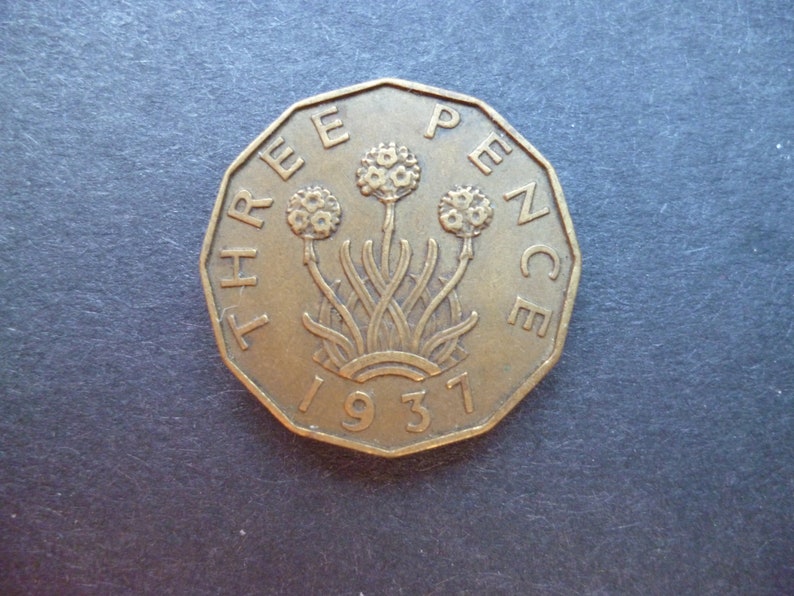
The 12 sided thrupenny bit was first minted in 1937

But there aren’t just two sides to a coin. There is another smaller side which nobody calls because it so disproportionately small that the chance of it landing on its edge are virtually zero. But then, who hasn’t spent time standing coins on their edge, and who of us of a certain age hasn’t enjoyed making the old thrupenny bit take its stand on one of its twelve sides (as opposed to its two large sides).

Just imagine twelve sides. That is precisely what our scriptures imagine – with the twelve tribes of the twelve sons of Jacob finding and founding society in the land they were caused to occupy. The early church shared that imagination, counting twelve apostles and replenishing that number when one fell out. The thrupenny bit represents a design to facilitate concelebration, conversation and dialogue – remembering that there are rarely only two sides to any question and that to resolve conflict many sides have to be considered. Sitting round a circular table is to adopt this design. Each person has their point of view, their side, in a facilitative process which intends to iron out the abuses of positional power.

Polyhedron 20 from yellow

Pope Francis, in Fratelli Tutti (2020), suggests the image of the polyhedron as the shape of better things to come. Promoting a “culture of encounter” he writes:

“The image of the polyhedron can represent a society where differences coexist, complementing, enriching and reciprocally illuminating one another, even amid disagreements and reservations. Each of us can learn something from others. No one is useless and no one is expendable. This also means finding ways to include those on the peripheries of life. For they have another way of looking at things; they see aspects of reality that are invisible to the centres of power where weighty decisions are made.”

Fratelli Tutti 2020

Colum McCann underlines how tricky it is to get beyond binary thinking about winners and losers and right and wrong in his novel Apeirogon. The title is a mathematical term for an object of an “observably infinite number of sides” – a shape that reflects that conflict can never be reduced to simple opposed positions. Apeirogon is based on the real life friendship between Rami Elhanan and Bassam Aramin, two fathers (one Israeli, the other Palestinian) united in their grief for their daughters – both killed in conflict. They both join the Parents Circle Families Forum – a group of people similarly bereaved who unite in their sorrow to press for a peaceful resolution to the conflict.

Apeirogon: a shape with a countably infinite number of sides. Countably infinite being the simplest form of infinity. Beginning from zero, one can use natural numbers to count on and on and even though the counting will take forever one can still get to any point in the universe in a finite amount of time

from The Apeirogon

And there’s another shape – the circle. The shape of things to come if ever we come to the time of resolution – when there are no sides to join or oppose, when the corners we tend to cling to are rounded off by our encounter with the various truths of any situation. The earth is well rounded as if prepared for peace making.

The Little Boy who bombed the Little Girl: a prayer for transfiguration

2336374171_1abb948e89_b
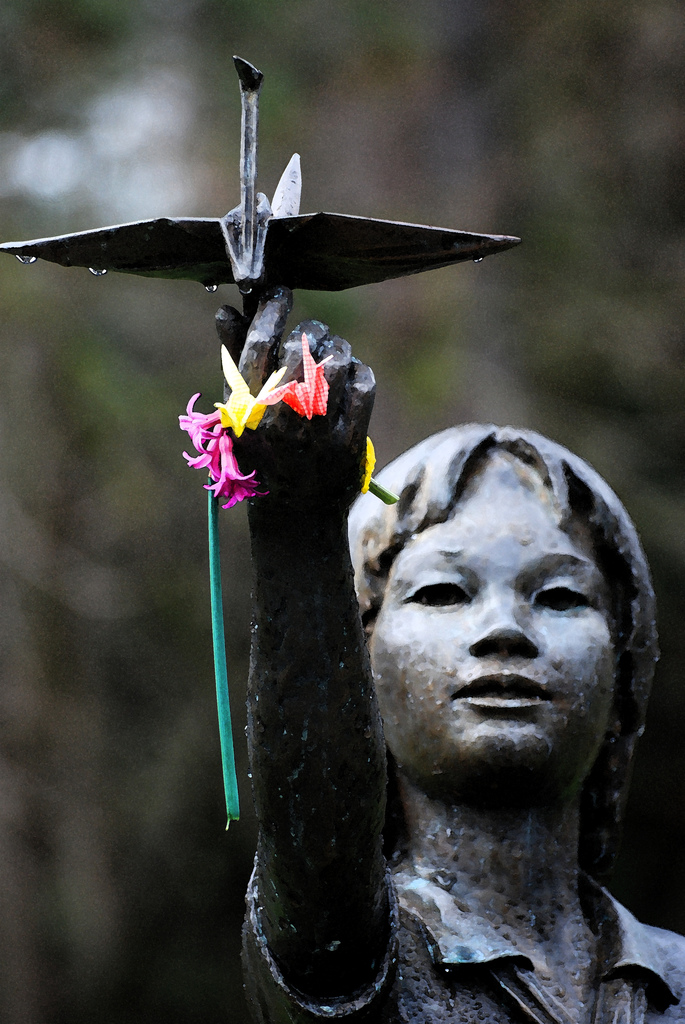
I did look for photos to illustrate this post. What I found were so awful and distressing – and what I would have used seemed so trivial in comparison. So I have posted Scott Butner’s photo of the statue of one of the so many tragic victims, Sadako Sasaki – she seems to be beckoning us into her “wishing well”.

Sadako Sasaki died when she was 12. She spent her life praying for peace. A sculpture of her in Seattle (pictured) shows her beckoning us to join her prayer. She was two years old when an atomic bomb was dropped on her town of Misasa Bridge in Hiroshima on August 6th 1945. This little girl survived the bomb but developed leukaemia. She is remembered for the thousand cranes she (nearly) folded before her death in 1955.

Her first crane was made by her best friend when she visited her in hospital and told her about the Japanese saying that one who folded 1000 cranes would be granted a wish. Legend has it that Sadako only managed to fold 644 cranes before she died, and that the other 356 were made by her friends after she died and buried them with her.

Ironically the bomb was called “Little Boy”.

Many people have made the connection between the Feast of the Transfiguration which the church celebrates every August 6th, and this act of disfiguration which took place on that August 6th. People in Japan celebrate August 6th as a national peace day.

Matthew (17:1-13) describes the Transfiguration and how disciples saw how Jesus’ face shone when he was seen on the mountain with Elijah and Moses. This was a meeting of three visionaries which not only transfigured Jesus’ appearance but also strengthened him for his journey to Jerusalem.

Many people will be taking their holidays at this time of year including some who, like Jesus, will be taking to the mountains. Can we pray that they will see life afresh and gain strength for the next stage of their journeys back to work against all that disfigures their own lives and the lives of others?

Besides the Seattle statue there is another in Hiroshima Peace Memorial Park. It has a plaque that reads: “This is our cry. This is our prayer. Peace in the world.” That is a prayer of lament, a visionary prayer and a prayer that we may see the world anew.

This is based on words originally written for the Chester Diocesan Cycle of Prayer

Overcommitment

To allow oneself to be carried away by a multitude of conflicting concerns, to surrender to too many demands, to commit oneself to too many projects, to want to help everyone in everything is to succumb to violence. More than that, it is cooperation in violence. The frenzy of the activist neutralises his work for peace. It destroys his own inner capacity for peace. It destroys the fruitfulness of his own work, because it kills the root of inner wisdom which makes work fruitful.

Thomas Merton in Confessions of a Guilty Bystander

Ah Bisto! Conspiracy Theories of Pentecost and Community

>

People who breathe together, stay together. People who can smell one another create community. The person who holds his nose because he doesn’t like the air that he is breathing is excluding himself from that community.

Ivan Illich reminds us of an old German saying: ich kann Dich gut reichen, “I can smell you well”. It captures well an apect of openness we often miss. We have our eyes and ears open, but rarely do we talk about having our nose open. I can smell you well. For me that adds another sense to the story of the Good Samaritan. Did the victim in the ditch smell so badly that people could not tolerate his smell, and had to walk by on the other side, holding their nose against the stink. With nose open, the Good Samaritan had his arms free to manhandle the victim to safety and recovery.


There is a custom in Christian liturgy called the “kiss of peace“, or osculum pacis – only recovered relatively recently in the Church of England. These days the kiss of peace isn’t so much a kiss as a handshake – very British – but at least it’s touching. Apparently in some places, until the 3rd century, the kiss was “mouth to mouth”, and was a sharing and mingling of breath. John’s story of Pentecost reminds us that Jesus breathed on his disciples, saying “receive the Holy Spirit” (John 20:22). They smelt each other well. They shared their breath in con-spiracy. The church formed conspiratorially to be a conspiracy. Illich writes:

“Peace as the commingling of soil and water sounds cute to my ears; but peace as the result of conspiratio exacts a demanding, today almost unimaginable, intimacy.”

Pax board, Early 16th century, in a frame from 19th century
16th century Pax Board from Budepest

The intimacy didn’t last as some regarded the practise as scandalous.  For example, Tertullian (in the third century) was rather worried about possible embarassment to “a decent matron”. The practice got well watered down. By the 13th century, the Catholic Church had substituted a pax board which the congregation kissed instead of kissing one another!

“Don’t imagine you can be friends with people you can’t smell.” That was the advice Illich was given. Friendships and communities develop amongst people who smell each other well, who can breathe in the air and the smell of their friends and neighbours, and who allow their own air and smell to be breathed by others. Friendships and communities are conspiracies – threatened in our de-odourised times of Lynx, Colgate and Ambi-pur where we struggle to smell anyone, or anything, well.

The playground cry “you stink, you stink” marks a cruel exclusion by those who won’t smell a person well – it is often accompanied with the gesture of the nose being held or up-turned. The person excluded has to find their friends who are prepared to smell. Above every friendship, every community, every conspiracy, there is a nose.

lop-sided truth


Channel 4’s drama series, The Promise, proved to be a powerful expose of the human cost of the protracted conflict on Palestinian soil. I was glad of the insight into this tragic (and for me, little understood) history spanning the last hundred years. (How is it so easy to remain ignorant of such significant events?). The story is based on a diary written by Len and held by Erin, his grandaughter. Len is a former British soldier who served both at the liberation of Bergen-Belsen and in Palestine, in the tense months before Israel declared itself a state in 1948 when the occupying British army was subject to a sustained and bloody terrorist campaign by Zionist groups. Besides portraying the cruel hard-heartedness of Jewish people trying to make room for themselves and the violent disruption to the loves and homes of the Palestinian people, the series brilliantly portrayed the plight of the professional soldier and his role at the complicated heart of conflict.

israel_wall
The size of the problem! Photo by Jim Forrest

In my enthusiasm for The Promise, I searched for reviews in the blogosphere – just to validate my enthusiasm. I found a review in the New Statesman, complete with outrageous and outraged comments. Comments include “inaccurate”, “anti-semitic” and “one-sided”. It made me wonder how The Promise (or any account) can be other than one-sided. Anyone who builds a bloody great wall – designed to prevent their neighbour seeing over – is destined to be victim of one-sided accounts of history. In conflict there is no middle ground. There is one side, or the other. There is no dis-passionate observer sitting on the fence with a view of both sides. There can be no balance.

There can, however, be peace process. Prophet (and Jew) Amos, centuries ago (a farmer from Tekoa – another Jewish settlement south of Bethlehem), proposed the “swords into ploughshares” policy – an early disarmament programme. “Swords” represent all the paraphernalia of war – its weaponry, its defences and its propaganda – upsetting the balance of truth and jeopardising peace for generations to come. Conflict creates its own insecurity and reverses common sense  – requisitioning the economic tools for prosperity, to melt them down for the savagery of war. We can, even with our one-sided truth, work for this disarmament. Even me, writing this, has declared my one-sided hand in conflict against those who were outraged by the pro-Palestinian stance of The Promise. But I didn’t see the series as an incendiary device lobbed over a great wall of conflict – but as an exercise to expose what is happening. Truth and plight can only be exposed one-sidedly. It is up to us to make it “sword” or “ploughshare”.

Ringing bells with our wishing wells


World Peace Bell
World Peace Bell – Newport, Kentucky

Dan Clenendin highlights in his post, the outrage of outsiders, repeats depressing research findings from America (Kinnaman 2007) showing how 16-29 year olds regard the church. Here are the percentages of people outside the church who think that the following words describe present-day Christianity:

antihomosexual 91%, judgmental 87%, hypocritical 85%, old-fashioned 78%, too political 75%, out of touch with reality 72%, insensitive to others 70%, boring 68%.

It would be hard to overestimate, says Kinnaman, “how firmly people reject — and feel rejected by — Christians” (19). Or think about it this way, he suggests: “When you introduce yourself as a Christian to a friend, neighbor, or business associate who is an outsider, you might as well have it tattooed on your arm: antihomosexual, gay-hater, homophobic. I doubt you think of yourself in these terms, but that’s what outsiders think of you” (93). This is a far cry from the reception of the first believers, who, according to Luke, “enjoyed the favour of all the people” (Luke 2:47). The church’s message isn’t ringing the right bells for generations of our people.

I wonder if we have forgotten to love our neighbour – that person who lives the other side of the fence with a different lifestyle and set of beliefs. In a fearful culture neighbours are suspect until they prove themselves otherwise  by “coming round” to our way of thinking. The first believers lived a different culture, being sent out to neighbours with the simplest of messages “peace to this house: peace to you” and with a love that was to overcome all sorts of barriers and offences. I wonder if we could ring more bells with more resounding wishing wells to those who now see themselves the other side of the wall – and the wrong side of-fence.