Seeing the wounds Jesus shows us

A sermon for the 2nd Sunday of Easter – Year C for two small churches. The gospel for the day is John 20:19-end.
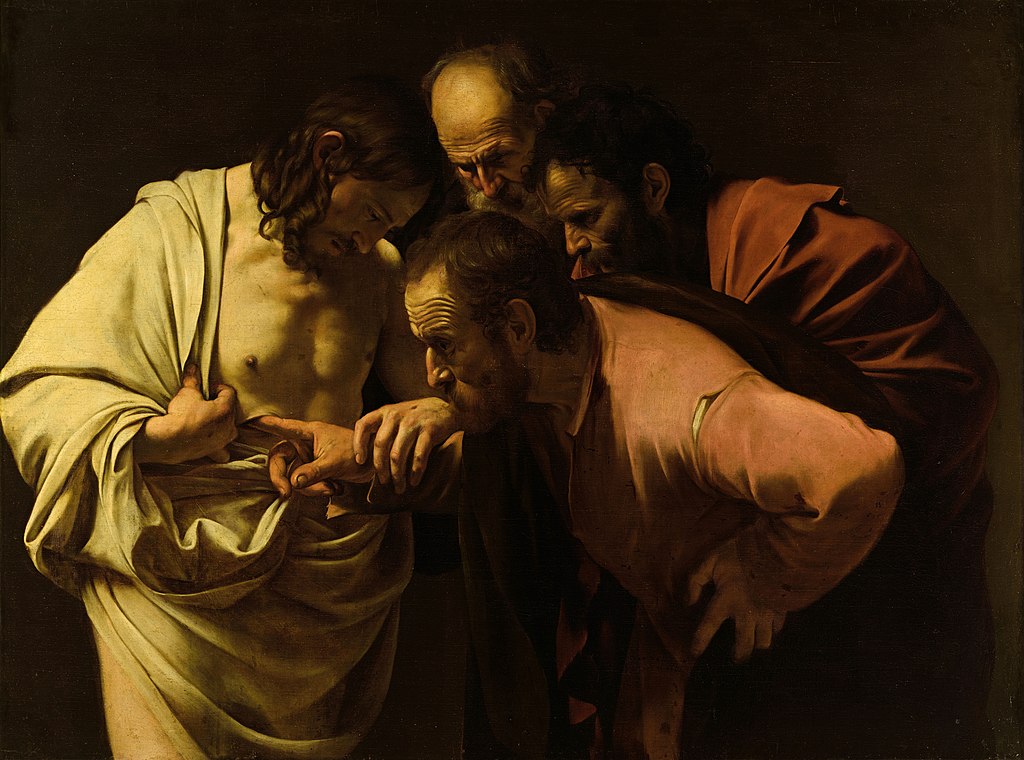
The Incredulity of St Thomas by Caravaggio – or should it be called Jesus showing Thomas his wounds?

I love preaching that brings Scripture to life—and that brings Scripture back to life.

That’s a line I’m going to repeat each week to remind us that every time we open Scripture together we are bringing it back to life.

This morning we return to John’s Gospel, still caught up in the wonder of that first Easter day (John 20:19-end). It’s a story only he tells.

John himself brings scripture back to life.
Particularly we see the influence of the creation story from the 1st chapter of our scriptures.
We can see that in the way that he tells us the time.
On the evening of that first day of the week.
It’s like last week’s gospel reading which began: Early on the first day of the week, while it was still dark. (John 20:1)
We are still on that first day which was like the first day of creation, when, according to Genesis 1:2, earth was a formless void and darkness covered the face of the deep.
That’s the time in today’s gospel. It was the first day of the week, and it was evening.
In other words, darkness was forming.
Taking our cue from Genesis, John’s readers can expect God’s wonders on this new day of creation.

Thomas wasn’t with the disciples when Jesus came on that first day, the day of resurrection.
It was the other disciples who had to let him know that they had seen the Lord.
Thomas told them that he would never believe “unless I see the nail marks in his hands and put my finger where the nails were, and put my hand into his side”.
It is this I suggest we focus on in our worship today.

Thomas is the patron saint of those who are blind because seeing wasn’t enough for him.
He needed to examine Jesus’s wounds by touching them and feeling them.
And the wonderful thing on that second Sunday, the first day of the week following, was that Jesus came and stood among them again and showed Thomas his wounds.
He welcomed his touch. He guided his hand. He let him explore his body.
Thomas is the patron saint of those who struggle to believe what they can’t see—or even what they can.
He shows us that resurrection faith isn’t just about seeing.
Sometimes it’s about touching, questioning and wrestling with God.

Jesus showed Thomas his scars. He wants his disciples to see them.


In the Last Supper, he took a loaf of bread and he broke it.
He wanted them to see his body in the brokenness of the bread.
“Take, this is my body,” he said. (Mark 14:22).
Then he gave them a cup for all of them to drink from.
In that cup he wanted them to see his blood.
“This is my blood of the covenant poured out for many.”
Even before he was wounded he wanted to show his disciples the wounds he was going to suffer.
And in today’s gospel, in one of his resurrection appearances, he invites Thomas to have a look at those wounds – to examine, inspect and see with his hands as well as his eye.

Thomas recognises Jesus through his wounds, just as Jesus wanted him to.
And this is how we come to know Jesus.
Just as Thomas encountered the risen Christ in his wounds, so too we encounter him today in the bread and wine of the Eucharist.
Every Communion we have with Jesus we have this invitation to examine the wounds of Jesus. Every time the bread is broken we are invited to see the brokenness of the body of Christ and to feel that brokenness in our mouths.
Every time we take this cup we are invited to taste the blood of Christ shed for us.

What is it that Jesus showed Thomas?
What did he want his disciples to see?
What does he want us to see when he shows us his wounds, when he invites us to see his body and his blood?

The first things we see are the wounds to his hands and feet where the nails were driven into his body by the hammer blows of empire.
Then, if he turns we see the wounds of the whipping scored into his back for being the scourge of empire and religion.
Then we see the scars on his head where they pressed the crown of thorns and added insult to injury, to press home the point that this “pretender” was nothing.

The rule of the kingdom of God is that the last, the lost and the least come first and those who are first in the kingdoms of this world come last.
The rule of the kingdom of God turns the rules of the world upside down.

In the wounds of Jesus, his disciples see a man who embodies that rule of the kingdom of God. In the brokenness of his body, in the bloodshed, we see a man the religious and political capital tried to reduce to nothing.
The plots against him and his crucifixion were intended to humiliate him and his followers – to make them least, last and lost – GONE for ever.

The problem for them was that the rule of the kingdom of God puts the least, last and lost – those lost and broken by the ways of the world – first.
When Jesus stood among his disciples, first without Thomas, then with him, he was the living proof of the fundamental rule of the kingdom of God.
Here was the humiliated, crucified and killed one.
You can’t get more “least, last and lost” than that.
Here he was, “the first fruits of those who have died”, Christ raised from the dead (1 Corinthians 15:20).

This is what Jesus showed Thomas –
the scars are the living proof of the rule of the kingdom of God.
Jesus stood among them as living proof of the rule he’d always followed,
that puts the last first and the first last.
Here is the one they put last made first.
This is what Thomas saw. This is what he said:
“My Lord, my God” – the rule of the kingdom of God realised in those few words.
“My Lord and my God” – Jesus comes first for Thomas.

So Jesus stands among us still, not with condemnation, but with scars.
What do we see? What difference does it make? Does Jesus come first?

Jesus doesn’t shame Thomas for his questions. He meets him in them.
He doesn’t rush belief. He invites it — gently, patiently, personally.

And he does the same with us.
To all who doubt, who ache, who long to see and touch and know — he says,
“Here I am. Peace be with you.”

He doesn’t hide his wounds. He offers them.
He lets us trace the pain and the mystery of a love that suffers with us and for us.
And in that wounded, risen body, we find our hope.

This morning, he says again:
“This is my body. This is my blood.”
This is how I choose to be known.
Look closely. Taste carefully.
And, if you are among the broken,
do not be afraid.
For crying out loud, what do you want me to do for you?

A sermon for the Last Sunday after Trinity (Year B) encouraging us to join Bartimaeus in his loud prayer that helps him see. The readings for the Last Sunday after Trinity (B) are Jeremiah 31:7-9 and Mark 10:46-end.

October 27th 2024

Here’s the question. “What do you want me to do for you?” This is the question Jesus asked Bartimaeus. It’s exactly the same question he asked the two disciples who approached him in last week’s gospel. The sons of Zebedee, James and John, came forward to Jesus, saying: “we want you to do for us whatever we ask of you”, to which Jesus replied: “What is it you want me to do for you?”

It’s a question any helper might ask. “What is it you want me to do for you?” It might well be a question you imagine Jesus asking you. As you settle down in prayer you might imagine Jesus asking you, “What do you want me to do for you?” Our prayer may specifically answer that question as we lay open the heart of our concerns to God.

Not that we expect God to do all we ask. Remember James and John. They wanted Jesus to do for them wherever they asked, but what they asked for was so wide of the mark that there was no way Jesus was going to do it for them. They asked to sit either side of Jesus in his glory – there was no way Jesus was going to save the seats for them. As it turned out the gospel shows us in the crucifixion scene that those to the left and right of Jesus “in his glory” are those disgraced by society, those shamed and ashamed – all three of them convicted criminals.

But sometimes our prayers are answered. Sometimes what we ask to be done is done, as in the case of Bartimaeus. 

The beginning of his prayer is shouted out and is heard above the noise of the crowd. Often our prayer is a cry, and sometimes we cry out loud, as Bartimaeus does here: ‘Jesus, Son of David, have mercy on me!’ He goes against the crowd who mercilessly tried to shut him up. But he carried on shouting, ‘Son of David, have mercy on me!’ Jesus heard his prayer. He couldn’t help hearing him: he was shouting so loud. 

Mercifully Jesus called him to him asking that question. “What do you want me to do for you?” The blind man replied, “My teacher, let me see again”. Jesus recognises the faith of the blind man in what the blind man has called him. He’s called him “Jesus”, “Son of David” and “Teacher”. According to Mark, Bartimaeus has seen in Jesus what the disciples have so far not seen. He’s the one who’s seen. It’s the disciples who are blind. When we call anyone “Teacher” we’re already trusting them to show us the way. Jesus responds to such faith, insight and trust. To the blind man he says “your faith has made you well”. Jesus had helped him see again – and Mark leaves us with this spectacle of Jesus journeying to Jerusalem with this beggar by his side. We don’t very often see the procession into Jerusalem that way, do we? But that is the way Mark paints the picture.

We can’t get away from the blind in our worship. Our other reading is also about the blind and the lame. They are what’s left of Judah after generations of suffering at the hands of the babylonian empire six centuries before Christ. Babylon invaded Judah three times that century and occupied her for 50 years. Judah was ruined. There was very little left. So much had been destroyed – Jerusalem, the temple – everything that gave them a national identity was gone. And most of the people had gone as well – killed or deported. Those who were left lived with the humiliation of being beaten. They were refugees scattered far and wide.

This scripture from Jeremiah has been treasured because of the vision Jeremiah has for these people and the words he has for them – the blind, the lame and those scattered to the four corners of the earth. These are traumatised people. They are survivors of devastating disaster. Some of you will know what it is to be traumatised by what’s happened to you. You may have lost someone or you may have suffered a life-changing injury. The news these days is full of reports of whole communities destroyed and traumatised by war in Gaza, Beirut, Lebanon. We look into their faces. There are no words. We often frame our speechlessness with those very words. “There are no words”, we say.

Traumatic shock leaves us reeling disrupting our normal mental processes because we can’t work out what is happening to us. The mind shuts down and the memory of the traumatic events become fragmented. The wounds are unspeakable. There are no words. The mind automatically shuts down feelings and turns off human responses locking violent experiences away in a form of self-protection which often means we never get to understand our pain, our loss, our grief. Trauma disrupts the trust we have – whether that is in God, in others or in the future. The future we had in mind is simply no longer there – and many traumatised people are left feeling that there is no future. “I see no future.”

This is the context for Jeremiah. He is part of a people traumatised by events. They have lost everything. There are no words. They have no vision for the future apart from their ongoing pain. But Jeremiah gives them words. They’re words given to him by God. Jeremiah shares his vision. Our reading comes from a part of the book of Jeremiah which is known as “the Book of Comfort”. God through Jeremiah is restoring their faith and renewing their hope. They have a vision for the future. Jeremiah is helping them see again.

Our readings are related. In both people are being helped to see again. That’s the one thing Bartimaeus asks of Jesus in today’s gospel. “I want to see again.” In our Old Testament reading Jeremiah helps the whole people to see themselves again, something like the people they had always been.

I suggested that you might use Jesus’ question in your prayer. Imagine Jesus asking you, “What do you want me to do for you?” After all you’ve been through, whatever that is, what will your answer be? What will you ask for?

Remember that Jesus asked that question to James and John as well as to Bartimaeus. He wasn’t interested in answering James and John’s request for status and privilege. Jesus will never answer our thirst for power, wealth or prestige. It’s no good praying over our lottery ticket. He only answers the beggar’s prayer.

Our readings are related to inspire the church to join the beggar in his prayer (not James and John in theirs).
Do we turn to Christ to help us see – to help us see differently,
to help us see ourselves differently,
to help us see our neighbours differently,
to help us see strangers differently,
to help us see our enemies differently,
to help us see the future differently,
to help us see our past differently?

Anais Nin wrote: “We don’t see things as they are, we see things as we are.” Maybe we’ve grown old. Maybe we are jaded, tired, cynical. Maybe ….

Lord Jesus, help us to see.
Help us see the way you see so that we may follow you that way.

Who do we see on our way to worship? A reflection on Acts 3:1-10

This is part of a series of reflections inspired by readings from the Book of Acts. This time the focus is on a scene at the Beautiful Gate of the Temple in Acts 3:1-10. The text is included at the end of the reflection. You might want to read that first because, after all, this is just a reflection. This is the part of the passage where I started:

One day Peter and John were going up to the temple at the hour of prayer … And a man lame from birth was being carried in. People would lay him at the gate of the temple called the Beautiful Gate so that he could ask for alms from those entering the temple.

And this is the question my reading left me with:

Who do we see on our way to worship? Who don’t we see?

The beggar isn’t named but I want to find a name for him. He is sitting at the Beautiful Gate and has his eye on all those going into worship, including Peter and John. They recognise him though they might not already know him. They see him as he looks at them.

Who do we see on our way to worship? Who don’t we see?

Willie James Jennings, in Acts, writes “At the doorway to worship are those whose very presence should discipline praise and guide hope. Before praises go up to God the poor and lame, the sick and pained must be seen.” (p41). Luke has already given his readers the story of the Good Samaritan featuring the pious hypocrites who fail to notice the needs of the wounded in the gutter.

Who do we see on our way to worship? Who don’t we see?

There is a lot of seeing in this passage. The lame man “saw Peter and John”, Peter “looked intently at him” and said “look at us”. Those in need need to be seen. So many in need remain invisible in corridors of power – being seen by those on their way to worship is their hope.

Who do we see on our way to worship? Who don’t we see?

The lame man, the beggar, probably didn’t know that he too was on his way to worship. Peter and John tell him to look at them. And Peter said to him: “I have no silver or gold, but what I have I give you; in the name of Jesus Christ of Nazareth, stand up and walk”. (Acts 3:6). His feet and ankles became strong and he was able to jump up, stand and walk, entering the temple with Peter and John, “walking and leaping and praising God”. (Acts 3:8)

Who do we see on our way to worship? Who don’t we see?

Jesus sees himself in the prisoner, the hungry, the stranger and the sick. In a parable the king curses those who gave him no food, no welcome, no clothing and no companionship. Those guilty ask the king, “When was it that we saw you hungry or thirsty or a stranger or naked or sick or in prison and did not take care of you?” He answers them: “Truly I tell you, just as you did not do it to the least of these, you did not do it to me.” (Matthew 25:31-46). Do we see Jesus in and with the vulnerable or do we overlook them?

Who do we see on our way to worship? Who don’t we see?

Perhaps we see Israel. From the beginning Israel walked with a limp. It might not be stretching imagination too far to see here those who inherited the name Israel from the patriarch Jacob who was called Israel because he wrestled with God. Israel is the Hebrew name that stands for those who wrestle with God. Israelites are bound by the injury and blessing of that wrestling and struggle. Jacob’s hip was put out of joint and he always limped after that. (Genesis 32:24-30). Is this who Peter and John saw? Perhaps significantly, we’re told that the man is more than 40 years old (Acts 4:22). 40 years is always the length of time that Israel waits. Did Peter and John see this man as Israel, limping and lame from the start, and now standing and leaping and praising God? If this is Israel, is this the Jewish people so often overlooked by Christians on their way to worship?

Who do we see on our way to worship? Who don’t we see?

Or, is this the church (or us), lying there lame in our excuses for mission and our attempts at Jesus begging for the power of the Holy Spirit.

Who do we see on our way to worship? Who don’t we see?

I said I wanted to find a name for the man born lame – we have a choice: he is the man born lame, he is Christ, he is Israel, he is church, he is us – all needing to be seen on the way to worship. Whatever his name, he is one who has been lame from the beginning and he is vulnerable. He begs to be seen and he begs to be seen by us, even on our way to worship. We need to make peace with him and take him with us in our hearts and imagination into our worship. If we don’t then our worship is hollow, hypocritical and unacceptable to God.

Who do we see on our way to worship? Who don’t we see?

Here’s the passage:

Acts 3:1-10
One day Peter and John were going up to the temple at the hour of prayer at three o’clock in the afternoon. And a man lame from birth was being carried in. People would lay him at the gate of the temple called the Beautiful Gate so that he could ask for alms from those entering the temple. When he saw Peter and John about to go into the temple, he asked them for alms. Peter looked intently at him, as did John, and said, “Look at us.” And he fixed his attention on them, expecting to receive something from them. Peter said, ” I have no silver or gold, but what I have I give you; in the name of Jesus Christ of Nazareth, stand up and walk.” And he took him by the right hand and raised him up, and immediately his feet and ankles were made strong. Jumping up, he stood and began to walk, and he entered the temple with them, walking and leaping and praising God. All the people saw him walking and praising God, and they recognised him as the one who used to sit and ask for alms at the Beautiful Gate of the temple, and they were filled with wonder and astonishment at what had happened to him.

New Revised Standard Version, Updated Edition. Copyright © 2021 National Council of Churches of Christ in the United States of America.

I don’t know who the man born blind is either, but idly speculating …

Who is the man born blind? Who do you think he is? How do you picture him? When Jesus went looking for him (John 9:35), after he had been thrown out, who did he ask for? Did he have a name?

John leaves him anonymous. He may be Bartimaeus but if it is John has stripped him of his name. Anyway, Bartimaeus is another man who is blind in Mark’s gospel – it’s the other one (also nameless) that Jesus uses spit on to help him see (Mark 8:22-26).

Even if it is Bartimaeus the meaning is unclear, for if Bartimaeus is an Aramaic name his name means “unclean”, but if it is a Greek name his name means “honoured”. He certainly isn’t unclean in the eyes of Jesus and John. In fact he is a man whose blindness is accompanied by other gifts – a kind of biblical sage who is such a contrast to the able-bodied disciples.

Is he then, the model disciple?

We guess the identity of the “beloved disciple”. There are theories – could be John, Peter, Lazarus – but there’s no settled answer.

It might be that John has deliberately anonymised both of them, the man born blind and the beloved disciple.

Who is the beloved disciple? My suggestion is that the beloved disciple is whoever has his or her head on the bosom of Jesus (John 13:23), so that he/she can hear the whispered will of God, so that he/she can feel how the heart of Jesus ticks.

And similarly I wonder, is the man born blind the one who comes to see? – was blind, but now s/he sees – not through their own efforts, experience, wisdom or learning but through the gift and creation of God.

I don’t know whether you ever call rain “spit”. Our dog always pokes her nose out of the door warily to check whether it is spitting. Even if it is just spitting she turns tail and heads back in.

The rain is the spit on the earth, and the making of mud. It was from the mud that the Lord God formed humanity to become a living being (Genesis 2:7) and it was with the mud and a rub of the eyes by the lord both of light and darkness that the man born blind could see (John 9:6).

But is this just about the one man born blind? Is it about all those who “come to see”? And is the man born blind a new Adam? Is the man born blind the beloved disciple?

Just speculating. Who do you think he is?

An Old Woman – a poem by Arun Kolatkar

An old woman grabs
hold of your sleeve
and tags along.

She wants a fifty paise coin.
She says she will take you
to the horseshoe shrine.

You’ve seen it already.
She hobbles along anyway
and tightens her grip on your shirt.

She won’t let you go.
You know how old women are.
They stick to you like a burr.

You turn around and face her
with an air of finality.
You want to end the farce.

When you hear her say,
‘What else can an old woman do
on hills as wretched as these?’

You look right at the sky.
Clear through the bullet holes
she has for her eyes.

And as you look on
the cracks that begin around her eyes
spread beyond her skin.

And the hills crack.
And the temples crack.
And the sky falls

With a plateglass clatter
around the shatterproof crone
who stands alone.

And you are reduced
to such much small change
in her hand.

Arun Kolatkar (1932-2004)

img_0307
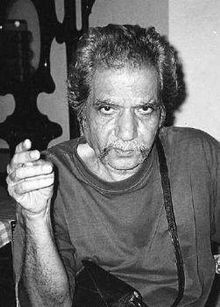
Arun Kolatkar was a poet from Maharashtra in India. He was a prolific poet writing in both Marathi and English. He was also an award winning designer. He won the Commonwealth Poetry Prize for his collection of poems, Jejuri, published in 1976.

This poem describes a fairly typical experience. The reader stands in the shoes of someone accosted in the street by a beggar desperate for money for something to eat. The reader knows what it’s like, to be stuck to “like a burr”. What we often forget, because we want to look past them as if they weren’t there, is that, for the desperate too, it’s part of their everyday, to latch on to others in the hope of charity. The tendency for the accosted is to shake off the attention. The norm for the beggar is to be shaken off.

But, in this poem, there is a notable turn towards compassion. The speaker looks “clear through the bullet holes she has for her eyes”. “You” look through and past her, but as you do so what you look at begins to shatter, and it’s only the “shatterproof crone who stands alone”. Is it then that the bullet hole eyes take on their significance? Is it at this point you recognise her wounds, the battles she may have fought and lost? Is it at this point that you realise what has become of her, and what has become of you in the hands of poverty – that “you are reduced to so much small change in her hand”?

There is such pathos in that last line. There is such small change in small change for a life that should be demanding huge change.

The Art of Hearing Heartbeats

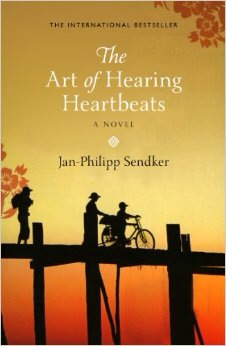
The Art of Hearing Heartbeats is Jan-Philipp Sendker’s first novel. It has a fairy tale feel and is set in Burma.

This book is a lovely telling of a woman overcoming her sense of resentment and betrayal through hearing the story of her lost father. The story-telling helps Julia and the reader see life in a different way, as Tin Win (with the help of Mi Mi and U May) makes sense of his blindness through his sense of hearing.

Mi Mi can’t walk, Tin Win can’t see – together they make the perfect couple (is it an unconscious retelling of the Genesis creation story against the background of a Burmese village?)

It is a book about seeing. U May (blind Buddhist monk), speaking to Tin Win: “It’s true, I lost my eyesight many years ago. But that doesn’t mean I’m blind … the true essence of things is invisible to the eyes. Our sensory organs love to lead us astray, and eyes are the most deceptive of all. We rely too heavily upon them. We believe that we see the world around us, and yet it is only the surface that we perceive. We must learn to divine the true nature of things, their substance, and the eyes are rather a hindrance than a help in that regard. They distract us. We love to be dazzled.”

“A person who relies too heavily on his eyes neglects the other senses – and I mean more than his hearing or sense of smell. I’m talking about the organ within us for which we have no name, let us call it the compass of the heart… A person without eyes must be aware. It sounds easier than it is. You must attend to every movement and every breath. As soon as I become careless or let my mind wander, my senses lead me astray. They play tricks on me like ill-mannered children looking for attention.”

It is a book that collapses distance and challenges the perceptions of the all-seeing, all-dancing world. “There were things a person who walked through the world on two sound feet simply couldn’t understand. They believed that people saw with their eyes. That footsteps overcame distances.”

It is a book about fear (or rather, the absence of fear). Rage muddles the senses. U May, speaking to Tin Win: “Eyes and ears are not the problem, Tin Win. It is rage that blinds and deafens us. Or fear. Envy, mistrust. The world contracts, gets all out of joint when you are angry or afraid.”

It is a book about the power that is stronger than fear and rage, which brings with it the art of hearing heartbeats.

Julia’s father tells her the tale of the prince and princess from two neighbouring and enemy kingdoms. They die on the same day. The prince dies in the mouth of a croc. The princess dies of a broken heart.

“The two kings decided independently not to bury their children but to burn them on the river bank. As chance would have it, the ceremonies fell on the same day, at the same hour. The kings cursed and threatened one another, each blaming the other for the death of his child.

“It was not long before the flames were roaring and the two corpses ablaze. All at once the fires began to smoulder. It was a windless day, and two great, mighty columns of smoke climbed straight to heaven. And suddenly it grew quite still. The fires ceased their crackling, burning on without a sound. The river ceased its chortling and gurgling. Even the kings fell silent.

“Then the animals began to sing … and suddenly … the two columns of smoke drifted slowly towards each other. The louder and clearer the animals’ song, the closer the columns drew, until at last they embraced each other and became one, as only lovers can.”

I love the book. I love the title.

Thomas’s Twin – a sermon for Easter 2A

Sermon notes for Easter 2A for St Alban’s, Broadheath. Again, it could be said better, and I hope it will be. I share it anyway. The Gospel reading is John 20:19-31

Who likes ants?

We are told to learn from the ants. Proverbs 6:6 – “Go to the ant, you sluggard: consider its ways and be wise.”

It’s true. We can learn a lot about community and industry from ants. We can also learn that if they get lost they die. When ants get lost, they follow a simple rule. The rule is to follow the ant in front. But they don’t know that the ant in front of them is only following the ant in front of him. They finish up going round and round in circles, blindly following the one in front until …. They die.

There is a famous example of this deathmill from the Guyana jungle. The ants were just going round in circles – it was a trail of ants which just kept marching in a column 400 yards long (the length of a running track). It took them 2 days to complete a circuit. On and on till they died from exhaustion.

Consider its ways, and be wise. What do we learn from the ant? We learn the importance of thinking for ourselves. We learn the importance of seeing for ourselves.

“Seeing is believing.” That’s what we say, isn’t it?

“We have seen the Lord” is what the disciples say in today’s gospel reading. “We believe”. “We have seen the Lord” is what the disciples say to Thomas, who wasn’t there to see and believe. He is the odd one out.

He was in the wrong place at the wrong time and missed seeing Jesus.

Seeing is believing is the theme of John’s gospel. Time and again John refers to the disciples “coming to see”. The frequency increases as we move to the end of John’s gospel.

  • Mary Magdalen came to the tomb and saw that the stone had been removed,
  • Peter and the beloved disciple ran to the tomb and saw the linen wrappings lying there. They went into the tomb, and saw and believed.
  • Mary Magdalen told the disciples that she had seen the Lord.
  • Mary Magdalen, Peter, the beloved disciples come to see the Lord.
  • And then, that same evening of the day of resurrection, the disciples “see the Lord” – apart from Thomas. Where was he? What was he doing?

Seeing is believing.

But if seeing is believing, what about those who are not there to see, like Thomas?

And what about those who can’t see? What about those who not even Specsavers can save?

This was a problem for a friend of mine who became blind. He was troubled about all that the Gospels say about “seeing” and “believing”, and about “light” (good) and “darkness” (bad). How could he believe when he couldn’t see? How could he be saved when he had been cast into outer darkness?

Do you see his problem?

He worked it out in the end, eventually realising that there are other ways of seeing. He called it “whole body seeing” and wrote the story of his blindness and his later whole body seeing in a book called Touching the Rock.

This is how he discovered his “whole body seeing” (WBS for short). He was staying at Iona. He had been told about the altar there by people who had described it to him. Then he saw it for himself. This is what he wrote:

 “After several nights, I discovered the main altar.

I had been told about this, and I easily recognised it from the description. It was a single block of marble.

Finding one corner, I ran my fingers along the edge, only to find that I could not reach the other.

I worked my way along the front and was amazed at its size.

The front was carved with hard, cold letters. They stood out baldly, but I could not be bothered reading.

The top was as smooth as silk, but how far back did it go?

I stretched my arms out over it but could not reach the back. This was incredible.

It must have a back somewhere. Pushing myself upon to it, my feet hanging out over the front, I could reach the back. I did this again and again, measuring it with my body, till at last I began to have some idea of its proportions. It was bigger than me and much older.

There were several places on the polished surface which were marked with a long, rather irregular indentations, not cracks, but imperfections of some kind.

Could it have been dropped? These marks felt like the result of impact. The contrast between the rough depressions and the huge polished areas was extra ordinary.

Here was the work of people, grinding this thing, smoothing it to an almost greasy, slightly dusty finish which went slippery when I licked it. Here were these abrasions, something more primitive, the naked heart of the rock.”

When I read that I just went WOW. He had seen things which would not have been noticed by the casual observer with her naked eye. With his whole body seeing he had found things there which I am sure he’d be telling others about over breakfast the next day. “Come and see” he’d have been telling everyone.

I mention this because I think there is something in today’s gospel about the importance of seeing things for ourselves. When we see things for ourselves we are not seeing through other people’s eyes. We are not conforming to their vision, and we are seeing things that nobody else sees.

This brings us to the beauty of Thomas who is the focus of our gospel reading.

Thomas is a disciple who captures our imagination, isn’t he? That’s shown in the number of Thomases there are. (How many here are called Thomas, or have a Thomas in their family?)

Two of our children have Thomas in their names, after their grandfather.

We often talk about “doubting Thomas” and then refer to him as typical of us, who are often “doubters” like him.

I’m not sure that this is helpful. Thomas is actually someone who sees and believes, but in a different way. Isn’t that a more helpful way to remember Thomas?

Thomas sees things differently. This is brought out in the gospel. He wants to see through his hands and fingers. He uses his body. He doesn’t just see with his eyes. He inspects. He uses his senses and his sense. He sees with feeling. He sees from the heart.

That is the way that Thomas comes to see.

He puts his hand into Jesus’ wounds. He reaches beyond first impressions. And then he sees. He feels the love in those scars and jumps to his joyful conclusion that he is seeing our Lord and our God. This is the staggering realisation which comes from seeing from the heart, which comes from seeing with feeling, which comes from his insistence that he should see things for himself.

Thomas is not the doubter. He is one who was willing to see.


Thomas is a twin. That is how he is introduced in the gospel. “Thomas the twin”. We don’t know whether Thomas had a twin brother or sister. IT’s more likely that “twin” was Thomas’s nickname because the meaning of the name Thomas is “twin”. But if Thomas had a twin, who might it be?

That  might have been a question that entertained John’s community. “If Thomas is the twin, who is his twin brother or sister?”

They could have played with that question and wondered “is that me?”

We can play with the same question. If Thomas is like us in his doubting, can we be like him in his seeing and believing? How much like him can we be? Can we be his twin brother or sister in the way that we are so much like him in wanting to see Jesus from the heart?


Jesus made many “resurrection” appearances – or should I say that Jesus makes many “resurrection” appearances. John admits that there are so many ways that Jesus showed himself and supposed that “if every one of them were written down the world itself could not contain the books that would be written.” Jesus wants us to see him for ourselves. He wants us to be witnesses.

Mary Magdalen, Peter, the disciple (disciples?) Jesus loves/loved, Thomas and ourselves come to see in their different ways. Together we are a body of believers who through our whole body seeing see things differently.

It is in such company that Jesus shows himself so that we might see life differently – with compassion that is able to feel for scars and wounds, and with the hope that love is stronger than death.

It is in such company that Jesus shows himself to us so that we might follow him in a way of life that is life giving, instead of blindly following others till, like the ants, we drop from exhaustion.

the quote is from Touching the Rock by John Hull
I found the picture of Still Doubting at Mattseyeshaveseen – with some interesting reflection.

The Bigger Picture

Photo of Kilham “tunnel” with permission. http://www.yocc.co.uk
David Hockney certainly provides the Bigger Picture at the Royal Academy of Arts. Increasingly he has rejected the viewfinder of the camera. The viewfinder of his most recent work is his own eyes and the imagination of his mind’s eye.

What Hockney sees is amazing the rest of us who haven’t practiced the art of seeing. The colours he sees in a field, a tree trunk or a forest floor are not far-fetched but are already hinted at in the subject. Many of the subjects are from his own homeland of East Yorkshire, including “the tunnel” near Kilham. The tunnel is an ordinary farm track with trees, hedgerow and tractor track, with the tunnel being formed by the trees that overarch the track.

It is a track which most of would take for granted, which we would pass by without noticing it. But Hockney treats us to his own views which he lays out on canvases that fill the room. Each view is different. He steps to one side and then another to give himself yet another point of view. He steps forward and he steps backwards. He sees it in the morning light and the evening light, when wet and when dry, in spring through to winter. He sees it in relaxed mood and when stressed and tired. There is the one scene, but so many views. There is one pair of eyes, but so many perspectives.  There is the partiality of personal insight but still such wonder. Even Hockney “only sees dimly”, because that is the human condition (1 Cor 13).

There is only so much that can go into one exhibition room. The exhibition is a sell out, even though it is open till midnight on some evenings. The rooms are crowded with people who have come to see. We are given a bigger picture which we see with our own eyes. Excitedly, many take the time to try to share what they see but it is each to their own. There is the one scene, and through one pair of eyes so many views. There is one room and so many pairs of eyes, each drawing their own conclusions.

Realising the many perspectives gives us the bigger picture. Is this the prescription that helps us see better? It is, so long as we can reconcile our views. In any room full of people there is a whole variety of views. But no bigger picture emerges if those views can’t be reconciled to each other. If our views are diametrically opposed to each other we become uncomfortable and we don’t know where to look.