
The Heresy of Western Leadership

screen-shot-2016-11-11-at-13-39-54

I am grateful to Justin Lewis-Anthony’s scepticism about leadership. The same day that America was going to the polls to elect Donald Trump I was exploring leadership in ministry with friends and colleagues in the Diocese of Chester including Helen Scarisbrick and Jenny Bridgman. Lewis-Anthony suggests that the leadership bandwagon started rolling in the early 90’s (he blames George Carey), and since then leadership programmes in the church have been proliferating. The Diocese of Chester was quick onto the bandwagon and I was involved in one of their first courses. (I don’t understand why we haven’t given as much attention to other ships which have a more legitimate claim to be part of the fleet – we never hear of friendship, fellowship or companionship training programmes do we, even though there is more theological justification for them?)

Where do our ideas of leadership come from, and why are we so bothered about leadership anyway?

Justin Lewis-Anthony’s book has the clever title You are the Messiah and I Should Know: Why Leadership is a Myth (and Probably a Heresy)He traces our thinking about leadership to the double headed Emersonian “ur-myth” of “the frontier” and “the American Adam”. For Lewis-Anthony “there is a layer of mythology which is omnipresent, omnipotent and omni-transparent, pervading and influencing every part of our understanding of the world. Our knowledge of leadership comes from believing in and living under the power of the myth of leadership”.

There is a reminder here that we can’t escape mythology in ideology. Drawing on the work of Levi-Strauss, Lewis-Anthony reminds us that ideology develop in an unconscious process shaped by the stories which we tell ourselves. He quotes Kelton Cobb (p.99):

Our myths feed us our scripts. We imitate the quests and struggles of the dominant figures in the myths and rehearse our lives informed by mythic plots. We awaken to a set of sacred stories, and then proceed to apprehend the world and express ourselves in terms of these stories. They shape us secretly at a formative age and remain with us, informing the ongoing narrative constructions of our experience. They teach us to perceive the world as we order our outlooks and choices in terms of their patterns and plots.

In other words, we are caught in a bubble – a bind. Once the myth making took place round the camp-fire. Since the 1950’s it’s been on-screen through film making. One nation has dominated the film industry, and consequently the unconscious formation of our ideology. For a long time we have been subjected to the only films available which have relentlessly had the same story to tell. They have fed us our scripts.

Lewis-Anthony quotes German film maker, Wim Wenders: “No other country in the world has sold itself so much and sent its images, its self-image, with such power into every corner of the world. For 70 or 80 years, since the existence o cinema, American films – or better, this ONE American film has been preaching the dream … of the Promised Land.” (p.75).

The frontier is not about place, but about defining experience. It is to the frontier that the American intellect, according to Turner, owes its striking characteristics. “That coarseness and strength combined with acuteness and inquisitiveness; that practical, inventive turn of mind, quick to find expedients; that masterful grasp of material things, lacking in the artistic but powerful to effect great ends; that restless nervous energy; that dominant individualism, working for good and for evil, and withal that buoyancy and exuberance which comes with freedom – these are the traits of the frontier.” (p.81).

The American Adam myth breeds the individualism that Turner talks about and which is such a modern phenomenon. The frontier depend the sense of individualism to the extent that Americans told themselves, according to Billington, that “every man was a self dependent individual, fully capable of caring for himself without the aid of society.” (p.93).

The journey to the frontier is essentially westwards. The journey spawned a genre of film which took over our screens, the “Western”. The western myths of the Western have shaped a leadership that is essentially masculine and white. The films show how the west was won and defended and how the wild was tamed and controlled. Typically the hero is a man “in the middle, between civilisation and savagery”. Lawrence and Jewett describe the Myth: “A community in harmonious paradise is threatened by evil: normal institutions fail to contend with this threat; a selfless superhero emerges to renounce temptations and carry out the redemptive task: aided by fate, his decisive victory restores the community to its paradise condition: the superhero then tends to recede into obscurity.” (p.210).

The American Adam is a man, and a man with a gun. Lewis-Anthony is quite right to point out that in carrying out the redemptive task, the American Adam becomes the American Cain. But it is with the status of hero and leader that this American Cain is expelled, rather than with a curse.

For Lewis-Anthony any leadership based on this Myth is fundamentally violent, and therefore wrong. “Under the American mono myth of redemptive violence, to be a leader/hero means to be prepared to use violence. To be a disciple/follower means to accept, in turn, an invitation to use and be thrilled by violence.” (p.213). Leadership in our society is “fatally flawed by its roots in violence, the will to power and destruction”.

Tom Wright asks the question about “what any of this has to do with something most Americans also believe, that the God of ultimate justice and truth was fully and finally revealed in the crucified Jesus of Nazareth, who taught people to love their enemies, and warned that those who take the sword will perish by the sword”. Lewis-Anthony continues: “Wright reminds those within the church, the ‘religious admirers of leadership’ that there is a basic problem in this admiration of North American society. With its roots in the mythic use of violence by the outsider, the extra-societal Adam, what can we find in the scriptural tradition to counteract, or set aside, this cult of violence? Surely we can find some ways in which the crucified Jesus of Nazareth rescues leadership from both Marduk and John Wayne.”(p.213).
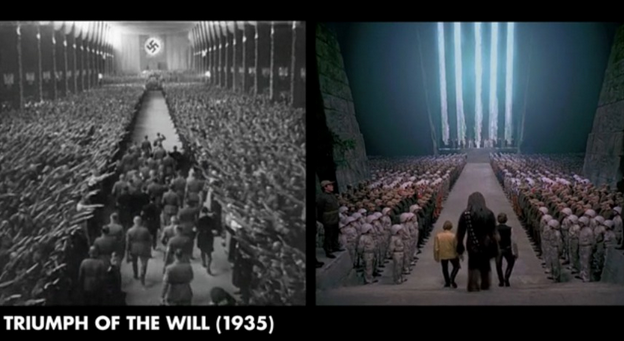
starwarsrallypng

Why are we bothered about leadership? It matters to those who are the victims of leadership violence. It matters to those of us whose minds have been made up by a myth of leadership. It matters to those who are excluded by such a myth – anyone who is not a white, male, rooting’ tooting’ son of a gun. It matters to God’s mission. The Washington Free Beacon has put these two images together, a Nazi rally – which inspired a scene in Star Wars. It all looks frighteningly ecclesiastical, except there’s more people.

Training Champions of the Human Race

Yusra Mardini
Notes for a sermon for Christ the King, Birkenhead, August 14th 2016 (Proper 15C, Ordinary 20C, Pentecost +13)

Have you been watching the Olympics?  It’s too easy to watch too much isn’t it? What have been your highlights?

Did you see Yusra Mardini win her 200 metre freestyle swimming heat? Yusra was swimming for the Refugee Olympic team. She got such a cheer. She won her heat, though didn’t qualify for the semi finals because others had swum faster than her.

Yusra is 18 years old. She was born in Damascus, a Syrian Christian and represented Syria in 2012. Her family’s house was destroyed and the roof of her training pool was blown off. She and her sister Sarah decided to flee Syria last summer. They reached Lebanon, then Turkey, and then boarded a boat for Greece. There were 20 of them in a dinghy designed for six. The boat was soon in trouble with the motor failing after 30 minutes. There were only four swimmers in the boat: Yusra, her sister and two others. They had to get out and pushed and pulled for 3 hours until they bought the boat to shore on Lesbos and the lives of the people on board so saving the lives of all their fellow passengers.

Last August, after 25 days, she arrived in Berlin. She gets up at 4 o’clock every morning to train before going to school. That has been her training schedule. That is how she arrived at the Olympics.

Also in the swimming pool was Adam Peaty, our first swimming gold medal since 1988. He’s from Uttoxeter. He used to be scared of water. You couldn’t tell could you?

Besides his own dedication – his story is one of immense and sacrificial support by his mother, the rest of the family and his neighbours – as they have struggled to make the money to pay for the petrol to get him to his training.

His response to winning: “I’m proud to have pushed the boundaries of the human race.” Are we pushing the boundaries of the human race? And if we are thinking to ourselves how old we are, that we are too frail, there will be the Paralympians coming along next month to shame our outlook. And if we are thinking that we are unfit then we have to open our ears and hearts to the good news that God’s love helps us fit for the kingdom, not our strength.

Are any of you successful athletes? Or maybe you’re not medal winners, but you’ve got a life of achievement because of the work that you have put in – you’ve brought up children, you’ve supported a sick relative, you’ve ….

Or, perhaps more of us are conscious of our failings, the missed opportunities, inability to keep our resolve – losing our way in lives full of regrets. Me too.


Our first reading (Hebrews 11:29-12:2) gives honourable mentions to many people – to the prostitute Rahab, to Gideon, Barak, Samson, Jephthah, David, Samuel and the prophets – those who administered justice, those whose weakness was turned to strength, those who endured torture, imprisonment and persecution – destitute, ill-treated, homeless. They are all commended for their faith.

The letter is written in the past tense, but the honourable mention is intended to embrace those who now administer justice, those who endure torture, imprisonment and persecution, those whose faith is commendable. They are all champions of the human race – and we are all encouraged to run with them for a podium finish – at the right hand of God. “Let us run with perseverance the race marked out for us, fixing our eyes on Jesus, the pioneer and perfected of faith.” (Hebrews 12:1f)


We have all been introduced to the pool in our baptism. It might be a long time since we swam in those waters but perhaps it’s worth casting our minds to our baptisms and the call to swim in those waters. That is the training pool for future champions – champions of the human race.

Those who get honourable mentions are commended for the race they ran even though they could hardly make out the tape. According to this letter to the Hebrews, God has planned something far better for us. I don’t know whether any of you have been to the dogs but the greyhounds race after the hare that has been set running. We have Jesus before us, to fix our eyes on, to follow.

Where Jesus goes, our eyes follow. That is where we set our sights. The highways and by-ways, the margins ………… “Let us run with perseverance the race marked out for us, fixing our eyes on Jesus, the pioneer and perfecter of faith.”

Yusra Mardini, in an interview this week says that she has been overwhelmed by the support that she has had and that she hopes that she has “opened the world’s eyes to the plight of those who have been displaced” – which is where eyes will focus if they are fixed on Jesus because we know his time was/is for them and those like them who are strangers (even aliens) to the powers that be.

Jesus is the goal, but what about our training schedule?

The words of Psalm 90 shouted out to me this week:

The days of our life are three score years and ten, or if our strength endures, even four score; yet the sum of them is but labour and sorrow, for they soon pass away and we are gone (verse 10)

How soon life passes. Before we know it we are at the end of our days, and we can easily become overwhelmed by the sense of opportunities missed. Life runs away with us. In this context the psalmist prays:

Teach us to number our days, that we may apply our hearts to wisdom (verse 12). Numbering our days means making our days count, whether we have 3 days, months, weeks, years. How shall we use the time that we have? Shall we train them on the human race we run?

The psalmist continues (verse 15), Give us gladness for the days you have afflicted us, and for the years in which we have seen adversity – a simple plea for a better time than the times wasted or suffered.

Part of my own training schedule is to pick up a poem each day. For me it’s like a protein shake – it builds me up and gives me energy. This poem I picked up this week is by Annie Dillard and is called How we Spend our Days  It is about how we manage our time, structure our time so it helps us keep a good time and a winning time.

How we spend our days
is, of course,
how we spend our lives.

What we do with this hour,
and that one,
is what we are doing.

A schedule
defends from chaos
and whim.

It is a net
for catching days.
It is a scaffolding

on which a worker
can stand
and labor with both hands

at sections of time.
A schedule is a mock-up
of reason and order –

willed, faked,
and so brought into being;
it is a peace and a haven

set into the wreck of time;
it is a lifeboat
on which you find yourself,

decades later,
still living.
Each day is the same,

so you remember
the series afterward
as a blurred and powerful pattern.

So what about a training schedule? (And what would go in that schedule?)

What about aiming for a good time? (And what a good time for you be?)

How about championing the human race and the whole of God’s creation?


Seeing differently, seeing by heart – St John’s Day

A sermon for St John’s Day for St Alban’s, Broadheath

candle_flame_01

Is there anyone here named John …… or Jonathon, or Joan, or Jean, or Jeanette, or Janet, or Ian or Joanne or Johnson, or Jones ……?

We light a candle to you today, because it is your name day – it is St John’s Day.

Do you know what the name means?

It’s from the Hebrew, Yohanan, which means “Yahweh is gracious”.

What a lovely name to carry. (I often wonder how our names shape our outlook and who we are.)

John is the one (and there could be several people rolled into one – but let’s not complicate things too much), John is the one who proclaims Jesus as the Word made flesh, the Light of the world, and who was “the disciple Jesus loved”. He was one of the sons of Zebedee, follower of Jesus, with Jesus at the Transfiguration, with Jesus at the Last Supper, with Jesus in his agony in the garden, with Jesus and his mother at the foot of the cross, with Jesus as a witness of the resurrection and was with Jesus in the church in the proclamation of his gospel.

There is no birth story in John’s gospel. There’s no Bethlehem, Nazareth, shepherds, wise men or baby Jesus. Simply and wonderfully John begins his gospel:

In the beginning was the Word, and the Word was with God, and the Word was God. He was in the beginning with God. All things came into being through him, and without him not one thing came into being. What has come into being in him was life, and the life was the light of all people. The light shines in the darkness, and the darkness did not overcome it.

That is a birth story of a different kind.

And the Word became flesh and lived among us.

That’s a different way of telling the story of Jesus’ birth

hunt_light_of_the_world

One of our most favourite paintings is the painting by Holman Hunt of the Light of the World – which pictures Jesus standing at the door of our dark lives, knocking. Holman Hunt painted the picture – John gave us the picture: a picture of the light which shines in the darkness – a picture of hope, warmth and tenderness.

As John talks about the Light of the world he talks about seeing. Time and again there is the invitation in his gospel “Come and see”. While the people in Matthew’s gospel are divided as sheep and goats, in John’s gospel the division is between those who see and those who don’t see.

Those who see don’t just see with their eyes. They see with their hearts. John uses three different words for seeing. There’s the seeing with the eyes, as in John 20:1 when Mary Magdalen went to the tomb and SAW that the stone had been moved from the tomb. That was something she noticed, that she saw with her eyes.

A little later in that same chapter (John 20:4) Peter looks into the tomb and sees the linen wrappings there. John uses a different word for seeing – it’s a seeing with the mind as when we say “the penny dropped”. It began to dawn on Peter. He began to understand what had happened.

Then finally, just a few verses on in that chapter, 20:8, the other disciple, the one Jesus loved, went in the tomb. “He saw and believed”.

So John describes three ways of seeing – with eyes, with the mind and with the heart. That’s why we can all see the same thing and come to different conclusions. That’s why when we have different commitments to the same conclusions. We see a lot of things but barely take notice, we understand other things and just a few things we know by heart.

Specsavers doesn’t help.

I knew a man who did see but then became blind. And he was greatly troubled by John’s gospel with its language of light and sight. The world became dark to him – the darkness spread from eyes to mind, from mind to heart, but the darkness did not overcome him. There came a time when he started to see by heart. He called it WBS – “whole body seeing”. Imagine his joy when that darkness lifted.

Specsavers may help us the mistake of stripping in the kitchen (with all its sharp knives) instead of the sauna, or help us to make sure we are snogging the right person on the train platform, but however many pairs of glasses Specsavers give us they are not going to help us make sense or make love with the world.

What is our sight like? The eye tests we get at Specsavers are no measure for what John is talking about. We may be able to read all the letters on the bottom line. That doesn’t guarantee our understanding. There is so much we see that we don’t understand. There is so much that we see that is just prejudice (blind prejudice).

We may have excellent eyesight. We may have three degrees, be clever clever with all the things that we see with our minds, but until we see from our heart we will never be able to read the love that is between the lines.

John tells the story of the man born blind who was helped to see by Jesus. The incident caused a great deal of trouble. Jesus told the man who had been blind “I came into the world for judgement so that those who do not see may see, and those who do see may become blind.” To which, some of the Pharisees said “surely we are not blind, are we?”

But there are things that we don’t see aren’t there? For example, we tend not to see what is happening in the Jungle at Calais. And on the other hand, there are those who are so moved with compassion that they do see the suffering of others, as celebrated by the Christmas Number 1 by the Greenwich and Lewisham NHS Choir.

The Pharisees question is the wrong question. “Surely we are not blind, are we?” They don’t see, do they? The question that we should be asking is “How can we see?” or “how can we see by heart?”

John gives us an answer.

The disciples and Jesus had many meals together. They didn’t use tables and chairs – those of you who have holidayed in Turkey will have seen how people still eat – sat on cushions on the floor around a slightly raised table. John’s gospel refers to “reclining” at the table. In his account of the Last Supper

John 13:23: Now there was leaning on Jesus’ bosom one of his disciples, whom Jesus loved. (KJV)

That’s where the disciple Jesus loved had his head, with his ear to Jesus’ heart – at the bosom of Jesus, so close he could hear the heart-beat, the whisper of Jesus in his ear: seeing by heart what Jesus also knew by heart because he too (1:18) is at the bosom of his father. NRSV translates that verse as “No one has ever seen God. It is God the only Son, who is close to the Father’s heart, who has made him known.

Picture1

The key to vision is being close to Jesus’s heart. The key to Jesus’ vision is that he is that close to his father’s heart.

The disciple who lay like this is not named by John. Some have said that it is John himself. It’s more likely that he chose to leave the identity open – so that all beloved disciples could read themselves into this story. John means us.

How can we see with the heart? The answer is by being close enough that we can hear Jesus’ heart-beat, close enough that we can see what makes him tick, close enough that we can feel the breath of his whisper on our skin.

That’s how we can see better. That is how we can see differently.

Or we could go to another gospel for an answer. We can go to the birth stories of Jesus, to the point of view of the crib, recognising God’s outlook from the vulnerability of a baby, and realising that we see our lives differently in the light of the light of the world, that we see others, even strangers and enemies in a new light, and that helps us to read the love between the lines that the world draws us to divide us.

Readings for the day: Exodus 33:7-11a, 1 John 1, John 21:19b-end

(The Greenwich and Lewisham NHS Choir singing “A Bridge Over You” – something that has been around for two years

Bernard on Canals & Reservoirs


Wisdom runs deep, and the pace of our lives seems to run us out of wisdom.

Bernard (he became Abbot of Clairvaux 900 years ago in 1115) has this to say about the pace of our lives and the place of stillness:

The man who is wise, therefore, will see his life as more like a reservoir than a canal. The canal simultaneously pours out what it receives; the reservoir retains the water till it is filled, then discharges the overflow without loss to itself … Today there are many in the Church who act like canals, the reservoirs are far too rare … You too must learn to await this fullness before pouring out your gifts, do not try to be more generous than God.

Oh Yeah Now That’s a Table

georgemesso's avatarGeorge Messo's Blog

A man filled with life’s joy
Placed his keys on the table
Put down flowers in a copper bowl
Put down his milk, his eggs
Placed light coming from the window there
Sound of a bicycle, sound of a spinning wheel
He placed there the softness of weather and bread

On the table the man
Put things that occurred in his mind
Whatever he wanted to do in life
He placed it there
Who he loved, who he didn’t love

The man put them too on the table
Three times three equals nine
The man placed nine on the table
He was next to the window next to the sky
He reached out placed infinity on the table
For days he’d wanted to drink a beer
He put the pouring of beer onto the table
He put down his sleep his wakefulness
Placed there his fullness his hunger

Oh yeah…

View original post 43 more words

Eucharistic community – is it the bearing we’re wearing? Sermon notes Trinity 9B

Notes for a sermon for the saints at St Wilfred Grappenhall – August 2nd 2015 (Proper 13B, Ordinary 18B, Trinity 9)

The text: Ephesians 4:1-16

We all have one letter in our hands – it’s a part of a letter with a prison stamp, which seems to be addressed not just to people in one place, Ephesus, but to all places at all times. This fragment is intriguing because of the wonderfully motivating language, but because it touches on the behaviour of saints. It’s a letter to saints about how saints behave. In the letter WE are called saints so it’s a letter about how we behave.

My sermon is playing for time – time for us to dwell on this fragment – time to gather round three hearths within the fragment. Please feel free to wander round this in your own way at any point, but for those who want to stay with me I start with a question that, for some reason kept bugging me while I was reading this letter. The question is, “Why did the guest have to leave the party?” It’s a question posed by the story from Matthew’s gospel (chapter 22).

I’ve got an email here which might remind you of that story. It’s one of those “complaining” emails.

It begins:

“Hi King”, (isn’t it strange how we don’t use “dear” so much in emails? Does it mean that people are now less dear and precious to us in the days of bulk correspondence?) – anyway, the email goes on:

“I feel I have to complain to you about the way you treated me at the party you organised. First of all, thank you for the invitation. I had thought that I would have been invited to one of your earlier parties because of the work I have done in the community. Anyway, I did manage to rearrange my diary so that I could join you in the palace.

“I was shaken when your flunkies grabbed me and escorted me from the party. I can’t see what I did wrong. They said it was because of what I was wearing, but the invitation did say that the dress code was informal, and other people were wearing t-shirts and shorts as well.

“What’s made matters worse is the media coverage. The headlines are awful and everywhere, and the film showing me weeping and gnashing my teeth has gone viral on youtube. You have made me a laughing stock. It has been so damaging, embarrassing and disrespectful. I demand an immediate apology.

“And one more thing. I don’t know who did the seating plan, but I can’t understand why I wasn’t at one of the top tables. You don’t seem to realise who I am.

Yours, humiliated,
Frank Lee Speaking.”

I’ve got the king’s reply:

“May I speak to you frankly? I do this in love.

I felt honoured that you accepted my invitation, and that you made the time to come (many didn’t – which explains why there were so many people there who you’d probably only seen begging at the city gate). It wasn’t the clothes you wore (I rather liked that t-shirt you wore). No, it was the bearing that you were wearing. You were upsetting the party and upstaging the guests. You were resentful, argumentative and arrogant. You had to go.

I am sorry that you felt embarrassed. That was never my intention. I hope you understand.

Love

Rex X”

Welcome to the party.

As Christians we enjoy ourselves. We use the language of party – a eucharistic language. Sunday by Sunday there is eucharist, celebration, wine, good company, gifts, song and a party Spirit. It’s not a party to be missed for the food – the bread that gives life to the world.

The party spirit of the worshipping community is captured by describing it as “Eucharistic community”. I want to share three hearths with you – the three hearths take us to the heart of what a eucharistic community is – what the party is about.

First:

At the heart of our eucharistic community is our “thank yous”. A eucharistic community meeting is full of thank-yous – count the “thanks” in the liturgy, in our prayers, in our scriptures, in our interactions. We are awash with thanksgiving. Thank you, thank you, thank you. The eucharistic community is raised in appreciation and thanksgiving – indeed, that is the very meaning of the word eucharist.

Alice Walker, author of The Color Purple, says that “Thank you” is the best prayer that anyone could say. She says that she gets to say that prayer a lot: “thank you expresses extreme gratitude, humility and understanding.” Is that our prayer?

Ephesians talks of “thank yous”. Here’s how The Message translates another verse (5:4) in the letter: “Though some tongues just love the taste of gossip, those who follow Jesus have better uses for language than that. Don’t talk dirty or sill. That kind of talk doesn’t fit our style. Thanksgiving is our dialect.” Thanksgiving is our dialect.

Positive psychologists are also talking about the importance of gratitude and thankfulness as a transformative and converting behaviour…..

Second:

In the depths of Eucharistic language there is gifting – and that is the basis of our gratitude and thankfulness. It is how “eucharist” is spelled. CHARIS comes in the middle of that word. “Charis” is left when you peel away the “eu” and the “t” from the beginning and end of “eucharist”. “Charis” is the heart of “eucharist”. “Charis” means “gift” and “grace”. We have words that are recognisably derived from CHARIS, for example “charity”, “charism” and “charismatic”.

Someone who wears a charm bracelet wraps gifts around her wrist (– a charm arm) – celebrating charming life, an acknowledgement of being charmed and a vocation to be charming, generous and gracious. Grace is the word that is used in the “thank you” letter addressed to the Ephesians. “Each of us was given grace according to the measure of Christ’s gift.”

I wonder if the wedding guest was told to leave because he had no charm.

According to our reading, there are two groups of people within a Eucharistic community. One group is made up of saints, the other group is made up of apostles (they are advocates), prophets (they speak from the heart of God to the heart of the people), evangelists (they are angels with only have good news to share), pastors (they shepherd) and teachers (guess what they do). Those are charisms that form a ministry team – and you can bet that some people here are part of a team like that – the beginnings of a team of people who are gifted and charmed to help this other group of saints, so that all of us are equipped for ministry until we find the unity that God has in store for us. All of us are charmed and gifted – but some are charmed and gifted to help the rest of us – be saints.

The gifts God gives can only be valued by a Eucharistic community. They are gifts of ministry for the sake of the saints who live for the sake of the world. That’s the party spirit.

Third:

The third hearth of a Eucharistic community is that we are communities in formation.

We are still growing up, with growing pains which show in our joints and the way we join each other. Our relationships are always less than perfect. Outsiders often call us hypocrites because we so often don’t walk the talk.

We often forget that we are still growing, that we have so much to learn, that we are building one another up. We often speak the truth to one another (try to teach one another a lesson) forgetting that the responsibility within the Eucharistic community is to speak the truth in love. That is the party spirit.

I wonder if the wedding guest had to leave because he only spoke the truth, or because he was a know-all, not humble enough to realise that he had so much to learn. Paul said, “we must no longer be children … but speaking the truth in love, must grow up in every way into him who is the head, into Christ ..”

I wonder if it was something about the guest’s bearing. Was it the bearing he was wearing? I wonder whether it is something about the church’s bearing which, in some quarters, has become branded as toxic. Thanksgiving isn’t always what hits people in the eyes. it’s not always obvious that we see ourselves only as children, only as “growing up”. Nor is it always apparent that we are thankful party people, or that we are always charming and blessing.

Each place needs a community of thanksgiving, a community which is intentionally growing up, and a community which is charming and blessing, so that the ways of the world can be changed, so that so that life can be different, so that those who walk through the valley of the shadow of death may find hope, and may find a welcome at the table where all their hungers are satisfied, so that they may share the bread of life.

(The drawing is by Cerezo Barredo, part of series of illustrations for the Revised Common Lectionary – this one is of the parable of the wedding feast (Matthew 22).

Holiday plans – some sermon notes for St Nicholas, Burton – Proper 11B/Ordinary 16B/Trinity 7

July 19th 2015  – some notes for sermon for St Nicholas, Burton

Proper 11B/Ordinary 16B/Trinity 7.

There is only one reading: Mark 6:30-34, 53-56 (In my mind is the verse from Psalm 127, Unless the LORD builds the house, They labor in vain who build it; Unless the LORD guards the city, The watchman keeps awake in vain.) The other readings which could have been used are about God’s building (he doesn’t want David to build him a house, he wants to do the building for David – and all his house)

I thought we would plan some holiday this morning.

The run for the sun has begun – I think most schools finished on Friday. I distracted a boy when I was walking our dog the other morning. The boy was riding his bike to school. His trousers caught in the chain. I noticed he’d ripped them and asked if he would be in trouble. He said “no, it’s only another 3 days”.

Muslims have been holidaying this weekend. The sighting of the new moon heralded EID, marking the end of Ramadan.

It is time to be thinking of holidays.

First Choice and Thomas Cook could have lifted a verse from today’s gospel to sell us their holidays. “Come away to a deserted place all by yourselves and rest a while”.

Do you ever catch yourself saying “I haven’t got time for this that or the other”? I suspect that as long as we are saying that we need to be hearing those words that Jesus spoke to his disciples – and what a week they’d had! EXPLAIN

We talk about “time poverty”, where we struggle to fit in all that we are committed to – work, family, interests – and with holidays we find time.

For the disciples, the rest time they are given is a gift of Jesus – it’s how God cares for his people, then (after all they had been doing) and now (with all our business).

“Come to me, all you who labour and are heavy laden, and I will give you rest. Take my yoke upon you and learn from me, for I am gentle and lowly in heart, and you will find rest for your souls.”

Sabbath

For one rabbi (Heschel), the Bible is more concerned with time than with space (history more than geography. It’s the time of rest that is more important than the place of rest.

For this rabbi, the Sabbath is a spirit that is lonely and that comes looking for us.

Let it come, I say. It’s not so much that we long for rest, as rest longs for us.

Heschel writes

  • that unless we learn how to relish the taste of rest we will be unable to enjoy the taste of eternity in the world to come.
  • that the world’s survival depends on the holiness of the 7th day. The task is how to convert time into eternity, how to fill our time with spirit.
  • “Six days we wrestle with the world. ringing profit from the earth: on the Sabbath we especially care for the seed of eternity planted in the soul. The world has our hands, but our soul belongs to Someone Else.”
  • that the Sabbaths are our great cathedrals – time that is our own, for us to walk around in

….. days of rest that are holidays that can make holy days ….

Letting Go and Letting Come

I don’t know about you, but my best ideas happen when I’m not working. It’s when I’m in the shower, or out walking, or just waking, or suddenly hearing or seeing. It’s when I’m not trying – it’s when I’ve let all that busyness go. And isn’t that ironic? It’s when we let go of our work, when we put down our clever, when we are off guard – that suddenly we realise – and we use words like “the idea came to me” – we aren’t doing anything, and the idea just came to me. This is what I have to do. This is how I have to be. This is what life is all about – it’s just come to me.

We need to sleep on things.

We have to let go …… to let come

It’s at holiday that we let go, and that we let come those things which transform the way we look at life and the way we live our life.

And so we should pray for those on holiday, for those planning a holiday, that those things which come to them do transform their lives, and that when the holiday ends it’s not a case of busyness as usual.

And we should pray for those who aren’t able to holiday, who can’t see their way to having a holiday – because they don’t think they can afford one, either because they haven’t got the time, or because they haven’t got the money. What should we pray for them? That they do find rest, that they do know that God wants them to rest, that he wants them to have holy days to sanctify their other days.

There is a quote that I love to repeat:

The world longs for the generosity of a well rested people (Wayne Muller)

Things come to well rested people. If rest is the ministry of God to us, it is not much of a stretch to think that those things that come to well rested people are what Paul describes as the fruits of the Spirit – love, joy, peace, patience, kindness, generosity, faithfulness, gentleness and self control (Gal 5:22f)

I dare say that they don’t come to those who don’t rest – because they haven’t let go to let come those gifts that so transform ourselves, relationships and society.

I also dare say that the contrasting works of the flesh (as listed by Paul – Gal 5) are seen as a result of an absence of rest. Check that out from your own experience and behaviour as I read through some from the list:  impurity, envy, drunkenness, strife, jealousy, anger, quarrels, factions.

I mentioned Ramadan earlier – I think it is worth us understanding more about Ramadan. Ramadan is a rest that Muslims plan for and look forward to – in spite of the rigorous disciplines that last for a month. Ramadan is a gift from God, a time of prayer, fasting and learning scripture. The intention is that they accept God’s gift, and that they learn and change as a result.

Our own gospel reading, inadvertently I think, gives us a clue about what rest does. It had been busy, and it goes on to be busy doesn’t it? They thought they’d escaped the crowds, but the crowds catch them up. But there is no compassion fatigue in Jesus. He doesn’t wince of flinch when he sees the great crowd. He has the generosity of a well rested man – who draws breath, who lets himself be wrapped in God’s sending love – of whom the evangelist is able to say “he had compassion for them, because they were like sheep without a shepherd: and he began to teach them many things.”

The world longs for the generosity of a well rested people.

How can we help ourselves to rest? How can we encourage each other to find the rest that we need, and that those around us need us to have? This is holiday planning.

In rest, we discover what God is building. It’s a rather different market place than the ones that have been constructed by ourselves – that are for those with money (look at London). In the gospel, the tables are turned – the sick are laid in the market place – the poor, the needy ……..

Blessing of Rest (this is how God cares for his people – “Come away to a deserted place all by yourselves and rest a while.”

Curl this blessing
beneath your head
for a pillow.
Wrap it about yourself
for a blanket.
Lay it across your eyes
and for this moment
cease thinking about
what comes next,
what you will do
when you rise.

Let this blessing
gather itself to you
like the stillness
that descends
between your heartbeats,
the silence that comes
so briefly
but with a constancy
on which
your life depends.

Settle yourself
into the quiet
this blessing brings,
the hand it lays
upon your brow
the whispered word
it breathes into
your ear
telling you
all shall be well
all shall be well
and you can rest
now.

Jan Richardson: The Painted Prayerbook

A better frame of mind – sermon notes for Proper 10B

Sermon notes for July 12th 2015
St Thomas & All Saints, Ellesmere Port and St Lawrence’s, Stoak
Ordinary 15B, Proper 10B

Ephesians 1:3-14

What is your frame of mind? What frame of mind are you in?

Where are you on a scale of -5 to +5, where -5 is very negative and +5 is very posiitve?

Is it grim? Is it ecstasy?

What frame of mind are your loved ones in?

What frame of mind is your church in?

Where, on the scale -5 to +5?

What frame of mind is our society in? (Thinking of austerity, migrants, refugees, people on welfare)

What creates that frame of mind?

Things that happened to us as children, while we were still in the womb, things that happened to our parents, attitudes to learning, to school, to work, to neighbours, friendships, the opportunities that have been open to us, our health, our wealth

Where we live, whether in Belgravia with life expectancy of 91 or Stockton on Tees with life expectancy of 67,

Whether we are thriving, or just surviving, flourishing or languishing.


Can we change the frame of mind that we are in? Or does the frame of mind box us in, and box us round the ears? Can we be saved from a frame of mind, can we be reframed?

These are questions for the angels (all of whom are positive thinkers).

All those who are positive thinkers think we can change our frame of mind.

All those who are negative thinkers think they can’t – but the positive thinkers know they can change the frame of mind of the most negative, and that is the good news that Paul is talking about in the letter to the churches of Ephesus.

Listen to him again,

“Long ago, even before he made the world, God loved us and chose us in Christ, to be holy and without fault in his eyes. His unchanging plan has always been to adopt us into his own family by bringing us to himself through Jesus Christ. And this gave him great pleasure.” That’s how and where he wants to see us – his frame.

But stuff happens to us doesn’t it? And it’s easy to think as the world thinks, or as the world tells us to think – to worry about tomorrow, to fret about what we’ll wear and how we present ourselves to others. We hurt, we suffer, we protect ourselves and our loved ones, we get angry, we get jealous.

Apparently, the more somebody thinks angry thoughts, the angrier they become. Anger narrows our thinking. When angry, people expect life to throw more annoyances at them. Angry people become more judgemental, their threshold for provocation is lowered, and they become negative about people who are not like them etc etc.

The negatives in our lives are so much more powerful than the positives.

Did you know, that to flourish, you have to have a ratio of 5 positives to 1 negative. That’s how strong the power of negative experiences are. Teachers have got it wrong – the guidance for feedback is “3 stars and a wish”. That’s only 3:1. We can get the possible feedback at work, we can be told we are doing a grand job, but the thing we leave with can be one negative comment. “There is one area of weakness that you need to work on”. That will bother us.

The negatives have far more power than the positives, and that is why they need to be so heavily outnumbered. We can live with a ratio of 3:1, but we don’t thrive. Anything less than 3:1 and we are nosediving, we’re languishing, just surviving.

These ratios work on a personal level, but they also work in all organisations – families, work, neighbourhoods, churches.

And that raises the question of how we can help one another, how can we help one another into a better frame of mind? How can we help our loved ones thrive? How can we help ourselves? How can we help our church?

5:1 – Anything from 5:1, but less than 11:1. Anything over 11:1 is going overboard – there needs to be critical awareness. The naysayer is good – we don’t want to be surrounded by yes men and women.

The summary list of positive emotions is: love, joy, gratitude, contentment, interest, hope, pride, amusement, inspiration and awe. They are the Big 10. How can we help others and ourselves to more of these, so that we flourish, so that we bless and know our blessing?

The summary list of negative emotions is: fear, anger, sadness, disgust, contempt, shame, jealousy and envy. There only needs to be eight of them because of their power. It sounds like a description of the Daily Mirror doesn’t it? (I pick on the Daily Mirror only because it fits in with what I want to share in a minute). How do we limit their frequency and intensity?

It seems to me that Paul and Jesus were amazing encouragers in their preaching and teaching. It’s as if they want to get into our hearts and minds to turn the tables so that those voices which deal in fear, anger, sadness, disgust, contempt, shame, jealousy and envy are driven out.

The power of that encouragement is there in Paul’s letter to the churches of Ephesus. Paul layers it on in spades.

“God is so rich in kindness”, he says.

“He has showered his kindness on us, along with all wisdom and understanding”, he says.

He wants us to believe in the one who wants to reframe our lives so that when he looks at us he sees his very image and likeness, to be framed by God’s purpose which is to bring everything together, even everything in heaven and everything on earth.

This is positive thinking, positive preaching – to change our minds.

But he doesn’t just want to change our minds. That isn’t good enough. He doesn’t just want us to believe, because that isn’t good enough.

There’s a connection between the words “believe” and “beloved”. Say them often enough and your hear the likeness. John’s gospel talks about the beloved disciple. Believing can be all in the head – it can be about things that have passed. He wants us to be beloved and be-loving. That’s when we believe from the heart. That’s when we are truly in a new frame of mind.

So we need big words, grand gestures in all the small steps of our lives. God is SO rich in kindness. God SHOWERS his kindness on us, along with all wisdom and understanding.

What can we do for ourselves? How can we help one another? How can we help one another to flourish? What can we do as believing and beloved?

When you look in the mirror, what do you see? What frame of mind are you in?

When you look in the Daily Mirror, what do you see?

The picture is called Tabula Rasa – which means a “clean slate”. It’s by Cecil Collins. We get a glimpse of a woman brushing her hair. Would she win a beauty contest? I don’t think so. Would she be wishing sho could have her roots done? Would she be counting the wrinkles? I don’t think so. She sees in her daily mirror her life transformed. Staring back at her is beauty with all her emotions of love, joy, gratitude, contentment, interest, hope, pride, amusement, inspiration and awe – the very image of God – heaven and earth coming together in a frame of mind – a frame of mind to praise God.

Hidden Islam & Makeshift Places of Worship

“Consider these facts. In Italy the right to worship, without discrimination, is enshrined within the constitution. There are 1.35 million Muslims in Italy and yet only eight official mosques in the whole country. … This shortage of places to worship is particularly acute in North East Italy as the right wing Lega Nord party campaigns on an anti-Islamic platform.  this region, consent to build a new mosque is never granted.”

That is how Martin Parr introduces a wonderful book that documents the places of worship improvised by the Muslim population of NE Italy, a large proportion of whom are migrant workers. The book is called Hidden Islam and is made up of a series of photographs by Nicolo Degiorgis of the places of worship housed in lockups, garages, shops, warehouses and old factories.

The book’s design is intriguing. Each page is folded. On the outside of the fold is a simple black and white photo of a shop, warehouse etc together with the building’s postcode. There is no clue on the outside of what goes on in the inside. To find that out, we have to go to the inside of the fold – and there we find vibrant photos of Friday Prayers. For example, the stark exterior photo of a garage (postcode V136015)


opens to this


A wonderful book which tells a disgraceful story in a disarmingly simple way.

My own morning prayers took me to Ezra 6 in the Hebrew Scriptures (Old Testament). That situation offers such a contrast to what is happening in Italy and in so many other places where the rights and needs of religious minorities are ignored. The scene there is the rebuilding of the Temple in Jerusalem with the support of the imperial government. Royal revenues were to be used to provide whatever was necessary “so that they may offer pleasing sacrifices to the God of heaven, and pray for the life of the king and his children.” (Ezra 6:10).

It seems obvious to me that religious people need to gather to pray, to pray even for those who persecute them, and to pray for the welfare of the city. Religious landmarks in our cities and on our skylines are reminders of our vocation as children of God. They should be there for all our citizens.

The Art of Hearing Heartbeats

The Art of Hearing Heartbeats is Jan-Philipp Sendker’s first novel. It has a fairy tale feel and is set in Burma.

This book is a lovely telling of a woman overcoming her sense of resentment and betrayal through hearing the story of her lost father. The story-telling helps Julia and the reader see life in a different way, as Tin Win (with the help of Mi Mi and U May) makes sense of his blindness through his sense of hearing.

Mi Mi can’t walk, Tin Win can’t see – together they make the perfect couple (is it an unconscious retelling of the Genesis creation story against the background of a Burmese village?)

It is a book about seeing. U May (blind Buddhist monk), speaking to Tin Win: “It’s true, I lost my eyesight many years ago. But that doesn’t mean I’m blind … the true essence of things is invisible to the eyes. Our sensory organs love to lead us astray, and eyes are the most deceptive of all. We rely too heavily upon them. We believe that we see the world around us, and yet it is only the surface that we perceive. We must learn to divine the true nature of things, their substance, and the eyes are rather a hindrance than a help in that regard. They distract us. We love to be dazzled.”

“A person who relies too heavily on his eyes neglects the other senses – and I mean more than his hearing or sense of smell. I’m talking about the organ within us for which we have no name, let us call it the compass of the heart… A person without eyes must be aware. It sounds easier than it is. You must attend to every movement and every breath. As soon as I become careless or let my mind wander, my senses lead me astray. They play tricks on me like ill-mannered children looking for attention.”

It is a book that collapses distance and challenges the perceptions of the all-seeing, all-dancing world. “There were things a person who walked through the world on two sound feet simply couldn’t understand. They believed that people saw with their eyes. That footsteps overcame distances.”

It is a book about fear (or rather, the absence of fear). Rage muddles the senses. U May, speaking to Tin Win: “Eyes and ears are not the problem, Tin Win. It is rage that blinds and deafens us. Or fear. Envy, mistrust. The world contracts, gets all out of joint when you are angry or afraid.”

It is a book about the power that is stronger than fear and rage, which brings with it the art of hearing heartbeats.

Julia’s father tells her the tale of the prince and princess from two neighbouring and enemy kingdoms. They die on the same day. The prince dies in the mouth of a croc. The princess dies of a broken heart.

“The two kings decided independently not to bury their children but to burn them on the river bank. As chance would have it, the ceremonies fell on the same day, at the same hour. The kings cursed and threatened one another, each blaming the other for the death of his child.

“It was not long before the flames were roaring and the two corpses ablaze. All at once the fires began to smoulder. It was a windless day, and two great, mighty columns of smoke climbed straight to heaven. And suddenly it grew quite still. The fires ceased their crackling, burning on without a sound. The river ceased its chortling and gurgling. Even the kings fell silent.

“Then the animals began to sing … and suddenly … the two columns of smoke drifted slowly towards each other. The louder and clearer the animals’ song, the closer the columns drew, until at last they embraced each other and became one, as only lovers can.”

I love the book. I love the title.