The estate we’re in: how working class people became the ‘problem’
Author: David Herbert
My name is David Herbert. I started growing up in Leicester. I’m currently growing up in Ellesmere Port. I am a priest in the Church of England. I was ordained in Sheffield in 1974. I have been privileged to serve in communities in Sheffield (Manor and Gleadless Valley) and communities near to Chester (Ellesmere Port and Tarvin). I am a keeper of learning spaces and support continuing ministerial/professional development in the Diocese of Chester.
Of Preachers, Poets & Performance, with some inspiration from Sarah Kay
I was blown away by this utterly captivating performance by Sarah Kay telling of things that matter and drawing people into her enterprise. Poetry lifted from the page takes on an entirely different dimension.
Peter Stevenson reminds us that preacher and poet are both performance arts and reminds us of David Schlafer’s encouragement to preachers that they find their own preaching voice as Poet, Storyteller or Essayist.
Now so much performance art is available on the likes of Youtube, more preachers will find their poetic voice. Irish poet Michael O’Siadhail points out that the Irish word for poet, ‘files’, translates as seer.
The prophetic voice is the poetic voice, ordinarily spoken and performed. It’s a tradition that is as old as God’s people as poets have spoken from the heart and to the heart, from the heart of God to the heart of people, from the heart of the people to the heart of God.
Gerry Hughes on encouraging the critical element

Gerard Hughes SJ died last month – an obituary is here. He had much to say about Christian formation, including this from a chapter called “clearing the approaches” in God of Surprises.
“The Church must encourage the critical element in its members.
If it fails to do so, then the individual will not be able to integrate religious belief with everyday experience or, put in other words, God will be excluded from most of the individual’s life until religion comes to be considered a private but harmless eccentricity of a minority.
If the Church does encourage the critical element, then it must expect to be questioned and challenged by its members and it must be prepared to change its own ways on thinking and acting, submitting itself to the light of truth. Such an attitude is only possible in a Church which has a strong faith in God’s presence in all things………….
Her teachings will never be delivered as the last word on any subject, but rather as signposts, encouraging her members to explore the route further for themselves.”
Gerard Hughes, God of Surprises, DLT 1985, p. 21
Thanks to Friday Mailing for bringing this to our attention. The “complete blank signpost” is a photo by Andrew Bowdon.
So you want to be a sheep then: sermon notes for Christ the King (Sunday and church)
Sermon – Nov 23rd 2014
Christ the King Sunday
So you want to be a sheep, do you?

Do you remember PE at school – when teams were picked. “Pick me”. We prayed didn’t we that we wouldn’t be the last person chosen. There are two teams in today’s gospel (Matthew 25:31-end). On the one hand there are Sheep, and there are Goats on the other. The Sheep are the winning team, the Goats are the losers – although the team looks anything other than a winning team. The Sheep are promoted by the Son of Man – they have a podium position. The Goats are relegated and put out of business.
Who do we want to play for: the Sheep or the Goats?
But then, there are good sheep and bad sheep, according to our OT reading (Ezekiel 34:11-16, 20-24). Ezekiel explains how we can tell them apart when he talks about God’s way of judging them apart. The fat sheep are accused of being violent, abusive and non-caring within their community, pushing their way around. “You pushed”, God says. “You pushed with flank and shoulder. You butted at all the weak animals with all your horns until you got your own way and had it all for yourself. You scattered them far and wide.”
Ezekiel is one of the “lean sheep”, pushed around, butted and scattered – forced into exile.
His complaint rings true through all ages. There always seem to be people who behave like this, like bad sheep. Back then, Ezekiel’s people have been scattered far and wide in a way that reminds us of what happens in our world today, when so many people are dislodged from their families, forced to flee their homes, communities, work and livelihood.
For Ezekiel and his fellow exiles, the problem has been poor leadership (the leaders are referred to as shepherds). The leaders have only been interested in themselves, feeding themselves at the expense of the people, failing to provide any welfare or benefit system. The sick were ignored. The injured were ignored – and the leaders ruled with a rod of iron. That is why the people were scattered. Ezekiel and his fellow exiles had no choice. They had to go. That is largely the case today as well. The villagers under attack by Islamic State have no choice but to flee. The victims of domestic violence who pluck up the courage to leave their situation say “we had no choice, we had to get out”, and others who can’t leave also say “we had no choice, there was nowhere to go.”
Life should have been uncomplicated for them. They should have led settled lives in straightforward communities, in close contact with parents, grandparents and grandchildren. Instead their lives were disrupted.
The calamity of weak and/or violent leadership catches up with people so quickly, at all levels of our lives. It’s the national tragedies which catch our eye in the news – but the tragedies are lived out small in our workplaces, in the playground (bullying) and in our homes (we are used to hearing about domestic abuse, elder abuse and child abuse). The victims are the lean sheep, pushed around, butted, battered, scattered, unfairly and cruelly treated.
We know what happens to them:
to the children who are neglected, who go unheard, who deserve better.
- Some of our children are treated so badly – maybe their parents caring only for themselves in the manner of the bad shepherds that Ezekiel riles against. Some of the children manage to run away – scatter – and we all know that there are many adults preying on vulnerable youngsters. Why should they be denied a home? Why should they be denied safety? Why should they be denied care? These lambs deserve the care of a good shepherd – by their very nature. Any different and the natural order of things is turned upside down.
- to those who become refugees, clinging desparately to their identities, crossing boundaries into lives where they’re still not wanted forced to do work which really was beneath their dignity. The skills of doctors being wasted as they become cleaners. Fully trained nurses having to take any job they could find – zero hours contracts. The dream is somewhere safe to escape to – somewhere you’ll be wanted for what you can offer, but then discover that you’re fenced in from making the border crossing. Some become desparate – casting out to sea with a vague hope that they might make it, but fearful of other wild creatures who lurk in the deep
There is a charity called Eaves which runs the Poppy Project. They report Ellie’s story (which I didn’t use in the sermon):
When Ellie, 32, describes the first part of her life, she races through the disturbing details in a neutral tone; the problems she experienced as a child and a young woman are not what makes her angry. She grew up in a slum outside Kampala in Uganda. She was sent to live with another family when she was seven and sexually abused by the head of the household; when she turned 15, she was forced to marry him. He was violent, so when a neighbour offered to help her escape to a new life abroad, she agreed.
She was taken by plane to the UK with a group of six other women. Ellie thought that she was going to work as a cleaner, but on the day she arrived, she was driven to the home of a white man who told her she would have to work as a prostitute to pay back her debts for the passport and air travel. For two years she was locked in a house with the other women, and periodically driven to customers’ homes.
She only escaped when a sympathetic client gave her £60 and explained how to get to London. In London, she met a man who allowed her to stay with him, but who quickly began to ask for sex in exchange for shelter. One night when he was violently abusive, she called the police.
This is the moment, in a life story of unmitigated misfortune, when you might expect that things would begin to improve. However, it marked the beginning of a new wave of difficulty, and this is where she begins to get angry. She was taken to hospital, but not treated; later the police took her to a police station, where she was fingerprinted and told she had no visa. Since she had only been given a passport to hold for a few seconds when she passed border control at the airport, she knew nothing about visas.
“They were asking each other: ‘Did she come here legally or illegally?’ The way they were talking was very intimidating. They didn’t ask about the attack. They were more interested in why I was staying in the country without a visa.” The man who hit her was not arrested, but she was taken to Yarl’s Wood detention centre. “I’d never been in detention before. It felt like a prison: being locked up, eating your food at certain times, sleeping at certain times. Most of the time you can’t go outside; you can barely see daylight.”
The other inmates laughed at her when they found out she had called the police, and told her she was stupid to have expected them to help her. She was quickly put on suicide watch because she told staff that she would kill herself rather than be deported back to a country where she would be in danger from her husband and her traffickers. “They wouldn’t let me buy tinned food in case I took the tin and cut myself; they watched me while I showered in case I hanged myself,” she says. For a while she regretted having escaped from her trafficker, and thought returning to her existence as a sex slave might be preferable.
It was only when she was in Yarl’s Wood that she realised she had been trafficked. “So many of the women I met in detention had been trafficked. I don’t think the police who interviewed me knew about trafficking. They were more interested in catching someone for being an illegal migrant than in helping someone who has called for help. All they were talking about was deporting me,” she says.
It was only when a sympathetic guard suggested that she put her name down for legal aid that she was put in touch with Eaves. Her asylum claim on the grounds of trafficking was rejected initially, but with Eaves’ help, this was overturned.
She wishes there was greater awareness of trafficking throughout the system. If border staff had been on the lookout for people-trafficking when she arrived in the UK, she would have been prevented from coming into the country. “If they had stopped me on the border, I would have been so much happier; I wouldn’t have done all the bad things that I was made to do. But I came here and I was turned into a prostitute.”
She is calm when we speak; very articulate and very angry about what has happened to her. “Putting trafficked people in prison – that is the worst part of it. You have gone through bad times, and then you find yourself in detention, told you are going to be deported back to the traffickers. That man is still there and he is still bringing in women. That’s why I’m so upset.”
Pushed around, butted, battered and scattered. In exile with a longing for the care of something like a good shepherd.
Tuesday is White Ribbon Day – a day for men to pledge to “never commit, condone or remain silent or remain silent about men’s violence against women” – tantamount to a commitment to playing a proper part in home, family and community.
Good sheep don’t push their way round. Good sheep aren’t selfish. Good sheep aren’t frightening.
Good sheep have good shepherds who they follow. The people of God have had many shepherds. Some have been good, many of them have been bad (Ezekiel is speaking from experience). Ezekiel looks forward to the time when the bad shepherd has had his day, looking forward to the time of good shepherding when the scattered sheep will be gathered in good grazing land.
Jesus shows himself as the good shepherd. It is how he describes himself as the good shepherd, and that is why he is interested in the sheep. His place is with them, not with the goats. At times, at the worst of times, his sheep look awful – and no wonder, because they are the ones pushed around, butted and scattered. They are hungry, thirsty, naked and sick. They are strangers and prisoners. Good sheep who have responded to the shepherd’s call.
If we are sheep, how do we play our part amongst them? Do we act big or play gentle? Are we one of them, or are we acting the goat?
Acknowledgements:
- Image is by Cerezo Barreda
- Ellie’s story was told in the Guardian on November 3rd 2014
Growing Gardens of Love

How disappointing is joyless religion? William Blake captures the disappointment so well in The Garden of Love.
I went to the Garden of Love,
and saw what I never had seen;
a Chapel was built in the midst,
where I used to play on the green.
And the gates of this Chapel were shut,
and ‘thou shalt not’ written over the door;
so I turned to the Garden of Love
that so many sweet flowers bore.
And I saw it was filled with graves,
and tombstones where flowers should be;
and priests in black gowns were walking their rounds,
and binding with briars my joys and desires.
This is big religion and tragic religion. This is religion that perversely keeps watch, that keeps people out of the garden, that cancels playtime. It overpowers many faith communities around the world. Eucharistic religion, on the other hand, rejoices in the present moment, delights in love and hope, and grows new gardens of playfulness. Church planters take note.
The photo has been released into public domain by its author, Chitrapa at the wikipedia project
Watching migrants drown: ‘there are lines which, if crossed, make us immoral’

Great post and collection of responses to a shocking decision.

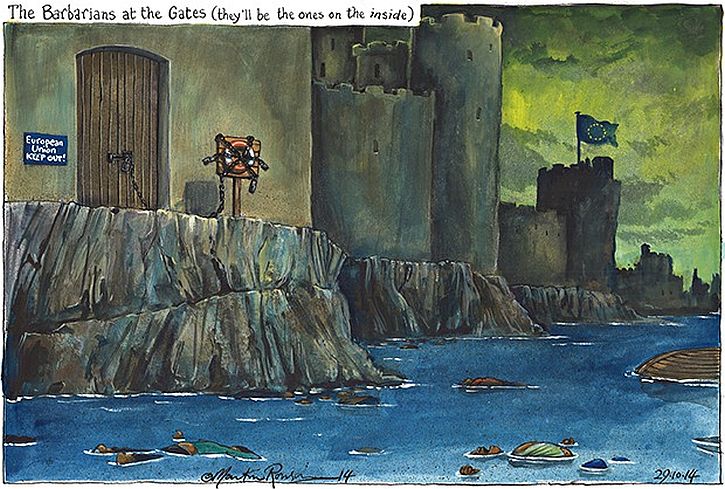
Martin Rowson in today’s Guardian
A few days ago I posted a piece about the photo of desperate migrants perched on top of the border fence that surrounds the Spanish enclave of Melilla on the north African coast. Now we learn that the British government has supported, and the EU justice and home affairs council has adopted a policy of leaving migrants to drown.
For the past year the Italian navy, with EU financial and logistical support, has operated a search-and-rescue operation called Mare Nostrum for migrants in danger of drowning in the Mediterranean which has saved the lives of an estimated 150,000 refugees. It is to be replaced with a much more limited EU ‘border protection’ operation codenamed Triton which will not conduct search-and-rescue missions. The justification given by both the UK government and the EU for this inhumane decision is that Mare Nostrum exercised a ‘pulling factor’, encouraging economic migrants to set sail for Europe.
Amnesty International’s UK director, Kate…
View original post 1,224 more words
The gateway where hope and history rhyme

In her beautiful blog, Maria Popova describes Reverend Victoria Stafford’s meditation in The Small Work in the Great Work (in the collection The Impossible Will Take a Little While: Perseverance and Hope in Troubled Times) as “gorgeous”. Stafford is “interested in what Seamus Heaney calls the meeting point of hope and history, where what has happened is met by what we make of it. What has happened is met midstream by people who are … spiritual beings and all that implies from creativity, imagination, crazy wisdom, passionate compassion, selfless courage, and radical reverence for life.” Here is how Heaney puts it in The Cure at Troy where hope and history rhyme:
Human beings suffer,
They torture one another,
They get hurt and get hard.
No poem or play or song
Can fully right a wrong
Inflicted and endured.
The innocent in gaols
Beat on their bars together.
A hunger-striker’s father
Stands in the graveyard dumb.
The police widow in veils
Faints at the funeral home.
History says, don’t hope
On this side of the grave.
But then, once in a lifetime
The longed-for tidal wave
Of justice can rise up,
And hope and history rhyme.
So hope for a great sea-change
On the far side of revenge.
Believe that further shore
Is reachable from here.
Believe in miracle
And cures and healing wells.
Popova frames her post with Dorothea Lange’s iconic photograph of Migrant Mother. The woman moved by Lange is possibly a Californian pea picker in the Great Depression. Perhaps Popova has been prompted to turn to this photo by Stafford’s anecdote:
“I have a friend who traffics in words. She is not a minister, but a psychiatrist in the health clinic at a prestigious women’s college. We were sitting once not long after a student she had known and counselled, had committed suicide… My friend, the doctor, the healer, held the loss very closely in those first few days, not unprofessionally, but deeply, fully – as you or I would have, had this been someone in our care.
At one point (with tears streaming down her face), she looked up in defiance (this is the only word for it) and spoke explicitly of her vocation, as if out of the ashes of that day she were renewing a vow or making a new covenant (and I think she was). She spoke explicitly of her vocation, and of yours and mine. She said, “You know I cannot save them. I am not here to save anybody or to save the world. All I can do – what I am called to do – is to plant myself at the gates of Hope. Sometimes they come in; sometimes they walk by. But I stand there every day and I call out till my lungs are sore with calling, and beckon and urge them toward beautiful life and love.”
Michael Sadgrove also claims the “gate” as the standpoint for Christian ministry. Considering Job in his book Wisdom and Ministry, Sadgrove asks about the piety required of those who are called to be friends and comforters to those who have to endure pain, and says that we don’t stand apart from suffering humanity, but face the world as it is. “We must often sit among the ahses where Job is, and must always go outside the gate to the place of the skull, where Jesus is.”
Opening the gate of Hope at the meeting point of hope and history begins with holding a moment (as in Lange’s photo) closely and deeply, and meeting that with all that we are. For me, this is a passionate rendition of all the pastoral cycle seeks to do in theological reflection and pastoral practice. The final word goes to Victoria Stafford: “Whatever our vocation, we stand, beckoning and calling, singing and shouting, planted at the gates of Hope.” There we see the world “as it is and as it could be; the place from which you glimpse not only struggle, but joy in the struggle” Dorothea Lange’s Migrant Mother is in the public domain.
People gatherers

Some people are just good at gathering people together. They call on people and the people come. This seems to be what leaders can do – or, rather, are those people who can gather us together our leaders? People gatherers have an attraction and an authority. Whether we call a meeting or throw a party, we are acting as people with authority, people able to call on others. Most people can grow that authority, usually by the attractive way that they gather people. Conversely, we have all been in gatherings which have been so carelessly organised that we have said “never again”. There’s usually a reason why “nobody came”.
Neighbours Table tells the story of a people gatherer. In an interview with Tammy Helfrich (available as podcast), Sarah Harmeyer talks about her recent life as a “people gatherer”. She adopts a word for the year. Word of the Year 2011 was “community” which brought a vision for inviting 500 people to her table during the year. At the point of the interview, she is nearing 1500 for the 3 year period on a budget of $75 per month. She started with an invitation to a “pot luck” delivered to her neighbours. Her father made a table to seat 20 – 91 came. She suggests that people are waiting to be invited, that whole neighbourhoods are waiting for such catalysts for change, for people to step forward.
Her “manners” can guide us all. “Plan ahead to be present with people”, develop a culture of mutual respect, interest and listening, introduce people to one another by saying what you love about them – all that makes for a good time gathering. So, pause for thought. Why do we call people together? Are they just instruments to our ambition, pawns in our little games? Are we prepared for them? What is our interest in their offering? Do we know them? Do we love them?
There is always a reason why “people come flocking”.
PS People gatherers are the image of God who gathers people like a shepherd, making of them a nation and a church. Eularia Clarke’s picture of the feeding of the 5000 is a celebration of God as “people-gatherer”, recalling the feeding of the multitude. The painting is part of the Methodist Modern Art Collection, © TMCP, and is used with their permission.
In our all together

What shall I wear?
It’s a question that never crossed my mind when I turned up to a fancy dress party in plain clothes. Embarassing. It seems to be a question that never crossed the mind of the guest who was caught out at the wedding (Matthew 22:1-14).
He could have argued back. Jesus had, after all, told people not to worry about what to wear (Matthew 6:31), but there he was just tipping his head towards Eden where the boy and girl were unashamed by being in the all-together (Genesis 2:25). At the other bookend (Revelation 21:2) we are shown what we’ll look like when all-together we are got ready by God. “And I saw the holy city, the new Jerusalem, coming down out of heaven from God, prepared as a bride for her husband.”
There is a dressing down for those who worry about what they wear, and those who aren’t ready in time. Jesus reminds us that God clothes us. The guest who hadn’t dressed properly wasn’t clothed in righteousness.
There are various dressing prayers. David Adam has a dresing prayer based on St Patrick’s Breastplate. And Jan Richardson has this blessing in her Painted Prayerbook:
In your mercy
clothe me
in your protection
cloak me
in your care
enfold me
in your grace
array me.
With your justice
dress me
for your labor
garb me
by your love
envelop me
and fit me
for your work.
Photo by Paul Vlaar (http://www.neep.net/photo/london/show.php?12881) [CC-BY-SA-2.5 (http://creativecommons.org/licenses/by-sa/2.5)%5D, via Wikimedia Commons
Celebrating eucharistic action: Dix’s purple passage

“At the heart of it all is the eucharistic action, a thing of absolute simplicity—the taking, blessing, breaking and giving of bread and the taking, blessing and giving of a cup of wine and water, as these were first done with their new meaning by a young Jew before and after supper with His friends on the night before He died. He had told his friends to do this henceforward with the new meaning “for the anamnesis” of Him, and they have done it always since.
Was ever another command so obeyed? For century after century, spreading slowly to every continent and country and among every race on earth, this action has been done, in every conceivable human circumstance, for every conceivable human need from infancy and before it to extreme old age and after it, from the pinnacles of earthly greatness to the refuge of fugitives in the caves and dens of the earth.
People have found no better thing than this to do
- for sovereigns at their crowning and for criminals going to the scaffold;
- for armies in triumph or for a bride and bridegroom in a little country church;
- for the proclamation of a dogma or for a good crop of wheat;
- for the wisdom of the Parliament of a mighty nation or for a sick old woman afraid to die;
- for a school child sitting an examination or for Columbus setting out to discover America;
- for the famine of whole provinces or for the soul of a dead lover;
- in thankfulness because my mother did not die of pneumonia;
- for a village chief much tempted to return to fetish because the yams had failed; because the Turk was at the gates of Vienna;
- for the repentance of Margaret; for the settlements of a strike;
- for a child for a barren woman; for Captain so-and-so, wounded and prisoner of war;
- while the lions roared in the nearby amphitheatre;
- on the beach at Dunkirk; while the hiss of scythes in the thick June grass came faintly through the windows of the church;
- tremulously, by an old monk on the fiftieth anniversary of his vows;
- furtively, by an exiled bishop who had hewed timber all day in a prison camp near Murmansk;
- gorgeously, for the canonisation of S. Joan of Arc—one could fill many pages with the reasons why people have done this, and not tell a hundredth part of them.
And best of all, week by week and month by month, on a hundred thousand successive Sundays, faithfully, unfailingly, across all parishes of Christendom, the pastors have done this just to make the plebs sancta Dei— the holy common people of God.”
Dom Gregory Dix, The Shape of the Liturgy, London, 1945, p. 743, with a few changes I’ve made for the sake of a more inclusive language.
 Grits and Grains

