Turning stones

Stone Tower III

How far skims the stone on the water?
big bounces, many bounces,
final skip
each stone weighed with outstretched arm
for howls of laughter
for cries of pain.
How deep gashes the body with violent pelt?
Turning stones on the one hand
to the other
(weaker)
turns random stones
from arsenal to cairn no stone unturned

Richard Beck posts a quote from a recent interview given by Sr Joan Chittister for the Jackson Free Press. The question was:

“So, as a woman of faith, as a monastic, how do you see your role and the role of other people of faith in the world?”

Sister Joan’s reply:

It’s a simple one: To see injustice and say so, to find the truth and proclaim it, to allow no stone to be unturned when it is a stone that will be cast at anyone else. It’s just that simple. There is nothing institutional, organizational, political about it. It says: “Where I am, you may not harm these people. You may not deride them; you may not reject them; you may not sneer at them, and you certainly cannot blame them for their own existence.”

Shard Villa (1872-1874) - stone megaphone detail

Photos by Keith Bloomfield and Don Shall

Social capital & a man in a hat

Parker J Palmer (worth following) shared this link from the public square of Sadabell in Spain. Turn the sound up, watch, enjoy.

It made me think ……

Public gathering, public square, ode to joy and delight
brings life to creases in old faces
Hands wring pleasure.
Young hands wielding innocent batons
conduct the mood of the moment
Public gathering background noise
Baby face smiles first music to the ear
Girl scales lamppost entranced
public square
ode to joy. Heaven.

Parable

I love this poem/parable of Jan Dean’s and the way she/kingdom undermine the man made house building enterprise.

Jan Dean's avatarshinystuff

the kingdom of God is like
a man who buys a bargain basement shrub
and plants it in his garden
and when it grows
it is not a small and tidy thing
it is horse chestnut
alive with lime green leaves
and tall pink candle flowers
its roots will wreck the footings
of his house
and when he sees this great tree
shoot into the air
a solid fountain
pouring shushing foliage
and sparking blossom flames
the man’s eyes widen
and he roars with laughter
such is the kingdom of God

View original post

Harrowing

Harrowing experience !
There are some words you just want to roll around in your mind isn’t there? “Harrowing” did its work on me when I saw this poem by Parker Palmer, which he describes as “taking form” within him.

Harrowing

The plow has savaged this sweet field
Misshapen clods of earth kicked up
rocks and twisted roots exposed to view
last year’s growth demolished by the blade.
I have plowed my life this way
turned over a whole history
looking for the roots of what went wrong
until my face is ravaged, furrowed, scarred.

Enough. The job is done.
Whatever’s been uprooted, let it be
seedbed for the growing that’s to come.
I plowed to unearth last year’s reasons –
The farmer plows to plant a gleaning season.

This poem from Let your life speak by Parker J Palmer.

The photo is from Biltho’s photostream

Goblin Market

Goblin Market, Goblin Market.

Goblin Market is a remarkable poem by Christina Rossetti. I love this video version because of its pace, images and soundtrack. The words are here. Christina Rossetti was a volunteer worker for over ten years at a refuge for former prostitutes (St Mary Magdalene “house of charity” in Highgate, London), and this experience pulses through the poem.

Rossetti is also well known for writing the words of the Christmas carol, In the bleak Midwinter, (here sung by Alison Crowe). The carol ends with the question “what can I give him, poor as I am?” This is a profound and everyday question. What can we give when we think we have nothing to give? Gift shops have ideas with price tags for those not so poor. Their buyers may wonder what they can get away with. The receivers of such gifts may pass them on to others as something unwanted. What they wanted was something of themselves.  Something that comes from the heart: something that is wholehearted.

What can I give him, poor as I am? If I were a shepherd, I would bring a lamb; If I were a wise man, I would play my part; Yet what I can, I give him: give my heart.

For posing the question and for her wholehearted responses  – we give thanks today, a feast day for Christina Rossetti.

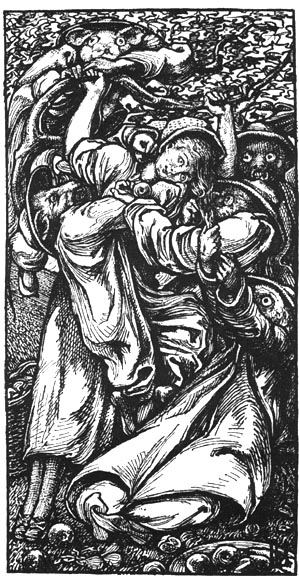
The image is Come Buy, a wood engraving by Laurence Housman (1892) scanned by George Landow.

Integrity and teaching

>

organic growth
“A complex web of connections”
Organic Growth from the Internet Mapping Project
posted by jurveston
These lines from May Sarton indicate something of the integrity of the “good” minister, teacher or human being:
Now I become myself.
It’s taken time, many years and places.
I have been dissolved and shaken,
worn other people’s faces … (the rest of the poem is here)
I have worn other people’s faces because it’s safe to be in the crowd. I have worn other people’s faces but they have never fit. I have tried to be clever. I have tried to be funny. I have even tried to be effective. But these faces never fit. We live in a world where standards are imposed and where we are trained from the outside in to conform to certain standards. When Jesus breathed new life into his disciples (John 20:19-23) he seemed to be giving them a very different inside-out spiritual direction for their lives. Parker Palmer, who quotes the above lines from May Sarton, talks about the divided self and the undivided self. A self divided is a self dis-membered and lacking integrity. For Palmer “good teaching cannot be reduced to technique; good teaching comes from the identity and integrity of the teacher.” They “join self and subject and students in the fabric of life.”
Palmer goes on to say that good teachers are “able to weave a complex web of connections among themselves, their subjects, and their students so that students can learn to weave a world for themselves. … The connections made by good teachers are held not in their methods but in their hearts – meaning heart in its ancient sense, as the place where intellect and emotion and spirit and will converge in the human self.”
When I reflect on the good teachers I have had I find that they are people who refused “other people’s faces”, who committed time to me and gave me their undivided attention. I also reflect that they have been a rather rare breed, but then I may not have been the right student to help great teaching happen with all the others I have known. The good teachers, though. have been more than enough – thank God.

a thousand kisses deep

>


For lovers of Leonard Cohen, a “thousand kisses deep” is an amazing poem/song (song is here) measuring the relationship between lovers. What if it was used as a different sort of measure? Our knowledge of one another is superficially assessed within twenty seconds. Apparently – and worryingly – we are only right 70% of the time. 70% may sound first class but for the 30% misjudged, denied jobs, shut out that statistic can be disastrous.

Us clergy, ministers, community developers and planners come and go. Sensibly we audit our place before forming opinions – but the data is skewed by preconceptions and historic artefacts of superficial excavation. What if we went a thousand kisses deep?

Down into the passions, convictions, emotions of successive generation and regeneration we would go. On our cheeks the hot breath of passion and the tears of betrayal. Lips caressing disconsolate children, the embrace of neighbours in the face of disaster, the kiss for a bereaved friend for whom there are no words. Seamly and unseemly: love denied and love made – our findings from a thousand kisses deep. Mining, owning, knowing.

Ricky Yates helpfully reminds us of the great store we set by outward appearance, and our use of image consultants. We remember Hyacinth Bucket (Bouquet) in long-running TV comedy Keeping up Appearances. For her, attraction was but a surface veneer – with relationships barely a peck deep. But, as Ricky says, the Lord doesn’t look on the outside, but on the inside (Mark 7:15) – a thousand kisses deep, at least!

chitter-chatter

>

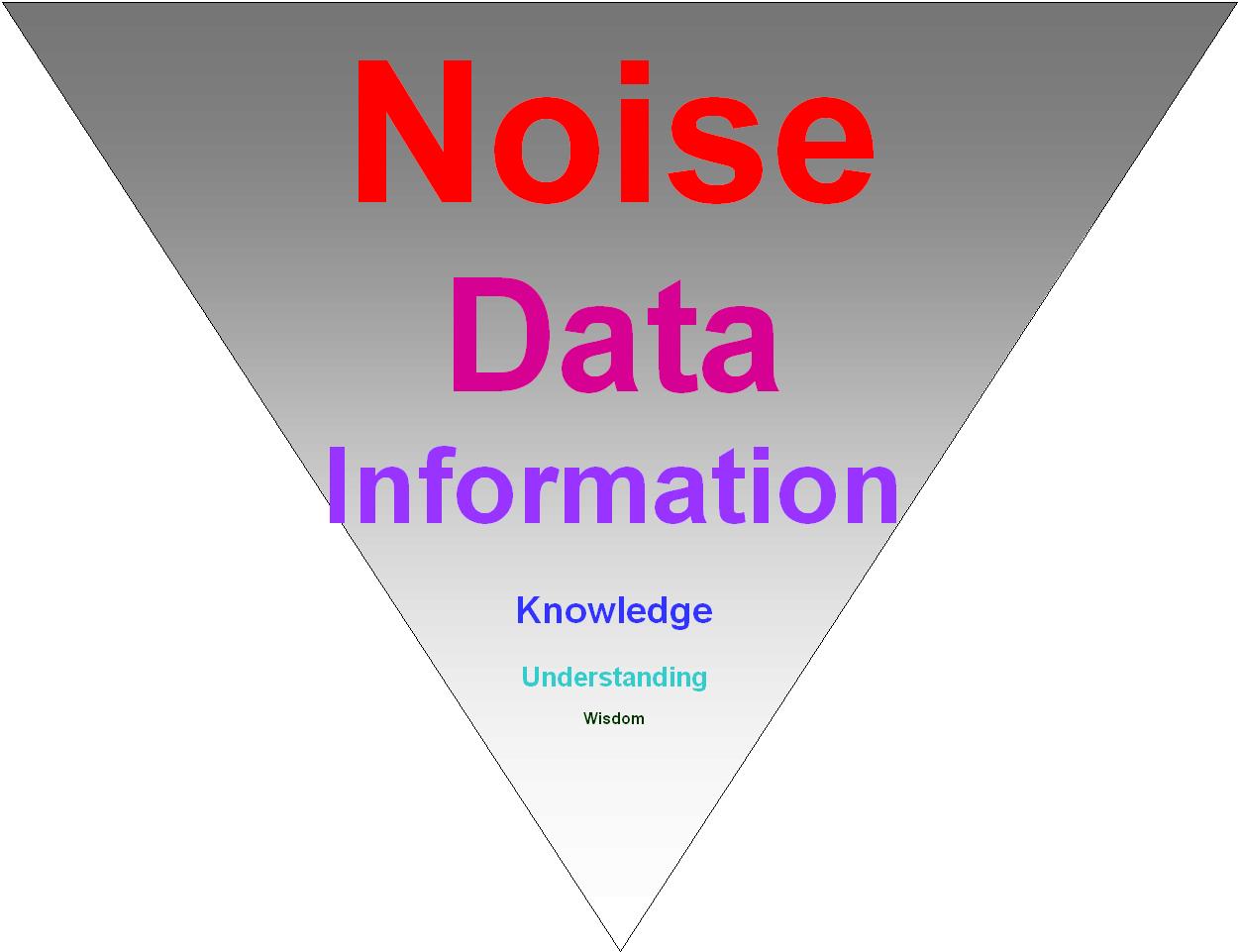
This diagram describes the ratio of noise to wisdom and the descending volume and value from noise to wisdom. According to Dee Hock “Noise becomes data when it transcends the purely sensual and has cognititve pattern.
Data becomes information when it can be related to other information in a way that adds meaning.
Information becomes knowledge when it is integrated with other information in a form useful for deciding, acting or composing new knowledge.
Knowledge becomes understanding when related to tother knowledge in a manner useful in conceiving, anticipating, evaluating and judging.
Understanding becomes wisdom when informed by purpose, ethics, principle, memory of the past, and projection into the future.” 

At one end of the spectrum, data is increasingly abundant, whereas wisdom (which is “holistic, subjective, spiritual, conceptual, creative”) seems to becoming scarcer.
 
We watched Lark Rise to Candleford last night. Based on life in bygone Buckingham (Candleford) and Juniper Hill (Lark Rise) the series reflects a time when there seems to have been a far higher ratio of understanding and wisdom to data and information. Wise counsel seems to have been part of being in settled communities slowly facing up to change. The wisdom is captured in the winning entry to last night’s poetry competition:
 
     As I went on my way,
     Gossamer threads span from bush to bush like barricades,
     As I broke through one after another
     I was taken by a childish fear
     They are trying to bind and keep me here
     But as I grew from girl to woman, I knew
     The threads that bind me were more enduring than gossamer.
     They were spun of kinship and love
     Given so freely that it could never be taken away from me. 
 
They were the days before the coming of the railway – a back story of Lark Rise. The coming of the railway meant increased communication, which meant more noise, which meant more data, which meant more information – and before we know it, we are too tired and overwhelmed to process it any further. Now we contemplate rail journeys of  only two hours from London to Glasgow – though wisdom may have gone out the window.
 
I am in the process of exploring the world of Facebook and Twitter. I now have the knowhow – now I am looking for the understanding and the wisdom to discern how to use it. Though there is a lot of noise and chatter going on I think I can now see a point to Twitter – I travel slowly! So I have changed my profile to “Cascading Insight – a dealership in second hand views” – and I am thankful for the tweets of others which have pointed me in the direction of understanding and wisdom. I will not be tweeting about my moods, where I am, and what time I’ve gone to bed. That is definitely too much information and just adds to the volume of noise we haven’t got a hope in hell of managing.

The Kingdom

>I have listened to two sermons from +Robert Atwell in two days. Today I get a day off!The first sermon was at the induction of friend Kathy Kirby as Vicar of St Paul’s Macclesfield. Kathy is a special person who is immensely generous in her appreciation of others. She will offer a very special ministry of affirmation and encouragement. The second sermon was to our Committee for Ministry in which he quoted “the Kingdom” by R.S.Thomas:

It’s a long way off but inside it
There are quite different things going on:
Festivals at which the poor man
Is king and the consumptive is
Healed; mirrors in which the blind look
At themselves and love looks at them
Back; and industry is for mending
The bent bones and the minds fractured
By life. It’s a long way off, but to get
There takes no time and admission
Is free, if you purge yourself
Of desire, and present yourself with
Your need only and the simple offering
Of your faith, green as a leaf.
R.S. Thomas, Collected Poems 1945-1990

I am playing round with ideas on supervision at the moment. Where many minds are bent on specifying, my mind is bent on generalising. I am told that if supervision becomes too general it loses its meaning. I counter that if supervision is too specific it doesn’t mean so much. If the kingdom is “mirrors in which the blind look at themselves and love looks at them back” I dare the word to bear such meaning and defy those who say I go too far.