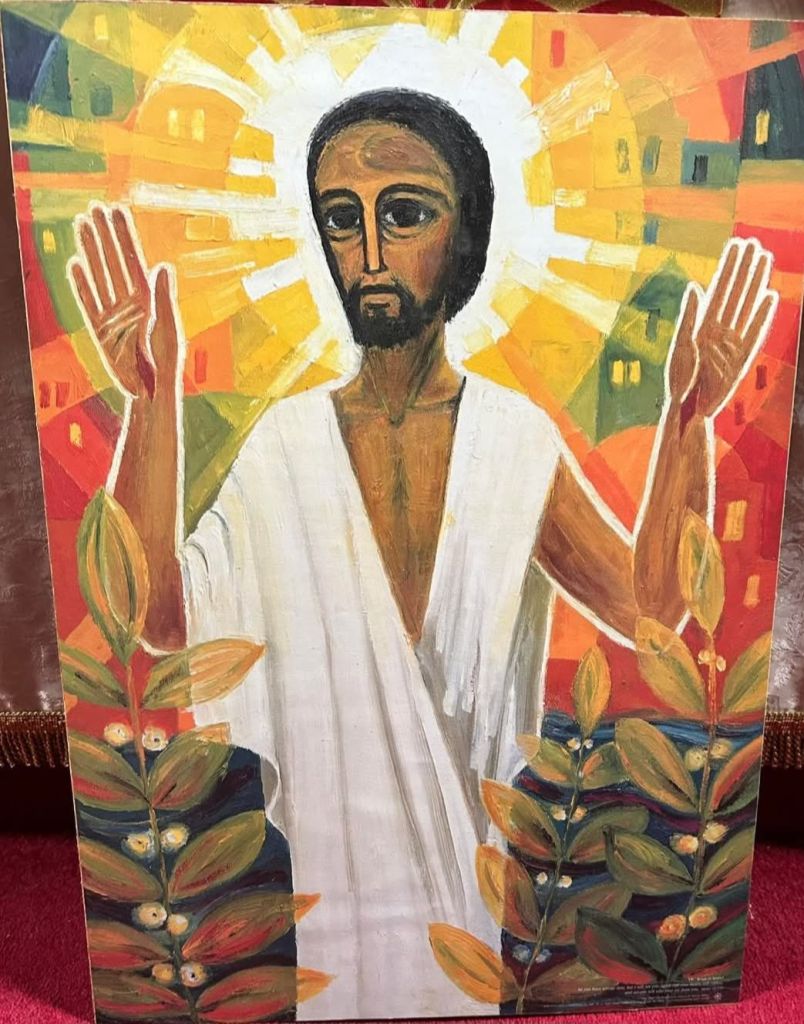
Do you turn to Christ while it is still dark?

a sermon for Easter Day, picking up on the turn made by Mary Magdalen. The readings for the day are Acts 10:34-43 and John 20:1-18
I love preaching that brings scripture to life. I love preaching that brings scripture back to life – back to the life, the often bitter experiences through which the word of God has been heard.

This morning, I want to highlight two moments in John’s Easter story. The first is about time. The second is about a turn.

So the time. 
It was early.
It was the first day of the week.
It was still dark.

We set our clock by that sentence.
We gather as early as we can on the first day of the week.
And we do that because of what was found that morning.
Our whole body clock is set to the rhythm of resurrection.
We don’t live by Greenwich Meantime.
We live according to Resurrection time.
Early on the first day of the week, while it was still dark …..

It’s always dark in John’s gospel.
Taking his cue from the very first verses of our scriptures, from Genesis, John begins his gospel with the words In the beginning was the Word, and the Word was with God and the Word was God.
For John, Jesus was always the Word.
In him was life, and that life was the light of the world. The light shines in the darkness and the darkness has not overcome it.

In John’s gospel there is always darkness, from first to last.
Even on this morning of resurrection, John writes, it was still dark.
His context was that his community faced a hostile environment.
The persecution they suffered cast a long shadow over them.
They were persecuted by their fellow Jews who rejected their beliefs about Jesus and mocked them as Nazarenes.
Eventually they were excluded from their synagogues and became outcasts.

So, it was still dark when John wrote his gospel.
I suspect most of us would recognise the usefulness of darkness as a metaphor for our own times.
It is still dark because our lives are overshadowed by all sorts of crises of carelessness and cruelty, and because of the suffering we inflict on one another because of what we can get away with under the cover of darkness. We walk through the valley of the shadow of death.
We all have known dark times in our lives.
Every generation says the same.
It is still dark. 

We can’t wait for the clocks to change. For lighter nights.

With darkness comes despair.
Our fears and anxieties come alive in our darkness.
It is still dark and there are those with the upper hand who want to keep us in the dark.
There are those who profit by keeping us in the dark—not just politically, but emotionally and spiritually. 

The algorithms of social media don’t care about truth—they care about our despair. Despair keeps people scrolling down, microdosing us with reasons for despair till we turn against ourselves and one another.

Our teachers are saying that there is a national emergency as they see the damaging effects of dangerous influencers on our children. They report a rise in misogyny and racism flooding our schools as pupils ape the behaviour of figures such as Donald Trump and Andrew Tate.

One teacher said, “I have had boys refuse to speak to me, and speak to a male teaching assistant instead, because I am a woman and they follow Andrew Tate and think he is amazing with all his cars and women and how women should be treated. These were 10 year olds.”

This is a black hole our children are falling down.
The challenge for all of us is how we build resilience for our children and ourselves to prevent our doomscrolling and to build our resistance to those who have a vested interest in keeping us in the dark, despairing at the way things are.

And what’s all this got to do with Easter?

Well, Jesus is the light that shines in the darkness.
it’s still dark.
In 2025, it’s still dark – very dark for many.
As it was in the beginning when, in the words of the first verses of our scriptures, darkness was over the whole world (Gen 1:2) so it is now, for our children and for ourselves.
Wherever we look there are things we can’t see and things we can’t understand.
It is still too dark to see.

And that’s how it is in our gospel this morning. It was still dark, and there was a woman by a tomb, one of the disciples Jesus loved and who loved him. She is weeping her heart out because the body she wanted to see was nowhere to be seen. She is overcome by grief and despair. It was very dark for her that morning. The only light she could see was the light of two angels who asked her what the matter was?

And she turns.

She turns in her grief and sees Jesus standing there. She didn’t know it was Jesus. She thought he was the gardener.

The first question the church asks us when we are baptised is “Do you turn to Christ?”.
The whole movement of Mary Magdalen is loaded into that question.
We turn with her.
John, the evangelist takes us deep into the heart of darkness in the details of Jesus’ death and crucifixion and then turns us round.
Instead of  being fascinated by the tomb and death, he turns us round to see Jesus.

There’s a turning we all need to keep making.
It’s a turning called repentance.
Resisting darkness, despair and all the fears of the night means turning our heads, our minds our hearts and our whole selves round.

 It’s such a simple movement John describes.
He wants us who share the same darkness to notice her turn.
She turns.
He wants us to turn round with her to see what she sees.
While it was still dark and she was weeping she turns around.
She turns round to see a stranger. 

At first she doesn’t see.
She thinks he is the gardener who might have carried Jesus’ body away.
She is like the blind man Jesus healed in Mark’s gospel.
He needed a second touch from Jesus.
At first he could only see people looking like trees walking, but then “he saw everything clearly” (Mark 8:22-26).

So it is with Mary Magdalen. When she first turned she did not know what she saw. She knew him in the intimacy of his call. Mary.

This is how Easter people are formed.
It’s our turn now
from despair to hope
from darkness to light
from hatred to love
from the dead ends
of selfish dominions
to life that is eternal.
It is to see a different way
and look in a new direction
that we join Mary of Magdala
the disciple Jesus loved
and called in the whisper of her name.

She became the first apostle, not by understanding, but by turning – and then being sent. Resurrection begins with a turn, in the dark. Let us follow her intentional movement. First, to turn, then to see, and then to go.

Do you turn to Christ while it is still dark?

In the thick of things – a sermon for Palm Sunday

On Palm Sunday we celebrate Jesus’ humble entry into the thick of things where we say he is very welcome. This sermon for a small Warwickshire church picks up that theme. The readings appointed for the day are Luke 19:28-40 and Philippians 2:5-11.

Entry of Christ into Jerusalem by Pieter Coecke van Aelst Bonnefantenmuseum 1246

I love preaching that brings scripture to life, and we are in the thick of it, aren’t we? We’re in the thick of it, with one thing after another.

We’re always in the thick of things with things going on in families, things that prevent us having a balance in our lives, worries about our health, pressures in our relationships. We are in the thick of things. In the thick of things our reptilian fear threatens to overwhelm us.

We can hardly believe what we are seeing of what’s going on for the people of Ukraine.
We can’t believe our eyes when we see news of the destruction of lives and communities in Gaza.
And now we’re on the edge of a trade war brought on by the obscenity of a billionaire President’s complaint that the wealthiest nation on earth feels cheated and that they are going to get their own back on nations that are poorer.

And in the thick of things, we are, like Jesus’s generation, “an unbelieving generation” (Mark 9:19). We are people of unclean lips, living among a people of unclean lips. (Isaiah 6:5). How can we be any other? We live in the thick of things. The thick of things take their toll on the way we are, our minds and our behaviours.

Today of all days, Palm Sunday, we look to Jesus who was, and is, always in the thick of things. When he rode into Jerusalem he rode into the thick of things. (Not that he wasn’t already in the thick of things in his ministry in Galilee.) But in setting his mind to go to Jerusalem he was setting his mind to get to the thick of things – Jerusalem, the place of religious and political capital, the place of those who made the rules, the place of turmoil, the place which had such an effect on people’s lives – on their fortune, their anxiety, their shame.

When we reenact the welcome of Jesus by the crowds in Jerusalem we are saying how welcome Jesus is in the thick of things for us. In the thick of things we turn to Christ. That’s the choice we made at baptism. “Do you turn to Christ?” “I turn to Christ”. We turn to Christ in the thick of things because there really is no choice.

Isn’t there?

The truth is that we are spoilt for choice. There are so many contenders, so many who want to govern us, to rule over us, to be our landlords, presidents, press barons and manipulators. That’s why there are so many power struggles. It’s surprising what an unbelieving generation believes. It’s surprising (and alarming) who an unbelieving generation will follow..It is shockingly easy to be misled when we are in the thick of it. We are sheep in the midst of wolves.

There is a choice. Who will we choose?

African-American writer Octavia E Butler wrote this in her Parable of the Talents:

Choose your leaders with wisdom and forethought.
She went on:
To be led by a coward is to be controlled by all that the coward fears.
To be led by a fool is to be led by the opportunists who control the fool.
To be led by a thief is to offer up your most precious treasures to be stolen.
To be led by a liar is to ask to be told lies.
To be led by a tyrant is to sell yourself and those you love into slavery.

Choose your leaders with wisdom and forethought, because when we don’t we find ourselves in the thick of things.

Who do we choose to lead us in the thick of things?

While Butler warns us of bad leaders, another voice—from an unexpected place—tells us what does hold evil in check. This is from The Hobbit.

“Some people believe it is only great power that can hold evil in check, but that is not what I have found. It is the small everyday deeds of ordinary folk that keep the darkness at bay. Small acts of kindness and love.”

In the thick of things we look for a messiah, someone to save us, usually an alpha male, a charismatic leader, someone with great power – a disaster who leads us into war, or poverty, or slavery, or hatred and fear.

Today, we wave our palms as Jesus comes before us, as in Jerusalem, so in our lives. (Incidentally, we see the deaf community waving the palms of both hands in the air – that is silent sound of welcome applause.)
Our palm waving is the sign of our choice, the welcome of Jesus into our lives.

We are at the beginning of the week.
When we get into the thick of the week we find out how Jesus was when he was in the thick of it,
the way that he hung out to the end,
the way he turned the tables on the religious leaders in the cleansing of the temple,
his refusal to justify himself in front of Caesar’s representative, Pilate,
his non-violence when he told Peter to put down his sword
the greeting of his betrayer with a kiss
the promise of paradise to the thief at his side, the way he made a brother of him

All these things add up, and in the thick of the crowd people changed their mind.
They didn’t like the choice they’d made by welcoming Jesus.
They preferred Barabbas.
When they were given a choice about who should be saved,
Barabbas or Jesus,
they chose Barabbas.
They mocked Jesus.
They insulted him, spat at him, and hung him out to die.

It shall not be so with us.
We have saved Jesus for when we are in the thick of things,
all those moments when we are searching
for a better way for our work, for our love,
we have welcomed Jesus into the thickness of our lives
and inclinations, when our tempers flare
when hatreds and jealousies might prevail
when our worries keep us awake
we have chosen Jesus as our saviour.

Let Jesus always be our choice
whenever we are tempted
by the ways of the world
in the thick of things,
in our relationships with one another
have the same mindset as Christ Jesus.
He never considered equality with God something to be used for his advantage,
but chose instead the way of a servant,
joining the suffering of the last and least
always following the rule of the kingdom
that puts love first and the last first.

That’s the way we choose when we wave our palms to welcome Jesus into our thick of things.

So let us wave our palms not as decoration, but as declaration. That in the thick of things—today, this week, this world—Jesus is still our choice, our way to go.

Mercy’s embrace and the scandal of grace

a sermon for the 4th Sunday in Lent (C) reflecting on the readings for the day, 2 Corinthians 5:16-end and Luke 15:1-3, 11b-end – the parable of the Prodigal Son (and Merciful Father)

Today’s Gospel presents a well-known story about a father and his two sons. 

(It is ironic that on Mothering Sunday our gospel is about a father and his two sons. The story may, just as easily, be about a merciful mother, wayward daughters and resentful sisters.)

Beyond being just a family drama, this is a story about the Kingdom of God.

How do we know that?
Because in God’s Kingdom, the last come first, and the first come last.
The world’s order favours the eldest son, granting him the inheritance and privilege.
Yet, in this parable, it is the younger son who finds blessing, while the older son stands in the shadows, sulking in resentment.

This reversal is a hallmark of the Kingdom of God. It is a theme woven throughout Scripture, going back to Genesis, where God repeatedly upends human expectations.

Consider Cain and Abel. Cain, the elder, offers his sacrifice, but it is the younger, Abel, whose offering finds favor with God, igniting Cain’s jealousy and leading to the first murder.

Think of Jacob and Esau. Esau, as the firstborn, should have received the blessing, yet through divine mystery and human cunning, it is Jacob, the younger, who carries God’s promise forward.

Look at Joseph, the eleventh son of Jacob—his brothers despised him, sold him into slavery, but in God’s providence, he rises to power and saves them all from famine.

And then there is David, the youngest of Jesse’s sons, overlooked by his family but chosen by God to be king of Israel.

This is the pattern of the Kingdom of God—a new order where grace, not entitlement, reigns. And so we return to today’s parable, which could rightly be called “The Parable of the Merciful Father.” Here again, we see contrast: the younger and the older, the old and the new.

Paul captures this contrast beautifully when he writes: “If anyone is in Christ, the new creation has come: the old has gone, the new is here!” (2 Cor 5:17). In the Kingdom of God, status, wealth, and achievement count for nothing. The new creation does not weigh merits but pardons offences. This is the amazing grace that calls us out of darkness and into light.

That’s what’s new. And we often still don’t get it.
Still the picture lingers in our minds of Peter at the pearly gates, standing like an examiner, ruling people in or out of heaven on the basis of what they’ve done. Jesus, in this parable, shatters that image. 

What’s the prodigal to say for himself other than that he has squandered his wealth in wold living (and we all know what that means)? 

And the older brother.
What has he to say for himself other than “I’ve worked like a slave for my father. I have never disobeyed orders.”
But it is the reckless, wayward son who is embraced, and the rule-keeping, responsible older brother who distances himself from his father’s joy.

“The Return of the Prodigal Son”, by Rembran(d)t Harmenszoon van Rijn, c. 1669

Rembrandt has painted the contrast brilliantly.
You see the older and the younger. You see the light and the dark, you see the old and the new. Rembrandt highlights the father and the prodigal younger son. His boy has nothing on him – no weight, not even a pair of shoes, utterly dishevelled, totally loved.
This is the new order, the order of the kingdom of God, where, in the words of the psalm appointed for today (Psalm 32 v11), mercy embraces those who trust in the Lord and happy are those whose transgression is forgiven.

The other son, the prodigal’s older brother, Goody, goody two shoes, has been painted into a very dark corner. His body language is so different to his father’s. He is wringing his hands in anger and despair and looking down his nose in judgement at the scene he is witnessing. He is standing over the merciful reconciliation of father and son and resisting it with all his might.

This is the dark corner we all paint ourselves into when we self righteously resist the new which doesn’t weigh our merits but pardons our offences. It’s the corner where we so easily let anger and resentment take hold of our heart, where we insist on our righteousness and our just desserts.

The resistance of the older son/brother puts him at such an emotional distance from his merciful father, as distant from his father as his younger prodigal brother had ever been in terms of physical distance. He has rejected the new order. He is far from the kingdom of God. He has cast himself out into utter darkness.

Imagine the father’s grief. He has seen the return of his youngest, now he has to grieve for his older son who has put such distance between them. He now has to wait for his return, for him to see sense, for him to join his brother in mercy’s embrace. The family will remain broken until that happens. But what joy there will be when both sons have returned, brotherhood united in mercy’s embrace. What joy. What a party!

Where do we see ourselves in this picture? Are we wringing our hands with the older brother? Or, are our hands stretched out in mercy ready to embrace those who come first in the new rule of the kingdom of God, the lost, the least and the last? Or, are we like the prodigal – once far off, but now glad, rejoicing in the Lord, happy in mercy’s embrace? 

Quite likely we see ourselves all over the place. Perhaps we see ourselves in the older brother – yes we can be like him. Perhaps we wish ourselves to be like the merciful father. Perhaps we know there’s joy in heaven when we’ve allowed ourselves to fall into the arms of love.

As I looked at Rembrandt’s painting this week I remembered my confirmation and my ordination. Do you remember your confirmation and kneeling just like the prodigal is kneeling in Rembrandt’s painting? It’s the same scene isn’t it?

It’s as if Rembrandt has painted me out of the dark shadows into the light, onto my knees in mercy’s embrace. I can feel the hands of mercy on my shoulders confirming God’s love for me, discounting all my sins – and myself confirming my commitment to the rule of God that puts the last, the least and the lost first in his heart. And from those hands I take the ministry of reconciliation that he commits us to, according to Paul in his letter to the Corinthians.

Jesus leaves us with a question. How does the family find healing? How can the brothers be reconciled? Is it only through the ministry of reconciliation that the father has committed his younger son to. Surely the younger brother has to share the same longing for his brother as his merciful father had for him. Surely the younger brother has to wait, his arms ready to embrace his long lost brother, discounting his anger and resentment and pardoning the ways he has offended.

The questions we are left with:
Will we join the work of reconciling love?
Will we stand together with Christ as people of mercy?
Will we set aside resentments?
Will we choose the scandal of grace?
Will we make way for joy?

The fig tree and the landlord

A reflection for the 3rd Sunday in Lent (Year C) focusing on the parable of the fig tree. The readings for the day are Isaiah 55:1-9 and Luke 13:1-9

The gospel writers give us two parables of Jesus featuring fig trees. He may have used more. The two we’ve got teach different lessons. In one, the fig tree is cursed. In the other the fig tree is spared. The fig tree (featured in Mark 11:12-14, 20-25 and Matthew 21:18-22) is cursed by Jesus for not bearing fruit. In the other, from Luke’s gospel, the parable which is our good news for today, the fruitless fig tree is given a time of grace. 

Our other reading from Isaiah (55:1-9) culminates with these words of the Lord: “my thoughts are not your thoughts, neither are your ways my ways”.

How are we going to bring these two passages of scripture together and bring them to life today?

“My thoughts are not your thoughts, neither are your ways my ways.” A good question for us to be asking is “How?” How do my ways differ from the Lord’s ways? How does our thinking differ? These are good questions for self-examination, particularly during Lent which is a season given us for repentance, for changing our minds, attitudes and behaviour.

There is a distinction drawn. “My ways are not your ways …..”

The distinction is graphically illustrated by Jesus in today’s parable. It’s our Lord telling a story about another lord, a landlord – and we can read between those few lines of the parable the thought of the Lord: “my thoughts are not your thoughts, neither are your ways my ways. As the heavens are higher than the earth, so are my ways higher than your ways and my thoughts than your thoughts.”

Let’s look at the difference between one lord and the other and try to unpack a parable which takes up so little page room that it is easy to skate over it. But small is beautiful and less is more – such is the rule of God’s kingdom.

The difference is in their respective responses to fruitlessness, and their different relationships to the fig tree.

The owner of the vineyard, the landlord, had a fig tree growing in the vineyard.
He keeps coming back to the vineyard to see if there were any figs on the tree.
Time and time again he did this.
For three years he kept checking up, and then he ran out of patience.
Cut it down, he said.

Here is a man with authority who can say to his servant, do this, do that.
He gives the orders. He doesn’t dirty his own hands.
His servant is the one who took care of the vineyard.
He is the one who does the work.
If there’s cutting down to be done, he’s the one who will do it – the owner isn’t going to get involved in that dirty work.

So, here the picture is building up of this landowner-boss, who comes from time to time to check up on his investments, to check up on his interests.
His interest is what matters to him.
It’s all about him.
It’s his vineyard, but he’s away from it most of the time.
His is a remote control. He’s distant and disconnected.
It’s his fig tree, and it’ll be his profit if the fig tree were to give a fig.

We won’t blame the landowner.
We won’t call him wicked.
His behaviour is normal.
This is what happens in the real world.
His order makes perfect sense to our thinking.

Of course, we are not surprised that the landlord wants to cut the plant down.
We know that is the way of the world governed by money, profit and vested interests.
We are seeing that in our current economic crisis with cuts to welfare.
The way of the world is to cut down the fruitless and profitable, so that the fruitless and unprofitable make way for something that will be productive.
The ways of the world measure us in productivity and fruitfulness.
The less productive and fruitful we are the more vulnerable we become to cuts.

But is this the only way? Must fruitlessness always be met with destruction and condemnation?

There’s the landlord. 

Now let’s explore how different the one who actually took care of the vineyard.
We need to make a judgement between them otherwise Jesus has told the parable in vain.

In the words from our Isaiah passage we can play the question whether the thoughts of the caretaker are the same as the thoughts of the landlord.
Do they think the same?
Are the ways of the caretaker higher than the landlord?
Is his thinking higher than the thinking fo the landlord – “as the heavens are higher than the earth”?

The one who took care of the vineyard is the caretaker.
He is the one who is always there, working the vineyard day to day, spending his time and energy, rooted in the earth and tied up with the vines, the figs and all the challenges they face.
He’s the one who takes care of the vineyard for the landlord who takes care of his pocket.

(If you want to play with words again, our word care, originates from the Old English caru and cearu (meaning “sorrow, anxiety, grief”), ultimately stemming from the Proto-Germani karo (meaning lament, sorrow) and potentially tracing back to a Proto-Indo-European root meaning “to cry out, shout”. Just ask Google!

The word cure came to us through French after the Norman Conquest, and ultimately derives from the Latin word cura, meaning care.

The caretaker, the one who takes care of the vineyard, is the curator.
I’m labouring this point because you are in your vacancy of praying for a new priest – someone the Book of Common Prayer calls curate who will have the cure of souls in these parishes, a curate who will spend her/his time and energy in the day to day care for the vineyard round here,
someone who will join you in caring for those around you,
someone who will sorrow and grieve with you for how things are for those who are hurt and suffer the cuts of those who don’t care so much,
someone who will join you in lament, crying out and shouting about pain, injustice and suffering,
someone like the caretaker in Jesus’ parable who speaks up for the doomed fig tree,

someone who knows better ways for the world, someone who will think differently to the world …

Through the caretaker’s pleas we see the heart of our Lord Jesus.
Where the world rushes to judgement, Jesus intercedes for grace.
Here’s the difference between the landlord and our Lord.
The reason Jesus was sent into the world was to save us, not condemn us.
God is slow to condemn – with God there is always the period of grace, another season for the caretaker to do his work.

So, which lord will we follow?
Will we stand with the landlord in judgement, or with the caretaker in mercy?

Jesus wants us to follow him.
He wants us to join him to save the world
He wants our ways of thinking and our patterns of behaviour to be passionate in our care during this hard won season of grace.

If we follow Christ we will see the fruits of his patience.
We will see lives restored and hope rekindled,
and after the season is done, the caretaker, our Lord will say to the landlords:
“See this, the fruit of your planting, the harvest of this season of grace.
See the compassion, see the harvest.”

Citizens of heaven behind enemy lines

A reflection for the 2nd Sunday of Lent on the readings, Psalm 27, Philippians 3:17-4:1 and Luke 13:31-end

If we were to get a tattoo, and if we were to choose from the texts of today’s readings, I wonder what you would choose? These are some of the words that are held at the heart of the church. I am sure many have tattooed over scars of harm and hurt some of the verses we’ve heard today. What are the words you would inscribe on your skin because you want to take them to heart?

It is the second Sunday in this season we have been given for repentance,
It’s time to look at ourselves,
to change our minds
and reimagine ourselves as children of God
and behave, as citizens of heaven.

It’s a time to look at ourselves,
not so much to remind ourselves that,
in the words of the psalmist,
we are fearfully and wonderfully made,
but to wonder at ourselves,

at the habits of our hearts and minds,
to ask ourselves why we are inclined to do this and that,
and when we do this or that,
whose side are we on?

Are we on the side of God,
are we on the side of the angels?
Or, are we on the side of those our scriptures
so loudly call out as enemies?

What are we like
when we are tired.
when we are hungry,
when we have too little to do,
when we have too much to do,
when we are in a confrontation,
when we are facing criticism,
when we are struggling with our finances,
or our health,
when we look at ourselves in the mirror,
when we’re alone
or when we are with certain others?
What are our responses?
What’s our inclination?

Are we inclined to be anxious,
or hateful,
or judgemental,
or selfish,
or proud?
Why? How?
How come so many voices got into our heads
to incline us to self-doubt?
Where did they come from?

What are the habits of our hearts?
What is our natural inclination?
Why? How?

What has spoiled us?
Who has spoiled us?
Why did they spoil us?
How did they spoil us?
What is spoiling us?
What is spoiling our lives?

Can we change?
Can we be born again, reimagining ourselves behaving differently?
Can we be saved from our harmful habits of our hearts and minds?
Can we lean another way?
Are we bound to be the way we are,
and to think the way we do?

These are urgent questions.
They’re getting more urgent by the minute
in these mean times which are so mean to those God puts first,
those who are last, the first victims
of our carelessness, pride and selfishness.

These are urgent questions,
more urgent by the minute
as we get older and our habits
more ingrained

We made a decision at some point in our lives to turn to Christ,
to be on his side and to be sided by him.
We are on his side. He’s on our side.
Side by side we go through our lives 

just as Jesus called it,
as sheep amongst wolves.

The deacon has the doubtful privilege of sending us out,
telling us to go in peace
to love and serve the Lord
wherever we go.

In the name of Christ, we go,
just as in the name of Christ
the deacon sends us
as sheep amongst wolves,
citizens of heaven
operating behind enemy lines.

Our scriptures today remind us of the enemy fire,
their stones pounding the prophets to death.
The Psalmist knows enemies amongst the wicked surround us to make trouble amongst us,
to make war against us, to spoil our life.

We feed each other with the news of enemies
(often neglecting those dark psychological forces within us)
and the devastation of their atrocities,
yet somehow we miss the heat of their fire,
the tragedy in their enemy power
preventing us from caring enough.

Only this week we heard how young children are becoming addicted to vaping. This is just one example of the powers that overwhelm us. How dare anyone put our children in harm’s way with the risks of nicotine addiction, risks to brain development, to concentration, to learning and to their overall wellbeing? These are just some of the enemies our children have to face – and need to be sheltered from.

This is our life, surrounded by enemies,
enemies around us and enemies within us,
forces within us inclining us more to fear and anxiety,
to competitiveness and spite,
to live more selfishly
to ignore the cries of the poor.


Our citizenship is in heaven.
Please note the present tense.
Our citizenship is in heaven.
It’s not “will be in heaven”,
our citizenship IS in heaven
and it is only the enemies of the people
who want to rob the present of its heaven.

We are citizens of heaven
and we live our lives behind enemy lines.

In Lent, we journey to Jerusalem with Jesus.
Jesus stays in the city, behind enemy lines.
He cries for the state of the city and what it does to people.
His cry is one of lament and longing.
He laments the killings and the stonings,
the violence and the injustice
and longs to provide shelter for those made vulnerable.

Where is our shelter?
Where is the shelter that Jesus longed for?
Where is the shelter we can join the psalmist in
in our days of trouble when we are surrounded
by enemy forces undermining us?

Here is my shelter. The Lord is my light and salvation,
proclaims the psalmist.
The Lord is the strength of my life,
of whom then shall I be afraid?

He has been my helper.
In all the days of my trouble
He has had me in his shelter.

Here is our shelter.
Look around, not at the walls, but at the people who love us,
in whom we have trust.
Within our hearing is the sound of heaven, the call of God and the love of Jesus,
in the hearing of our scripture,
in the talk that makes for peace
in the prayers which voice the longings
of citizens of heaven.

This is where we need to be to recover if ever we are going to be more than we are ever inclined to be by the enemy forcing us to hatreds, anxiety and despair.

The Lord is here, his Spirit is with us.
We are under the shelter of his wings.
Under his shelter, all the forces behind
the  I COULDN’T HELP ITS lose their power.

When we pray to our Lord in heaven,
who is so different from our everyday lords,
our overlords, warlords, empire builders and media moguls,
when we pray to our Lord God, the psalmist joins us,
the psalmist who knows the Lord his helper,
helping us, when,
because of the odds against us,
we just couldn’t help it,
helping us to change to be true citizens of heaven.

Making choices, making life

A reflection on the stories of creation in Genesis 2 and the storm on the lake in Luke 8:22-25. These are the readings set for the 2nd Sunday before Lent (C).

This image was created by AI from the words of the sermon. Interestingly and controversially AI has made a choice for a white Adonis – more filmstar than gardener!

In the beginning everything was so good, and so well made.
Everything was generated from the heavens and the earth when they were created, when the Lord God made the earth and the heavens.

This story of creation is not the history of creation – as if this happened, then that happened, and the rest is history, sort of thing.
This story of creation is the theology of creation, and is true.
It is true for those who believe in God, who see God in all our beginnings, who trust in God’s blessing. It is spiritually true, not scientifically true.
Spiritual truth stands the test of time.
It is so true that it moves us to wonder and reverence.

It comes from a faith that sees God’s blessing in the beginnings of all life, that sees heaven and earth knitted together by a God who in the first place only ever wanted to give life. It comes from a faith that sees God loving everything he has made, delighting in what he has so well made.

It is a faith which realises that without God we are nothing.
Here God brings man to life by getting into his face and breathing into his nostrils the breath of life, and the first breath of language.

God brought to the man in the garden everything he’d made from the dust of the ground.
This was to see what he’d call them and whatever he called them, that became their name. 

God wanted to see what he called them.
That is something we’ve stopped imagining isn’t it?
Do we imagine God being interested in the names we call things, and the names we call people?
How different our world would be if we did have that imagination to name others in a way that would please God.
How different our world would be if, with that imagination, we didn’t demean the creatures of God’s making.

Our naming, our calling, the language we use, is part of the choice that is fundamental to the book of Genesis. In a world where language so much divides us we could usefully reflect on the choices of words and names we make and how they reflect our relationship with God and creation. 

The choices we make about language can be mighty acts of creation.
But remember, it takes time to call someone “lovely” in a way they will understand and take to heart.
It takes no time at all to voice a hurtful call that will break the heart of a relationship.
Our words have creative power and they have destructive power.
The choice is ours to make.

From the beginning there is choice.
There’s always been choice. 

Besides our naming and calling there’s the choice of obedience and disobedience.
The choice is there for the couple in the garden.
Can we get away with eating the fruit from the tree of the knowledge of good and evil?
There was only one thing forbidden by God and that was it.
The man and the woman only had to be obedient in that one thing and they weren’t.
They were disobedient and took the law into their own hands. 

This was their first bad choice, and the rest they say is history.
One bad choice led to another, and then another and then another in rapid succession.
They got dressed to cover their shame (bad choice, but perhaps necessary), they ducked their responsibility and blamed something else (the serpent) and they hid themselves from God.

One rotten choice after another.
Hot on the heels of these choices comes the story of the children of the first procreation, the story of Adam and Eve’s two sons, Cain and Abel, the story of the first murder, a shocking murder, fratricide, the killing of brother by brother.
God had tried to help Cain. “Why are you angry?”
(Perhaps we all need God to ask us that question in our anger.)
“Why are you angry? Why is your face downcast?
If you do what is right, will you not be accepted?
But if you do not do what is right, sin is crouching at your door; it desires to have you, but you must rule over it.” (Genesis 4:6-7).

That’s the choice.
That’s the choice for Cain and it’s the choice for us.
Sin crouches at the door.
We must rule over it.
That’s the way with sin, isn’t it?
It makes itself small and then looms large.
It makes itself seem so small that we often think that we have done little wrong. 

The book of Genesis concludes with stories about Joseph and the right choices he made.
He goes from being a tactless 17 year old (37:2) to become a powerful and self-disciplined man by the choices he make.
He refuses sex when it’s offered him on a plate, and he refuses to retaliate against his brothers for their jealous bullying, instead he saves their lives and the lives of all in Egypt.
Sin was always at his door, but he nails it.
His good choices undo some of the harm caused by the bad choices of his brothers – including their jealousy of Joseph, their intention to kill Joseph (another fratricide) and their intention to deceive their father into believing his son was dead.

The picture painted by Genesis is that in all our beginnings is God’s love of life, love for our life and blessing in abundance.
There are all the blessings of creation, all the animals, the flora and fauna, and all living beings – all to enjoy.
There is almost too much to choose from and choices become challenging and difficult decisions have to be made. 

From the beginning it’s the choices we make that intrigue God.
He wants to see what we will call others.
He wants to see how we will manage the passions he has given us to work the garden and take care of everything.
He wants to see how we manage our emotions.
He wants to see the choices we make when all around us people are choosing to hate and despise others.
He wants to see the choices we make about brotherhood and sisterhood. He wants to love all the choices we make.

Genesis is a book about beginnings, but is also about the mean time, when times get mean in the midst of life, when life gets challenging and difficult, like the time depicted in today’s gospel in the crossing of the lake (Luke 8:22-25).
At first, it’s all plain sailing, so much so that Jesus fell asleep.
Then a squall came down on the lake, and the boat was swamped and they were in danger.
They panicked.
“We’re going to drown!”

Isn’t this the way life goes?
First it’s plain sailing – then as we grow up life gets rough and we have choices to make.
The choice is whether we become doomsayers – “we are drowning in this, or in that”, or whether we remain hopeful, constant in love, believing our blessing.
When the storm subsided, when all was calm, Jesus asked those who were with him, “where is your faith?”

They were amazed.
“Even the winds and the water obey him”.
Their choice was to follow him.
How do the choices we make show our faith and our choice to trust that God is with us in the storms of our lives, longing to love the choices we make within those storms – whether we choose life, whether we choose peace, whether we choose kindness, whether we choose obedience?

Here’s the link to the readings

The blessing of being alongsides

A reflection on Psalm 1 and Luke 6:17-26 for two small congregations in a group of parishes in vacancy.
The 3rd Sunday before Lent – Year C

In last week’s gospel (Luke 5:1-11) crowds surrounded Jesus so much that to find space for himself Jesus needed to get into a boat on the lake as crowds gathered around Him to hear His teachings.

We have another crowd in today’s gospel (Luke 6:17-26). There’s a large crowd of his disciples (including the twelve he called “apostles”), and “a great number of people from all over Judea, from Jerusalem, from the coastal region around Tyre and Sidon” who had come to hear him and be healed of their diseases.

In the context of safeguarding we need to note that Luke has underlined where Jesus was in relation to the crowd. He is not “high up”, over others. 

In the boat on the lake he would have been lower than his hearers. 

And in today’s gospel Luke paints a different picture to Matthew’s Sermon on the Mount. Luke has them all on a level place – Jesus on the level with all the people. 

In this, and so many other ways, Luke is wanting to show how Jesus stands in relation to others – never overbearing, never patronising, always side by side – as typified by walking incognito with disciples to Emmaus. 

There is no distance between Jesus and the people. He was there with them, eye to eye, shoulder to shoulder, side by side, valuing relationship over hierarchy.

That’s the position you’re hoping to fill, isn’t it? You’re hoping for a priest who will ask your permission to come alongside, as your helper. It’s probably also the position we long to be ourselves, alongside others with others alongside us.

None of us are ever safe when people look down on us, and nobody is safe from us as long we look down on them. Jesus’ physical positioning in relation to others guarantees safety. He is the good shepherd.

That’s how Jesus positioned himself, alongside us, always on the side of those he blesses. What is our position? Where do we stand?

The psalmist points to those who take a very different position. They “walk in the counsel of the wicked”, “linger in the way of sinners” and join “the assembly of the scornful”. They’re condemned. They won’t stand the judgement of the law of the Lord or stand in the “congregation of the righteous”.

There is another way. That is the way of Jesus and all those who delight in the law of the Lord, meditating on his law day and night. They’re the ones blessed and the psalmist sees them like trees “planted by streams of water, bearing fruit in due season”.

There is a clear choice: the way of the wicked, or the way of the Lord. It’s either blessings or curse.

I had to go to a two column format to get our two readings on one sheet of paper. But in so doing I have shown the pairings: 

Blessed are all you who are poor, but woe to you who are rich
Blessed are you who hunger now, but woe to you who are well fed now
Blessed are you who weep now, but woe to you who laugh now
Blessed are you when people hate you, exclude you and insult you, and woe to you when everyone speaks well of you

This is the law of the Lord. This is Jesus’ teaching. This is the law of the Lord according to Luke who has already given us Mary’s song celebrating the ways of God in scattering the proud, toppling rulers from their thrones, raising the humble and humiliated, filling the hungry with good things and sending the rich empty away. This is the law of the Lord. (Luke 1:46-53).

This is the law of the Lord brought to us by Luke who has already told us how Jesus preached in the synagogue about the law of the Lord being good news for the poor: freedom for prisoners, recovery of sight for the blind and liberation for the oppressed. (Luke 4:18-19).

This is the law of the Lord our scriptures describe as blessed. This is the law that delights the blessed but which the wicked, the sinners and the scornful scorn. This is the law that those who are blessed think on day and night, according to Psalm 1.

They are like a tree planted by streams of water, bearing fruit in due season, with leaves that do not wither.

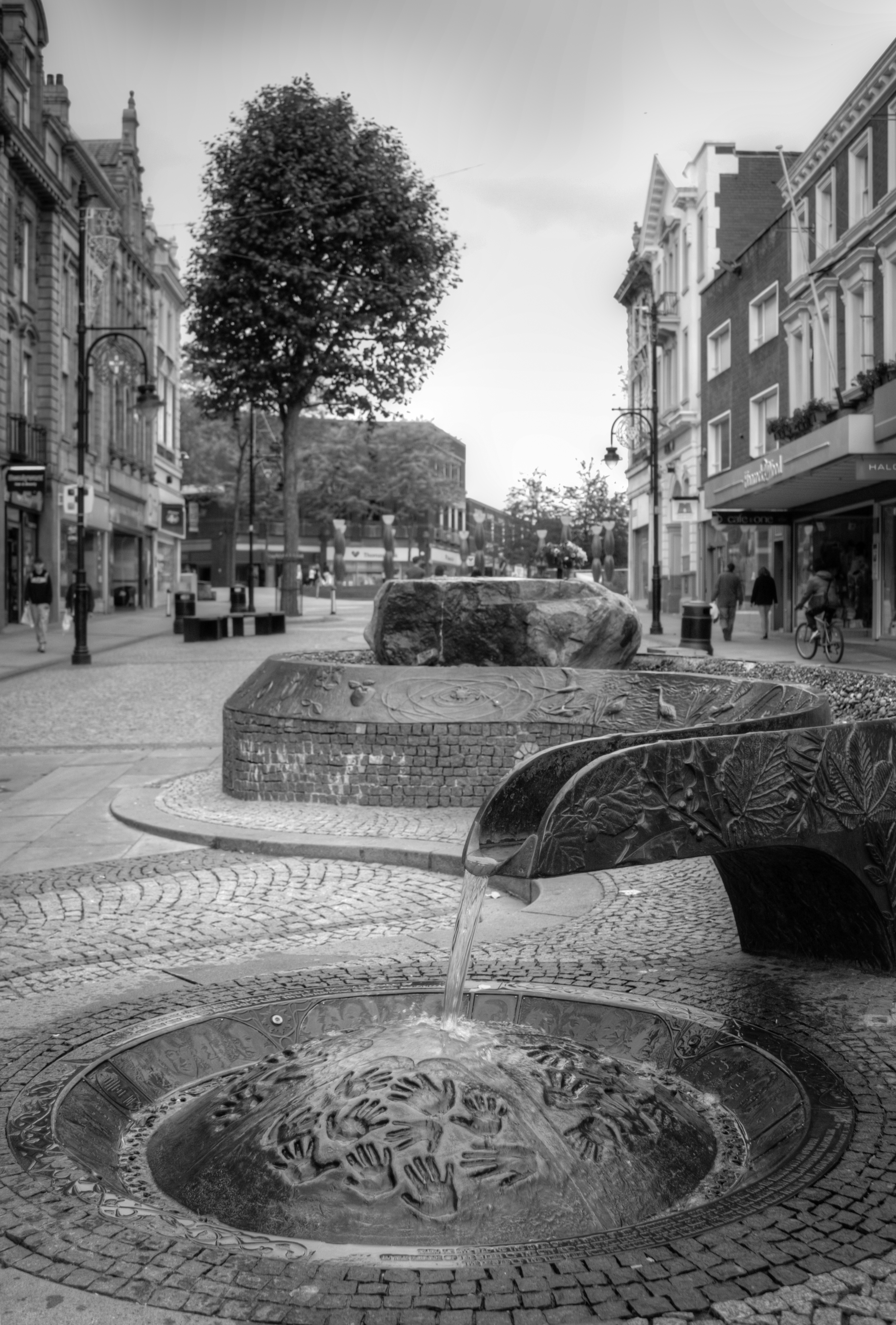
When I read that verse this week my mind went to a sculpture called The River of Life which runs down the main shopping street in Warrington. The sculpture was built by Warrington Council after two bombs were detonated by the IRA, killing 3 year old Johnathan Ball and 12 year old Tim Parry and injuring 56 others. It was the day before Mothering Sunday, March 20th, 1993.

The city council turned to a sculptor to discuss a memorial. Stephen Broadbent was the sculptor. He saw that the street was not just physically broken, but spiritually broken as well. He wanted to design something that would be “a symbol of renewal and faith in the power of the human spirit to triumph over adversity and to invest the future with hope.”

His inspiration was the image of the river of life in Revelation 22.
The angel showed me the river of the water of life, as clear as crystal, flowing out from the throne of God and of the Lamb down the middle of the great street of the city. On each side of the river stood the tree of life, bearing twelve crops of fruit, yielding its fruit every month. And the leaves of the tree are here for the healing of the nations.

And so it is. Now, flowing down that street is the River of Life  he made and on either side of the streaming water are trees, one for each month, each bearing fruits of the Spirit for the healing of the nations, for all times and seasons.

And so it is in Psalm 1 where the blessed are like a tree planted by streams of water bearing fruit in due season. I wonder that Stephen Broadbent himself is one of those trees, planted by the stream of tragedy and violence, leaving blessings of hope and healing through the season of trauma and grief.

I’ve seen photocards with these verses from Psalm 1. In them the stream is picturesque with sunlight reflecting from its gentle flow. The psalm doesn’t say the water is safe. 

The stream may be dangerous, fast flowing floodwater, a tidal wave, or deep or toxic. 

Or with a stretch of the imagination, the waters could be the waters that have to break for us to be born or baptised. 

Or the stream and the metaphor may be a metaphor for life.

Does the law of the Lord raise up people who delight in the law that there should be people by all the rough waters of life, that there should be lifesavers of healing, hope and blessing bearing fruit for all seasons of difficulty and danger?

It’s worth visiting that sculpture in Warrington. It’s on Bridge Street. It was always Bridge Street. The street hasn’t been renamed because of the sculpture and its intention to bridge the awful violence that tore people’s lives apart.

And here we are. The Bridges Group of Parishes – so called because of the bridges of the villages that make up the group of parishes. And the bridges are there to bridge the waterways that cut through the landscape.

We’ve reflected on Jesus’ position in relation to the crowds that streamed to him. We’ve reflected on the Psalmist’s position on those who delight in the law of the Lord.
We’ve reflected on the sculptor’s position in relation to the trauma of a community.
What about our own position?

Are we bridge builders and lifesavers? Do we delight in the law of the Lord, meditating on his law day and night? Are we blessed as agents of blessing, healing and hope? Or are we a curse on the poor, the stranger, the refugee, and all those vulnerable to losing their life at sea because we take our cues from the scornful, lingering in the way of sinners, taking the counsel of sinners?

Where are we as the river of life flows through our lives? Are we bridgebuilders offering healing where there has been division, hope where there has been despair? Are we like trees that bear the fruits of God’s Spirit, the fruits of love, joy, peace, forbearance, kindness, goodness, faithfulness, gentleness and self-control (against which no other law can stand) (Galatians 5:22f)? 

What is our position in relation to those Jesus blesses? Are we on their side, or are we on the side condemned by Jesus, with those who’ve grown rich at the expense of the poor, those who have stuffed themselves while so many go hungry, those who can afford to laugh while the rest of the world is in bits, those who walk the corridors of powers and still exclude, insult and reject others?

For as long as we delight in the law of the Lord, for as long as we seek to understand it, we will be on the side of those in the roughest of waters.

Here Am I: Embracing God’s Call in Worship

Worship fires us. Worship hires us. This is what we see at the heart of our two readings today. (Isaiah 6:1-8 and Luke 5:1-11). This is a sermon for the 4th Sunday before Lent for a small church “in vacancy”.

The poetry of Mary Oliver is full of worship. Here are some of her lines:

Poems are not words, after all,
but fires for the cold,
ropes let down to the lost,
something as necessary as bread
in the pockets of the hungry.

Poems are not words, but fires for the cold, ropes let down to the lost, something as necessary as food in the pockets of the hungry.

There is poetry in the heart of worship – fires for the cold, ropes let down to the lost. We repeat these lines of poetry in the heart of our worship. We call it the Sanctus. The poetry goes along these two lines:

Holy, holy, holy is the Lord Almighty,
the whole earth is full of his glory.

This is the song of the seraphim overheard by the prophet Isaiah in his vision of heaven when he was transported in worship. They are words which reverberate in our own worship. Holy, holy, holy is the Lord Almighty. The whole earth is full of his glory. This has become our song too.

In Mary Oliver’s words, they are fires for the cold, ropes let down to the lost. Holy, holy, holy is the Lord Almighty; the earth is full of his glory. This is the song of those Isaiah sees around the throne – the song of the seraphim. 

Seraphim are the fiery ones. That is the meaning of seraphim. Their words are fires for the cold, ropes let down to the lost. They are ropes we hang onto as we join Isaiah as he is transported in worship.

The whole earth is full of his glory. This is the faith of the heavenly host. It doesn’t mean that everything is hunky dory. Isaiah knows only too well his own lies and the lies of those around him. I am a man of unclean lips, and I live among a people of unclean lips. And that hasn’t changed over the centuries, has it? We say one thing and mean another. We mislead and are misled. Truth is distorted to our own ends. We, too, are a people of unclean lips living among a people of unclean lips.

In our gospel reading Simon Peter is transported to a similar sense of wonder and worship. Luke paints the scene well. Jesus is on the edge of the lake, with people on the edge. 

Crowds are all around him. The only space he could find was by getting into the boat of one of the fishermen, one whose life was all at sea, a landless labourer on the lowest level of Roman occupations pushed to the edge by the taxes they had to pay for the right to fish and the right to sell their fish. Jesus put himself in the same boat as them.

Jesus told Simon Peter to put out a little from the shore – and there Jesus sat and taught the crowds on the shore. (Interestingly, he would have been on a lower lever to those he was teaching.)

Jesus then told Simon Peter to “put out into deep water, and there let down the nets for a catch”. They were astonished by how much they caught because they had been fishing all night and had caught nothing.

To deep water, far from the safe haven where everything is smooth sailing is where Jesus led Simon Peter, to where life is desperate, dangerous and difficult, the place we’re afraid to go to – and it was there that Simon Peter saw the glory of the Lord in the miraculous catch which would mean that he and his partners had something to take to market.

Both Simon Peter and Isaiah are gifted a vision of the glory of the Lord that fills the earth. Simon Peter’s reaction is similar to Isaiah’s. “Go away from me, Lord; I am a sinful man.” Jesus answers as if to calm the storm arising in Simon Peter. “Don’t be afraid.” he tells Simon Peter. “From now on you will fish for people.” And from that moment they did, pulling their boats onto the shore. They left everything and followed Jesus.

For Isaiah it had been a burning coal from one of the fiery ones to his unclean lips which took away his guilt and opened his mouth to the Lord’s question, “Whom shall I send? And who will go for us?” with his own words, “Here am I. Send me!”

Both recruits, Isaiah and Simon Peter were recruited in worship and their sense of the glory of the Lord that fills the whole earth. Neither recruit thought themselves worthy. One was a man of unclean lips, the other “a sinful man”.  Neither was a strong candidate, neither had anything they needed to prove and neither was recruited on merit. Once again we see the rule of the kingdom of God which starts with the last and the least in the building of that kingdom – the very opposite to the general rules of every other kingdom.

And here are we. Here are we, caught up in worship, sharing the sense of God’s glory in spite of our unworthiness, clinging to the songlines from the heart of heaven through the amazing grace of God. Lines let down to the lost, as necessary as bread in the pockets of the hungry.

Holy, holy, holy is the Lord Almighty,
the whole earth is full of his glory.

And here we are. Here we are in what we call “a vacancy” waiting for someone who knows the earth is full of God’s glory to say to the Bishop “here am I, send me”, someone who will leave everything to follow Jesus to the Bridges Group.

And here we are. Here we are – possibly tiring in waiting. It is, after all, getting to be a long vacancy. Let us not lose heart. Our worship becomes our encouragement however deep the water in which we find ourselves. Let the live coal touch our lips and be the fire for our cold hearts so that we don’t become prophets of doom.

Even in the waiting, God’s glory is at work. It may seem like there is no answer, but His glory fills the earth, and He is already moving in ways we can’t always see.

Here we are, worshipping through the amazing grace of God in sight of the glory which fills the earth. Our worship opens our minds, our hearts and our mouths. Our worship prepares our next step beyond our unworthiness

Our worship calls us back to God’s glory. How shall we respond to that call? Is ours a “yes” to God, or a “no” to God? Peter typifies us. His call reminds us that God is always at work in the deep waters, in the quiet moments, in the challenging seasons preparing his people to fish for people by reaching out in love and serving in faith. How shall we respond? What is the “here am I” that God is waiting to hear from our heart.

Here we are.
Here we are,
a few of us,
too few of us
if we keep saying “No”,
enough of us
if our response is “Yes”,
all of us
growing older by the day.
Here we are
looking round for help.
Who’ll do this,
who’ll do that?

It’s easy to lose heart and to say “nobody will”. That is the language of doomsayers and the sound of bitter experience. It’s a self-fulfilling prophecy and it’s the sound of people speaking for everybody. It’s not the sound of hope and not the sound of those who believe God’s glory is at work throughout the world in ways we can’t always see.

Here we are, without churchwardens. “Nobody wants to be churchwarden”. That is doomsaying and is without hope. When we say “Nobody wants to be ….” we are speaking for everybody. We can’t speak for everybody, only for ourselves.  Somebody will be churchwarden. It’s just a case of waiting for one or two people to be caught up in the glory that fills the earth – for their “yes” to the call they hear in their sense of worship, and for their reassurance that their recruitment is not about their merit but about God’s love and glory.

Even in the waiting, God’s glory is at work. It may seem like there is no answer, but His glory fills the earth, and He is already moving in ways we can’t always see.

How will each of us respond to the call of the moment when we realise Holy, holy, holy is the Lord almighty and the whole earth is full of his glory. The call will be different for each of us. 

What is the “Here am I” that God is waiting to hear from your heart?

God’s work in broken community

Reflecting on Paul’s call to order and Jesus’ manifesto in the readings for the day, 1 Corinthians 12:12-31a and Luke 4:14-21 for the 3rd Sunday of Epiphany (C) for two small congregations in a lively/lovely group of parishes in rural Warwickshire. This post includes a video of Bishop Mariann Edgar Budde discussing her sermon that made headlines following President Trump’s inauguration service.

January 26th 2025

First of all, a note. I normally get round the problem of God’s pronoun by  using the name of God instead of a pronoun.  But, here, I am going to need a pronoun. There are many objections to using “he/him” because the name God is then linked with power, privilege and patriarchy – and the language we use about God needs to set God free from such associations, particularly in these days of right wing nationalism popularised by men such as Trump, Putin, Musk and Netanyahu. So, for this sermon, when I need to resort to God’s pronouns it will be she/her. I hope you will understand why.

In a world where God’s name is often associated with power, control, and patriarchy, using ‘she/her’ reminds us that God transcends these human limitations and works to free us from systems that seek to dehumanize and divide. It is not an attempt to redefine God’s essence but to challenge our projections of power. Forever God gathers the lost, gives strength to those who are weak, and honour to those who have been shamed and ashamed.

In the midst of controversy Paul has this to say to the troubled, disjointed community of Corinth. “We were all baptised by one Spirit so as to form one body – whether Jews or Gentiles, slave or free”. Here was a community facing all sorts of problems with all sorts of differences. Paul reminds them what God does in the middle of such a community. She brings us together to form one body from the splinters and divisions. She gathers us from far and wide and makes of us one body whatever the differences between us.

Paul stands in the middle of the conflict and witnesses to what God does. He reminds the community of the abundance of God’s gifts and the value and diversity of each and every one of them for the purpose of community building and reconciliation, reminding the body around him that every member needs every other body to fully function. 

Perhaps Paul remembered the prophecy in the valley of dry bones – a valley of untold war crimes from which the bones of those killed were left out in the scorching sun for the wild animals to pick the meat from. The sound from this valley overshadowed in death was the noise of a disjointed people overwhelmed by tragedy. “Our bones are dried up, our hope is lost” is what they said. (Ezekiel 37:11). Those bones speak of a people abandoned, dehumanised and rendered invisible. In that valley Ezekiel was made to tell the truth about what God does, how she undoes the shame by breathing life into the very bones of a community destroyed, dismembered and left to rot.


This is what God does. Even as we walk through the valley of the shadow of death, God brings us together. From the four corners of the world, Jews and Gentiles, slave and free, God brings us together in love in spite of differences between us. The Spirit that breathes life into the valley of dry bones is the same Spirit Paul saw at work amongst the Corinthians and is the same Spirit that unites us as the body of Christ, knitting us together from the corners of the world, and overcoming shame, division, and death itself.

You see, God remembers us. She remembers bodies that are broken, whether that be in the valley of dry bones, or the valley overshadowed by death, or communities torn asunder. 

Remembering for God isn’t simply a case of casting her mind back, as we would usually remember. God’s remember is always a re-creation, a bringing back together of what’s become disjointed and scattered, and making whole what has become broken. God’s remembering is a literal re-membering of the body, the remaking of community through the gifts of her Spirit.

This is, if you like, another creation story – the coming together of a people through the creativity of God’s Spirit. The Spirit remembers us as one body – connecting toe bone to foot bone to ankle bone to leg bone to knee bone to thigh bone.

So Paul reminds the broken body around him that God has remembered them. God has remembered their broken body. “God has placed the parts in the body, every one of them” – just as she wanted them to be.

He goes on: “God has put the body together so that there should be no division in the body.” This is what God does and this is why God does it. God knits us together in love to be a strong body, a resilient body, a withstanding body, a body that can stand, even in the valley overshadowed by death.

This is what God does. She puts the body together.  

And this is what she does as a rule. She gives “greater honour to the parts that lacked it”. The rule of God is always to put the last and the least first. Here we see that rule being followed again with greater honour given to the parts that lacked it so that those parts which seemed weaker become indispensable and those parts thought less honourable are treated with special honour. This is how God remembers her people. This is what God builds a body for.

This is not just a spiritual gathering; this is a body meant for action. To be bound together by the Spirit is to be called into the work of justice, to bring good news to the poor, freedom to the prisoners, sight to the blind and liberation to the oppressed. This is the body God is building: a body that stands in stark contrast to the systems of division, hatred and shame that continue to pull our bodies apart.

We are the body God is building – here today listening to the body God prepared for us, listening to Jesus as he finds the body’s purpose revealed through the prophet Isiaiah to read to his fellow villagers in their synagogue in Nazareth.

The Spirit of the Lord is on me, because he has anointed me to proclaim good news to the poor. He has sent me to proclaim freedom for prisoners, and recovery of sight for the blind, to set the oppressed free, to proclaim the year of the Lord’s favour. 

Mariann Budde is a member of the body of Christ, gifted to be Bishop of Washington, president within a community God has brought together. It was her responsibility to preach at the prayer service in her cathedral. She preached the only way she could appealing to President Trump for mercy for those afraid because of the policies of the incoming president – those who are gay, lesbian or trans, and immigrants being targeted for deportation. Trump should not have been surprised by her appeal. She was only embodying the very work of the body of Christ. In a time when power is often wielded by shame and divide, the body of Christ cries out on behalf of the oppressed, the disempowered and broken. This is the DNA of the body of Christ. This is all God brings us together for. This is what we are gifted for. We can do no other.

Closing prayer

God of unity, you breathe life into us and call us to be one body in Christ. We thank you for the gifts you’ve placed within each of us, and we ask that you strengthen us as a community, that we may bear witness to your love. We pray for healing where there is division, for hope where there is despair, and for courage to stand with the broken and the oppressed. May your Spirit unite us in justice, peace, and compassion. In Jesus’ name, we pray. Amen.

Finding Unity in January’s Gloom

2nd Sunday of Epiphany (C) – part of the Week of Prayer for Christian Unity. The readings for the day are 1 Corinthians 12:1-11 and John 2:1-11.
January 18th 2025

How’s your January going?

I’ve heard January described as “one long Monday”.

Dare I ask, how are the new year’s resolutions going? Are you keeping them, have you lapsed or have you forgotten what they even were?

We’re quite self-centred in our resolutions aren’t we? They tend to be centred on what we are going to do for ourselves and on our own. We tend to set the resolutions on our own. On our own we tend to set personal goals without deeper reflection on the greater needs around us. Our resolutions can be shockingly disconnected from our shared reality, such as the climate crisis, the migration crisis and the cost of living crisis.

And we make the resolutions at the time of the year we’re in the worst shape to keep them, in the gloom of January, when we’re often under the weather, whether the “weather” be the worst cold of the year, or whether “the weather” be our personal health, suffering flu or the worst cold of the year. Our resolutions are fragile. Our resolutions, if they could choose, would appreciate a February start, not a January one!

Tomorrow is Blue Monday, supposedly the most depressing day of the year. I wonder whether the likely failure of our resolution is a factor in this, alongside the cold, the credit card bills, the dark nights etc etc.

Our Sunday worship is our opportunity to reorientate ourselves in these days of darkness. The season of Epiphany takes us through January to February 2nd and gives us one epiphany after another, to help us to find our way and strengthen our resolve. There is one revelation after another.

Last Sunday it was the voice of revelation from the heavens when Jesus was baptised. Today it’s the changing of the water into wine and Mary’s instruction to the stewards to do what Jesus tells them that is the revelation. John writes: “What Jesus did here in Cana of Galilee was the first of the signs through which he revealed his glory.” These signs are revelations of God’s glory in the world – a new way of seeing and being in the world.

And, in our reading from Paul’s letter to the Corinthians, all the gifts of the Spirit to a troubled community are a manifestation of the Holy Spirit of God working through that community for the common good. “There are different kinds of service but the same Lord. There are different kinds of working, but in all of them and in everyone it is the same God [we see] at work”.

Paul sets out his reason for writing to the Corinthians (in 1:10). His purpose was “to appeal to you, brothers and sisters, by the name of our Lord Jesus Christ, that all of you be in agreement and that there be no divisions among you, but that you be united in the same mind and the same purpose. Paul’s appeal for unity isn’t just a call for believers to find agreement, but for them to see beyond their own individual desires and divisions. 

The gifts of the Spirit Paul talks about are not meant to isolate or empower individuals but to strengthen the body of Christ. The gifts of the Spirit are for the common good. Paul’s list reminds us that unity is not about sameness, but about recognising and celebrating the diversity of God’s work in us. Seeing that is a revelation of God’s glory in the church. Not seeing that reveals God’s powerlessness, even in the church where Jesus is supposedly lord.

Yesterday marked the beginning of the Week of Prayer for Christian Unity, a week of prayer when we pray that we will pray along with Jesus for all who believe in him that they (we) may be one and that they (we) “may be brought to complete unity”. That was Jesus’s prayer that we are called to join this week in particular. It’s a prayer to withstand our horrible histories and to find resolutions to all that divides us. It’s not a prayer for doctrinal unity but is a practical commitment to reconciliation and understanding. The prayer for unity which we are called to join Jesus in is prayer for the kind of unity which reveals God’s love to the world, a unity which transcends the personal, political, racial and denominational divisions of our horrible histories.

Jesus knew that then, when his prayer for unity was answered that that would be epiphany and revelation. “Then the world will know that you sent me and have loved them even as you have loved me.” (John 17:20-23)

The Roman Catholic Church are keeping 2025 as a Jubilee year. It sounds notes of joy and jubilation in our calendar. Every 25th year is kept in jubilee picking up on Jubilees referred to in Leviticus when the 50th year became a time for putting the economy right. Indentured servants were released from servitude, debts were forgiven and everyone was returned to their property. Imagine the jubilation!

This 2025 Jubilee was proclaimed in the papal bull, the title of which translates as “Hope does not disappoint”.  The motto for the year is “Pilgrims of Hope”. That is to be their resolution. Jubilee begins with the opening of the doors of the basilica in the Vatican. On Christmas Eve, Pope Francis knocked on the holy door of St Peter’s basilica. The door was swung open and Francis rolled through in his wheelchair.. There are four such doors in the Vatican. On the Feast of Stephen, December 26th, a fifth door was opened. This was the door of the prison in Rebibbia in Rome and this was intended to serve as a symbol “inviting all prisoners to look to the future with hope and a renewed sense of confidence”. In other words, this was another epiphany – a revelation of how the prisoners, and ourselves, can see ourselves and one another differently because of the glory of God in the world.

I have included their logo of the Jubilee on the sheet of readings. The four figures come from all corners of the world. They represent all people that on earth do dwell. They embrace each other as they hold on to the cross which anchors them in hope as they (we) navigate rough seas as pilgrims of hope.

Is this an image we can take with us into this special week of prayer and even, with fresh resolution, into the rest of the year? How will we embody the unity which Jesus prayed for? How can we be signs of his love? How can we resolve our differences and conflicts? How can we align ourselves with God’s greater purpose? It won’t be in our own strength. None of us are resolute enough for that. To change the world God’s Spirit wants to work through us, strengthening our resolve to do his will.