The Bishop of Digne and dropping keys for prisoners

The Bishop of Digne

The Bishop of Digne is a key character of Les MiserablesHe is the one who offers Jean Valjean refuge, who treats him as an “honoured guest” and a shelter from the rules which allows Valjean to change his mind to the question which echoes through the story: the question of “who am I?” Valjean, or, rather, Prisoner 24601 conforms to type when he abuses the hospitality. He runs off with the silver and is captured by the law enforcers. They deliver Prisoner 24601 to the Bishop. The Bishop seizes the moment (what had he done to be prepared to react with such imaginative compassion?) and lyingly claims he had given the silver to Valjean, dismisses the police, commending them for their duty, and gives Valjean his chance.

Digne is in south-eastern France. I don’t know whether the name Digne had significance for Victor Hugo, but surely some association with dignity was intended. We might say that the Bishop of Digne was a steward (another word for “bishop”) of Dignity. The Bishop is only a marginal character but according to Theresa Malcolm “he is the soul of the novel, he who sowed love where there was hatred, light where there was darkness”. Bishop Myriel (as was the name of the then Bishop of Digne) was also known as “Monseigneur Bienvenu” for his spirit of generosity and welcome.

Victor Hugo dwells on the character of the Bishop of Digne at great length. He describes how he moved out of his episcopal palace so that it could be used as a hospital. He describes how he gave 90% of his stipend to charity, and how he simply lived for the poor. He spent his life for them matching deed to word. He spent time with prisoners. Hugo described how Myriel went with one prisoner, standing side by side with him on the scaffold, having spent the previous day with him, sharing with him “the best truths, which are also the most simple. He was father, brother, friend; he was bishop only to bless.” It was through such a lifestyle that people came to refer to the Bishop as “Monseigneur Bienvenu” – a bishop most welcome and welcoming.

This key character brings freedom. He unlocks Valjean’s soul and “gives him back his life”. Fourteenth century poet Hafiz comments on such great people who “drop keys all night long”:

The small person
builds cages for everyone
he
sees.

Instead, the sage,
who needs to duck his head,
when the moon is low
can be found dropping keys, all night long
for the beautiful
rowdy,
prisoners.

Valjean sums his situation up with these words:

For I had come to hate this world
This world which had always hated me
Take an eye for an eye!
Turn your heart into stone!
This is all I have lived for!
This is all I have known!
One word from him and I’d be back
Beneath the lash, upon the rack
Instead he offers me my freedom,
I feel my shame inside me like a knife
He told me that I have a soul,
How does he know?
What spirit came to move my life?
Is there another way to go?
I am reaching, but I fall
And the night is closing in
And I stare into the void
To the whirlpool of my sin
I’ll escape now from the world
From the world of Jean Valjean
Jean Valjean is nothing now
Another story must begin!

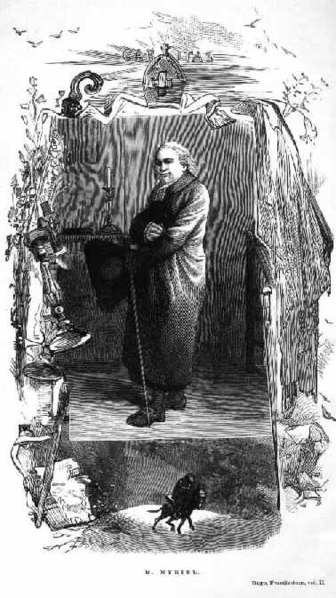
The engraving by Gustave Brion shows the Bishop of Digne – prepared for the first edition of Victor Hugo’s Les Miserables in 1886.

Risking self in learning

“Learning is not a process from which the learner can stand aloof, remaining fundamentally unchanged, as the possessor of her knowledge.  Rather, learning – if it is true learning – is a process in which the learner’s present understanding, her present configuration of desire, her present way of being in the world, are at stake. It is a process in which the learner’s relation to the object of her knowledge, and so everything that she has invested in the present form of the relationship, are placed at risk.  Yet the Gospel proclaims both that the learner must take such a risk with herself, and also that she is safe enough to take it.  Held by God’s lavish mercy, the learner is freed to take the risk of an ongoing kenosis that is the form of her journey deeper into God’s own knowledge, and the proper form of learning.”
This is the quote which comes as the PS in Friday Mailing. Friday Mailing is a useful compilation of resources for adult education produced by Joanna Cox and Tim Ling at the Education Division of the Church of England. (Contact Joanna Cox if you want to subscribe). This quote is from Mike Higton’s A Theology of Higher Education,  (OUP 2012), p 158. It applies to all disciples. (The book may be out of reach cost-wise. £71 at Amazon. OUCH).

Playing chess with God

chess

14th century poet Hafiz suggests two ways of playing God at chess.

What is the difference
Between your Existence
And that of a Saint?

The saint knows
That the spiritual path
Is a sublime chess game with God
And that the beloved
Has just made such a fantastic move
That the saint is now continually
Tripping over joy
And bursting out in laughter
And saying, “I Surrender!”

Whereas, my dear,
I am afraid you still think
You have a thousand serious moves.

Photo from Gabork

Preparing for responsible companionship

Theological perspectives have changed. Tonight I am meeting with our “Readers’ Council” to hear their concerns about their “Continuing Ministerial (Professional) Development”.These changes in theological perspective will be very much on my mind.

Reader ministry in the Church of England was “revived” in 1561 and in 1866 to minister in poorer parishes “destitute of an incumbent” and to cope with the population explosion in cities in the early 19th century. They had a different point of view from the clergy. The Bishop of Bangor (in 1894) saw the advantage of “Christian men who can bridge the gap between the different classes of society” – And the Dean of Manchester  recognised that most Readers were “more in unison with the masses with whom they mixed”. Although the Diocesan Readers came from the professions, the Parochial Readers were described as ‘the better educated from among the uneducated’. Nowadays Readers and clergy train together both before and after licensing and ordination. I have been ordained long enough to remember that this was not always so, and to remember that the idea that Readers and clergy could train together seemed preposterous. Now we take it for granted and appreciate the advantages of learning together.

This movement of theology is reflected in many of our traditions. From a Roman Catholic perspective, Ilia Delio traces the development of theology from the preserve of the priest in his academic study to a vast lay, creative and inter-disciplinary movement. This huge paradigm shift is dated back as recently as the 1970’s when only 5% of theologians were non-priests. That figure has grown to over 60%. Theological education is now well beyond the control of the institutional church. Diarmuid O’Murchu lists features of this shift in his book Adult Faith:

  1. Theology is no longer reserved to the academic domain.
  2. Theology has gone global, even beyond the boundaries acknowledged in multi-faith dialogue.
  3. Theology has become quite multi-disciplinary and interdisciplinary. “The contemporary lay theologian seeks to address the here-and-now of evolutionary creation … [casting] a wide net within a contextual landscape … [seeking] dialogue with partners in various fields of learning, transcending wherever possible the dualistic distinction between the sacred and the secular” (O’Murchu, p66f).
  4. Lay theologians do theology in a vastly different way from their clerical counterparts, who “prioritise the church, its traditions, teachings and expectations” (O’Murchu, p119)
  5. Christian theology has become radicalised as theologians “sought to realign Christian faith with one pervasive theme of the Christian Gospels: the New Reign of God”. (O’Murchu). Christian life is increasingly seen as “empowerment” and “called to be a counterculture to all forms of destructive power … facilitated not by some new benign form of hierarchical mediation, but by dynamic creative communities.” (O’Murchu).

For O’Murchu the “Kingdom of God” is “the companionship of empowerment” with theology being the “servant wisdom” of that companionship, so that “theology once more becomes a subversive dangerous memory, unambiguously committed to liberty from all oppressions and to empowerment for that fullness of life to which all creatures are called.” (O’Murchu, p65).

Theology has changed. In many traditions theology was thought to have been the preserve of the clergy. Readers and other lay ministers helped to open those boundaries, but their tendency remains to “prioritise the church, its traditions, teachings and expectations.” Now we increasingly realise that theology goes beyond the church (why has that taken so long?). Our shared “ministerial development” is to realise this, to overcome the tendency to prioritise the church and to engage with the “companionship of empowerment” wherever that is found.

No comment

royal exchange, london
In Leaving Alexandria Richard Holloway recalls Virginia Woolf’s tract Three Guineas  (originally published in 1937) in which she contrasts the private house (woman’s sphere) with public life (man’s sphere):

Your world then, the world of professional, of public life, seen from this angle, undoubtedly looks queer.

At first sight it is enormously impressive. Within a small space are crowded together St Paul’s, the Bank of England, the Mansion House, the massive if funereal battlements of the Law Courts: and on the other side, Westminster Abbey and the Houses of Parliament. There we say to ourselves, pausing, in this moment of transition on the bridge, our fathers and brothers have spent their lives. All these hundreds of years they have been mounting those steps, passing in and out of those doors, ascending those pulpits, preaching, money making, administering justice. It is from this world that the private house … has derived its creeds, its laws, its clothes and carpets, its beef and mutton. And then, as is now permissible, cautiously pushing aside the swing doors of one of these temples, we enter on tiptoe and survey the scene in greater detail.

The first sensation of colossal size, of majestic masonry is broken into a myriad points of amazement mixed with interrogation. Your clothes in the first place make us gape with astonishment. How many, how splendid, how extremely ornate they are – the clothes worn by the educated man in his public capacity! Now you dress in violet; a jewelled crucifix swings on your breast; now your shoulders are covered with lace; now furred with ermine; now slung with many linked chains set with precious stones. Now you wear wigs on your heads; rows of graduated curls descend your necks. Now your hats are boat-shaped, or cocked; now they mount in cones of black fur; now they are made of brass and scuttle-shaped; now plumes of red, now of blue hair surmount them. Sometimes gowns cover your legs; sometimes gaiters. Tabards embroidered with lions and unicorns swing from your shoulders; metal objects cut in star shapes or in circles glitter and twinkle upon your breasts. Ribbons of all colours – blue, purple, crimson – cross from shoulder to shoulder.

Even stranger, however, than the symbolic splendour of your clothes are the ceremonies that take place when you wear them. here you kneel; there you bow; here you advance in procession behind a man carrying a silver poker; here you mount a carved chair; here you appear to do homage to a piece of painted wood; here you abase yourselves before tables covered with richly worked tapestry. And whatever these ceremonies may mean you perform them always together, always in step, always in the uniform proper to the man and the occasion.

The photo is of the Royal Exchange in London by Synwell

About Grace

Do we know what it means to be struck by grace?

It does not mean that we suddenly believe that God exists, or that Jesus is the Saviour, or that the Bible contains the truth. Grace strikes us when we are in great pain and restlessness.

It strikes us when we walk through the dark valley of a meaningless and empty life. It strikes us when we feel that our separation is deeper than usual . . . It strikes us when our disgust for our own being, our indifference, our weakness, our hostility, and our lack of direction and composure have become intolerable to us. It strikes us when, year after year, the longed-for perfection of life does not appear, when the old compulsions reign within us as they have for decades, when despair destroys all joy and courage.

Paul Tillich.

quoted by Holloway, Richard (2012-03-01). Leaving Alexandria: A Memoir of Faith and Doubt (Kindle Locations 1668-1674). Canongate Books. Kindle Edition.

a little pure joy

Thanks to Simon Marsh for posting Sparkling WatersAs he says, “a little pure joy for the eyes and ears.” My own reflection, my play on the water, is filtered through questions of those who feel in the doldrums and those who can’t be still.

Stunningly beautiful,
fairly typical
reflecting water
reflecting life
never calm
playground
for light
sparkling, bubbling,
becoming.
Never still.
Only becalmed to the senseless, the dead.

Serious houses on serious earth

locked away
I am not one for visiting churches, but I do love to see a church that is open, rather than closed. There are various reasons why churches are closed (and communities deprived of what should be public spaces). Some are afraid of the security risks (even though, according to the Open Churches Trust churches that are open have a lower risk). Sometimes the gatekeepers are forbidding in their attitudes so people feel they have to be qualified to enter – the “good enough” test. At other times people have been priced out. I am delighted to see that the price barrier at Chester Cathedral has been dropped, and that the Cathedral is now open and free to enter.

In his book, Leaving Alexandria: a Memoir of faith and doubt, Richard Holloway speaks of his love of Old St Paul’s in Edinburgh, particularly when it was empty. Old St Paul’s is a church that is kept open so that people can drift in. Holloway has this to say:

Churches that stay open unclose themselves to the sorrows of humanity and alchemise them into consolation. And not a cheap consolation. Just as artists reconcile us to our ills by the way they notice and record them, so open churches console us by the way they accept the unreconciled aspects of our natures.

They are a haven for the homeless woman whose destitution is obvious, muttering to herself over there in the back pew; but they also accept the moral destitution of the confident man sitting in the dark chapel, gazing at the white star of the sanctuary lamp, heavy with the knowledge of the compulsions that have dominated his life and refuse to leave him.

There is no reproach. Churches do not speak; they listen. Clergy speak, unstoppably. They are ‘randy’ to change, challenge or shame people into successful living. Church buildings that stay open to all know better. They understand helplessness and the weariness of failure, and have for centuries absorbed them into the mercy of their silence. This is grace.

I like the story told by Jesus from the open “church”. It is the story of the Pharisee and the tax collector and their respective prayers in Luke 18:9-14. You’d expect the Pharisee to be “there”. He is the religious one, who spends his life “there” saying his prayers and paying his tithes. He would be an approved key-holder. It’s the other one, the “tax collector” who has stolen in because the place is open. His prayer is the prayer of the people, including the prayer of the destitute woman and morally destitute high achiever referred to by Holloway. The qualification for being a tax collector was to have money for bribes, and the willingness to bribe. These were the people prepared to do the dirty deeds of the day. The building hears his confession and the cornerstone reorders his life.

Two men went up to the temple to pray, one a Pharisee and the other a tax-collector. The Pharisee, standing by himself, was praying thus, “God, I thank you that I am not like other people; thieves, rogues, adulterers, or even like this tax-collector. I fast twice a week; I give a tenth of all my income.” But the tax-collector, standing far off, would not even look up to heaven, but was beating his breast and saying, “God be merciful to me, a sinner!” I tell you, this man went down to his home justified rather than the other.
Chester Cathedral, Chester
This photo, of Chester Cathedral, is by Xavier de Jauréguiberry.
The photo, “locked away” is by Kicki.

The title of this post is taken from the poem Church Going by Philip Larkin.