a thousand kisses deep

>


For lovers of Leonard Cohen, a “thousand kisses deep” is an amazing poem/song (song is here) measuring the relationship between lovers. What if it was used as a different sort of measure? Our knowledge of one another is superficially assessed within twenty seconds. Apparently – and worryingly – we are only right 70% of the time. 70% may sound first class but for the 30% misjudged, denied jobs, shut out that statistic can be disastrous.

Us clergy, ministers, community developers and planners come and go. Sensibly we audit our place before forming opinions – but the data is skewed by preconceptions and historic artefacts of superficial excavation. What if we went a thousand kisses deep?

Down into the passions, convictions, emotions of successive generation and regeneration we would go. On our cheeks the hot breath of passion and the tears of betrayal. Lips caressing disconsolate children, the embrace of neighbours in the face of disaster, the kiss for a bereaved friend for whom there are no words. Seamly and unseemly: love denied and love made – our findings from a thousand kisses deep. Mining, owning, knowing.

Ricky Yates helpfully reminds us of the great store we set by outward appearance, and our use of image consultants. We remember Hyacinth Bucket (Bouquet) in long-running TV comedy Keeping up Appearances. For her, attraction was but a surface veneer – with relationships barely a peck deep. But, as Ricky says, the Lord doesn’t look on the outside, but on the inside (Mark 7:15) – a thousand kisses deep, at least!

Post-Phone (get it?)

I rarely get letters now – apart from leaflets from the local pizzerias. There are days when the phone does not ring. Communication has changed very significantly and rapidly. We have moved from beacon to drum to messenger to post to phone to fax to email to facebook to …. We have moved from moorland track to canals to railtrack to the road to the by-pass to Runway 5. Our horizons have shifted from village to town to Spanish Costas to antipodean holidays and now interplanetary travel plans.

My own journey is from a 35 year ministry in parishes where my business was “to know and be known” to living more anonymously on a housing estate. I have been discovering what most people have long known. That is, that communication is minimal in neighbourhoods. We talk amiably as neighbours – though we don’t see much of one another because working hours are very different. Others are just “passers by”. When we go to the local shops (thank goodness we’ve got some) we pass by one another without recognising one another and realising that the common ground that we share.

Fortunately new communities are being constructed all the time. These are often communities of our own making – virtual communities which offer conviviality and new possibilities for relationship. Unfortunately we feel safer in our Facebook communities than we do in our own street (even though the stats say that crime is lower than it has been for years).

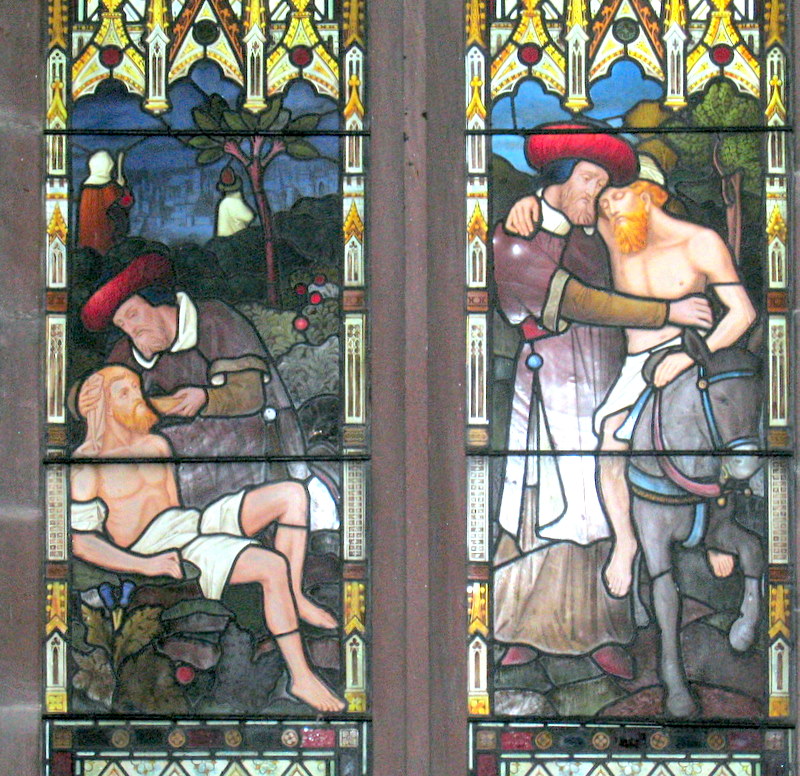
Good Samaritan window at Tarvin Church

Passers-by don’t get a good press in the gospels. The Good Samaritan was the exception to the general rule of passers-by when he went out of his way to help the victim. Peter Shaw, in Conversation Matters, reports on a discussion with Veronica who told him about the short conversations she had (she is a flight attendant). She explained that they were all trained to be cheerful, and to look people in the eye and smile. She was full of stories about conversations she had with footballing stars and leading politicians making the point that what mattered was not who they were, but the way they were. What sort of tone did they adopt? Did they smile? Were they cheerful? Did they say ‘thank you’?

I suppose these sort of short conversations prevent us from being just passers-by of one another. A “thank you” shows we appreciate the other person. A “good morning”  shows we’ve noticed. A “how are you” shows we care. Words get over our boundaries. Maybe communities are only built brick by brick and word by word.

Ethics of education

“When we deal with ethics in education (and often we ignore it altogether), we approach it as a matter of helping individuals develop standards for personal behaviour. Not only do we stress personal at the expense of communal ethics: deeper still, we ignore the fact that the presence, or absence of communal imagery at every level of teaching and learning can form, or deform, students for life in the world. We underestimate the hidden curriculum of ethics that is being taught in classrooms even – and perhaps especially – when ethics is not the formal topic.”

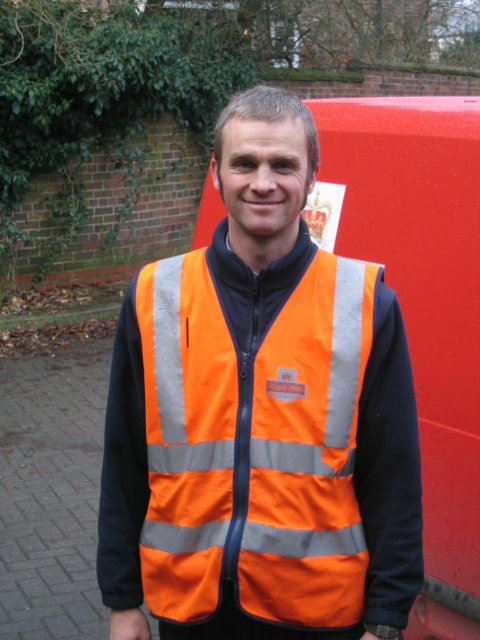
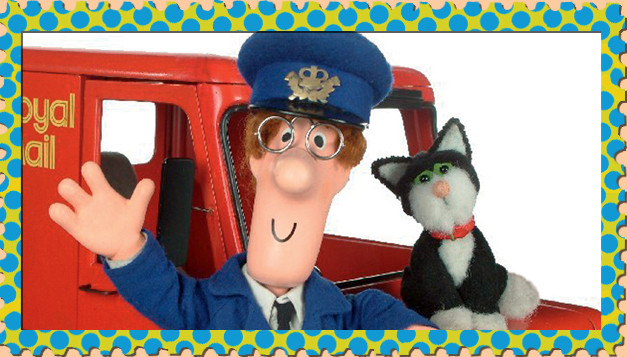
>Postman Chris

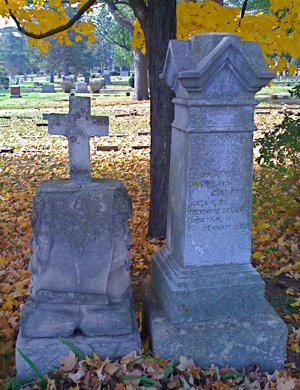
>Editing our parish magazine is a job I could do without – I’m not the sort of person who likes to devote hours to any one task. To make the job more satisfying I introduce a bit of impishness like copying this photo of some grave humour taken by Scott P Richert.

Part of the impishness was to inaugurate the monthly Editor’s Award. Past winners have included Tarvin Environment Group (“best new group” and “group with most promise”, to Jenny Wardle for capturing the essence of prayer in a bouquet, and a collective award for all those who are dis-regarded in their communities in spite of the integrity and service (“our communities would be much the porrer without them”)

This month’s award is for “cheerfulness” and is awarded to our village postman, Chris. I stopped him so I could take a photo of him and explained the reason. He was seriously (and cheerfully) overwhelmed – and shocked! I wonder why. Is it because he doesn’t regard himself as any different to anyone else? Is it because we rarely show appreciation? Is it because we are not used to prizing such qualities?

>Life Together

>
This is from a graphic novel of Bonhoeffer I found on bonhoefferblog.

Bonhoeffer wrote a book called Life Together laying down guidelines for communal living in the 20th century. He was a vehement opponent of the Third Reich. At a time when Nazi policy was to eliiminate the weakest (Jews, gays, gypsies, mentally ill et al) Bonhoeffer was arguing for small family-like units to protect the smallest and the weakest. He used the image of chain links as in this quote from Life Together:

In a Christian community, everything depends upon whether each individual is an indispensable link in a chain. Only when even the smallest link is securely interlocked is the chain unbreakable. A community which allows unemployed members to exist within it will perish because of them. It will be well, therefore, if every member receives a definite task to perform for the community, that he may know in hours of doubt that he, too, is not useless and unusable. Every Christian community must realize that not only do the weak need the strong, but also that the strong cannot exist without the weak. The elimination of the weak is the death of the fellowship.

While reflecting on this I have been reading The Boy in the Striped Pyjamas (film clip below). This is a very powerful – and very simple – story of two boys who strike up a friendship either side of the wire fence of Auschwitz. A different sort of story of Hitler’s Germany. Another story is told in the film Defiance – a film of four Jewish brothers from Poland who escape the Nazis to fight back to rescue fellow Jews – (on my list of films to see).

>Jubilee

>Morning Prayer today included the wonderful reading from Leviticus 25 outlining the teaching on Jubilee.

It’s green – recognisnng the rights of the land – every 7th year was to be a sabbath of complete rest for the land – a time for the land to sigh.

After 7 lots of 7 years – ie the year after the 49th, the 50th – “and you shall proclaim liberty throughout the land to all its inhabitants”. All capital transactions were to use the Jubilee as its basis. So if land was sold it was sold until the next Jubilee year with the land returning then to its original owner. The price for the sale was to be linked to the number of crops.

How amazing is that! In our country we talk about ‘old money’ and ‘new money’. We talk about the ‘landed gentry’ who are the beneficiaries of a capital system which knows of no Jubilee.

Is it surprising that there is no reference in the Bible to the Jubilee principle being put into practice? Of course it isn’t. Because in this world of ours people like to accumulate power (and property). We shouldn’t be surprised that vested interests prefer the status quo. The consequence is that inequality, oppression and poverty become systemic, and people become alienated. It also means there can never be Jubilee, because that is when liberty is procalimed throughout the land to all its inhabitants.

(This picture was taken by Jeanette)

I live in a village community which would be transformed by the Jubilee principle. Inheritance (particularly land) is an enormous issue within families and grievances stretch generations back. Fault lines are embedded in the fabric of community life. It’s not stereotypes that divide communities such as ours. It’s not race, gender or age – though they do paly a part. It’s who snubbed who three generations back, and which side people founght on in the war that counts (the Civil War I mean!)I suspect that when hurts are deeply embedded in the fabric of a community most people don’t even realise that they are there.

The Church is able to offer a breathing space – a place to untangle the past and space to take on enterprise with fresh partners and renewed relationships. The political realignment of the Jubilee principle may not be feasible but the life of the Church (the mission of God) show that the fault lines aren’t inevitable, and that alienation and division are short-lived – certainly less than 50 years. This sounds very idealistic doesn’t it? Why’s that?

Politics

Politics is not just a tiresome consequence of human shortcomings, it is an ongoing conversation about how to bring out and empower the ocean of different gifts and talents in a community. It is not about the limited money in people’s pockets, it is about the limitless potential in their hearts and minds and souls and bodies. It is about how to engage all the energy that is about, and how to discern and embody that which constitutes the goodl life. It may not always be happy, beautiful, or rich, but if a community can express such a notion of politics, it can experience a goodness that other communities, with their impoverished politics, can only envy.
Sam Wells: God’s Companions (2006) p169

Giving

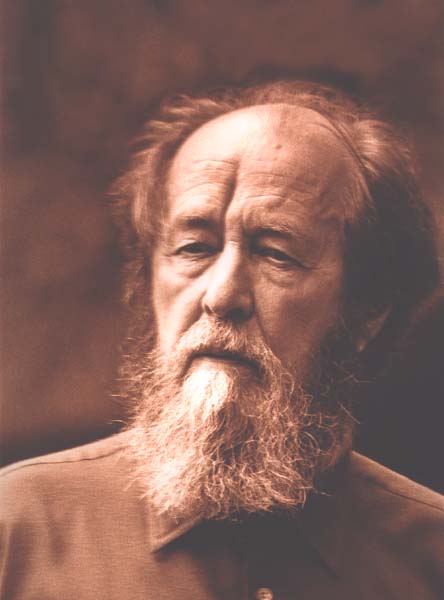
>Miroslav Volf refers to a story written by Alexander Solzhenitsyn in his book Free of Charge. That’s Solzhenitsyn’s picture.

In the story Matryona’s House an old woman “never tried to acquire things for herself. She wouldn’t struggle to buy things which would mean more to her than life itself. All her life she never tried to dress smartly in the kind of clothes which embellish cripples and disguise evildoers.” As the story unfolds she is misunderstood and abandoned, even by her husband. Six of her children die but she carries on giving.

“We all lived beside her”, Solzhenitsyn put in mouth of one of her fellow villagers, “and never understood that she was the righteous one without whom, according to the proverb, no village can stand. Nor any city. Nor our whole land.”

Volf comments a gift is an “event between people. Gifts serve “to create, nourish or re-create” social bonds.

I don’t think I am a good giver. According to Volf “ungracious and reluctant givers inspect the causes of a need and dole out the benefits in proportion to its legitimacy.” He refers to Nathan the Wise , a play by Lessing written in 1779, in which Sultan Saladin enlists a beggar to be his treasurer. The Sultan wanted to end begging by ensuring that beggars could afford not to beg. He wanted a beggar as his treasurer “because only a beggar knows how to give to beggars appropriately”. Of his previous treasurer Saladin said:”He gave so ungraciously when he gave; first inquired so vehemently into the situation of the receiver; never satisfied that he wa slacking, also wanted to know the cause of the lack, in order to measure the cause stingily against the offering.”

I wonder whether Christian teaching about giving has helped. Most sermons seem to be about persuading worshippers to hand over their cash to keep the show on the road. On the drain/radiator test, this sounds more like a drain and a far cry from God giving life to the world. (radiator!)

Faith

>
Miroslav Volf in Free of Charge (subtitled “Giving and Forgiving in a Culture Stripped of Grace” expands on the theme of God the Giver who continues to give in a world inclining towards “gracelessness”. He speaks of faith:

Faith is not something we give to God. In that case, faith would be a work, and a silly kind of work because it would be work we do even though it deosn’t benefit anyone. But exactly the opposite is true. To have faith in God is to be “without works” before God (Romans 4:5). Faith is the way we as receivers relate appropriately to God as the giver. It is empty hands held open for God to fill…. In contrast good works offered to God dishonour God; they tell a lie about God and our relation to the divine Giver, and they take away God’s due.

I remember David Lunn, on hearing of his appointment to be Bishop of Sheffield speaking of his surprise because he felt “he didn’t believe enough”. Who hasn’t thought that?
The faith that expresses itself with hands outstretched trustung God’s gifts is something of the heart. When I say something like “I’m not sure what I believe” part of that is to do with my head and perhaps is saying “there are loads of things I don’t understand”.
Being empty handed before God suddenly makes that not matter. There is nothing we can do to make God love us more, and there is nothing more we can say which will make him love us less. All we can give to God is delight or pain.
Rowan Williams likened the giving of God to the Niagara Falls. Love cascades to us – that’t the empty hands bit – but it’s only living water if we release the gifts to others. If we don’t the water stagnates and becomes poisonous.