This is where mercy takes her stand: far off, in the distance

Readings: Luke 18:9–14; Ecclesiasticus 35:12–17

The clocks have changed. The weather’s changed.
And we stand now on the bridge between seasons.

Today is the last Sunday after Trinity.
Next Sunday is the first in the new Kingdom season –
when we see the darkness of the kingdoms of this world,
and pray again for the world to be turned the right way up
with the rule of God’s Kingdom founded in heaven.

As the light shortens and we cross that bridge between seasons,
it feels right to pause and ask what endures –
what stands firm when the world tilts and turns.

And Jesus gives us this story;
a parable about where mercy truly stands.

This is where mercy takes her stand: far off, in the distance.

I want us to notice this morning
the two men Jesus talks about in the parable –
a story he addressed to some
who were confident of their own righteousness
and looked down on everyone else.

Notice how the Pharisee did what was expected of him,
just as he was supposed to,
obedient to the teachings of his religion.

He tithed and he fasted.
He did just what was right.
He was a religious success –
the sort of success to make a temple proud.

He stood confidently still,
as if he owned the place –
the temple where he was the perfect fit,

And he smugly gave thanks
that he wasn’t like the others:
robbers, evildoers, and adulterers.

In fact, he put himself first,
the best he could be,
better than all the rest,
better than the tax collector they all despised,
standing over there, at a distance.

He gave himself the prize,
he was the pride of the temple –
the one to catch the eye
of those like him on centre stage:
the success stories,
the ones who come first in their own eyes
and the eyes of the world,
those who are proud of their achievement,
who look down on those who can’t match them.

But he’s not the one who catches Jesus’ eye.
Mercy’s gaze has turned elsewhere.

This is where mercy takes her stand —
not in the proud posture of the Pharisee,
but with the one who stands at a distance,
head bowed, heart open,
praying only, “God, be merciful to me, a sinner.”

The tax collector hasn’t much to commend him.
He’s made a living making compromises,
lining his own pocket when he must,
doing the bidding of an empire,
taxing his people, cheating his people,
keeping them poor.

He too has come to pray.
He stands apart.
He knows he’s not fit
to join those who look down on him.
He knows the weight of those eyes
and their condemnation, surely justified.

But still he prays where he’s been pushed aside –
in that low place, in that honest place –
and he finds the only prayer he can manage:
“God, be merciful to me, a sinner.”

That’s all.

There are people good at praying, like the Pharisee.
It comes easy to them.

But this tax collector has nothing to claim.
He can’t make comparisons; he can’t claim to be good.
He has no list of good intentions.
All he has are these few words –
and that’s enough for Jesus.

Jesus has highlighted two men –
two types, one self-righteous and sure of himself,
the other “worse” by some distance.

There’s only one who goes home justified,
and it’s not the one we expected,
the one who thanks God he’s better than all the rest,
the one who thinks he’s the best he can be.

It’s the other one, the one on the edge,
the one in the distance, going home justified
(whatever “going home” might mean).

That’s quite some punchline from Jesus,
punching the pride of the temple,
and those confident in their own goodness,
who look down on everyone else.

“All who exalt themselves will be humbled,
and those who humble themselves will be exalted.”


That’s turning the world upside down,
and the truth inside out.

And it still happens today,
whenever we’re brave enough to look beyond ourselves.

There’s a man who sits under the bridge in our town.
I’ve passed him many times,
hesitating, not sure what to say,
worried about what it might cost to engage.
But this week, I stopped.
I’d found my opening line.
We talked.
He had plenty to say.
I found him articulate, intelligent, resilient,
unhealthy, unlucky.
I went away thankful.

I wasn’t thankful I wasn’t like him –
God forbid.
Rather, I was thankful that I am.
Thankful that mercy makes us kin,
that empathy builds bridges and common ground.

I had stood my distance – the shame was all mine.
The shame that it’s taken me so long
to learn how to join those down and those out.

This is where mercy takes her stand —
on the bridges, in the margins,
in the hearts of those who stand at a distance.

And maybe this is a small thing to notice,
but it strikes me that the Pharisee, in his way,
is saying what we so often hear today —
“I’m feeling blessed.”
Blessed that life’s gone well,
blessed that I’m not struggling,
blessed that I’m not like those who’ve fallen on hard times.
But the tax collector doesn’t say that.
He doesn’t feel blessed —
he only feels the weight of mercy.
And yet he’s the one who goes home justified,
seen, forgiven, restored.
Maybe that’s what blessing really looks like —
not success, but mercy meeting us
when we’ve nothing left to boast about.

Today is Bible Sunday,
a reminder that Scripture isn’t just something we read —
it’s something that reads us.
The Pharisee knew his Bible well,
but he used it to build himself up.
The tax collector may not have known a verse,
yet he lived the truth of one we’ve heard this morning:
“The prayer of the humble pierces the clouds” (Ecclesiasticus 35).
God’s Word lands where mercy already waits.

And that is what this parable shows us —
the way God’s kingdom comes:
not through pride or perfection,
but through mercy that stoops low
and finds us where we are.

For God sides with the penitent sinner,
with the humble, with the broken,
with those the world overlooks.
And when we begin to see as God sees —
when we recognise the brother under the bridge,
the sister on the edge —
we discover that the kingdom has already drawn near.

This is where mercy takes her stand:
far off, in the distance,
on the edge where humility meets hope,
and where God is already at work,
turning the world the right way up.

All who exalt themselves will be humbled,
and all who humble themselves will be exalted.
That’s not a threat.
That’s a promise.
That’s the way the world is set right.

Luke 18:9-14
To some who were confident of their own righteousness and looked down on everyone else, Jesus told this parable: ‘Two men went up to the temple to pray, one a Pharisee and the other a tax collector. The Pharisee stood by himself and prayed: “God, I thank you that I am not like other people – robbers, evildoers, adulterers – or even like this tax collector. I fast twice a week and give a tenth of all I get.”
‘But the tax collector stood at a distance. He would not even look up to heaven, but beat his breast and said, “God, have mercy on me, a sinner.”
‘I tell you that this man, rather than the other, went home justified before God. For all those who exalt themselves will be humbled, and those who humble themselves will be exalted.

Match of the Day

a poem marking the 80th anniversary of the ending of World War 2

Match of the Day cameras
focus their lenses on
young boys and their disappointments
in the closing minutes
in the dashing of hope.
The fingers on their hands
go to the bone
of the sockets of eyes
to prevent their tears
staining their faces.

After the match, so we’ve heard,
men will go home
and pass on their beating.

There are no cameras
for those beaten in war.

They’re all parading victors
their celebrations
their talk of living for peace.

How does it feel to be
a beaten people?
What would history tell us
if written by losers?

The shame is in defeat,
in losing everything
they’ve ever fought for,
for being on the wrong side
for allowing themselves to be misled,
for still breathing
and surviving
and wondering forever
if they fought hard enough,
or if survival
was its own betrayal.

They need new warriors
to help them fight again.

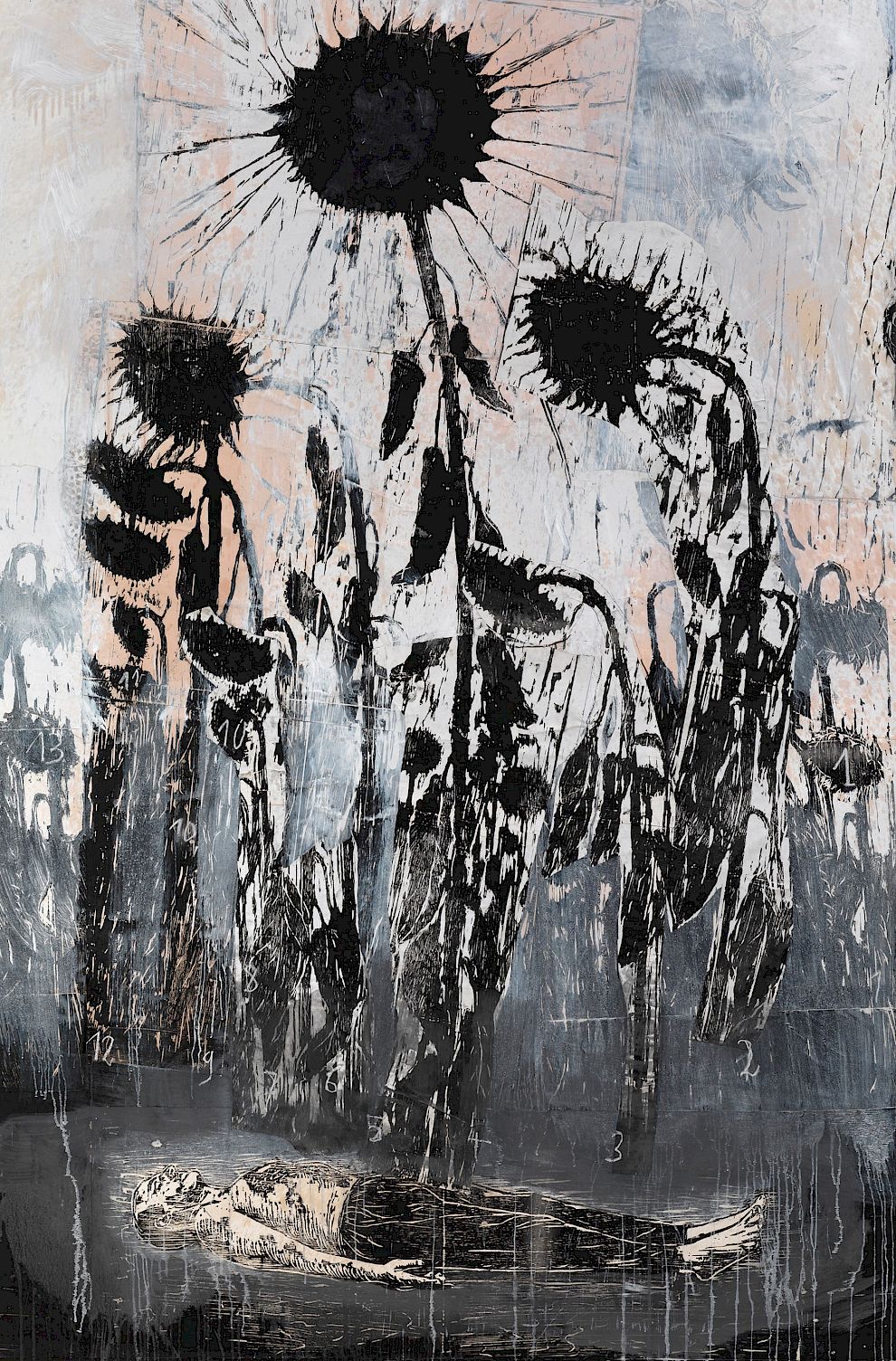
Kiefer had it,
the imagination
for a nation
down on its knees.

Following Vincent,
he painted the sunflower,
now bent and grey,
head shaking
stem hollowed,
shame-faced,
shaken to its core,
spilling the seed
of its future
watering the bloody earth
for a different
golden dawn.

September 2nd 2025
©DavidHerbert

God’s work in broken community

Reflecting on Paul’s call to order and Jesus’ manifesto in the readings for the day, 1 Corinthians 12:12-31a and Luke 4:14-21 for the 3rd Sunday of Epiphany (C) for two small congregations in a lively/lovely group of parishes in rural Warwickshire. This post includes a video of Bishop Mariann Edgar Budde discussing her sermon that made headlines following President Trump’s inauguration service.

January 26th 2025

First of all, a note. I normally get round the problem of God’s pronoun by  using the name of God instead of a pronoun.  But, here, I am going to need a pronoun. There are many objections to using “he/him” because the name God is then linked with power, privilege and patriarchy – and the language we use about God needs to set God free from such associations, particularly in these days of right wing nationalism popularised by men such as Trump, Putin, Musk and Netanyahu. So, for this sermon, when I need to resort to God’s pronouns it will be she/her. I hope you will understand why.

In a world where God’s name is often associated with power, control, and patriarchy, using ‘she/her’ reminds us that God transcends these human limitations and works to free us from systems that seek to dehumanize and divide. It is not an attempt to redefine God’s essence but to challenge our projections of power. Forever God gathers the lost, gives strength to those who are weak, and honour to those who have been shamed and ashamed.

In the midst of controversy Paul has this to say to the troubled, disjointed community of Corinth. “We were all baptised by one Spirit so as to form one body – whether Jews or Gentiles, slave or free”. Here was a community facing all sorts of problems with all sorts of differences. Paul reminds them what God does in the middle of such a community. She brings us together to form one body from the splinters and divisions. She gathers us from far and wide and makes of us one body whatever the differences between us.

Paul stands in the middle of the conflict and witnesses to what God does. He reminds the community of the abundance of God’s gifts and the value and diversity of each and every one of them for the purpose of community building and reconciliation, reminding the body around him that every member needs every other body to fully function. 

Perhaps Paul remembered the prophecy in the valley of dry bones – a valley of untold war crimes from which the bones of those killed were left out in the scorching sun for the wild animals to pick the meat from. The sound from this valley overshadowed in death was the noise of a disjointed people overwhelmed by tragedy. “Our bones are dried up, our hope is lost” is what they said. (Ezekiel 37:11). Those bones speak of a people abandoned, dehumanised and rendered invisible. In that valley Ezekiel was made to tell the truth about what God does, how she undoes the shame by breathing life into the very bones of a community destroyed, dismembered and left to rot.


This is what God does. Even as we walk through the valley of the shadow of death, God brings us together. From the four corners of the world, Jews and Gentiles, slave and free, God brings us together in love in spite of differences between us. The Spirit that breathes life into the valley of dry bones is the same Spirit Paul saw at work amongst the Corinthians and is the same Spirit that unites us as the body of Christ, knitting us together from the corners of the world, and overcoming shame, division, and death itself.

You see, God remembers us. She remembers bodies that are broken, whether that be in the valley of dry bones, or the valley overshadowed by death, or communities torn asunder. 

Remembering for God isn’t simply a case of casting her mind back, as we would usually remember. God’s remember is always a re-creation, a bringing back together of what’s become disjointed and scattered, and making whole what has become broken. God’s remembering is a literal re-membering of the body, the remaking of community through the gifts of her Spirit.

This is, if you like, another creation story – the coming together of a people through the creativity of God’s Spirit. The Spirit remembers us as one body – connecting toe bone to foot bone to ankle bone to leg bone to knee bone to thigh bone.

So Paul reminds the broken body around him that God has remembered them. God has remembered their broken body. “God has placed the parts in the body, every one of them” – just as she wanted them to be.

He goes on: “God has put the body together so that there should be no division in the body.” This is what God does and this is why God does it. God knits us together in love to be a strong body, a resilient body, a withstanding body, a body that can stand, even in the valley overshadowed by death.

This is what God does. She puts the body together.  

And this is what she does as a rule. She gives “greater honour to the parts that lacked it”. The rule of God is always to put the last and the least first. Here we see that rule being followed again with greater honour given to the parts that lacked it so that those parts which seemed weaker become indispensable and those parts thought less honourable are treated with special honour. This is how God remembers her people. This is what God builds a body for.

This is not just a spiritual gathering; this is a body meant for action. To be bound together by the Spirit is to be called into the work of justice, to bring good news to the poor, freedom to the prisoners, sight to the blind and liberation to the oppressed. This is the body God is building: a body that stands in stark contrast to the systems of division, hatred and shame that continue to pull our bodies apart.

We are the body God is building – here today listening to the body God prepared for us, listening to Jesus as he finds the body’s purpose revealed through the prophet Isiaiah to read to his fellow villagers in their synagogue in Nazareth.

The Spirit of the Lord is on me, because he has anointed me to proclaim good news to the poor. He has sent me to proclaim freedom for prisoners, and recovery of sight for the blind, to set the oppressed free, to proclaim the year of the Lord’s favour. 

Mariann Budde is a member of the body of Christ, gifted to be Bishop of Washington, president within a community God has brought together. It was her responsibility to preach at the prayer service in her cathedral. She preached the only way she could appealing to President Trump for mercy for those afraid because of the policies of the incoming president – those who are gay, lesbian or trans, and immigrants being targeted for deportation. Trump should not have been surprised by her appeal. She was only embodying the very work of the body of Christ. In a time when power is often wielded by shame and divide, the body of Christ cries out on behalf of the oppressed, the disempowered and broken. This is the DNA of the body of Christ. This is all God brings us together for. This is what we are gifted for. We can do no other.

Closing prayer

God of unity, you breathe life into us and call us to be one body in Christ. We thank you for the gifts you’ve placed within each of us, and we ask that you strengthen us as a community, that we may bear witness to your love. We pray for healing where there is division, for hope where there is despair, and for courage to stand with the broken and the oppressed. May your Spirit unite us in justice, peace, and compassion. In Jesus’ name, we pray. Amen.

We have nothing to prove and everything to love

Here’s a sermon for two rural churches in Warwickshire for the first Sunday in Lent. I’ve wondered whether Jesus only went into the wilderness for 40 days, or was his whole life there? Is wilderness a way to see “life”? The gospel for the day is Mark 1:9-15.

Catching my eye this week were these words of a benediction by Cole Arthur Riley; “May you rest in the immanence of your own worth, knowing you have nothing to prove and everything to love.”

Know you have nothing to prove and everything to love.

It’s the first Sunday of Lent and we’re just getting started. The question is, do we begin with shame, or do we begin with love? When/if we choose to give up chocolate or social media is it because it’s a shame we eat too much chocolate or spend too much time on social media? Do we begin with shame or do we begin with love?

Lent is the opportunity to intensify the awareness in our lives – our behaviours and the life around us. But do we begin with shame, or do we begin with love? Perhaps we begin with shame, and perhaps we begin again with love.

We are fond of thinking that Jesus went into the wilderness for 40 days – to be tempted by Satan. And that is what the gospels tell us. But were those 40 days an intensification of the wilderness experience which was to consume his whole life? The temptations didn’t stop after 40 days. The wild beasts didn’t go away – they bruised him, beat him and crucified him. They were hard times in a harsh and barren landscape – a lifetime in the wilderness. 

His 40 days in the wilderness with the wild beasts were part of his whole life in a wilderness with the wild beasts of empire and religious authority baying for his blood.

Our gospel tells us it began with love, not shame.

Mark gives the sequence of events – and his sequence is his version of “in the beginning”. Beginning the gospel, beginning the good news of Jesus Christ, the Son of God, Mark gives this sequence of events:

  1. First, John appeared in the wilderness, proclaiming a baptism of repentance, and crowds came out to the wilderness to be baptised by him.
  2. Jesus, from a backwater village in Galilee was one of them. Just as he came out of the water he saw the heavens torn apart and the Spirit descending like a dove on him, and a voice came from heaven, “You are my Son, the Beloved, with you I am well pleased.”
  3. Immediately the Spirit drove Jesus deeper into the wilderness
  4. Then John was arrested

The Spirit drove Jesus into the wilderness. It began with love. “You are my Son, the Beloved, with you I am well pleased.” He was driven into the wilderness by love ringing in his ears, giving him the resilience for devilish temptation and for a life with the beasts. 

And with love he walked the wilderness for the rest of his life, facing the wilder-ness of human nature and the be-wilderment of the victims of that wilder-ness and beastliness.

Resounding above all the voices of that wilder-ness, the beasts baying for his blood, the crowds shouting “crucify him”, the mockery – above all that din is the voice of heaven: “you are my Son, the Beloved, with you I am well pleased”, and the sound of the angels who waited on him in the wilderness, whose only sound is the sound of heaven and their lyric, “do not be afraid”.

The wilderness is our world too. We are in serious denial if we ignore the wilder-ness of our human nature and the beastliness that so many suffer: if we ignore the beasts that force themselves on us and the beasts that we entertain. 

Lent is our opportunity to intensify our awareness of the wilderness of our lives, to take stock of the wars around us, the greed that threatens us, the environment we’ve neglected, the injustice that is suffered, the emptiness of so much of life, the distance between us, and the isolation which is so much a feature of life. 

Life is wilderness. The wilderness is so much bigger than any of us can ever imagine – too big for our hearts and minds. We have a problem if we reduce Lent to a personal remedy for our over-use of social media or our over-indulgence of chocolate. Lent will have been a waste of time if all we do at the end is reach out for a Cadbury’s cream egg. The devil will have won big time then.

Just as it was the love shown to Jesus in his baptism that drove him into the wilderness, to love in the wilderness, to do wonders in the wilderness, so it can be the love shown to us in our baptism that drives us into the wilderness, into these 40 days, into the rest of our lives.

We’ve got nothing to prove and everything to love. The wilderness isn’t an easy place to be. Heaven knows we’ve suffered enough there already. The landscape is often bleak and unforgiving. We may be tested to our limits. We will take wrong turns. There will be complicated choices for which there are no easy answers. We will be be-wildered and bothered by the wilder-ness around us and within us

The wilderness isn’t easy. But it’s the only place to be – or, the only place to be is where love drives us, where God’s Spirit takes us. Just don’t make it a guilt trip. Don’t let shame take you there these 40 days, and into the rest of your lives. Let love take you.

From the beginning God brought love to the wilderness. That is clear to us when we open our scriptures. “In the beginning when God created the heavens and the earth, the earth was a formless void and darkness covered the face of the deep.” In other words there was nothing but wilderness and chaos – and a wind from God swept over the face of the waters, and he did wonders in that wilderness and chaos.

Similarly, at the beginning of Mark’s gospel, there are all the signs of wilderness and chaos – that is why the crowds came to John, for his baptism of repentance as a way through the wilderness and chaos they were facing. It is the Spirit of God which drove Jesus into the wilderness and chaos which has never gone away. It’s our wilderness, our chaos – and he begins with love.

When we are baptised, we are christened – becoming one in Christ, driven by love into wilderness. St Teresa of Avila gave us this blessing which will surely help us follow Jesus in his love into the wilderness, far from the easy life some of us may have been tempted to choose. It is the truth of our christening and being in Christ.

Christ has no body but yours, no hands, no feet on earth but yours.
Yours are the eyes with which he looks compassionately on this world.
Yours are the feet with which he walks to do good.
Yours are the hands, with which he blesses the world.
Yours are the hands.
Yours are the feet.
Yours are his eyes.
You are his body.
Christ has no body now but yours, no hands, no feet on earth but yours.
Yours are the eyes with which he looks compassionately on this world.
Christ has no body now on earth but yours.

Jesus began with love in the wilderness. We don’t need to begin with anything other than love. We don’t have anything to prove but we have everything to love.

Mark 1:9-15

In those days Jesus came from Nazareth of Galilee and was baptised by John in the Jordan. And just as he was coming up out of the water, he saw the heavens torn apart and the Spirit descending like a dove on him. And a voice came from heaven, ‘You are my Son, the Beloved; with you I am well pleased.’

And the Spirit immediately drove him out into the wilderness. He was in the wilderness for forty days, tempted by Satan; and he was with the wild beasts; and the angels waited on him.

Now after John was arrested, Jesus came to Galilee, proclaiming the good news of God, and saying, ‘The time is fulfilled, and the kingdom of God has come near; repent, and believe in the good news.’

Cole Arthur Riley’s book from which the opening benediction is taken is Black Liturgies, published in 2024 by Hodder and Stoughton

The shocking truth of my feet: a sermon for Maundy Thursday

We decided we wouldn’t stage a “foot-washing” as part of our service this evening.

If we had included a foot-washing I am sure that we would have prepared for it very well. We would have asked for volunteers last Sunday. Those volunteers will have made sure that their feet were in good shape for tonight. In other words, to save embarrassment, all would be well planned and totally expected.

Whereas in this evening’s gospel the foot washing comes as a total surprise to the disciples as we can see from Peter’s reaction. “Are you going to wash my feet? …. You will never wash my feet.”

In other words, we might miss the point of the gospel if we had staged a “foot-washing”.

This is a well known story. It’s a story that needs to be seen through Middle Eastern eyes because shoes and feet have very different meanings in the culture of Jesus, Peter and the Middle East (to this day).

I owe much to Ken Bailey for these insights. He has written a book called Jesus through Middle Eastern Eyes. Ken Bailey was brought up in the Middle East. He tells the story from his schooldays in an Egyptian boarding school when an American teacher threw a shoe at an Egyptian student because he wasn’t waking up. The student took it as an insult and reported it, and that resulted in the school being closed for two days. 

Shoes and feet are regarded as dirty and rude. Shoe and feet are four letter words in more senses than one. Some of those who hated Saddam Hussein and all he stood for pelted his fallen statue with their shoes as a way of registering their hatred and disgust. Shoes are shame. So those Saddam Hussein haters were in effect saying “shame on you” when they beat their shoes on the statue.

Worshippers leave their shoes outside the mosque when they go to pray because shoes are ritually unclean. They then bathe their feet and pray in long lines with the soles of their feet virtually in the face of those praying in the line behind them. 

Apparently you will be told to uncross your legs in some middle eastern churches – the reason being that you are bearing the sole of your shoe to others when you have your legs crossed, and that is considered rude and grossly disrespectful.

So perhaps you can see that performing a foot washing in any planned way tonight would scarcely be scratching the surface of what is going on in this passage.

The disciples didn’t have chance to pre-wash their feet, cut their nails or have a pedicure before Jesus was at their feet. Jesus got up from the table, took off his outer robe, and tied a towel around himself. He poured water into a basin and began to wash the disciples’ feet. Jesus takes the disciples by surprise and he is doing what no Jewish slave would be expected to do. Normally the Jewish slave would draw the water so that people could wash their own feet. 

This is humble service which would not have been expected from a servant. Jesus is going way above and beyond what a servant would do, and when he says to those who are disciples that he has set an example and that we should do as he has done for us. Jesus is not saying, “do for each other what is expected of service” – but go above and beyond what is expected.

This is a demonstration of costly, unexpected love.

It is no wonder that Jesus said to them “You do not know what I am doing, but later you will understand.” That is because it is all about tomorrow, Good Friday, and the costly, unexpected love which gives itself utterly and to the end by dying for us on the cross. 

As well as being the perfect sacrifice, Jesus is also the scapegoat. He is the scapegoat to end all scapegoats, taking on all the iniquities, all the transgressions, all the sins of the people of Israel, of the people of his church – making atonement and addressing all that shames us. That’s tomorrow. But we can see tomorrow today in Jesus’ demonstration of unexpected, costly love in the washing of the disciples’ feet.

Jesus’ behaviour would have been troubling for the disciples. He was doing what he wasn’t supposed to be doing. He was transgressing the cultural boundaries between clean and unclean. It’s Peter who expresses their concern when he tells Jesus “You will never wash my feet”. That wasn’t because Peter was embarrassed by the state of his feet but because his Lord and Teacher was stooping so low to attend to something so very shameful..

But Jesus insists, while still leaving the choice with Peter. “Unless I wash you, you have no part with me”. To be part with Jesus is about being part of the body of Christ and about being part of his mission and church. To have no part with Jesus is about the inevitable distance that would grow between Peter and Jesus if Peter doesn’t accept the shame that Jesus has taken in hand in the footwashing and events of tomorrow, Good Friday.

There is, of course, an elephant in the room. 

The elephant is Judas. Jesus washes Judas’s feet as well.
He knows that Judas hasn’t come clean and has already betrayed him.
But still Jesus washes Judas’s feet in the same demonstration of costly, unexpected love.
These are not the beautified feet of the ones who bring good news.
These are the feet which will march off to the Roman authorities and lead them to the Garden of Gethsemane so that he can point Jesus out to them.
Being good was not the qualification for having their feet washed. Being good enough has nothing to do with it. It is nothing to do with being Goody Goody Two Shoes.

Our shame is in all that we conceal and in the act of concealment and hiding. 

This is what we’re like and what we’ve always been like, ever since Adam and Eve discovered their private parts and hid them behind fig leaves, and Adam went into hiding from God. 

The shame, its concealment, our feet, our shoes is what Jesus takes in hand in tonight’s gospel and in the goodness of tomorrow. We will only be part of Jesus and all he dies for and lives for if we allow him to stoop as low as we go, to the ground of our being and the soles of our feet to take our shame in hand.

On this night, when the moon was full, Jesus gave us a new commandment – to love one another. “Just as I have loved, you also should love one another.” In that room those first disciples had seen how Jesus loved them through an unexpected and shocking act of footwashing that took shame in hand with love. 

All of this happened in one room – with the disciples. The example of footwashing and the commandment to love became theirs to follow. 

What happens next, in the Garden, on this night of the full moon, highlights the disciples’ failures. They fail to keep watch with Jesus. They went to sleep, they scattered, one denied him, another betrayed him. 

None of us are good enough a-part from Jesus. It is by being a part of him that we become good enough. We are bad enough that we need Jesus to stoop so shockingly low to us to deal with our shame. We are bad enough that we need that new commandment of Jesus – to deal with our shame by loving one another.

The only way to deal with shame, with shame as old as time is with costly love. And the only way to be part of Jesus is to love the way Jesus deals with shame.

Reference:
Ken Bailey, 2007, Jesus through Middle Eastern Eyes : Cultural Studies in the Gospels

PS. I’m wanting to also work in the idea that our feet turn once we are part of Jesus. Then our feet become beautiful. “How beautiful on the mountains are the feet of those who bring good news, who proclaim peace …” (Isaiah 52:7)

Rags – a poem by Caroline Bird

This poem by young British poet and playwright Caroline Bird has more than a whiff of Pentecost about it. Caroline Bird was born in 1986. Already she has had five collections of poetry published. This poem is from her latest collection In These Days of Prohibition (Carcanet, 2017).

Rags

When love comes through
the vents, you press wet rags against
the grill, lest you are smoked out
of your loneliness, you tape egg boxes
to your ears so you can’t hear
the hissing, you swathe yourself
in shame like vinegar
and brown paper. At sundown,
you gather up the rags
and press them to your face
like the dress of a lover, hoping for
a slight effect, the remnants of a rush –
not enough to change your mind – just
enough to pacify the night.

Yes, I’ve done all that. And now I am full of questions.

How do we make the most of love?
How do we make the most of every minute of love?
What do we do about our preoccupations and those things which make us unprepared for love?
How dare we hope for love and remain openminded to recognise love?
How do we avoid leaving it all too late?
How can we let love do her work in us and through us?

Kintsugi, the art of scars and the value of repair

kintsugi2Things break. We break things. We break. But what do we do with the pieces?
When I have broken things I have sometimes pretended it’s never happened (playing the innocent) or I have hidden the evidence. When I’ve broken I have pretended it’s never happened, or I have hidden the shame. This is shocking dishonesty.

The prophet Jeremiah knew a thing or two about brokenness and shame. The broken thing he had his eye on was the nation itself. He came to see hope in brokenness – not shame – by studying the work of a potter. The potter was making a vessel of clay and it was spoiled in the making. Instead the potter reworked it into another vessel “as seemed good to him”. He heard God say, “can I not do as this potter has done?”

There is another school of pottery which makes something of broken pieces. This is Kintsugi. Kintsugi is known as “golden joinery” because of the method of using gold dust to mend the broken pieces. The repairs themselves become the work of art. While we might be tempted to use superglue to mend a broken ornament and then turn the damage to the wall, Kintsugi works in a different way. The repair is brazen and flaunted. The breakage gives the object a story and the object becomes more valuable than it ever was before.

The Japanese art of Kintsugi has given rise to a philosophy and metaphor for life. Also known as the “art of scars” it signals a way for us to value what is broken in our lives and to celebrate what has re-paired us.

We can look at the broken pieces of our society. Those broken pieces all have labels to identify one piece from another, and we continue to break into new pieces. We’ve got new labels, more broken pieces with Leavers/Remainers. They go along with more worn labels such as Workers/Shirkers, Gay/Straight, Black/White, North/South, Red/Blue etc etc. I like the suggestion that prayer is like the gold dust of Kintsugi – when we pray we seek to make a-mends and pray for repair and reconciliation. The putting together of the pieces is the answer to that prayer.

Kintsugi is one art of scars. Writing this as we come into Holy Week I am conscious that Christianity too is the art of scars – though crimson rather than gold. Brokenness is taken with utmost seriousness. All the repair work and the reconciliations stand proud as witnesses. Repaired brokenness makes us more precious and valuable than ever.

PS. Here’s more about the spirituality of mending by Laura Everett

PPS. #Visiblemending is trending on Twitter

PPPS. Mending is seen as practice for “tikkun olam” – for the “mending of the world”

Sunflowers weeping

kiefer_hortus_conclusus.990x0

The sunflowers weep. Anselm Kiefer has done several paintings of sunflowers. He was born in 1945 in Germany, two months before the end of the war. It is hard to imagine the state of mind of the German nation at that time – on the edge of a shameful defeat, confronting the horrors of their totalitarian regime and, of course, the Holocaust. How does a society ever recover from sinking that abysmally low?

Anselm Kiefer has been determined to confront  his culture’s dark past. Here, the sunflower weeps. The sunflower looks so different in Kiefer’s work to the glory of its portrayal by Van Gogh. In Kiefer’s work, the sunflower stands for the national shame. Once proud and tall, the sunflower hangs its head in shame and disgrace – and weeps.

We can see the tears falling – they are the sunflowers going to seed. The seed is watering the earth for a new cycle of life – for a better season.

I was hoping to use this picture in a sermon – (particularly appropriate for Holocaust Memorial Day). I asked myself, “is Kiefer a Christian?”. Then I thought, “what is the point of that question?”, and “what an ugly question to be asking”. In that question there is a “as opposed to what?” – as in “if he is not a Christian then what is he?”. It becomes “Is he a Christian – (as opposed to a Jew)?” See what I mean. It’s an ugly question, particularly on Holocaust Memorial Day.

Kiefer is an artist in the business of lament and hope. There are plenty of others – largely inspired by the Jewish artists and prophets of the Hebrew scriptures.

The Negative Spaces We Forget

I didn’t know what “negative space” was until I joined an art class and discovered just how important negative space is. Negative space is the space that surrounds an object in an image. Negative space helps to define the boundaries of positive space and brings balance to a composition.

We highlight what we do. In conversations we talk about what we do, showing some things, hiding others. In our work meetings we report on what we are doing. But what is going on in the negative spaces? Do we get asked to share what we are conscious of not doing? What are the things that lie in the shadow of those things we highlight? What about those things we don’t have time for, or can’t find time for? What happens when we scrutinise the composition of our negative space?

When I think of my own negative space I am conscious of the thinking, the theology, the sharing I could be doing but can’t because of a mixture of my laziness and my preoccupation with other things. I also become conscious of the people I have forgotten and who have receded into the shadows, the neighbours I should know, the circumstances I should understand and empathise with.

It is not a pretty picture. Like many in pastoral ministry I am sure that I failed to take account of negative space. It was the people in front of me who got my attention – those who could talk, those who could demand a hearing. It was the people who were privileged enough, well enough to walk the same streets as me. The assumption was made that if you didn’t see someone they were OK. So we judged how well bereaved were coping from what we saw – the evidence before our eyes, sometimes forgetting that the very reason we don’t see some people is because they are hiding (or being hidden), because they are not well enough to be “out”, because they don’t want to be a burden or because they are shamed by a society that only seems to know positive space.

We forget that positive space is a privileged space, a space for those who are able to stand proud. Negative space, on the other hand, is a much larger space – a pit of not knowing, ignored and forgotten by those who don’t occupy such space. In the dazzle of positive space it is easy to forget God’s light shines in darkness. It is easy to forget that there is much love in that negative space.

The image of The Bomb, is by Israeli artist Noma Bar