From the Riverbank

– Sister Itchen and the River of Life
A sermon for Harvest Festival at St Lawrence’s Napton, inspired by St Francis’s Canticle of the Creatures, the Warwickshire River Itchen, artist Stephen Broadbent’s River of Life sculpture in Warrington, the writing of Robert Macfarlane and the indigenous wisdom represented by Robin Wall Kimmerer. It’s a thanksgiving for the quiet grace that still flows through creation, and a reminder that we are family with all that lives.


We are brothers and sisters together,
one family, caring for one another.
It’s 800 years this year since St Francis highlighted the interdependence of all things that have life,
and I thought it would be appropriate to have Francis helping us in our Harvest thanksgiving,
when we give thanks for the fruits of God’s creation.

Today we praise God for his creation,
for the nature given to us.

We would be mistaken to think we praise God alone.
For Francis, all creation sings God’s praise —
our whole family: Brothers Sun, Wind and Fire,
Sisters Moon and Water.

If St Francis had walked here,
I think he would have sung of Brother Itchen
the river that rises at Wormleighton and flows its way
past Priors Hardwick through here in Napton.

It seeps quietly through our fields,
watering crops and feeding wildlife,
joining its voice to the River Leam and the Avon beyond.

It’s not a mighty river like the Jordan or the Nile,
but a patient, life-giving one —
a reminder that the grace of God often flows quietly,
unnoticed, yet sustaining everything around it.

Robert Macfarlane asks in a book I’m reading,
“Is a river alive?”
I think the Itchen would answer yes.
It breathes, moves, nourishes —
and if we listen carefully, we can almost hear it praise.

Other songs of the church treasures spell this interdependence of praise out in more detail.
The Benedicite calls
the sun, moon and stars,
every shower of rain and fall of dew,
all winds, and fire and heat,
winter and summer,
the chill and cold,
frost and cold, ice and sleet,
mountains and hills,
everything that grows upon the earth,
springs of water, seas and streams,
whales and everything that moves in the water,
all the birds of the air, the beasts of the wild,
flocks and herds, men and women
all to praise and glorify God,
alongside those of upright spirit,
those who are holy and humble in heart.

Psalm 148 is a call to worship
for the angels, the sun, the moon and stars of light,
for the waters, sea monsters and all deeps,
for fire and hail, snow and mist,
for mountains and hills, fruit trees and cedars,
wild beasts, all cattle, creeping things, birds,
kings of the earth and all people,
men and women, boys and girls
to worship and praise together.

The prophet, Isaiah, anticipated the joy of creation.
He saw the mountains and the hills bursting into song
and the trees of the field clapping their hands.

And, of course, we know that the hills are alive with the sound of music.

This is ancient wisdom that is treasured in many indigenous cultures
but which has been forgotten over the years.
We forget we are called to worship with the whole of creation
and we presume we worship alone — homo sapiens.

Is that why our family ties with the rest of nature have broken?
We’ve stopped caring as brothers and sisters.
Instead, we’ve used our dominance for exploitation of our brothers and sisters.

Robert Macfarlane asks in a book I’m reading (and heartily recommend),
“Is a river alive?”
“Is a river alive?”
I think the Itchen would answer yes.
She breathes, she moves, she nourishes —
and if we listen carefully, we can almost hear her praise.

That same living flow runs through the Bible —
through the river that rises in Eden, watering the garden,
through the waters that break open in the desert,
through the River of Life that Ezekiel and John both saw,
flowing from the throne of God,
their trees bearing fruit each month,
and their leaves for the healing of the nations.

The artist Stephen Broadbent knows something of that healing power.
His River of Life sculpture in Warrington
was created after two boys were killed by a terrorist bomb there in 1993.
In that place of loss and grief,
Stephen imagined a river of life flowing through the heart of the town —
a river that gathers up pain and turns it into hope.

The bronze figures he shaped seem to rise from the water itself.
They are imprinted with the hands of children,
contemporaries of the boys killed,
their hands open in welcome and peace.

By the river are the leaves of trees – 12 of them,
one for each month of the year,
a monthly reminder that the river and her trees
are there for all time, even the worst of times,
always remembering, healing and renewing life.

That is what God’s river does —
whether in scripture, in the heart of a town like Warrington,
or in the quiet fields of Warwickshire.
She carries life wherever she goes.
She invites us to join her flow —
to live as people of blessing, healing, and renewal.

I’ve got an allotment this year.
I see something of that same grace there.

An allotment teaches you that nothing is wasted.
Weeds go on the compost, scraps rot down into soil,
and what looks like death becomes food for life.

The tiniest seed, almost too small to hold,
can multiply into a hundredfold abundance.
And if you care for the soil, safeguard the earth,
you discover her astonishing energy for renewal.

It changes the way you look at things.
You learn the value of everything,
you learn to work with the grain of creation, not against it.
And you discover joy in being part of that family again —
brother soil, sister seed, mother earth,
working alongside us in God’s garden.

So today, at Harvest, our thanksgiving is not a private prayer.
It is part of a chorus with the sun, the moon, the wind, the water —
with rivers that sing and trees that clap their hands,
with a creation that still waits for healing,
yet never stops praising.

St Francis knew it 800 years ago.
The Bible has sung it for thousands of years.
Artists and poets remind us in scarred places.
And even the humble allotment teaches us:
we are family with all creation.

Our calling is to live as grateful brothers and sisters,
giving thanks, safeguarding the earth,
and letting the river of life flow through us
for the healing of the world

A Call to Worship and Defiance

A sermon for Trinity Sunday.

I love preaching that brings Scripture to life and that brings Scripture back to life, and I hope you do too. I begin this way as a reminder that when we open scripture together we are not just reading words from the past; we are bringing it back to life. What matters today is what happens to us when we worship God.

I take us back to the words of Mary, and the words Jesus would have heard her sing, and the song which has become a heritage track for Christians down the ages: 

My soul does magnify the Lord, and my spirit rejoices in God my Saviour,
for he has seen the lowliness of his handmaiden.
He that is mighty has magnified me and holy is his name.
He has shown strength with his arm, scattering the proud in the imagination of their hearts.
He has put down the mighty from their seat and has lifted up the humble and meek.
He has filled the hungry with good things and sent the rich away empty.

When we worship, we join Mary – and every other worshipper – in magnifying the Lord, until the name of God takes on a rich texture full of the meaning of life.

There are those who take the name of God in vain—using it without meaning, without reverence, without love. “Jesus Christ” is what they sday when they hit their thumb with the hammer. “God Almighty” – but not to worship, only to swear.

But when we magnify the name of God in worship, we are not just saying it louder—we are seeing it deeper. And what comes into view is the mystery at the heart of God: not a solitary ruler, but a communion of persons—Father, Son, and Holy Spirit.

When we worship God, we magnify God until we see God in three persons: Father, Son and Holy Spirit, perfectly united in love and purpose – a community of love giving everything for the sake of the world. —a community revealing the nature of relationships and the purpose of love and being alive for others.

What the magnification reveals to the worshipper remains hidden to those who never stop to magnify: the relational depth of God, the joy of divine communion, the living mystery of Father, Son, and Spirit, woven into the very fabric of creation.

When we join this worshiping community we join in this magnifying – seeing more, knowing deeper, loving wider.
We don’t change the size of God but through magnifying we begin to see God in the smallest things: in the still, small voice of calm; in the broken bread; in the least, the last, the lost.

The magnification of the Lord is an act of defiance.

When we magnify the Lord, when we consider the heavens, the work of his fingers, when we realise that we are the ones sought after by God, when we know our place in the created order – no more than a little lower than the angels, then we realise our responsibility for all creatures: animals, birds, fish and the very state of our oceans.

We are responsible for the state of things.
And when things fall apart, it’s not because God has forgotten us- but because we have forgotten who we are.
Made a little lower than the angels, yes – but crowned with glory and honour, and called to care.

There is a call to worship, to give worth to God, to magnify the Lord.
It is a call to wake ourselves to the beauty of a God who is Father, Son and Spirit, Creator, Wisdom and Breath of life.

Worship is a defiance of our worst selves and a remembrance of our true vocation: the call of God which crowns us with glory and honour and calls us beloved.

And it is an act of defiance against those who disrupt and spoil the very nature of human being, being human – those who abuse and neglect their neighbour and their responsibility for all that God has made.

Our worship is defiance.
According to the Psalmist, even the praise that comes from the mouths of babes at the breast becomes part of the stronghold of God –
the strong hold of God on the world – against the enemy and the forces of chaos and destruction.

And our worship is God’s creation.
Our worship would be empty, foolish and mis-directed were it not for the fact of God’s majesty – if not for the fact that there is something – Someone – worthy of magnification. Our worship is a consequence of the worth of God, when we magnify the Lord.

That’s Psalm 8: awe and vocation, majesty and meaning.

But now we listen for another voice—one that calls not from the stars, but from the street where the paths meet.
In Proverbs 8, Wisdom raises her voice.
She calls out at the crossroads, beside the gates, where life happens. And her voice is not new.

She was there from the beginning—before the mountains were shaped, before the depth of the oceans was established.

Wisdom is the voice of God’s delight—
the artisan at the Creator’s side, rejoicing always, delighting in the world, delighting in us.

Christians have long heard here the echo of the Son, the Word through whom all things were made.
And the Spirit – Hovering, present, giving breath.

This is the dance of Proverbs 8: not a cold blueprint for the universe, but a joyful choreography of divine relationship.
This is Trinity: not abstract doctrine, but the lived heartbeat of God – Creator, Word, and Breath in motion, in joy, in love.

Wisdom’s call is a call to worship.
This has always been her call, from the very beginning, when the world came to be – because as soon as the world came to be, there was the need to defy our worst selves, to resist the enemies of God,
and to magnify God until we see God –
not as remote, above the heavens, pie in the sky –
but as here and now, a stronghold of love, poured out from the whole being of God.

And so, like Mary,
our souls magnify the Lord.
Not because we make God larger,
but because in worship, we finally see.

A Saviour Stitched to a Star

moravian starThe Feast of Epiphany – when wise ones followed a star, seeing in it the shape of things to come.

Poet Mary Karr stitches crucifixion and resurrection to a star (not her words) in a poem called Descending Theology: The Resurrection. I wonder if it is that same star, and I wonder whether the wise ones saw the shape of things to come in the star they followed.

I have stitched Mary Karr’s poem to a particular image of the star of Bethlehem. It is particularly three dimensional, with a reach not just from east to west, but in all directions – to all the nations. (In fact, it has 26 points – that makes a full alphabet for me.)

The poem:

From the star points of his pinned extremities,
cold inched in – the black ice and squid ink –
till the hung flesh was empty.
Lonely even in that void even for pain,
he missed his splintered feet,
the human stare buried in his face.
He ached for two hands made of meat
he could reach to the end of.
In the corpse’s core, the stone fist
of his heart began to bang
on the stiff chest’s door, and breath spilled
back into that battered shape. Now

it’s your limbs he comes to fill, as warm water
shatters at birth, rivering every way.

If you liked this poem you might also like Descending Theology: The Nativity, also by Mary Karr. There’s an interview with Mary Karr by Krista Tippett here. Here’s how to get instructions to make a Moravian star (as pictured).

Take a look at this poor, wise man: reflecting on Ecclesiastes 9

img_0012
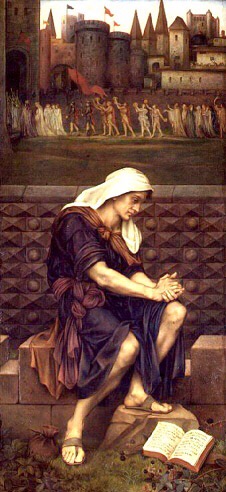
The Poor Man who Saved the City by Evelyn de Morgan (1901)

Like Qoheleth I am rather taken by the poor man in the city. It was a small city with only a few inhabitants. It was besieged but there was one man, a poor and wise man, who, by his wisdom delivered the city.

Not a lot of people know this man. He’s not someone I’ve ever noticed before, but he is there, highlighted in one of the less read books of the Old Testament, Ecclesiastes 9:14f. He doesn’t have a name. His story is told in not so many words:

There was a little city with few people in it. A great king came against it and besieged it, building great siegeworks against it. Now there was found in it a poor, wise man, and he by his wisdom delivered the city.

Like Qoheleth (the Teacher), I want to honour this man and the poor, wise men and women like him, who save their cities (our cities) from destruction by greed, speed and countless other destabilising and dehumanising forces. They are the salt of the earth, far removed from what we refer to as the typical “city gent”. We know he is not well-heeled and we know that he is care-worn (because his wisdom is forged from the attention and care he gives – and that is demanded of him in the challenge of just managing). These are the people we can turn to in times of trouble. They will hear us out, they will offer their wisdom. They become the heart (anagram of earth) of our communities and the springboards to trust and confidence.

But they are so often overlooked. This man reminds me of R.S.Thomas’s “friend”, Iago Prytherch – another man who would have gone unnoticed were it not for Thomas drawing him to our attention. Prytherch is down to earth, hard-working, more peasant than citizen, with an earthly wisdom. Thomas writes in Green Categories:

You never heard of Kant, did you Prytherch?
A strange man! What would he have said
Of your life here, free from the remote
War of antinomies: free also
From mind’s uncertainty faced with a world
Of its own making?
Here all is sure:
Things exist rooted in the flesh,
Stone, tree and flower. Even while you sleep
In your low room, the dark moor exerts
Its pressures on the timbers. Space and time
Are not the mathematics that your will
Imposes, but a green calendar
Your hearts observes; how else could you
Find your way home or know when to die
With the slow patience of the men who raised
This landmark in the moor’s deep tides?

His logic would have failed; your mind too.
Exposed suddenly to the cold wind
Of genius, faltered. Yet at night together
In your small garden, fenced from the wild moor’s
Constant aggression, you could have been at one
Sharing your faith over a star’s blue fire.

I don’t want to say that this man is Christ (because that might prevent us celebrating the ordinary people in ordinary places using their hard won wisdom for the welfare of the city), but I do want to say that man is Christ-like, and that Jesus too was poor and saves the city.

These are the people who are blessed. That is not an idle saying of Jesus (Luke 6:20). The blessing has substance and content, including wisdom that bears so much fruit. These are the people we hear praying in the Psalms. I think Isaiah is talking of a similar poor man in the city when he writes:

He will not cry or lift up his voice,
or make it heard in the street;
a bruised reed he will not break,
and a dimly burning wick he will not quench;
he will faithfully bring forth justice. (Isaiah 42:2f)

I want to remember that poor man and those men and women like him. Qoheleth writes, “No one remembered that poor man … the poor man’s wisdom is despised, and his words are not heeded.” He continues,

The quiet words of the wise are more to be heeded
than the shouting of a ruler among fools (Ecclesiastes 9:17)

But that is the world’s way – to be taken in by the vanities of the rich and powerful. We remember them (we name estates and prizes after them) and forget the poor (and the wisdom of their deep knowledge) – that’s if we ever notice them in the first place.

The Poor Man who Saved the City by Evelyn de Morgan is © De Morgan Collection, courtesy of the De Morgan Foundation, www.demorgan.org.uk

To Blog or Not – that is the question

linda-and-mary-blogger

Dear Linda and Mary (I’ve changed your names)

I was interested by your question, whether to blog or not. I thought I’d use a blog post to respond. It might seem less personal than an email response, or over the desk conversation, but others might be able to eavesdrop on this conversation if I blog in answer to your question. (And that is just one of the advantages of blogging.)

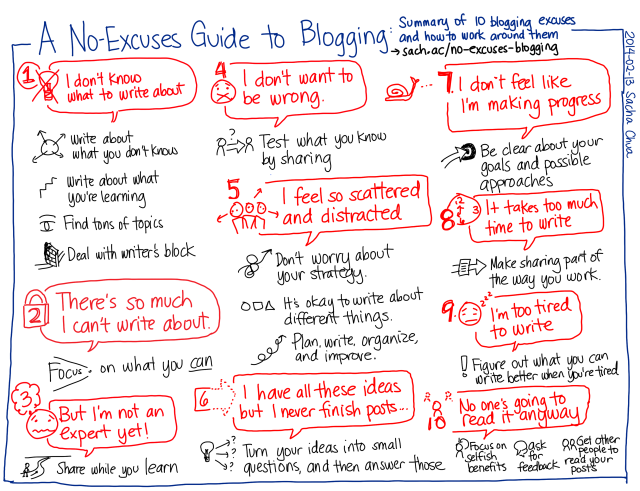
I have hit a brick wall with my blogging recently. I had thought that those who were posting had become more “expert” about their content. That was off-putting and intimidating. That might just have been an excuse I was using because I wasn’t finding the time for blogging (and I didn’t seem to have any inspiration). Here’s a summary of excuses I could have used (and being able to make these links is another advantage of blogging).

But your question has caused me to re-think.

You will notice from blogs you’ve read that there is a lot of learning contained in people’s posts. There is a lot of expertise on technical matters, as, for example, in this post on how to set up a blog (which you may find useful). But then, you really don’t have to be an expert to blog. I regard my blog as a memory bank – a jog for my memory and a way of reflecting on what I notice. It’s a workbench on which I can hammer out a few ideas. They’ll never be finished or finely polished, but I am learning and the blog is a useful place to put some of that learning.

I also don’t see any point in keeping things to myself. I do have a heart for some things and I do have a voice which is not to be kept silent, in spite of my introverted nature. I don’t believe that any of us should hide our light under a bushel (particularly in dark times) and I do believe that we should be sharing what we know in as many ways as we can.

But then, there are people who complain of the noise. They say that there is so much out there – so much noise, but so little sense: so much information but so little wisdom. Probably the same complaint has echoed through human history, from the time we started to talk, to the advent of the postal services, to the current development of online social media (social media is as old as our talk). Unless we use our intelligence to interpret the noise our talk will be babble, our mail will be junk and our conversation meaningless. Blogging is just another way of talking things through together – a way of publishing. Nobody needs to buy into what we have to say – but it is what we have to say, it is our part of the conversation. (I tried working this out in a post I called Chitter-Chatter five years ago – see how I can refer back to what I have done?)

I do have a bit of a problem about how social media fits my work culture. It’s widely seen as a distraction. But if we work by sharing then blogging seems an ideal means to that end.

I would be interested in what you have to say because I know that you are in unique situations and I would love to know what you are making of those situations given your own passions and interests. I won’t promise to keep up with your posts if you do choose to blog though I will click the “follow” button.

It doesn’t really matter to me how many “readers” or followers we have. I think I am the main beneficiary of my own blog because of the opportunity it gives me to do some creative writing, because it gives somewhere to put my stuff, because it helps me work things out of me and because it makes me interesting to me.

Happy blogging
David

PS You might be interested in this no-excuses guide to blogging from Sacha Chua. She suggests that you always start with a question when you blog. So I did. To blog or not to blog – I am grateful that you asked me the question. Why not have a look at Sacha’s blog for some inspiration?

Bernard on Canals & Reservoirs


Wisdom runs deep, and the pace of our lives seems to run us out of wisdom.

Bernard (he became Abbot of Clairvaux 900 years ago in 1115) has this to say about the pace of our lives and the place of stillness:

The man who is wise, therefore, will see his life as more like a reservoir than a canal. The canal simultaneously pours out what it receives; the reservoir retains the water till it is filled, then discharges the overflow without loss to itself … Today there are many in the Church who act like canals, the reservoirs are far too rare … You too must learn to await this fullness before pouring out your gifts, do not try to be more generous than God.

How high can you go without falling down? – a sermon and temptation for Lent 3B

A sermon for Guilden Sutton. Lent 3B. March 8th 2015.

On top of the World Trade Centre: how high can you go without falling down?

Well. Top of the morning to you.

Ever hear that expression? An Irish greeting – “top of the morning to you”, meaning “the best of the morning to you” – for which the response is “and the rest of the day to you”.

It’s a bit like our responses, “Peace be with you”, “and also with you”.

So “top of the morning to you” …………………

It’s a greeting of energy isn’t it – someone who’s got up at 5.30 and stolen a march on everyone else. “The top of the morning to you”. It’s the greeting of someone who is full of beans, feeling “on top of the world”: “On top of the world” as opposed to being “under the weather”.

I have a theory that we usually only ever see people who are “on top of the world”. People who are “under the weather” keep themselves to themselves in a self-imposed hiding, unless the weather they’re under is “fine”.

“How are you today?” “I’m fine thanks.”

But we see very few people who are really under the weather – those with depression, those who are drowning are hidden.

We are in a time of discipline. This is Lent when our consciousness of temptation is heightened and we are more likely to respond to the call to resist.

There are a number of temptations for those who feel “on top of the world”. Those “on top of the world” can be so annoying. “Cocky” is the word we’ll often use – the cock, who really is “top of the morning to you”.

Jesus had this temptation when he felt “on top of the world”. Do you remember the story (Luke 4:9-12)?

The devil had Jesus stand on the highest point of the temple and said “if you are the Son of God, throw yourself down from here”. He said “you’ll be all right because God will send his angels to make sure you don’t get hurt.”

Here is the temptation to be wonder-full, the temptation to be Mr High and Mighty, the temptation to be Mr Big. It’s a temptation that takes place on the pinnacle of the temple – on the height of religious experience and achievement. Many people stand at that same spot, on top of the world, on to the height of religious experience and achievement … and they think they’re wonderful, proud that they’ve got there, looking down on others, judging and despising.

I work at Church House. We have staff prayers on Mondays. The person leading those prayers asked us to have some moments of quietness to reflect on how we were doing in Lent, where we were up to in our Lenten discipline. This came as a bit of a shock to me because at that stage, 5 days into Lent, I hadn’t got round to thinking about my Lent.

I had read a reflection that morning on Jesus’ 3rd temptation. That made my decision for me for this Lent – to be disciplined to keep my feet on the ground, to count the blessings of being down to earth, to appreciate the lowly, and to remember who I am when, as sometimes happens, I am lured on to high ground. The question, the very real question for me (and for all of us) is how we behave when we are on high ground, when we are on the moral high ground, when we are on top of the world, how do we behave?

I was reminded of a story by G K Chesterton about a curate who had taken to praying, “not on the common floor with his fellow men, but on the dizzying heights of its spires”. Father Brown goes up to rescue him. He says: “I think there is something rather dangerous about standing on these high places even to pray. Heights were made to be looked at, not to be looked from.”

He tells the curate: “I knew a man who began by worshipping with others before the altar, but who grew fond of high and lonely places to pray from, corners or niches in the belfry or the spire. And once in one of those dizzy places, where the whole world seemed to turn under him like a wheel, his brain turned also, and he fancied he was God. So that, though he was a good man, he committed a great crime. He thought it was given to him to judge the world and strike down the sinner. He would never have had such a thought if he had been kneeling with other men upon a floor.”

You may ask what all this has to do with today’s readings. Paul (1 Cor 1:18-25) asked the Christians at Corinth to consider their own calling. He tells them “not many of you were wise by human standards, not many were powerful, not many were of noble birth. But God chose what is foolish in the world to shame the strong”.

The problems that Paul was addressing in his letter to the Corinthians are outlined in the same chapter. The Corinthian church is a divided community, torn apart by quarrels and people taking sides with Paul, Apollos or Cephas.

Paul’s response is that no one should boast about human leaders (3:21). He tells them that he came to them in weakness, in fear and trembling. “My speech and my proclamation were not with plausible words of wisdom, but with a demonstration of the Spirit and of power, so that your faith might rest not on human wisdom but on the  power of God.” (2:4)

So when we’re feeling “top of the world”, on top of our game, doing well, think again. That feeling is the doorway of temptation. God chose what is foolish in the world to shame the strong. How will you stand when you’re on top of the world? How will you behave? Will you resist the temptation to look good?

A Baptist minister talks about the robe that he puts on every Sunday. He says that it stands for his professional expertise and training. But he also says that it signals that “we’re all fools for Christ”. He says “I think of myself as a kind of court jester and freelancer in life.” He says that he is always wondering, wondering about God. He is an expert who knows his foolishness and his limits. This makes him a good facilitator of community and friendship.

What are we like? Whether we spend a lot of our time on the high ground, in high places, along corridors of power; or whether we are occasional visitors, what are we like? What do we do? How do we behave?

Do we remember our calling, to be salt of the earth, a calling of the foolish to shame the wise, a calling of the weak to shame the strong?

Do we remain down to earth, with feet on the ground? Or do we pride ourselves on our position?

Do we remain full of wonder? Or do our ways shout to those beneath us, “look at me, how wonderful I am”?

Oh, the temptations of high places and of doing well.

References:
Malcolm Guite. 2015. Word in the Wilderness: 3rd Temptation https://malcolmguite.wordpress.com/tag/temptation/
Celia Allison Hahn. 1994. Growing in Authority, Relinquishing Control. The Alban Institute.

The gateway where hope and history rhyme

Migrant Mother - Dorothea Lange 1936
Migrant Mother – Dorothea Lange 1936

In her beautiful blog, Maria Popova describes Reverend Victoria Stafford’s meditation in The Small Work in the Great Work (in the collection The Impossible Will Take a Little While: Perseverance and Hope in Troubled Times) as “gorgeous”. Stafford is “interested in what Seamus Heaney calls the meeting point of hope and history, where what has happened is met by what we make of it. What has happened is met midstream by people who are … spiritual beings and all that implies from creativity, imagination, crazy wisdom, passionate compassion, selfless courage, and radical reverence for life.” Here is how Heaney puts it in The Cure at Troy where hope and history rhyme:

Human beings suffer,
They torture one another,
They get hurt and get hard.
No poem or play or song
Can fully right a wrong
Inflicted and endured.

The innocent in gaols
Beat on their bars together.
A hunger-striker’s father
Stands in the graveyard dumb.
The police widow in veils
Faints at the funeral home.

History says, don’t hope
On this side of the grave.
But then, once in a lifetime
The longed-for tidal wave
Of justice can rise up,
And hope and history rhyme.

So hope for a great sea-change
On the far side of revenge.
Believe that further shore
Is reachable from here.
Believe in miracle
And cures and healing wells.

Popova frames her post with Dorothea Lange’s iconic photograph of Migrant Mother. The woman moved by Lange is possibly a Californian pea picker in the Great Depression. Perhaps Popova has been prompted to turn to this photo by Stafford’s anecdote:

“I have a friend who traffics in words. She is not a minister, but a psychiatrist in the health clinic at a prestigious women’s college. We were sitting once not long after a student she had known and counselled,  had committed suicide… My friend, the doctor, the healer, held the loss very closely in those first few days, not unprofessionally, but deeply, fully – as you or I would have, had this been someone in our care.

At one point (with tears streaming down her face), she looked up in defiance (this is the only word for it) and spoke explicitly of her vocation, as if out of the ashes of that day she were renewing a vow or making a new covenant (and I think she was). She spoke explicitly of her vocation, and of yours and mine. She said, “You know I cannot save them. I am not here to save anybody or to save the world. All I can do – what I am called to do – is to plant myself at the gates of Hope. Sometimes they come in; sometimes they walk by. But I stand there every day and I call out till my lungs are sore with calling, and beckon and urge them toward beautiful life and love.”

Michael Sadgrove also claims the “gate” as the standpoint for Christian ministry. Considering Job in his book Wisdom and Ministry, Sadgrove asks about the piety required of those who are called to be friends and comforters to those who have to endure pain, and says that we don’t stand apart from suffering humanity, but face the world as it is. “We must often sit among the ahses where Job is, and must always go outside the gate to the place of the skull, where Jesus is.”

Opening the gate of Hope at the meeting point of  hope and history begins with holding a moment (as in Lange’s photo) closely and deeply, and meeting that with all that we are. For me, this is a passionate rendition of all the pastoral cycle seeks to do in theological reflection and pastoral practice. The final word goes to Victoria Stafford: “Whatever our vocation, we stand, beckoning and calling, singing and shouting, planted at the gates of Hope.” There we see the world “as it is and as it could be; the place from which you glimpse not only struggle, but joy in the struggle” Dorothea Lange’s Migrant Mother is in the public domain.

Visions, leaders and ants – feeling my way

If army ants are wandering around and they get lost, they start to follow a simple rule: Just do what the ant in front of you does. The ants eventually end up in a circle. There’s this famous example of one that was 1,200 feet long and lasted for two days; the ants just kept marching around and around in a circle until they died.

James Surowiecki in The Wisdom of Crowds

We learn a lot from ants. “Go to the ant, you sluggard; consider its ways and be wise.”  (Proverbs 6:6). The death mill of the ants remind us of another biblical truth, that “where there is no vision the people perish.” (Proverbs 29:18). Helen Keller remarked that “the most pathetic person in the world is someone who has sight but no vision.”

The lesson we learn from the ants is that blindly following our leader is no guarantee of better times. We might just be going round in circles. The person in front of us might not have a clue where we are heading. Call him/her a leader? I don’t think so. But in bad times we will look round for the people we think can get us out of the mess. We will not always search out the same person. Someone who can get us through a forest of emotions may not be the same person to get us through deep water.

We talk about vision in leadership as if there is only one vision to be had, and as if there is only one person to have it. But we don’t have a single vision, we have visions. Some of those visions are immediately relevant, but other visions will only be useful once we have got over the hill we are currently climbing, for which we are depending on someone else who can help pace our climb and who can help us envisage cresting the hill. A community will thrive on the visions of its visionaries, not on the vision or hallucinations of its appointed leader.

Intelligent living means picking up information from the data around us. Where have you been? What have you seen? What have you found? Why do we see what we see? Why do we see it that way? These questions of curiosity shape what we see into something wiser. Vision is 360 degrees, and arises from looking all around us. My own work is supporting ministers in their parish ministries. Looking all around is so important for them if they are to be numbered among the visionaries (and leaders) of their communities. They have to look behind them to be aware of how they have arrived at their current position and to appreciate the journeys made by the people who make up their communities. They have to look round them to listen to the visions of those around them and the longings they represent. And they have to look forward with all these horizons in their mind’s eye to try to discern their foci.

David Runcorn underlines the importance of looking backwards in a sermon he preached at Lee Abbey. He comments that the best pastoral counsellors have learned to be “careful historians”.  We all live in and from our history and none of us can leave our past behind. He said: “The need for understanding and healing of memories; to be reconciled to people, events and hurts there, remains one of the most commonly expressed needs. It is also vividly illustrated through the experience of asylum seekers and victims of abuse or torture in our time. Before they can embrace any kind of new life they must find a way of recovering their past from the horrors they have endured. What is not remembered cannot be healed.”

There are many histories, longings and visions in a community. Vision needs to be celebrated as a complex process. It should not be reduced to a leadership task but should be allowed to develop as the height of intelligence.

What we learn from the ants is the importance of independence. According to Surowiecki “independent individuals are more likely to have new information rather than the same old data everyone is familiar with. The smartest groups are made up of people with diverse perspectives who are able to stay independent of each other. Independence doesn’t imply rationality or impartiality, though. You can be biased and irrational, but as long as you’re independent, you don’t make the group any dumber.”

Oppressed communities have leaders and views imposed on them, but when we are free we are able to choose the leaders who will help us. Those choices aren’t based on position and status. Instead we turn to those who have deep knowledge and understanding of where we are. They are our wise guides. In their hands we feel safe. They will help us find our way.

O come, Wisdom

This is what wisdom looks like. It is not as we have come to know wisdom which so often comes dressed in cap and gown. Wisdom so often looks serious, powerful and distant. But here, wisdom looks personal, merciful, charitable and child-like. This icon of Our Lady, Seat of Wisdom is by Slovenian artist and theologian Marko Rupnek, and was commissioned by Pope Paul II. This is what wisdom looks like for those who feel betrayed by those who have impersonated Wisdom and for those whose only hope is in a Wisdom, the likes of which we have never seen before.

The prayer for Wisdom is the first of the Advent Antiphons. They are for those who live in lamentable times. There are seven of them, and they are part of Common Worship Daily Prayer for the seven days starting today.

The prayer goes:

O Wisdom, coming forth from the mouth of the Most High,
reaching from one end to the other mightily,
and sweetly ordering all things:
Come and teach us the way of prudence.

Malcolm Guite has composed an appeal for Wisdom as part of his reflections on the Advent Antiphons. This is part of his collection of Sonnets, Sounding the Seasons.

O Sapientia

I cannot think unless I have been thought,
Nor can I speak unless I have been spoken.
I cannot teach except as I am taught,
or break the bread except as I  am broken.
O mind behind the mind through which I seek,
O light within the light by which I see,
O Word beneath the words with which I speak,
O founding, unfound Wisdom, finding me,
O sounding Song whose depth is sounding me,
O Memory of time, reminding me,
My Ground of Being always grounding me,
My Maker’s Bounding Line, defining me,
Come, hidden Wisdom, come with all you bring,
Come to me now, disguised as everything.

When we pray for Wisdom we recognise that we are still seeking her. We know Folly sure enough, but Wisdom is yet to be found. In Matthew’s story of Jesus’ birth we are reminded just how elusive Wisdom is. There, the so-called Wise Men got their directions so wrong that they travelled to Jerusalem before realising their mistake. Worldly wise they expected the special birth to be at the seat of power, and not in a stable. As Brueggemann says, they were nine miles wide of the mark.

But we act as if we are “spot on”.

I am heartened by the attention being given to how we can share concerns about how we are failing (the Harvard Business Review has published its Failure Issue). We tend to protect ourselves by saying what a good job we are doing, and how we are meeting our targets, like Little Jack Horner sat in his corner. Too often we just list our successes to promote ourselves and our organisation. This is hiding the truth. This is foolish. Further questions need asking such as “in what ways are we (am I) failing to do what we feel we should be doing?” That question is far more likely to uncover the truth. Realising the lamentable truth of our lives is the start of our quest for Wisdom. Wisdom’s absence makes our hearts grow fonder for her.

Here is a link to a general post I wrote about the Advent Antiphons which you may like to read.