Blackbirds and Hock

I am back with Dee Hock this month as I reread his book ‘Birth of the Chaordic Age‘. What a treat that is for me. Dee Hock has spent his life considering these important questions:

  1. Why are organisations, everywhere, whether political, commercial, or social, increasingly unable to manage their affairs?
  2. Why are individuals, everywhere, increasingly in conflict with and alienated from the organisations of which they are part?
  3. Why are society and the biosphere increasingly in disarray?

He contrasts the ways of nature with the ways of institutions. He describes his own childhood discovery of the lack of generosity and respect within institutions by telling the story of a disastrous event in church in which he was scapegoated for the spilling of the communion (and he was not guilty!) He writes:

What is this chasm between how institutions profess to function and how they actually do; between what they claim to do for people and what they actually do to them? What makes people behave in the name of institutions in ways they would never behave in their own name? Church, school, government, business – all the same…. Nothing in nature feels like church or school. There’s no ‘principal’ blackbird pecking away at the rest of the flock. There’s no Super frog telling the others how to croak. There’s no teacher tree lining up the saplings and telling them how to grow….

 Nothing in the early years prepared me for the shock of institutions. With school and church came crushing confinement and unrelenting boredom … It was as though everyone began to shed wholeness and humanity at the door, along with coats and overshoes, and, one by one, to cut the threads of connection to the inner spirit, the world of nature and the humanity of others.

Hock’s response was the creation of VISA for which he is renowned and from which he turned to work on land savaged by over-cropping from a culture of command and control. He translates his learning from nature into his thinking about organisation, and the “birth of the chaordic age”.

Tyranny is tyranny no matter how petty, how well rationalised, how unconscious, or how well intended. It is that to which we have persuaded ourselves for centuries, in thousands of subtle ways, day after day, month after month, year after year. It need not be so, ever. It need not be so now. It cannot be for ever. (p24)

Tyranny’s culture is reversed, nature is respected and chaordic organisation is celebrated as Hock reports that “soil is building as thousands of gophers, mice and moles work assiduously carrying grass underground and dirt to the surface. Beneath us, billions of worms, ants, beetles, and other creatures till the soil round the clock. Trillions of microscopic creatures live, eat, excrete and die beneath my feet, fulfilling their destiny and mine as well, just as surely I fulfil theirs.” (p21)

>Christmas Penguins

>


The penguin escalator has come round again. 27 years after our oldest son was so fascinated by it that we had to dash out on Christmas Eve to buy it as a present. This year Oliver is presented one by his partner. It is such a happy toy. Is that because of our memories of family Christmases? Is it because it reminds us of our childhood dash to get back up to the top of the slide? Is it that the penguins make fun out of life’s constant round? Or do we just like penguins?

>Meaning what …

>In translation (thank you Guardian 1999 – and for Michael Carroll for pointing it out)

  • “exceptionally well qualified” means “has made no major blunders yet.
  • “active socially” means “drinks a lot”
  • “quick thinking” means “offers plausible excuses”
  • “exceptionally good judgement” means “lucky”
  • “loyal” means “can’t get a job anywhere”
  • “work is first priority” means “too ugly to get a date”
  • “has leadership qualities” means “is tall or has a loud voice”
In our diocese we have three bishops none of whom speak loudly but they do tend to look down on us – only because they are tall (he hastens to add). We look up to them.

Kum II Sung pictured here stood tall as a leader in North Korea – but not as tall as Robert Wadlow at 8 feet 11 inches!

>’andicapp-ed

>

I was intrigued by a throwaway line at a recent training session when Gail Robinson (our Lay Chaplain for Deaf and Disabled People) explained the origin of the word “handicap”. It dates back to the time before welfare when they would have to beg cap-in-hand. The plight of the “handicapped” has been politically corrected over the years as we have responded to the demands of people with disabilities to be recognised as people with particular challenges which need not be totally disabling.

Andy Capp statue
Photo of Andy by Stan Laundon


Andy Capp is a famous cartoon character whose name is a deliberate pun on the word “handicap” (please imagine a North-East Hartlepool accent). The creation of Reg Smythe, Andy Capp was always the (very politically incorrect) cartoon I turned to in the Mirror when growing up. Andy never had a job and his life seems hopeless and hapless. Rather than rejecting the caricature of people surviving on benefits and those who have to go cap in hand to anyone who might buy them a pint, the people of Hartlepool have taken Andy to heart by celebrating him as a hero for those who can’t (or won’t) work – or aren’t and don’t fit. His place in society is cemented by the statue in Hartlepool – pictured above. There’s more information from Stan Laundon here.


Political correction still has a way to go. Access issues remain. But many people are becoming more aware of their own situation of having a place on the different spectra – for example, autism, asperges, obsessive compulsive disorder and dyslexia. We are now able to diagnose different learning problems (and, as often as not, their compensating abilities), appreciate different personality types and celebrate different intelligences. But in a training room focusing on diversity and disability it is still the tendency to look outside the room towards disabled people, instead of recognising the different (dis)abilities within the group as various people showed themselves differently gifted at sign language, and not so cap-able when it came to coping with IT.


It was distressing to hear the apparent exclusion of people with learning difficulties from our churches and how stones often seem to matter more than people when churches are trying to improve access. But it was good to hear about the Causeway Prospects and other initiatives to include people who find it difficult to express themselves.


Henri Nouwen reflecting on his experience of ministry (back in ’89 when the word “handicapped” was still being politically corrected) within L’Arche writes in The Road to Daybreak

‘Handicapped people are not only poor, they reveal to us our own poverty. Their primal cry is an anguished cry: ”Do you love me?” And “Why have you forsaken me?” We hear this cry everywhere in our world: Jews, blacks, Palestinians, refugees and many others all cry out, “Why is there no place for us, why are we pushed away, why are we rejected?”.

>

It has taken a Volf (a Miroslav) to remind me that I am a Fox living amongst Wolves. Leicester City FC shirts are a rarity in Ellesmere Port. Not so Wolves shirts. Ellesmere Port is the place where many people travelled from Wolverhampton and the west Midlands – walking along the Shroppy Canal – to find work in Jones’s Ironworks. Wolverham is an estate which marks that geographical link. Ellesmere Port the birthplace of Stan Cullis, player and  manager of Wolverhampton Wanderers during their glory years. He was an England international until he refused to give the Nazi salute when England played Germany in 1938. As manager in 1949, he led the Wolves to an FA Cup win over, of all teams, the Foxes!

In Against the Tide Volf reminds his readers that “more Christians have been martyred in the 20th century than in the previous centuries combined”. He refers to the unambiguity of Jesus sending out his disciples min Matthew’s gospel. “See, I am sending you out like sheep into the midst of wolves …” Suffering, persecution and martyrdom are to be the rule rather than the exception for the Christian following the one who gave his life for the sake of others. Suffering, according to Martin Luther, is a mark of the true church. Volf writes:

For the disciples just like for Jesus, there is no uncontested space, no exit from the struggle, and therefore no way to avoid suffering.

But life doesn’t seem like that. Living is easy. It’s an easy life being a fox living amongst wolves. Have I forgotten to be a sheep – following the Good Shepherd? Maybe. I’d rather be a sheep in fox’s clothing than a fox in sheep’s clothing. I could still be cunning as a fox – after all Jesus did say “I am sending you out like sheep into the midst of wolves; so be wise as serpents and innocent of doves.” The cunning of the fox, and the wisdom of the serpent both stretch the imagination -as we try to overcome evil with good.

>h.r.l. – his royal lowliness

>

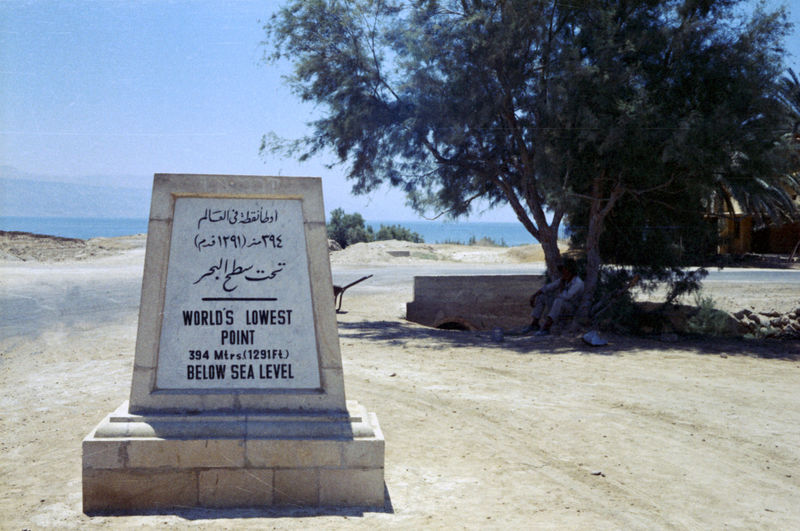
this stone marks the lowest point on earth

Jesus starts at the bottom – and stays there.

Ten days ago we were rounding off the church’s year by celebrating Christ the King – it has to remain a private awards ceremony because so many in the world choose to disagree – and Jesus would never impose himself. He’s King only to those who want him as such. Humility is his middle name.

We start the new year with clues that it is not “Highness” to describe his position, but low(li)ness. It is his royal lowliness (no capitals please) that according to the Advent hymn O come, o come Emmanuel “from depths of hell thy people save”. Jesus’s ministry begins at the lowest point on the surface of the earth – in the River Jordan. His life proceeds along the same low level of altitude – the wrong side of the fault line – to his death on the cross.

Jude Simpson has a wonderful Advent Reflection called Broken Open which takes us along this low line. She traces Jesus’s movements through the lowest points of people’s lives.

>between hope and optimism

>

Between optimism and hope there is a huge credibility gap. Optimism can be foolish or a realistic prediction based on evidence. Is life getting any better? There are grounds for both optimism and pessimism depending on your point of view – but a well rounded maturity would find it difficult to call one way or another because the evidence is so complex. The folly of liberal optimism shows itself in  the advent of Holocaust and economic meltdown. The only ground for optimism seems to be forgetfulness – when we forget our history and our nature: or arrogance, when we think of ourselves superior to either.

Optimism trusts human progress. The opposite of optimism isn’t pessimism but hope. Miroslav Volf (in Against the Tide: love in a time of petty dreams and persisting enmities) reminds his readers of Moltmann’s wonderful work on helping us to think about “hope”. Moltmann distinguished between two ways in which the future is related to us. There are two Latin words for “future” – futurum and adventus. “Future in the sense of futurum developes out of the past and present inasmuch as these hold within themselves the potentiality of becoming and are “pregnant with future”.” But future, expressed as adventus is the future “that comes not form the realm of what is or what was, but from the realm of what is not yet, from outside, from God.”

Advent is about the future that bursts in on our darkness. There is nothing in the data of our existence that gives us grounds for optimism. It is just faith. There is no optimism in W H Auden’s Christmas Oratorio “For the Time Being”. There is no sense of “what shall we get for Christmas?” that we have to endure in the commercialised Christmas. How could there be? Auden was writing in the 40’s where the overwhelming “grinning evidence” is that the “Pilgrim Way has led to the Abyss”. There is only one option left for us “who must die”. Auden writes:

We who must die demand a miracle.
How could the Eternal do a temporal act,
the Infinite become a finite fact?
Nothing can save us that is possible:
We who must die, demand a miracle.

And Volf writes:

“Every year in the Advent season we read the prophet Isaiah: “The people who wlaked in darkness haveseen a great light; those who lived in a land of deep darkness – on them light has shined.” (Isaiah 9:2) This is what Christmas is all about – something radically new that cannot be gernerated out of the conditions of this world. It does not emerge. It comes…. God promises it”

The Kingdom

>I have listened to two sermons from +Robert Atwell in two days. Today I get a day off!The first sermon was at the induction of friend Kathy Kirby as Vicar of St Paul’s Macclesfield. Kathy is a special person who is immensely generous in her appreciation of others. She will offer a very special ministry of affirmation and encouragement. The second sermon was to our Committee for Ministry in which he quoted “the Kingdom” by R.S.Thomas:

It’s a long way off but inside it
There are quite different things going on:
Festivals at which the poor man
Is king and the consumptive is
Healed; mirrors in which the blind look
At themselves and love looks at them
Back; and industry is for mending
The bent bones and the minds fractured
By life. It’s a long way off, but to get
There takes no time and admission
Is free, if you purge yourself
Of desire, and present yourself with
Your need only and the simple offering
Of your faith, green as a leaf.
R.S. Thomas, Collected Poems 1945-1990

I am playing round with ideas on supervision at the moment. Where many minds are bent on specifying, my mind is bent on generalising. I am told that if supervision becomes too general it loses its meaning. I counter that if supervision is too specific it doesn’t mean so much. If the kingdom is “mirrors in which the blind look at themselves and love looks at them back” I dare the word to bear such meaning and defy those who say I go too far.

>Supervision and oversight

>It’s hard to believe the stories of people who have been told by their supervisor that they haven’t time for supervision.

Friend John Lees led a training session on supervision and collaborative ministry for clergy who will be moving on to posts of responsibility in the next few months. He invited us to think of the different supervisory roles people may ask us to take on. In our own words these roles included acting as advocate, mediator, valuer, confessor, coach etc etc. This has got me to thinking that supervision actually happens formally and informally. By formal supervision I mean the intentional setting aside of space for supervision (that’s the space that often gets crowded out by business). When we ask for feedback, support, directions are we not also asking for supervision, but without requiring the creation of an intentional space? To my mind we are at that moment asking for someone to watch over us, to look after us and to help us to a superiorvision.

I worry that “supervision” has become a word made precious by those who would like to see themselves as supervisors. I wonder whether supervision thereby becomes something that is exclusive to the few – depending on scarce resources. I wonder whether supervision isn’t something that all of us need – but in very different guises. Vigilance and watching out for one another alerts us to the needs of others – when they need encouragement, assurance and challenge. The requests aren’t always verbalised. Jesus tells the story of the victim of violence lying at the side of the road. He remarks on the neglectful carelessness of those who passed him by. He highlights the response of the Good Samaritan who looked after the wounded victim and watched over his recovery.

Supervision belongs to the whole people of God. It is in fact a gift of God for his people which gives us confidence in prayer. The Lord who watches over us will neither slumber nor sleep (Ps 121). Therefore, we need to avoid the exclusive practice of supervision to make room for both the informal and formal requests that come our way (the way of all humans) – and we all need to have the confidence to ask for the help we need to get a better sight of our lives. We are all vulnerable. I fear that if we don’t make room for both the formal and informal aspects of supervision we will continually overlook the victims of our peripheral vision. I wonder whether the priest and the levite who passed by the wounded victim of Jesus’s story said – “sorry, that was an oversight”. It’s strange that “oversight” has two such opposite meanings.

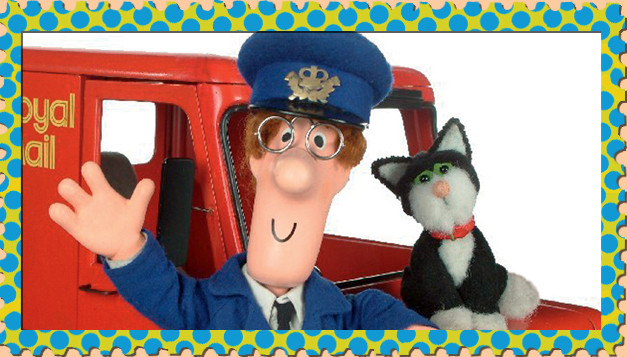
Post-Phone (get it?)

I rarely get letters now – apart from leaflets from the local pizzerias. There are days when the phone does not ring. Communication has changed very significantly and rapidly. We have moved from beacon to drum to messenger to post to phone to fax to email to facebook to …. We have moved from moorland track to canals to railtrack to the road to the by-pass to Runway 5. Our horizons have shifted from village to town to Spanish Costas to antipodean holidays and now interplanetary travel plans.

My own journey is from a 35 year ministry in parishes where my business was “to know and be known” to living more anonymously on a housing estate. I have been discovering what most people have long known. That is, that communication is minimal in neighbourhoods. We talk amiably as neighbours – though we don’t see much of one another because working hours are very different. Others are just “passers by”. When we go to the local shops (thank goodness we’ve got some) we pass by one another without recognising one another and realising that the common ground that we share.

Fortunately new communities are being constructed all the time. These are often communities of our own making – virtual communities which offer conviviality and new possibilities for relationship. Unfortunately we feel safer in our Facebook communities than we do in our own street (even though the stats say that crime is lower than it has been for years).

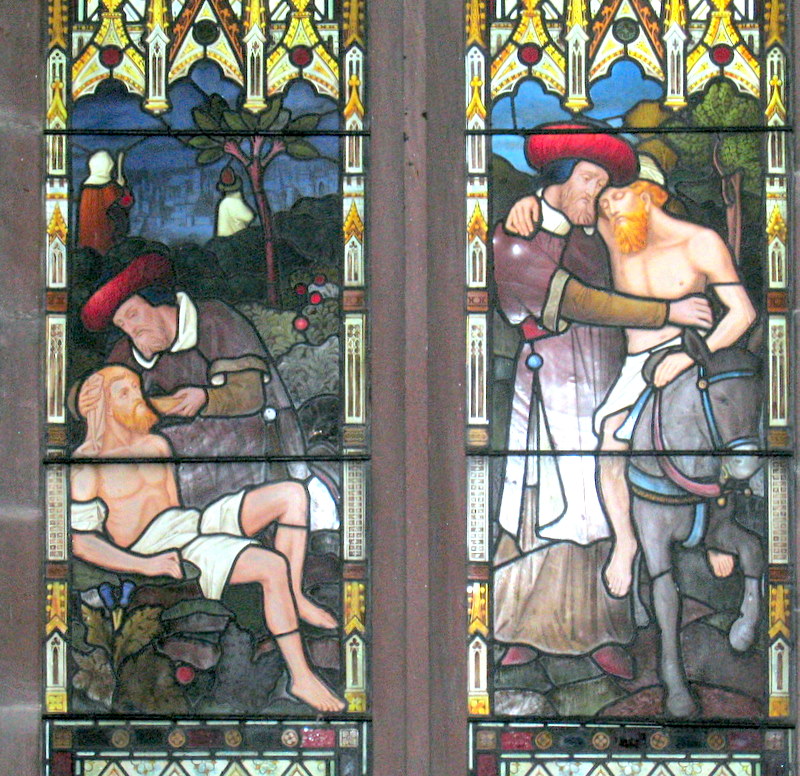
Good Samaritan window at Tarvin Church

Passers-by don’t get a good press in the gospels. The Good Samaritan was the exception to the general rule of passers-by when he went out of his way to help the victim. Peter Shaw, in Conversation Matters, reports on a discussion with Veronica who told him about the short conversations she had (she is a flight attendant). She explained that they were all trained to be cheerful, and to look people in the eye and smile. She was full of stories about conversations she had with footballing stars and leading politicians making the point that what mattered was not who they were, but the way they were. What sort of tone did they adopt? Did they smile? Were they cheerful? Did they say ‘thank you’?

I suppose these sort of short conversations prevent us from being just passers-by of one another. A “thank you” shows we appreciate the other person. A “good morning”  shows we’ve noticed. A “how are you” shows we care. Words get over our boundaries. Maybe communities are only built brick by brick and word by word.