The Sound of Jesus: hearing his voice, following his call

Using scripture appointed for the 4th Sunday of Easter (YrC), Psalm 23 and John 10.22-30, here’s a reflection on what it means to hear the voice of Jesus in a noisy world.

I love preaching that brings Scripture to life—and that brings Scripture back to life, and I hope you do too. That’s a reminder that every time we open scripture together we are bringing it back to life. What matters today is what we call people, what we call ourselves and what we call God. Today is Vocations Sunday – a day to explore our calling, our calling of one another and God’s calling of us.

That’s the point Jesus makes when he is confronted by Jews at the Festival of Dedication at Jerusalem with the question showing their lack of understanding of him. “How long will you keep us in suspense? If you are the Messiah, tell us plainly.” I’m discovering that John is always telling us the time. In our gospel readings through this Easter season, all from John’s gospel, he has always told us the time. It’s morning, it’s evening, it’s early in the morning. Today, we hear that it is “winter”. Perhaps John wanted to introduce a shiver in his readers to indicate the coldness of these Jews towards Jesus and the frostiness of their relationship towards him.

Jesus replied to them to say “I did tell you, but you do not believe”. He draws the distinction between those who do believe and those who don’t. Those who do believe have listened to his voice and followed him. It’s his voice that makes us think vocationally. We are those who believe. We’ve heard his voice.

Vocation is not just about what we do – it’s about whose voice we listen to, and whose voice we speak with.

We live in noisy days. Everyone has something to say. Social media, politics, advertising, even the voices in our own heads – so many trying to define who we are, what we’re worth, and what matters. Those who follow Jesus make out his voice in all the hullabaloo. As Jesus said, My sheep hear my voice. They listen to my voice and follow me. Even surrounded by the sound of enemies, or even traumatised by suffering, or even as we walk through the darkest valleys overshadowed by death, there is the one call we listen out for. It’s the call that leads us to metaphorical green pasture and the still waters that refresh the soul.

And here’s the gift and challenge of vocation: those who follow Jesus begin to speak like him. They begin to sound like him. It’s not because they have perfect words, nor because they are fluent in the language of the kingdom, but because they speak in love. They echo his truth that so loves the world. They call people “beloved”. They become the kind of people whose words give life.

This is Jesus calling. His calling isn’t just for those who we say “have had a calling”. His calling is for the sake of the world. His calling is for the whole church – to hear, and to follow. On this Vocations Sunday, we’re not just praying for more priests or deacons (though some who hear his call might follow that course). We’re also praying for a church that listens to the voice of Jesus and follows his call, for a church that sounds like Jesus. We are praying for a Pope who sounds like Jesus, for an Archbishop who sounds like Jesus, and for one another, that we dare to follow the voice of Jesus even when it sounds strange in our world of noise.

So, let me ask you. Can you hear his voice?

Do you hear his voice,
the still small voice of calm,
the voice on the lake, in the storm?
Do you hear his voice
in the noise of your lives?
Do you hear his voice
above the voices of harm?
Do you hear his voice
singling you out
for the new rule of the kingdom?

What does he call you?
Are you Forgiven?
Are you his Friend,
freed, no longer slave?
Are you his Beloved?

And what of others?
Can you hear him calling them?
Can you hear him
calling the last first,
the first last?

Can you hear him
calling the stranger
closer as neighbour,
extending the family
by calling brother, sister,
even mother of those
quite unrelated?

His call goes far and wide,
as far as those who are called
“far from the kingdom of God”,
even to those who’ve grown rich
at the expense of others,
the proud and arrogant,
the self-righteous,
the self-satisfied, the guilty.

He calls the warnings of woe,
speaks of mercy to the guilty.
He calls the wayward home,
and calls the proud down.

Love’s call is strong, not mealy-mouthed,
exactly what is needed by those
who put themselves first,
those who are comfortable now.

This is the call of the shepherd
who loves his sheep
and raises his voice
for them to follow.

But the call of the shepherd
also raises the alarm
to disrupt the plans of wolves.

That is not a gentle voice we hear
nor does the shepherd
reassure us to stay where we are.
His is the leading voice,
leading us to fresh pastures,
calling us back, calling us out,
calling us up to the narrow way
that leads to life.

Can you see
how his voice might carry
in every breath of the church,
on the wind and wings
of the Spirit?

Do you know
the messages of your own lives
in your words and deeds?

And can you imagine
all your words being of
the one word that made you
and called you by name
Forgiven and Beloved?

Can you imagine your voice
reverberating his love and
amplifying his call?

Can you imagine
that being your only call?

There are those
who find it hard to hear
and difficult to believe
the voice that calls them
Forgiven, Beloved,
First, not Last
Friend, no longer Stranger,
Brother, Sister, even Mother.

What did he say?

They need the words
in love’s translation,
the amplification
of those who follow
the sound of his voice.

So listen well, church.

Get the sense of vocation.
We know his voice,
we hear his call.

Let us follow the sound
of his voice so truly
that we too call
strangers friends
and the last first.

Let us see how
the voice of Jesus
carries light
into the darkness
of the night.
Let us echo
the good news
that names us
and calls us
Beloved.

© David Herbert

Nostalgia never wins the day: there’s fights to fight and victories still to win

A reflection for VE Day for the 3rd Sunday of Easter. Readings for the day: Acts 9:1-6, Psalm 30 and John 21:1-19

I love preaching that brings Scripture to life—and that brings Scripture back to life, and I hope you do too. That’s a reminder that every time we open scripture together we are bringing it back to life.

Our readings today are those appointed for the 3rd Sunday of Easter (year C) – and they’re a perfect fit for this week when we celebrate the 80th anniversary of VE Day on Thursday, May 8th. How do these readings, Acts 9:1-6, Psalm 30 and John 21:1-19 reflect the experience of victory in Europe, what it meant then in 1945 and what it means now in 2025?

Psalm 30 may well be a reflection on war – and more specifically, a reflection on surviving and winning a war.
You didn’t let my foes triumph over me …
You brought me up from the dead … from among those who go down to the Pit.”

That was God’s doing.
But how many have gone through the hell of war and not survived?
How many were herded into the hell of concentration camps?
How many Jews, Roma, LGBTQ+ people?
How many people were killed resisting evil?
How many families shattered, communities broken, bodies and spirits scarred for life?

And yet …
“You have turned my mourning into dancing;
you have taken off my sackcloth and clothed me with joy.” (verse 11)

Verse 5 may say it best:
Heaviness may endure for a night,
But joy comes in the morning.

That was VE Day – a dawn after a long, dark night.

Then we heard what scripture has to say about Saul before he became Paul (Acts 9:1-6).
Make no mistake. Saul was an absolute tyrant “breathing out murderous threats” against Jesus’s followers.
He was an architect of hell.
He had legal letters giving him power to arrest followers of Jesus.
Earlier in Acts (8:1-4) we are told that after Saul’s involvement in Stephen’s martyrdom Saul ravaged the church, going house after house, dragging men and women off to.
Here was a tyrant, a religious stormtrooper.
He needed to be stopped.
It was a light from heaven that flashed around him that did it.
It blinded him. He was never able to see the same way again.
When he got his sight back, he saw the world completely differently.

In our gospel reading (John 21:1-19) six disciples fished all night and caught nothing.
Then –  “early in the morning”, a stranger stood on the shore.
They didn’t know it was Jesus.
But when they followed his call to cast their net on the other side of the boat, they caught a huge haul of fish.
Only then did they recognise him.
This is the third time, John tells us, that the risen Jesus appeared to his disciples – and he always tells us what time it was.
In our Easter gospel, it was “early on the first day of the week” (John 20:1)
In last Sunday’s gospel, it was “in the evening” (John 20:19),
Today it’s “early in the morning”, the first light at the end of a dismal night.
just as May 8th 1945 must have seemed – the first light after long nights of total blackouts.

It’s breakfast time.
We’re gathering around the table to eat and drink together, just like those first disciples overjoyed with their catch and their rediscovery of Jesus.
This is the breakfast table too.
We gather round to bring the scriptures back to life.

The question is, what does Victory in Europe really mean, not just 80 years ago in 1945, but for us now.
For many in 1945 it meant the end of unimaginable suffering, the fall of a monstrous regime and a return to peace.
But for others, especially in countries like Germany VE Day was the Day of Defeat.
And yet, 40 years later, German President Richard von Weizsacker called it something else.
He called it a “Day of Liberation” – liberation from tyranny, from lies, from fear, from a system that devoured its own people.

Germany was beaten.
But our scriptures have a lot to say about those who are beaten – as we discover in today’s readings.
Those beaten are given a second life.
Think about Jesus, crucified, dead and buried – utterly beaten by the authorities, and still appearing on the seashore.
Think about the disciples defeated by a night of failure, turned around by morning..
Think about the psalmist whose mourning was turned to dancing.
Think about Saul/Paul – persecuted, transformed into the missionary of grace.
Post-war Germany was not just a defeated enemy but a mission field for reconciliation and rebuilding and we should be joining German Christians in giving thanks for all of that.

There was a victory – declared on May 8th 1945.
A huge victory.
But we can’t settle for nostalgia.
There are many more victories yet to be won.
New nationalisms are emerging here and abroad which are undermining the truth of others, of those desperate for refuge.
There are still people who are hungry, broken and forgotten. 

We sing the hymn Peace, perfect peace is the gift of Christ the Lord.
It reminds us that there is such a thing as imperfect peace, and then there is perfect peace.

The perfect peace of the Lord is, as we say, a peace which passes all understanding.
It’s the peace that met Peter and the others on the beach,
the peace that transformed Saul on the road,
and the peace that raised up the psalmist from the pit.
It’s the peace that tends to the hungry, beaten and forgotten,
a peace that puts the last, least and lost first.

In our gospel reading Jesus told the disciples to cast their nets the other way – to try the other side.
As we move beyond VE Day let’s seek the peace of Christ,
casting our nets in a new way
that tells the truth,
that seeks the lost,
that reconciles enemies
and that turns mourning into the scenes of dancing and revelry we remember from VE Day 1945.

So may we, like those disciples, recognise the risen Christ on the shore,
and with joy cast our nets in new ways,
seeking not only peace,
but peace that restores,
peace that heals,
and sets the world dancing once more.

Seeing the wounds Jesus shows us

A sermon for the 2nd Sunday of Easter – Year C for two small churches. The gospel for the day is John 20:19-end.

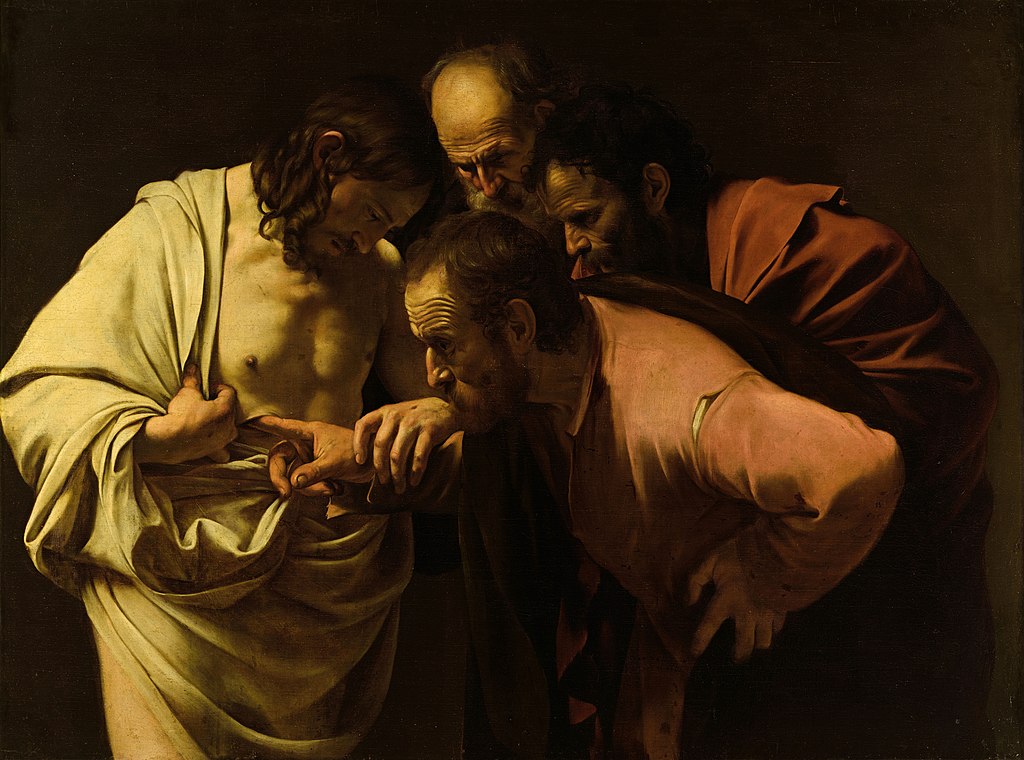
The Incredulity of St Thomas by Caravaggio – or should it be called Jesus showing Thomas his wounds?

I love preaching that brings Scripture to life—and that brings Scripture back to life.

That’s a line I’m going to repeat each week to remind us that every time we open Scripture together we are bringing it back to life.

This morning we return to John’s Gospel, still caught up in the wonder of that first Easter day (John 20:19-end). It’s a story only he tells.

John himself brings scripture back to life.
Particularly we see the influence of the creation story from the 1st chapter of our scriptures.
We can see that in the way that he tells us the time.
On the evening of that first day of the week.
It’s like last week’s gospel reading which began: Early on the first day of the week, while it was still dark. (John 20:1)
We are still on that first day which was like the first day of creation, when, according to Genesis 1:2, earth was a formless void and darkness covered the face of the deep.
That’s the time in today’s gospel. It was the first day of the week, and it was evening.
In other words, darkness was forming.
Taking our cue from Genesis, John’s readers can expect God’s wonders on this new day of creation.

Thomas wasn’t with the disciples when Jesus came on that first day, the day of resurrection.
It was the other disciples who had to let him know that they had seen the Lord.
Thomas told them that he would never believe “unless I see the nail marks in his hands and put my finger where the nails were, and put my hand into his side”.
It is this I suggest we focus on in our worship today.

Thomas is the patron saint of those who are blind because seeing wasn’t enough for him.
He needed to examine Jesus’s wounds by touching them and feeling them.
And the wonderful thing on that second Sunday, the first day of the week following, was that Jesus came and stood among them again and showed Thomas his wounds.
He welcomed his touch. He guided his hand. He let him explore his body.
Thomas is the patron saint of those who struggle to believe what they can’t see—or even what they can.
He shows us that resurrection faith isn’t just about seeing.
Sometimes it’s about touching, questioning and wrestling with God.

Jesus showed Thomas his scars. He wants his disciples to see them.


In the Last Supper, he took a loaf of bread and he broke it.
He wanted them to see his body in the brokenness of the bread.
“Take, this is my body,” he said. (Mark 14:22).
Then he gave them a cup for all of them to drink from.
In that cup he wanted them to see his blood.
“This is my blood of the covenant poured out for many.”
Even before he was wounded he wanted to show his disciples the wounds he was going to suffer.
And in today’s gospel, in one of his resurrection appearances, he invites Thomas to have a look at those wounds – to examine, inspect and see with his hands as well as his eye.

Thomas recognises Jesus through his wounds, just as Jesus wanted him to.
And this is how we come to know Jesus.
Just as Thomas encountered the risen Christ in his wounds, so too we encounter him today in the bread and wine of the Eucharist.
Every Communion we have with Jesus we have this invitation to examine the wounds of Jesus. Every time the bread is broken we are invited to see the brokenness of the body of Christ and to feel that brokenness in our mouths.
Every time we take this cup we are invited to taste the blood of Christ shed for us.

What is it that Jesus showed Thomas?
What did he want his disciples to see?
What does he want us to see when he shows us his wounds, when he invites us to see his body and his blood?

The first things we see are the wounds to his hands and feet where the nails were driven into his body by the hammer blows of empire.
Then, if he turns we see the wounds of the whipping scored into his back for being the scourge of empire and religion.
Then we see the scars on his head where they pressed the crown of thorns and added insult to injury, to press home the point that this “pretender” was nothing.

The rule of the kingdom of God is that the last, the lost and the least come first and those who are first in the kingdoms of this world come last.
The rule of the kingdom of God turns the rules of the world upside down.

In the wounds of Jesus, his disciples see a man who embodies that rule of the kingdom of God. In the brokenness of his body, in the bloodshed, we see a man the religious and political capital tried to reduce to nothing.
The plots against him and his crucifixion were intended to humiliate him and his followers – to make them least, last and lost – GONE for ever.

The problem for them was that the rule of the kingdom of God puts the least, last and lost – those lost and broken by the ways of the world – first.
When Jesus stood among his disciples, first without Thomas, then with him, he was the living proof of the fundamental rule of the kingdom of God.
Here was the humiliated, crucified and killed one.
You can’t get more “least, last and lost” than that.
Here he was, “the first fruits of those who have died”, Christ raised from the dead (1 Corinthians 15:20).

This is what Jesus showed Thomas –
the scars are the living proof of the rule of the kingdom of God.
Jesus stood among them as living proof of the rule he’d always followed,
that puts the last first and the first last.
Here is the one they put last made first.
This is what Thomas saw. This is what he said:
“My Lord, my God” – the rule of the kingdom of God realised in those few words.
“My Lord and my God” – Jesus comes first for Thomas.

So Jesus stands among us still, not with condemnation, but with scars.
What do we see? What difference does it make? Does Jesus come first?

Jesus doesn’t shame Thomas for his questions. He meets him in them.
He doesn’t rush belief. He invites it — gently, patiently, personally.

And he does the same with us.
To all who doubt, who ache, who long to see and touch and know — he says,
“Here I am. Peace be with you.”

He doesn’t hide his wounds. He offers them.
He lets us trace the pain and the mystery of a love that suffers with us and for us.
And in that wounded, risen body, we find our hope.

This morning, he says again:
“This is my body. This is my blood.”
This is how I choose to be known.
Look closely. Taste carefully.
And, if you are among the broken,
do not be afraid.

In the thick of things – a sermon for Palm Sunday

On Palm Sunday we celebrate Jesus’ humble entry into the thick of things where we say he is very welcome. This sermon for a small Warwickshire church picks up that theme. The readings appointed for the day are Luke 19:28-40 and Philippians 2:5-11.

Entry of Christ into Jerusalem by Pieter Coecke van Aelst Bonnefantenmuseum 1246

I love preaching that brings scripture to life, and we are in the thick of it, aren’t we? We’re in the thick of it, with one thing after another.

We’re always in the thick of things with things going on in families, things that prevent us having a balance in our lives, worries about our health, pressures in our relationships. We are in the thick of things. In the thick of things our reptilian fear threatens to overwhelm us.

We can hardly believe what we are seeing of what’s going on for the people of Ukraine.
We can’t believe our eyes when we see news of the destruction of lives and communities in Gaza.
And now we’re on the edge of a trade war brought on by the obscenity of a billionaire President’s complaint that the wealthiest nation on earth feels cheated and that they are going to get their own back on nations that are poorer.

And in the thick of things, we are, like Jesus’s generation, “an unbelieving generation” (Mark 9:19). We are people of unclean lips, living among a people of unclean lips. (Isaiah 6:5). How can we be any other? We live in the thick of things. The thick of things take their toll on the way we are, our minds and our behaviours.

Today of all days, Palm Sunday, we look to Jesus who was, and is, always in the thick of things. When he rode into Jerusalem he rode into the thick of things. (Not that he wasn’t already in the thick of things in his ministry in Galilee.) But in setting his mind to go to Jerusalem he was setting his mind to get to the thick of things – Jerusalem, the place of religious and political capital, the place of those who made the rules, the place of turmoil, the place which had such an effect on people’s lives – on their fortune, their anxiety, their shame.

When we reenact the welcome of Jesus by the crowds in Jerusalem we are saying how welcome Jesus is in the thick of things for us. In the thick of things we turn to Christ. That’s the choice we made at baptism. “Do you turn to Christ?” “I turn to Christ”. We turn to Christ in the thick of things because there really is no choice.

Isn’t there?

The truth is that we are spoilt for choice. There are so many contenders, so many who want to govern us, to rule over us, to be our landlords, presidents, press barons and manipulators. That’s why there are so many power struggles. It’s surprising what an unbelieving generation believes. It’s surprising (and alarming) who an unbelieving generation will follow..It is shockingly easy to be misled when we are in the thick of it. We are sheep in the midst of wolves.

There is a choice. Who will we choose?

African-American writer Octavia E Butler wrote this in her Parable of the Talents:

Choose your leaders with wisdom and forethought.
She went on:
To be led by a coward is to be controlled by all that the coward fears.
To be led by a fool is to be led by the opportunists who control the fool.
To be led by a thief is to offer up your most precious treasures to be stolen.
To be led by a liar is to ask to be told lies.
To be led by a tyrant is to sell yourself and those you love into slavery.

Choose your leaders with wisdom and forethought, because when we don’t we find ourselves in the thick of things.

Who do we choose to lead us in the thick of things?

While Butler warns us of bad leaders, another voice—from an unexpected place—tells us what does hold evil in check. This is from The Hobbit.

“Some people believe it is only great power that can hold evil in check, but that is not what I have found. It is the small everyday deeds of ordinary folk that keep the darkness at bay. Small acts of kindness and love.”

In the thick of things we look for a messiah, someone to save us, usually an alpha male, a charismatic leader, someone with great power – a disaster who leads us into war, or poverty, or slavery, or hatred and fear.

Today, we wave our palms as Jesus comes before us, as in Jerusalem, so in our lives. (Incidentally, we see the deaf community waving the palms of both hands in the air – that is silent sound of welcome applause.)
Our palm waving is the sign of our choice, the welcome of Jesus into our lives.

We are at the beginning of the week.
When we get into the thick of the week we find out how Jesus was when he was in the thick of it,
the way that he hung out to the end,
the way he turned the tables on the religious leaders in the cleansing of the temple,
his refusal to justify himself in front of Caesar’s representative, Pilate,
his non-violence when he told Peter to put down his sword
the greeting of his betrayer with a kiss
the promise of paradise to the thief at his side, the way he made a brother of him

All these things add up, and in the thick of the crowd people changed their mind.
They didn’t like the choice they’d made by welcoming Jesus.
They preferred Barabbas.
When they were given a choice about who should be saved,
Barabbas or Jesus,
they chose Barabbas.
They mocked Jesus.
They insulted him, spat at him, and hung him out to die.

It shall not be so with us.
We have saved Jesus for when we are in the thick of things,
all those moments when we are searching
for a better way for our work, for our love,
we have welcomed Jesus into the thickness of our lives
and inclinations, when our tempers flare
when hatreds and jealousies might prevail
when our worries keep us awake
we have chosen Jesus as our saviour.

Let Jesus always be our choice
whenever we are tempted
by the ways of the world
in the thick of things,
in our relationships with one another
have the same mindset as Christ Jesus.
He never considered equality with God something to be used for his advantage,
but chose instead the way of a servant,
joining the suffering of the last and least
always following the rule of the kingdom
that puts love first and the last first.

That’s the way we choose when we wave our palms to welcome Jesus into our thick of things.

So let us wave our palms not as decoration, but as declaration. That in the thick of things—today, this week, this world—Jesus is still our choice, our way to go.

Mercy’s embrace and the scandal of grace

a sermon for the 4th Sunday in Lent (C) reflecting on the readings for the day, 2 Corinthians 5:16-end and Luke 15:1-3, 11b-end – the parable of the Prodigal Son (and Merciful Father)

Today’s Gospel presents a well-known story about a father and his two sons. 

(It is ironic that on Mothering Sunday our gospel is about a father and his two sons. The story may, just as easily, be about a merciful mother, wayward daughters and resentful sisters.)

Beyond being just a family drama, this is a story about the Kingdom of God.

How do we know that?
Because in God’s Kingdom, the last come first, and the first come last.
The world’s order favours the eldest son, granting him the inheritance and privilege.
Yet, in this parable, it is the younger son who finds blessing, while the older son stands in the shadows, sulking in resentment.

This reversal is a hallmark of the Kingdom of God. It is a theme woven throughout Scripture, going back to Genesis, where God repeatedly upends human expectations.

Consider Cain and Abel. Cain, the elder, offers his sacrifice, but it is the younger, Abel, whose offering finds favor with God, igniting Cain’s jealousy and leading to the first murder.

Think of Jacob and Esau. Esau, as the firstborn, should have received the blessing, yet through divine mystery and human cunning, it is Jacob, the younger, who carries God’s promise forward.

Look at Joseph, the eleventh son of Jacob—his brothers despised him, sold him into slavery, but in God’s providence, he rises to power and saves them all from famine.

And then there is David, the youngest of Jesse’s sons, overlooked by his family but chosen by God to be king of Israel.

This is the pattern of the Kingdom of God—a new order where grace, not entitlement, reigns. And so we return to today’s parable, which could rightly be called “The Parable of the Merciful Father.” Here again, we see contrast: the younger and the older, the old and the new.

Paul captures this contrast beautifully when he writes: “If anyone is in Christ, the new creation has come: the old has gone, the new is here!” (2 Cor 5:17). In the Kingdom of God, status, wealth, and achievement count for nothing. The new creation does not weigh merits but pardons offences. This is the amazing grace that calls us out of darkness and into light.

That’s what’s new. And we often still don’t get it.
Still the picture lingers in our minds of Peter at the pearly gates, standing like an examiner, ruling people in or out of heaven on the basis of what they’ve done. Jesus, in this parable, shatters that image. 

What’s the prodigal to say for himself other than that he has squandered his wealth in wold living (and we all know what that means)? 

And the older brother.
What has he to say for himself other than “I’ve worked like a slave for my father. I have never disobeyed orders.”
But it is the reckless, wayward son who is embraced, and the rule-keeping, responsible older brother who distances himself from his father’s joy.

“The Return of the Prodigal Son”, by Rembran(d)t Harmenszoon van Rijn, c. 1669

Rembrandt has painted the contrast brilliantly.
You see the older and the younger. You see the light and the dark, you see the old and the new. Rembrandt highlights the father and the prodigal younger son. His boy has nothing on him – no weight, not even a pair of shoes, utterly dishevelled, totally loved.
This is the new order, the order of the kingdom of God, where, in the words of the psalm appointed for today (Psalm 32 v11), mercy embraces those who trust in the Lord and happy are those whose transgression is forgiven.

The other son, the prodigal’s older brother, Goody, goody two shoes, has been painted into a very dark corner. His body language is so different to his father’s. He is wringing his hands in anger and despair and looking down his nose in judgement at the scene he is witnessing. He is standing over the merciful reconciliation of father and son and resisting it with all his might.

This is the dark corner we all paint ourselves into when we self righteously resist the new which doesn’t weigh our merits but pardons our offences. It’s the corner where we so easily let anger and resentment take hold of our heart, where we insist on our righteousness and our just desserts.

The resistance of the older son/brother puts him at such an emotional distance from his merciful father, as distant from his father as his younger prodigal brother had ever been in terms of physical distance. He has rejected the new order. He is far from the kingdom of God. He has cast himself out into utter darkness.

Imagine the father’s grief. He has seen the return of his youngest, now he has to grieve for his older son who has put such distance between them. He now has to wait for his return, for him to see sense, for him to join his brother in mercy’s embrace. The family will remain broken until that happens. But what joy there will be when both sons have returned, brotherhood united in mercy’s embrace. What joy. What a party!

Where do we see ourselves in this picture? Are we wringing our hands with the older brother? Or, are our hands stretched out in mercy ready to embrace those who come first in the new rule of the kingdom of God, the lost, the least and the last? Or, are we like the prodigal – once far off, but now glad, rejoicing in the Lord, happy in mercy’s embrace? 

Quite likely we see ourselves all over the place. Perhaps we see ourselves in the older brother – yes we can be like him. Perhaps we wish ourselves to be like the merciful father. Perhaps we know there’s joy in heaven when we’ve allowed ourselves to fall into the arms of love.

As I looked at Rembrandt’s painting this week I remembered my confirmation and my ordination. Do you remember your confirmation and kneeling just like the prodigal is kneeling in Rembrandt’s painting? It’s the same scene isn’t it?

It’s as if Rembrandt has painted me out of the dark shadows into the light, onto my knees in mercy’s embrace. I can feel the hands of mercy on my shoulders confirming God’s love for me, discounting all my sins – and myself confirming my commitment to the rule of God that puts the last, the least and the lost first in his heart. And from those hands I take the ministry of reconciliation that he commits us to, according to Paul in his letter to the Corinthians.

Jesus leaves us with a question. How does the family find healing? How can the brothers be reconciled? Is it only through the ministry of reconciliation that the father has committed his younger son to. Surely the younger brother has to share the same longing for his brother as his merciful father had for him. Surely the younger brother has to wait, his arms ready to embrace his long lost brother, discounting his anger and resentment and pardoning the ways he has offended.

The questions we are left with:
Will we join the work of reconciling love?
Will we stand together with Christ as people of mercy?
Will we set aside resentments?
Will we choose the scandal of grace?
Will we make way for joy?

The fig tree and the landlord

A reflection for the 3rd Sunday in Lent (Year C) focusing on the parable of the fig tree. The readings for the day are Isaiah 55:1-9 and Luke 13:1-9

The gospel writers give us two parables of Jesus featuring fig trees. He may have used more. The two we’ve got teach different lessons. In one, the fig tree is cursed. In the other the fig tree is spared. The fig tree (featured in Mark 11:12-14, 20-25 and Matthew 21:18-22) is cursed by Jesus for not bearing fruit. In the other, from Luke’s gospel, the parable which is our good news for today, the fruitless fig tree is given a time of grace. 

Our other reading from Isaiah (55:1-9) culminates with these words of the Lord: “my thoughts are not your thoughts, neither are your ways my ways”.

How are we going to bring these two passages of scripture together and bring them to life today?

“My thoughts are not your thoughts, neither are your ways my ways.” A good question for us to be asking is “How?” How do my ways differ from the Lord’s ways? How does our thinking differ? These are good questions for self-examination, particularly during Lent which is a season given us for repentance, for changing our minds, attitudes and behaviour.

There is a distinction drawn. “My ways are not your ways …..”

The distinction is graphically illustrated by Jesus in today’s parable. It’s our Lord telling a story about another lord, a landlord – and we can read between those few lines of the parable the thought of the Lord: “my thoughts are not your thoughts, neither are your ways my ways. As the heavens are higher than the earth, so are my ways higher than your ways and my thoughts than your thoughts.”

Let’s look at the difference between one lord and the other and try to unpack a parable which takes up so little page room that it is easy to skate over it. But small is beautiful and less is more – such is the rule of God’s kingdom.

The difference is in their respective responses to fruitlessness, and their different relationships to the fig tree.

The owner of the vineyard, the landlord, had a fig tree growing in the vineyard.
He keeps coming back to the vineyard to see if there were any figs on the tree.
Time and time again he did this.
For three years he kept checking up, and then he ran out of patience.
Cut it down, he said.

Here is a man with authority who can say to his servant, do this, do that.
He gives the orders. He doesn’t dirty his own hands.
His servant is the one who took care of the vineyard.
He is the one who does the work.
If there’s cutting down to be done, he’s the one who will do it – the owner isn’t going to get involved in that dirty work.

So, here the picture is building up of this landowner-boss, who comes from time to time to check up on his investments, to check up on his interests.
His interest is what matters to him.
It’s all about him.
It’s his vineyard, but he’s away from it most of the time.
His is a remote control. He’s distant and disconnected.
It’s his fig tree, and it’ll be his profit if the fig tree were to give a fig.

We won’t blame the landowner.
We won’t call him wicked.
His behaviour is normal.
This is what happens in the real world.
His order makes perfect sense to our thinking.

Of course, we are not surprised that the landlord wants to cut the plant down.
We know that is the way of the world governed by money, profit and vested interests.
We are seeing that in our current economic crisis with cuts to welfare.
The way of the world is to cut down the fruitless and profitable, so that the fruitless and unprofitable make way for something that will be productive.
The ways of the world measure us in productivity and fruitfulness.
The less productive and fruitful we are the more vulnerable we become to cuts.

But is this the only way? Must fruitlessness always be met with destruction and condemnation?

There’s the landlord. 

Now let’s explore how different the one who actually took care of the vineyard.
We need to make a judgement between them otherwise Jesus has told the parable in vain.

In the words from our Isaiah passage we can play the question whether the thoughts of the caretaker are the same as the thoughts of the landlord.
Do they think the same?
Are the ways of the caretaker higher than the landlord?
Is his thinking higher than the thinking fo the landlord – “as the heavens are higher than the earth”?

The one who took care of the vineyard is the caretaker.
He is the one who is always there, working the vineyard day to day, spending his time and energy, rooted in the earth and tied up with the vines, the figs and all the challenges they face.
He’s the one who takes care of the vineyard for the landlord who takes care of his pocket.

(If you want to play with words again, our word care, originates from the Old English caru and cearu (meaning “sorrow, anxiety, grief”), ultimately stemming from the Proto-Germani karo (meaning lament, sorrow) and potentially tracing back to a Proto-Indo-European root meaning “to cry out, shout”. Just ask Google!

The word cure came to us through French after the Norman Conquest, and ultimately derives from the Latin word cura, meaning care.

The caretaker, the one who takes care of the vineyard, is the curator.
I’m labouring this point because you are in your vacancy of praying for a new priest – someone the Book of Common Prayer calls curate who will have the cure of souls in these parishes, a curate who will spend her/his time and energy in the day to day care for the vineyard round here,
someone who will join you in caring for those around you,
someone who will sorrow and grieve with you for how things are for those who are hurt and suffer the cuts of those who don’t care so much,
someone who will join you in lament, crying out and shouting about pain, injustice and suffering,
someone like the caretaker in Jesus’ parable who speaks up for the doomed fig tree,

someone who knows better ways for the world, someone who will think differently to the world …

Through the caretaker’s pleas we see the heart of our Lord Jesus.
Where the world rushes to judgement, Jesus intercedes for grace.
Here’s the difference between the landlord and our Lord.
The reason Jesus was sent into the world was to save us, not condemn us.
God is slow to condemn – with God there is always the period of grace, another season for the caretaker to do his work.

So, which lord will we follow?
Will we stand with the landlord in judgement, or with the caretaker in mercy?

Jesus wants us to follow him.
He wants us to join him to save the world
He wants our ways of thinking and our patterns of behaviour to be passionate in our care during this hard won season of grace.

If we follow Christ we will see the fruits of his patience.
We will see lives restored and hope rekindled,
and after the season is done, the caretaker, our Lord will say to the landlords:
“See this, the fruit of your planting, the harvest of this season of grace.
See the compassion, see the harvest.”

The blessing of being alongsides

A reflection on Psalm 1 and Luke 6:17-26 for two small congregations in a group of parishes in vacancy.
The 3rd Sunday before Lent – Year C

In last week’s gospel (Luke 5:1-11) crowds surrounded Jesus so much that to find space for himself Jesus needed to get into a boat on the lake as crowds gathered around Him to hear His teachings.

We have another crowd in today’s gospel (Luke 6:17-26). There’s a large crowd of his disciples (including the twelve he called “apostles”), and “a great number of people from all over Judea, from Jerusalem, from the coastal region around Tyre and Sidon” who had come to hear him and be healed of their diseases.

In the context of safeguarding we need to note that Luke has underlined where Jesus was in relation to the crowd. He is not “high up”, over others. 

In the boat on the lake he would have been lower than his hearers. 

And in today’s gospel Luke paints a different picture to Matthew’s Sermon on the Mount. Luke has them all on a level place – Jesus on the level with all the people. 

In this, and so many other ways, Luke is wanting to show how Jesus stands in relation to others – never overbearing, never patronising, always side by side – as typified by walking incognito with disciples to Emmaus. 

There is no distance between Jesus and the people. He was there with them, eye to eye, shoulder to shoulder, side by side, valuing relationship over hierarchy.

That’s the position you’re hoping to fill, isn’t it? You’re hoping for a priest who will ask your permission to come alongside, as your helper. It’s probably also the position we long to be ourselves, alongside others with others alongside us.

None of us are ever safe when people look down on us, and nobody is safe from us as long we look down on them. Jesus’ physical positioning in relation to others guarantees safety. He is the good shepherd.

That’s how Jesus positioned himself, alongside us, always on the side of those he blesses. What is our position? Where do we stand?

The psalmist points to those who take a very different position. They “walk in the counsel of the wicked”, “linger in the way of sinners” and join “the assembly of the scornful”. They’re condemned. They won’t stand the judgement of the law of the Lord or stand in the “congregation of the righteous”.

There is another way. That is the way of Jesus and all those who delight in the law of the Lord, meditating on his law day and night. They’re the ones blessed and the psalmist sees them like trees “planted by streams of water, bearing fruit in due season”.

There is a clear choice: the way of the wicked, or the way of the Lord. It’s either blessings or curse.

I had to go to a two column format to get our two readings on one sheet of paper. But in so doing I have shown the pairings: 

Blessed are all you who are poor, but woe to you who are rich
Blessed are you who hunger now, but woe to you who are well fed now
Blessed are you who weep now, but woe to you who laugh now
Blessed are you when people hate you, exclude you and insult you, and woe to you when everyone speaks well of you

This is the law of the Lord. This is Jesus’ teaching. This is the law of the Lord according to Luke who has already given us Mary’s song celebrating the ways of God in scattering the proud, toppling rulers from their thrones, raising the humble and humiliated, filling the hungry with good things and sending the rich empty away. This is the law of the Lord. (Luke 1:46-53).

This is the law of the Lord brought to us by Luke who has already told us how Jesus preached in the synagogue about the law of the Lord being good news for the poor: freedom for prisoners, recovery of sight for the blind and liberation for the oppressed. (Luke 4:18-19).

This is the law of the Lord our scriptures describe as blessed. This is the law that delights the blessed but which the wicked, the sinners and the scornful scorn. This is the law that those who are blessed think on day and night, according to Psalm 1.

They are like a tree planted by streams of water, bearing fruit in due season, with leaves that do not wither.

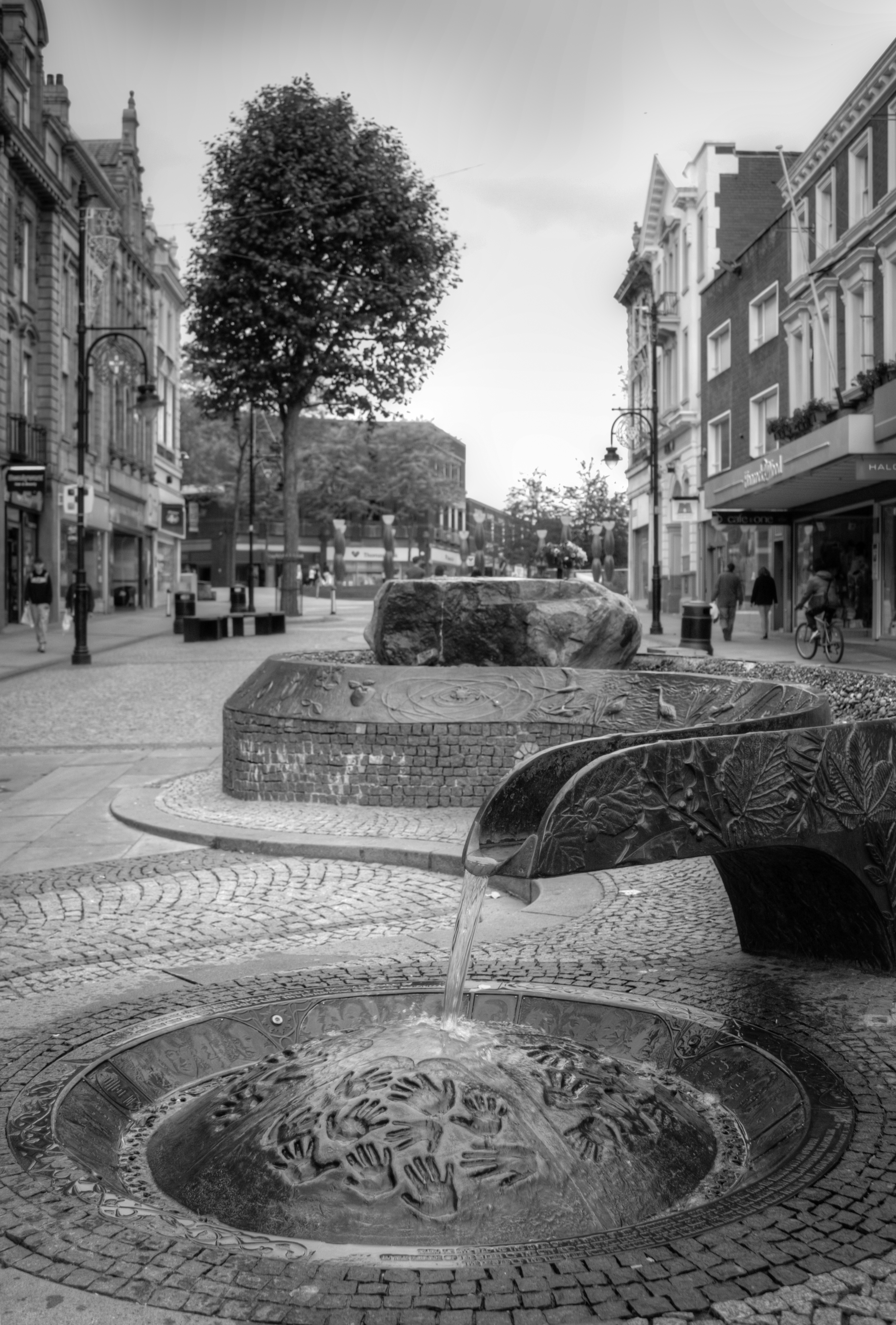
When I read that verse this week my mind went to a sculpture called The River of Life which runs down the main shopping street in Warrington. The sculpture was built by Warrington Council after two bombs were detonated by the IRA, killing 3 year old Johnathan Ball and 12 year old Tim Parry and injuring 56 others. It was the day before Mothering Sunday, March 20th, 1993.

The city council turned to a sculptor to discuss a memorial. Stephen Broadbent was the sculptor. He saw that the street was not just physically broken, but spiritually broken as well. He wanted to design something that would be “a symbol of renewal and faith in the power of the human spirit to triumph over adversity and to invest the future with hope.”

His inspiration was the image of the river of life in Revelation 22.
The angel showed me the river of the water of life, as clear as crystal, flowing out from the throne of God and of the Lamb down the middle of the great street of the city. On each side of the river stood the tree of life, bearing twelve crops of fruit, yielding its fruit every month. And the leaves of the tree are here for the healing of the nations.

And so it is. Now, flowing down that street is the River of Life  he made and on either side of the streaming water are trees, one for each month, each bearing fruits of the Spirit for the healing of the nations, for all times and seasons.

And so it is in Psalm 1 where the blessed are like a tree planted by streams of water bearing fruit in due season. I wonder that Stephen Broadbent himself is one of those trees, planted by the stream of tragedy and violence, leaving blessings of hope and healing through the season of trauma and grief.

I’ve seen photocards with these verses from Psalm 1. In them the stream is picturesque with sunlight reflecting from its gentle flow. The psalm doesn’t say the water is safe. 

The stream may be dangerous, fast flowing floodwater, a tidal wave, or deep or toxic. 

Or with a stretch of the imagination, the waters could be the waters that have to break for us to be born or baptised. 

Or the stream and the metaphor may be a metaphor for life.

Does the law of the Lord raise up people who delight in the law that there should be people by all the rough waters of life, that there should be lifesavers of healing, hope and blessing bearing fruit for all seasons of difficulty and danger?

It’s worth visiting that sculpture in Warrington. It’s on Bridge Street. It was always Bridge Street. The street hasn’t been renamed because of the sculpture and its intention to bridge the awful violence that tore people’s lives apart.

And here we are. The Bridges Group of Parishes – so called because of the bridges of the villages that make up the group of parishes. And the bridges are there to bridge the waterways that cut through the landscape.

We’ve reflected on Jesus’ position in relation to the crowds that streamed to him. We’ve reflected on the Psalmist’s position on those who delight in the law of the Lord.
We’ve reflected on the sculptor’s position in relation to the trauma of a community.
What about our own position?

Are we bridge builders and lifesavers? Do we delight in the law of the Lord, meditating on his law day and night? Are we blessed as agents of blessing, healing and hope? Or are we a curse on the poor, the stranger, the refugee, and all those vulnerable to losing their life at sea because we take our cues from the scornful, lingering in the way of sinners, taking the counsel of sinners?

Where are we as the river of life flows through our lives? Are we bridgebuilders offering healing where there has been division, hope where there has been despair? Are we like trees that bear the fruits of God’s Spirit, the fruits of love, joy, peace, forbearance, kindness, goodness, faithfulness, gentleness and self-control (against which no other law can stand) (Galatians 5:22f)? 

What is our position in relation to those Jesus blesses? Are we on their side, or are we on the side condemned by Jesus, with those who’ve grown rich at the expense of the poor, those who have stuffed themselves while so many go hungry, those who can afford to laugh while the rest of the world is in bits, those who walk the corridors of powers and still exclude, insult and reject others?

For as long as we delight in the law of the Lord, for as long as we seek to understand it, we will be on the side of those in the roughest of waters.

God’s work in broken community

Reflecting on Paul’s call to order and Jesus’ manifesto in the readings for the day, 1 Corinthians 12:12-31a and Luke 4:14-21 for the 3rd Sunday of Epiphany (C) for two small congregations in a lively/lovely group of parishes in rural Warwickshire. This post includes a video of Bishop Mariann Edgar Budde discussing her sermon that made headlines following President Trump’s inauguration service.

January 26th 2025

First of all, a note. I normally get round the problem of God’s pronoun by  using the name of God instead of a pronoun.  But, here, I am going to need a pronoun. There are many objections to using “he/him” because the name God is then linked with power, privilege and patriarchy – and the language we use about God needs to set God free from such associations, particularly in these days of right wing nationalism popularised by men such as Trump, Putin, Musk and Netanyahu. So, for this sermon, when I need to resort to God’s pronouns it will be she/her. I hope you will understand why.

In a world where God’s name is often associated with power, control, and patriarchy, using ‘she/her’ reminds us that God transcends these human limitations and works to free us from systems that seek to dehumanize and divide. It is not an attempt to redefine God’s essence but to challenge our projections of power. Forever God gathers the lost, gives strength to those who are weak, and honour to those who have been shamed and ashamed.

In the midst of controversy Paul has this to say to the troubled, disjointed community of Corinth. “We were all baptised by one Spirit so as to form one body – whether Jews or Gentiles, slave or free”. Here was a community facing all sorts of problems with all sorts of differences. Paul reminds them what God does in the middle of such a community. She brings us together to form one body from the splinters and divisions. She gathers us from far and wide and makes of us one body whatever the differences between us.

Paul stands in the middle of the conflict and witnesses to what God does. He reminds the community of the abundance of God’s gifts and the value and diversity of each and every one of them for the purpose of community building and reconciliation, reminding the body around him that every member needs every other body to fully function. 

Perhaps Paul remembered the prophecy in the valley of dry bones – a valley of untold war crimes from which the bones of those killed were left out in the scorching sun for the wild animals to pick the meat from. The sound from this valley overshadowed in death was the noise of a disjointed people overwhelmed by tragedy. “Our bones are dried up, our hope is lost” is what they said. (Ezekiel 37:11). Those bones speak of a people abandoned, dehumanised and rendered invisible. In that valley Ezekiel was made to tell the truth about what God does, how she undoes the shame by breathing life into the very bones of a community destroyed, dismembered and left to rot.


This is what God does. Even as we walk through the valley of the shadow of death, God brings us together. From the four corners of the world, Jews and Gentiles, slave and free, God brings us together in love in spite of differences between us. The Spirit that breathes life into the valley of dry bones is the same Spirit Paul saw at work amongst the Corinthians and is the same Spirit that unites us as the body of Christ, knitting us together from the corners of the world, and overcoming shame, division, and death itself.

You see, God remembers us. She remembers bodies that are broken, whether that be in the valley of dry bones, or the valley overshadowed by death, or communities torn asunder. 

Remembering for God isn’t simply a case of casting her mind back, as we would usually remember. God’s remember is always a re-creation, a bringing back together of what’s become disjointed and scattered, and making whole what has become broken. God’s remembering is a literal re-membering of the body, the remaking of community through the gifts of her Spirit.

This is, if you like, another creation story – the coming together of a people through the creativity of God’s Spirit. The Spirit remembers us as one body – connecting toe bone to foot bone to ankle bone to leg bone to knee bone to thigh bone.

So Paul reminds the broken body around him that God has remembered them. God has remembered their broken body. “God has placed the parts in the body, every one of them” – just as she wanted them to be.

He goes on: “God has put the body together so that there should be no division in the body.” This is what God does and this is why God does it. God knits us together in love to be a strong body, a resilient body, a withstanding body, a body that can stand, even in the valley overshadowed by death.

This is what God does. She puts the body together.  

And this is what she does as a rule. She gives “greater honour to the parts that lacked it”. The rule of God is always to put the last and the least first. Here we see that rule being followed again with greater honour given to the parts that lacked it so that those parts which seemed weaker become indispensable and those parts thought less honourable are treated with special honour. This is how God remembers her people. This is what God builds a body for.

This is not just a spiritual gathering; this is a body meant for action. To be bound together by the Spirit is to be called into the work of justice, to bring good news to the poor, freedom to the prisoners, sight to the blind and liberation to the oppressed. This is the body God is building: a body that stands in stark contrast to the systems of division, hatred and shame that continue to pull our bodies apart.

We are the body God is building – here today listening to the body God prepared for us, listening to Jesus as he finds the body’s purpose revealed through the prophet Isiaiah to read to his fellow villagers in their synagogue in Nazareth.

The Spirit of the Lord is on me, because he has anointed me to proclaim good news to the poor. He has sent me to proclaim freedom for prisoners, and recovery of sight for the blind, to set the oppressed free, to proclaim the year of the Lord’s favour. 

Mariann Budde is a member of the body of Christ, gifted to be Bishop of Washington, president within a community God has brought together. It was her responsibility to preach at the prayer service in her cathedral. She preached the only way she could appealing to President Trump for mercy for those afraid because of the policies of the incoming president – those who are gay, lesbian or trans, and immigrants being targeted for deportation. Trump should not have been surprised by her appeal. She was only embodying the very work of the body of Christ. In a time when power is often wielded by shame and divide, the body of Christ cries out on behalf of the oppressed, the disempowered and broken. This is the DNA of the body of Christ. This is all God brings us together for. This is what we are gifted for. We can do no other.

Closing prayer

God of unity, you breathe life into us and call us to be one body in Christ. We thank you for the gifts you’ve placed within each of us, and we ask that you strengthen us as a community, that we may bear witness to your love. We pray for healing where there is division, for hope where there is despair, and for courage to stand with the broken and the oppressed. May your Spirit unite us in justice, peace, and compassion. In Jesus’ name, we pray. Amen.

Finding Unity in January’s Gloom

2nd Sunday of Epiphany (C) – part of the Week of Prayer for Christian Unity. The readings for the day are 1 Corinthians 12:1-11 and John 2:1-11.
January 18th 2025

How’s your January going?

I’ve heard January described as “one long Monday”.

Dare I ask, how are the new year’s resolutions going? Are you keeping them, have you lapsed or have you forgotten what they even were?

We’re quite self-centred in our resolutions aren’t we? They tend to be centred on what we are going to do for ourselves and on our own. We tend to set the resolutions on our own. On our own we tend to set personal goals without deeper reflection on the greater needs around us. Our resolutions can be shockingly disconnected from our shared reality, such as the climate crisis, the migration crisis and the cost of living crisis.

And we make the resolutions at the time of the year we’re in the worst shape to keep them, in the gloom of January, when we’re often under the weather, whether the “weather” be the worst cold of the year, or whether “the weather” be our personal health, suffering flu or the worst cold of the year. Our resolutions are fragile. Our resolutions, if they could choose, would appreciate a February start, not a January one!

Tomorrow is Blue Monday, supposedly the most depressing day of the year. I wonder whether the likely failure of our resolution is a factor in this, alongside the cold, the credit card bills, the dark nights etc etc.

Our Sunday worship is our opportunity to reorientate ourselves in these days of darkness. The season of Epiphany takes us through January to February 2nd and gives us one epiphany after another, to help us to find our way and strengthen our resolve. There is one revelation after another.

Last Sunday it was the voice of revelation from the heavens when Jesus was baptised. Today it’s the changing of the water into wine and Mary’s instruction to the stewards to do what Jesus tells them that is the revelation. John writes: “What Jesus did here in Cana of Galilee was the first of the signs through which he revealed his glory.” These signs are revelations of God’s glory in the world – a new way of seeing and being in the world.

And, in our reading from Paul’s letter to the Corinthians, all the gifts of the Spirit to a troubled community are a manifestation of the Holy Spirit of God working through that community for the common good. “There are different kinds of service but the same Lord. There are different kinds of working, but in all of them and in everyone it is the same God [we see] at work”.

Paul sets out his reason for writing to the Corinthians (in 1:10). His purpose was “to appeal to you, brothers and sisters, by the name of our Lord Jesus Christ, that all of you be in agreement and that there be no divisions among you, but that you be united in the same mind and the same purpose. Paul’s appeal for unity isn’t just a call for believers to find agreement, but for them to see beyond their own individual desires and divisions. 

The gifts of the Spirit Paul talks about are not meant to isolate or empower individuals but to strengthen the body of Christ. The gifts of the Spirit are for the common good. Paul’s list reminds us that unity is not about sameness, but about recognising and celebrating the diversity of God’s work in us. Seeing that is a revelation of God’s glory in the church. Not seeing that reveals God’s powerlessness, even in the church where Jesus is supposedly lord.

Yesterday marked the beginning of the Week of Prayer for Christian Unity, a week of prayer when we pray that we will pray along with Jesus for all who believe in him that they (we) may be one and that they (we) “may be brought to complete unity”. That was Jesus’s prayer that we are called to join this week in particular. It’s a prayer to withstand our horrible histories and to find resolutions to all that divides us. It’s not a prayer for doctrinal unity but is a practical commitment to reconciliation and understanding. The prayer for unity which we are called to join Jesus in is prayer for the kind of unity which reveals God’s love to the world, a unity which transcends the personal, political, racial and denominational divisions of our horrible histories.

Jesus knew that then, when his prayer for unity was answered that that would be epiphany and revelation. “Then the world will know that you sent me and have loved them even as you have loved me.” (John 17:20-23)

The Roman Catholic Church are keeping 2025 as a Jubilee year. It sounds notes of joy and jubilation in our calendar. Every 25th year is kept in jubilee picking up on Jubilees referred to in Leviticus when the 50th year became a time for putting the economy right. Indentured servants were released from servitude, debts were forgiven and everyone was returned to their property. Imagine the jubilation!

This 2025 Jubilee was proclaimed in the papal bull, the title of which translates as “Hope does not disappoint”.  The motto for the year is “Pilgrims of Hope”. That is to be their resolution. Jubilee begins with the opening of the doors of the basilica in the Vatican. On Christmas Eve, Pope Francis knocked on the holy door of St Peter’s basilica. The door was swung open and Francis rolled through in his wheelchair.. There are four such doors in the Vatican. On the Feast of Stephen, December 26th, a fifth door was opened. This was the door of the prison in Rebibbia in Rome and this was intended to serve as a symbol “inviting all prisoners to look to the future with hope and a renewed sense of confidence”. In other words, this was another epiphany – a revelation of how the prisoners, and ourselves, can see ourselves and one another differently because of the glory of God in the world.

I have included their logo of the Jubilee on the sheet of readings. The four figures come from all corners of the world. They represent all people that on earth do dwell. They embrace each other as they hold on to the cross which anchors them in hope as they (we) navigate rough seas as pilgrims of hope.

Is this an image we can take with us into this special week of prayer and even, with fresh resolution, into the rest of the year? How will we embody the unity which Jesus prayed for? How can we be signs of his love? How can we resolve our differences and conflicts? How can we align ourselves with God’s greater purpose? It won’t be in our own strength. None of us are resolute enough for that. To change the world God’s Spirit wants to work through us, strengthening our resolve to do his will.

Wherever is Jesus? Where in the world is Jesus? Where on earth is he? Questions for the search team

A reflection on the loss of Jesus for the first Sunday of Christmas (year C). The gospel is from Luke 2:41-end when Joseph and Mary lost Jesus.

Crèche, December 2023, Evangelical Lutheran Christmas Church, Bethlehem. Photo: Munther Isaac

Today is the 1st Sunday of Christmas. Christmas is far from over as we revel in its meaning for us. Tradition has given us the 12 days of Christmas. Today is the 5th day.

What did my love give me on the 5th day? I’m sure someone will sing the answer.

What’s that all about? Maybe we can guess the significance of the 4 calling birds, the 3 French hens, the 2 turtle doves, and the partridge in the pear tree. Can we?

But what are those 5 gold rings, the four calling birds, the three French hens, the two turtle doves and the partridge in a pear tree?

We see the five rings flying on the Olympic flags, bringing separated nations to play games to bring the world together. Five gold rings, each one representing a continent, all of them representing the whole world. On this 5th day of Christmas, has my true love given me the whole world?

On this 5th day of Christmas our true love gives us this story of Jesus staying behind in Jerusalem and the worry he caused. It leaves us with the question “where in the world is Jesus?” “Where on earth is he?”

This story isn’t told in the other gospels. Luke uses the story to transition from the story of Jesus’ birth to the bigger story of Jesus’ ministry. Instead of staying with his parents for their journey home to Nazareth from the temple festival in Jerusalem Jesus stays behind.

The story gives us Jesus’ first words and they’re the words I suggest we focus on this morning – just in case we lose Jesus and struggle to find him.

We can perhaps all relate to the panic of losing someone in the crowd – so we can relate to what Mary and Joseph must have felt when they realised that Jesus was no longer with them. They thought he was walking back with their relatives or friends but he wasn’t to be found amongst them. They had to go back to Jerusalem to search for him. After three days they found him in the temple courts, among the teachers, listening to them and asking questions.

Remember, this is the beginning of Luke’s gospel. What’s at the beginning of the gospel should remind us of what’s at the end and fulfilment of the gospel, and vice versa. In the end there is another walk – from Jerusalem to Emmaus. Two people walking along the road, talking together about what had happened  – and joined by a third person who turns out to be Jesus. At the beginning of the gospel there were two walking together only because one had separated himself from them. In the fulfilment of the gospel there are three only because one had joined the two.

This is the gospel of Jesus being found in the gospel of the lost and found.

In both stories it takes three days to find Jesus, and three days is a hell of a long time to have lost someone. It was in the breaking of the bread that Jesus had become known to the two disciples in Emmaus. Subsequently he is found in his speech of just four words: “Peace be with you” (24:36) and recognised in his wounds. And this is where Jesus has been found in the church ever since: in the breaking of bread, wherever the greetings of peace are heard, and in the wounds he bravely bears These are the places to look for Jesus. This is where we find Jesus.

Now, that’s a lot to say about the end of his life, particularly as it’s the fifth day of Christmas and we’ve still got the nativity set up in our homes and minds. But already at Christmas we have a birth as well as a death and resurrection. One draws attention to the other in Luke’s telling of them.

Back to the beginning with Mary and Joseph being cross with Jesus. “Son, why have you treated us like this?” And Jesus’s reply to them, “Why were you searching for me? Didn’t you know I had to be in my Father’s house?” These are Jesus’ first words in the gospel of Luke. “Didn’t you know I had to be in my Father’s house?” But they didn’t know what he was saying to them.

This is the question I hope stays with us on this 5th day of Christmas, as we leave one secular year behind and are about to enter another – with fresh resolution to find Jesus wherever he may be – with a commitment to finding him and following him.
Where do we find Jesus?
Where do we find Jesus when we’ve lost him?
Where do we find Jesus when he’s stayed behind?
Why does he stay behind rather than going with us?

Mary and Joseph didn’t understand Jesus’ question. Luke tells us they didn’t understand what he was saying to them. Translators have struggled to capture Jesus’ meaning and have offered an alternative in the footnotes of the NIV – Did you not know I had to be about my Father’s business? But they thought he was in the family business – carpenters for the poor families of Nazareth – Joseph & Son.

But we don’t read the question “did you not know I had to be about my Father’s business? “. We read “Didn’t you know I had to be in my Father’s house?” The question is important because it is a question about where in the world Jesus can be found.

The translation in my Father’s house doesn’t quite seem right. Firstly it suggests the place Jesus can be found is so limited, and secondly it suggests Jesus can be found in a building and that leads us to churchianity rather than Christianity – with church buildings and the institution of church being the place to find Jesus when we know there are so many who love Jesus who’ve not joined a church.

Does this work as a question of Jesus for all his followers, for those who’ve lost him and those looking for him? “Did you not know you’d find me in what my Father is building?” Or, “did you not know you’d find me in whatever my Father is building?” Is that the guiding question? Is that the question to guide our search? As we build our resolution for the New Year, is that the clue to intensify our search for Jesus in what his father, our father, is building?

A couple of chapters further on in Luke’s gospel we come to what is called The Nazareth Manifesto when Jesus read in the synagogue in Nazareth from Isaiah the words, “The Spirit of the Lord is upon me to bring good news to the poor. He has sent me to proclaim release to the captives and recovery of sight to the blind, to let the oppressed go free.” He commented afterwards, “Today this scripture has been fulfilled in your hearing.”

The word manifesto  means showing. Here is Jesus showing what he is about. He is about his father’s business. He is in whatever his father is building. It is on that building site we will find him.

They’ve built a shrine for Jesus in Bethlehem. It shows baby Jesus lying in a pile of rubble in the devastation of his people while Mary, Joseph, the shepherds, the wise men and ourselves search for him. It’s on the side of the altar at Bethlehem’s Lutheran Church. The pastor there, Munther Isaac, a prominent Palestinian peacemaker says that he wants the world to know that is what Christmas looks like in Palestine these days.

Where in the world is Jesus? Where on earth is he? These questions going through the minds of Mary and Joseph go through our minds too.

This is where to find Jesus, in the devastation, wherever there is oppression and suffering, captivity and blindness. 

He’s in the news – in the good news for the poor.
He’s in the sharing of bread.
He’s in the making of peace.
He’s among the wounded.
That is where to find him.

We need look no further.