Luke’s Last Surprise: One Condemned Man Joining Another as the First in Paradise

This Sunday marks the end of the Christian year.
Next Sunday we hop on the next liturgical cycle of readings – it will be Year A.
Each year focuses on a particular gospel. Next year it will be Matthew’s. This year it has been Luke’s.

When I began this preaching year, I wondered what Luke would offer us.
I wondered how he might inspire us, challenge us, lead us.
And now, at the end of the year, I find myself saying one thing above all: WOW.
Luke has surprised us. Luke has stretched us.
Luke has shown us the kingdom of God in places we would never have thought to look.

This Sunday is a WOW moment,
a hinge on which we hang our wonder,
before the new year opens again.
Next week we begin again,
not from cold, not from scratch,
but already warmed by hope,
already knowing what God’s kingdom looks like
in the dominion of darkness.

We will return to the manger
knowing now what Luke has shown us all year –
that God’s kingdom begins with the smallest,
with the least, with the last instead of the first,
in a vulnerable baby held by exhausted parents
on the edges of empire.

These are the readings (Colossians 1:11-20 and Luke 23:33-43) that crown our year.
And this is where Luke has been leading us all along:
not to a palace, but to the place of the skull,
Not to a gold throne, but to a wooden cross.
A king.
A sign nailed above his head.
And a thief beside him.
That’s the gospel picture.
That’s where Luke brings us when the year ends and we crown Christ our King.

Our other reading, from Colossians, may seem difficult at first –
until we recognise it as a hymn.
A hymn praising the God who rescues us from the dominion of darkness,
who strengthens us with endurance,
who qualifies us for the kingdom of his beloved Son –
the kingdom of light,
the kingdom where Christ is King.

Luke paints the scene.
It is the “dominion of darkness” (to use the phrase from Colossians).
The place is the place of the skull,
Death Row in the Dominion of Darkness:
there is the smell of death
and the overpowering smell
of cruelty, injustice and wrongdoing.
There are three crosses.
One is for Jesus, the others for two criminals crucified either side of him.

Luke gives them very different voices.
One sneers – placing him with those who mock, jeer and insult Jesus.
“He saved others, let him save himself if he is who he says he is.”
(In other words, he isn’t who he says he is.)
“Aren’t you the Messiah? Save yourself and us!”

The other criminal rebukes him, saying the two of them deserve their punishment.
Then he protests Jesus’ innocence. “This man has done nothing wrong.”
And in that moment he is just right.
He is right to defend the defenceless
against the forces which have conspired against Jesus.
“This man has done nothing wrong,”
and yet he is facing the same sentence, only worse,
because insult is added to injury.

Then he turns to Jesus.
“Jesus, remember me when you come into your kingdom”

This criminal is the first to defend Jesus publicly.
He is the first to take his stand with Jesus.
And Luke wants us to see him.
This figure.
This last, least, condemned man
who becomes the first to declare Jesus innocent
and the first to receive a royal promise.

He is the last person in the world you’d expect
to be the first to defend Jesus –
(we are led to believe that there is no honour amongst thieves),
but here he is in the picture of paradise – alongside Jesus.
The last becomes the first in paradise,
that kingdom of love –
a relationship, not a place.

And here – right here – you can almost see it happen:

And perhaps this is Luke’s final surprise for us:
that the first to enter paradise with the King is not a saint or a scholar or a faithful disciple,
but a criminal who can offer Jesus nothing but honesty and trust.

He offers no record of virtue.
No proof of goodness.
No last-minute achievements.
He can’t even lift his hands in prayer.
All he can do is speak the truth —
about himself, about Jesus, about the kingdom.
And Jesus takes that truth, that tiny seed of faith,
and makes it bloom.

“Today you will be with me in paradise.”

And that paradise begins there,
in the dominion of darkness,
with a king crowned not with gold but with thorns,
and a wrongdoer who sees more clearly than anyone else.

The only crown Jesus could ever wear is a crown of thorns.
They’re the thorns of scorn, the barbs of bitterness.
They’re our failures, our wounds, our complicity,
our inability to rule even ourselves.

But the kingdom Luke has been showing us week after week
is a kingdom where the last come first,
the lost are found
and where the crucified King gathers in his arms
those the world’s unjust powers condemn.

This is the WOW moment.
Everything has led to this,
when the thorns begin to flower.
This is what Luke is intent on showing us.

His sequel, Acts,becomes the story
of the cross in bloom.
The frightened disciples become bold and generous.
The failures become witnesses.
A crippled beggar stands up and walks.
An Ethiopian outsider becomes the first fully Gentile convert.
A persecutor becomes an apostle.
Prisoners sing hymns; jailers are baptised;
enemies share bread.

Again and again the thorns flower.
Again and again the barren places bear fruit.
Again and again the last become first.

This is where the King of Love leads us:
into a rule of life that puts the last first
and sees thorns flower with grace.

All year long Luke has shown us a kingdom that grows in unlikely places,
and now at the last,
he shows us the unlikeliest place of all,
the place of the skull, Death Row.
Yet even here, if we look through Luke’s eyes,
Something ]begins to bloom.

At the place of the Skull grows the tree of life.
The crown of thorns flowers with grace.
The King of Love
and the convicted criminal
become the first couple in the new creation –
the first to walk the way of mercy,
the first to step into the garden of God’s future.

This is how the Christian year ends:
not with worldly triumph,
but with this strange, saving beauty –
a King who makes the last first,
who turns a place of execution into a place of promise,
who opens paradise to the least likely of all.

This is the kingdom of God and the gentle thorn-crowned rule of Jesus.

Luke 23:33-43

When they came to the place called the Skull, they crucified him there, along with the criminals – one on his right, the other on his left. Jesus said, ‘Father, forgive them, for they do not know what they are doing.’ And they divided up his clothes by casting lots.

The people stood watching, and the rulers even sneered at him. They said, ‘He saved others; let him save himself if he is God’s Messiah, the Chosen One.’

The soldiers also came up and mocked him. They offered him wine vinegar and said, ‘If you are the king of the Jews, save yourself.’

There was a written notice above him, which read: this is the king of the jews.

One of the criminals who hung there hurled insults at him: ‘Aren’t you the Messiah? Save yourself and us!’

But the other criminal rebuked him. ‘Don’t you fear God,’ he said, ‘since you are under the same sentence? We are punished justly, for we are getting what our deeds deserve. But this man has done nothing wrong.’

Then he said, ‘Jesus, remember me when you come into your kingdom.’

Jesus answered him, ‘Truly I tell you, today you will be with me in paradise.’
LimpLight

This one’s for all who wrestle in the dark and rise, blessed but limping, inspired by reading Genesis 32:22-31 and Luke 18:1-8 – the Revised Common Lectionary readings for October 19th 2025.

How shall we describe the state of Israel today?

The state of Israel today begins with both our readings —
from Genesis 32, the story of Jacob whose name means twister;
and from Luke 18, the story of the widow struggling for justice.

The state of Israel begins at the end of a night of struggle for the twister,
a night of struggle in which Jacob never discovers
the name of the one he’s wrestling with,
but finds himself called by a new name — Israel.

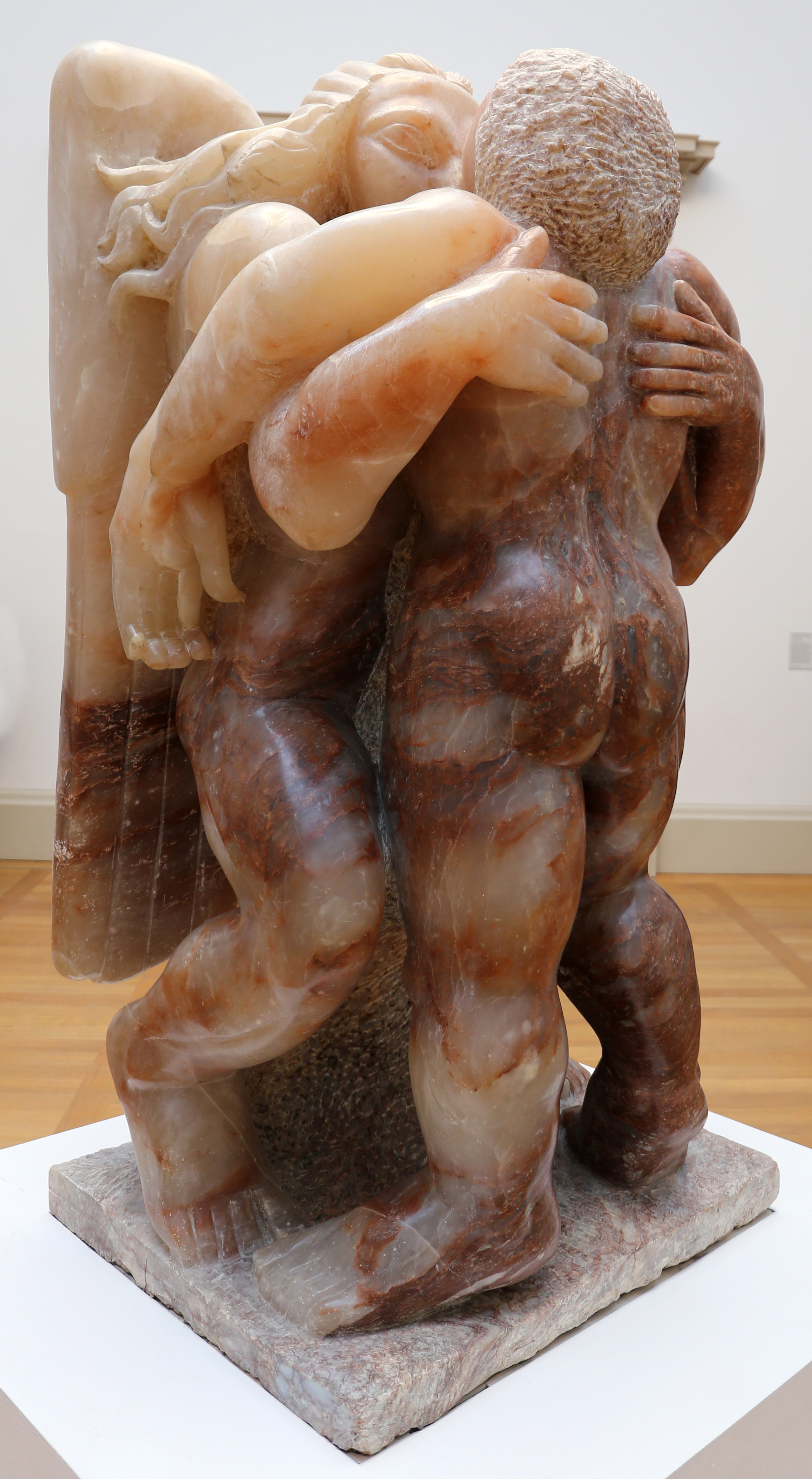
Jacob’s struggle as portrayed by Sir Jacob Epstein (shown in Tate Gallery, London)

Israel struggles with God,
and God struggles with Israel.
That is the very meaning of Israel.
If Israel means anything,
it means struggling with God.

Jacob is the first to be called Israel,
and he is called (renamed) that by the one he struggled with
because he “struggled with God and with people”
and withstood the whole night.

It is the calling of Israel to struggle faithfully through the night.

Jacob is the patriarch of Israel —
the patriarch of those who struggle with God and with people,
and who carry on wrestling through long nights and times of darkness
without being overcome,

people like the widow singled out by Jesus —
a victim of some injustice.
In the face of an utterly unjust justice system,
personified by a judge who neither feared God
nor cared what people thought,
she struggled.

For some time she struggled.
She kept coming at that lousy judge.
She wouldn’t let go until he gave in.

Those who struggle through the night,
with God and with people —
those who struggle to see the night through,
for whom the night is very dark,
and for whom there is little daylight,
those who won’t give up whatever the night brings —
they are the ones whose hope is rewarded.

They carry a blessing for all who wrestle with God
and with the wounds people inflict.

It’s the blessing of God
who himself wrestles through the darkness of the world,
who struggles with people and the suffering they cause,
but who, in spite of all that,
wrestles the whole night long.

This is the love that shines in the darkness
to the break of day.

And yet, the night is long.
Not just one night in Jacob’s life,
not just one night in ours,
but the long night of the world —
a night as long as history.

Through that long night we wrestle,
and God wrestles with us.

There are three struggles woven into this story,
and all three belong to Israel:

We struggle with God.
We struggle with people —
and people struggle with us.
And through it all,
God struggles with us.

That’s what it means to be called Israel:
to live the long night of wrestling,
and to trust that, at the end of it,
there will still be blessing.

The struggle with God

Sometimes it’s the long silence of prayer —
when we ask and wait and hear nothing.
Sometimes it’s the ache of loss,
or the questions that faith won’t easily answer.
We wrestle with God when life doesn’t fit the promise,
when love feels hidden,
when blessing comes only after a wound.

But still we hold on.
Faith is not certainty —
faith is the grip that will not let go until morning.

The struggle with people

And we wrestle with people too.
Not just those who hurt or wrong us,
but in all the difficult ways love tests us —
learning to forgive, to be patient,
to stay kind when we’d rather give up,
to bear with one another’s weakness.

People struggle with us too —
our faults, our sharp words, our stubbornness.
We are all part of each other’s wrestling.

These are the struggles that form the fruits of the Spirit —
the quiet strength that grows only in the dark:
patience, gentleness, self-control,
love that endures through the night.

The struggle with ourselves

And maybe there’s a fourth struggle too —
the one Jacob knew best —
the struggle with ourselves.
The fight to face what we’ve twisted,
to tell the truth about who we are,
and to accept the new name that grace gives us.

Before we can meet God face to face,
we have to face ourselves in the dark —
the parts we’d rather not see,
the wounds we’ve caused as well as borne.
Even that struggle can become blessing.

The struggle of God

And through it all, God struggles too —
not against us, but for us.
God wrestles through the night of the world,
bearing our pain,
refusing to give up on us.
The cross itself is the mark of that struggle —
God’s own wound,
the divine limp that still bears the weight of love.

This is the love that shines in the darkness
to the break of day.

Jacob wanted to know the man’s name,
but the man would not tell him.

Maybe that’s the mercy of God —
that we never get to hold the name too tightly.
The namelessness keeps the struggle open.
It reminds us that this wrestling is for everyone,
that God stands with all who struggle through the night —
beyond borders, beyond certainty, beyond control.

It was not for ease that prayer shall be.
The story of Israel is not the story of the untroubled.
The story of Israel is the story of the very troubled —
the story of slavery, exile, persecution,
the horrors of history, the nightmare.

Amos got it right three thousand years ago.
He condemned the complacent,
those who are at ease in Zion.
He said they put off the day of disaster
and bring near a reign of terror.
They are not fit to be called Israel.
They duck the fight and ignore the struggle.

But Jacob did not.
The widow did not.
And the God who wrestles through the night does not.

Jacob’s blessing comes with a wound.
He carries it into the dawn,
every step a reminder of the night he endured
and the God who would not let him go.

Perhaps this is the mark of the blessed —
not the ones who have had an easy time of it,
but the ones who have been wounded and changed.
The ones who know that life is not straightforward,
that faith is not certainty,
and that love costs something real.

Israel limps into the sunrise,
blessed and broken.

And still, the night is long —
as long as history,
as wide as the world.
Still, God wrestles with us,
still struggles with his people,
still bears our wounds,
and still blesses us.

And when the dawn comes —
as surely it will —
the blessing will not erase the limp,
but redeem it.

For the love that shines in the darkness
will shine until the whole world
limps into the light.

Afterthoughts
What might it mean for a people, or for a church, to be known by its limp – to be blessed not in strength but in struggle?
If God still wrestles through the long night of the world, where do you see that struggle – and that love – happening today?

Border Crossing: the dangerous way of grace

Our politics, like our hearts, are haunted by borders and fear. But Luke’s gospel shows Jesus walking the edge — not to keep people out, but to draw them in. Preached in a week when fragile talk of a ceasefire in Gaza flickers across the news, this reflection on Luke 17:11–19 and 2 Timothy 2:8–15 explores what happens when the unchained word of God crosses the lines we draw, healing what fear divides.


Jesus is on his way to Jerusalem, travelling along the border between Samaria and Galilee.
This is what Luke wants us to notice —
that Jesus is on the edge, not in the middle.
He’s on the edge where belonging is uncertain.

In nature, the edge is often where life is richest.
When two landscapes meet — forest and field, land and river —
there’s a place called an ecotone.
It’s a place of tension, yes,
but also of surprising life,
where species from both sides mingle
and new life appears.

Perhaps that’s why Jesus walks the edge —
because that’s where new life is breaking out.

We’ve all walked that edge:
in the playground,
the first days in a new job,
moving into a new community —
will we be included, will we settle?

Luke introduces us to ten lepers,
forced to live on that edge
by their communities who have wrenched them from home,
from all they’ve ever known, by one word — Unclean.

They are the wrong side of the border,
cast over the edge —
and that’s why they have to shout to Jesus.
They have to get their word across that boundary.

This is how Jesus gets to Jerusalem —
by walking the edge,
the dangerous way,
where grace and fear meet,
where the kingdom begins to break through.

But not every edge is walked the same way.
Our leaders keep pointing us to the edge too —
the edge of our borders, our safety, our identity.
They edge us with fear.
They tell us who to blame, who not to trust,
who belongs, and who should stay outside.

And we see again what happens
when fear builds its own borders.
Across the news this week —
the fragile talk of ceasefire,
the first steps toward peace in Gaza —
we glimpse what it costs to live so long
behind walls of pain and suspicion.

Every side has its wounds,
every border its fear.
And yet even there,
the smallest word of peace,
the tiniest crossing of compassion,
is a holy thing.
It’s where grace dares to walk the edge again.

And that’s the challenge for us, too.
Because we all have borders of our own —
those quiet lines we draw in our hearts,
between those we find easy to love
and those we keep at a distance.

The question is:
whose edge are we walking?
The one that fear builds,
or the one Jesus blesses —
the edge where healing begins?

Fear has its own language,
and it spreads easily.
You can hear it in the way people talk,
the way headlines shout,
the way words build walls
long before bricks ever do.

That’s what happened to the ten lepers.
They were pushed to the edge by words —
words that said Unclean,
words that exiled them from home,
from family, from touch.

And now they have to shout from a distance,
just to be heard —
their voices straining across the border,
trying to bridge the gap
that other people’s words created.

And Jesus sends a word back.
No touch, no ceremony —
just a word that crosses the border:
“Go, show yourselves to the priests.”

And as they go, they are made clean.
The word runs free.
It doesn’t stop at the boundary;
it heals as it goes.

Paul once wrote, chained in a prison cell:
“I may be in chains,
but the word of God is not chained.”

It’s the same truth here.
The unchained word runs ahead of Jesus,
crossing the lines that fear has drawn,
healing what twisted speech has broken.

This isn’t the first time Luke shows us Jesus on the edge.
From the very beginning, his gospel has been about
the outsiders God draws in.
It’s Luke who tells of the shepherds —
night workers, unclean in their own way —
hearing angels sing of peace on earth.
Luke remembers the woman who wept on Jesus’ feet,
the prodigal welcomed home,
the beggar Lazarus lifted up,
and another Samaritan —
the one who stopped on the roadside to bind up wounds.

In Luke’s world,
the people we push aside
become the very ones who show us what mercy looks like.
And here again, it’s the Samaritan —
the one no one expected —
who becomes the model of faith,
the first to come home to God.

But one turns back.
One crosses the border again.
He’s the foreigner —
the one who, by every rule, should have stayed outside.
Yet he comes closer,
falls at Jesus’ feet,
and his first word isn’t a cry for help,
but a word of thanks.

Ten were made clean —
but only this one is made whole.
Because healing isn’t complete
until it finds its voice in thanksgiving.

That’s the word Jesus has been waiting for —
not Unclean, not Go away,
but Thank you.
A word that restores relationship,
that binds what fear has torn apart.

The Samaritan becomes the first citizen
of this new borderland kingdom —
a kingdom without fences,
where mercy is the mother tongue.

And maybe this is what it means
to follow Jesus on his way to Jerusalem —
to walk the edge,
not the safe, well-marked path,
but the dangerous way,
where love meets fear
and refuses to turn back.

Because that’s where the unchained word still runs free —
crossing borders,
breaking through divisions,
making strangers into neighbours,
and outcasts into brothers and sisters.

Prayer

May the Christ who walks the edges
find us there —
where fear builds walls
and grace dares to cross.
May his word set us free
to speak peace,
to live thanks,
and to walk the dangerous way of grace.

What should we do? Everybody’s asking according to Luke

This sermon is for the 3rd Sunday in Advent (C) prompted by a question everyone seems to be asking in Luke. The question being what should we do? It’s prepared for two small churches I’m helping out in a vacancy. The gospel reading is Luke 3:7-18 (the text is at the end of the post).
December 15th 2024

What should we do? That question keeps cropping up.

Three times we hear that question in today’s reading. Luke pictures three audiences of John the Baptist. There’s the “the crowds”, there’s the “tax collectors” and there’s “the soldiers”. Each of those audiences ask the same question. “What should we do?”

Before being specific John had already told them to bear fruits worthy of repentance while also saying they couldn’t take their place in God’s kingdom for granted just because they had Abraham as their ancestor. They needed to repent.

“What should we do?” It’s a question which keeps cropping up in Luke/Acts. As well as the crowd, the tax collectors and the soldiers featured in today’s gospel, it’s a question asked by:

  • A lawyer asking “what must I do to inherit eternal life?” (Luke 10:25)
  • A rich man worrying about his abundant crops, “what should I do, for I have no place to store my crops?” (Luke 12:17)
  • An unscrupulous agent  getting sacked: “what will I do, now that my master is taking the position from me?” (Luke 16:3)
  • A rich ruler asking Jesus “what must I do to inherit eternal life?” (Luke 18:18)
  • The owner of the vineyard asks “what shall I do?” (Luke 20:13)
  • The Jews in Jerusalem for Pentecost asking the disciples “what shall we do?” (Acts 2:37)
  • A jailer asking Paul and Silas (what must I do to be saved?” (Acts 16:30)
  • Saul (aka Paul) asking Jesus “What am I to do Lord” (Acts 22:10)

I list these examples to highlight how important this question is to the people of God. The same question asked time and again through Luke/Acts: “What should I do?” And every time the answer comes back that they have to do things differently, and radically so. 

Significantly the question crops up at the beginning of both volumes of Luke’s work. It’s there in today’s gospel, and it’s there at the beginning of Acts. John the Baptist answers the question in the gospel. Peter answers the question in Acts.

John’s answer is that they should bear fruits worthy of repentance. Peter’s answer is that they should be baptised, and that day, 3,000 were, and they devoted themselves to the apostles’ teaching and fellowship. Luke comments: “all who believed were together and had all things in common; they would sell their possessions and goods and distribute the proceeds to all, as any had need.” In other words, here were people bearing fruits worthy of repentance.

I’m sure that Luke wanted this question to hang over all his readers. Why else would he keep repeating it? What should we do?

What should we do to count in the kingdom of God where the rule is to love God wholeheartedly, to love our neighbour as ourselves (whether we are like them or not) and to realise that those who come last in the ways of the world, and those who are counted least come first, and those usually first, come last?

Repentance means that we make a turn in our lives, that we turn ourselves round from self-ishness, self-satisfaction, self-absorption and self indulgence so that we see God and our neighbours face to face. Repentance means turning back, re-turning to where we started – loved by God from the beginning. Repentance means we change our ways and our minds with the result that we will do things very differently and see one another very differently.

I was saying last week that we might have focused so much on our forgiveness that we don’t see anything wrong with us. We might feel that we have done little wrong. But there are those we’ve wronged, those we’ve hurt, those we’ve taken advantage of, those we’ve demeaned and those we’ve neglected – and those who are frightened of us. Yes, the question is for us too. What are we to do?

I’ve looked at the three groups of people featured in today’s gospel. They have something in common. They are all potentially menacing, dangerous and harmful. The soldiers were obviously in a position where they could extort money by threats, could take backhanders and could blackmail people – and many probably did. Woe betide their vulnerable victims. John tells them to be satisfied with their wages and not to extort money from anyone by threats or false accusation.

The tax-collectors were obviously in a position where they could collect more in tax and make money for themselves at the expense of people who were reduced to poverty by the excessive triple tax demands of empire, state and temple. Woe betide you if you were on the wrong side of the tax-collector. Remember Zacchaeus. He admitted to Jesus that he’d wronged people – and in penitence offered to repay what he’d wrongly taken four times over. John tells the tax-collectors to collect no more than is their due.

Then there’s the crowd. How menacing is the crowd. How quickly can a crowd turn nasty by a single word, or a rumour? How toxic can groupthink be – how fearful it can be – and how demeaning and controlling the supposed crowd can be. You know when you’re told “everyone is saying”, “everyone thinks”, “everyone knows” that the virtual crowd has your back against the wall. Even when Christians say “Christians believe in x, y or z” when they know not all Christians do – that is crowd behaviour designed to intimidate and control others into conformity.

The crowd is the place to hide in. The crowd is what we follow so often. The crowd is what condemned Jesus – one day praising him and the next cursing him. The way John tells them to change is to be kind and generous: “whoever has two coats must share with anyone who has none; and whoever has food must do likewise”.

So, what should we do? What does repentance mean for us? It means we have to keep changing, changing our minds, our attitudes and our behaviours. And there is no place better to start than with our gospel reading.

We’ve noted how dangerous and harmful those three groups are – and why. The crowd, the tax-collectors, the soldiers were all people that those who come first in the kingdom of God – the last and the least – the most vulnerable are the most likely to be a major cause of their suffering. In other words, they were their enemies.

But watch what Luke does with them in the telling of his gospel. He shows that they’re not written off. He shows that they are capable of repentance. He shows them redeemed. They (at least some of them) come to be saved and become “true children of Abraham”. 

Here is one of the “enemy”.

Several soldiers feature in Luke’s writing. There was the centurion who asked Jesus for help whose faith, Jesus said, was like the faith he’d ever seen in Israel. It was one of the centurions at the crucifixion who stood out from the crowd  who praised God for Jesus believing “certainly this man was innocent.” (23:47) And right at the end of Luke’s work it was a soldier who stood up against his fellow soldiers to spare Paul’s life after their ship had run aground off the shores of Malta. (Acts 27:42, 43).

Here are some of the enemy.

Luke can even demonstrate the repentance of the crowd, those thousands who heard the word from Peter at Pentecost. They repented and produced fruits worthy of repentance. They devoted themselves to the apostles’ teaching and fellowship. They were united and held everything in common. They would sell their possessions and goods and share the proceeds as any had need.

Here was a crowd to love. And Luke comments that they had “the goodwill of all the people”. The gospel of Luke is so inclusive. There is good news especially for our enemies. 

For that very reason we need to change the way we see our enemies.

What shall we do?

Here’s something we can do.
Those who can harm us,
those who can exploit us,
do not condemn them
with our fearful judgement
(dangerous though those enemies are).

Instead, leave a window open
for the word of God
which from the beginning
spreads the table
even with my enemies present
so making all things possible.

Yes, we’ve been drilled
to hate our enemies,
but don’t let that fool us
or crowd our minds
so we can’t see
the possibility of change.

The word made flesh
suffered all his enemies
could throw at him.
Every stone became a prayer
as the word of God

came near for us to hear
that word “Repent” and change.
It’s our turn to turn Jesus’ way.
That’s what we can do this day
love the enemies that come our way
till some turn the kingdom way, the only way
to save ourselves from ourselves.

Luke 3.7-18
7   John said to the crowds that came out to be baptized by him, ‘You brood of vipers! Who warned you to flee from the wrath to come?
8  Bear fruits worthy of repentance. Do not begin to say to yourselves, “We have Abraham as our ancestor”; for I tell you, God is able from these stones to raise up children to Abraham.
9  Even now the axe is lying at the root of the trees; every tree therefore that does not bear good fruit is cut down and thrown into the fire.’
10   And the crowds asked him, ‘What then should we do?’
11  In reply he said to them, ‘Whoever has two coats must share with anyone who has none; and whoever has food must do likewise.’
12  Even tax-collectors came to be baptized, and they asked him, ‘Teacher, what should we do?’
13  He said to them, ‘Collect no more than the amount prescribed for you.’
14  Soldiers also asked him, ‘And we, what should we do?’ He said to them, ‘Do not extort money from anyone by threats or false accusation, and be satisfied with your wages.’
15   As the people were filled with expectation, and all were questioning in their hearts concerning John, whether he might be the Messiah,
16  John answered all of them by saying, ‘I baptize you with water; but one who is more powerful than I is coming; I am not worthy to untie the thong of his sandals. He will baptize you with the Holy Spirit and fire.
17  His winnowing-fork is in his hand, to clear his threshing-floor and to gather the wheat into his granary; but the chaff he will burn with unquenchable fire.’
18   So, with many other exhortations, he proclaimed the good news to the people.

Patara Beach

Patara

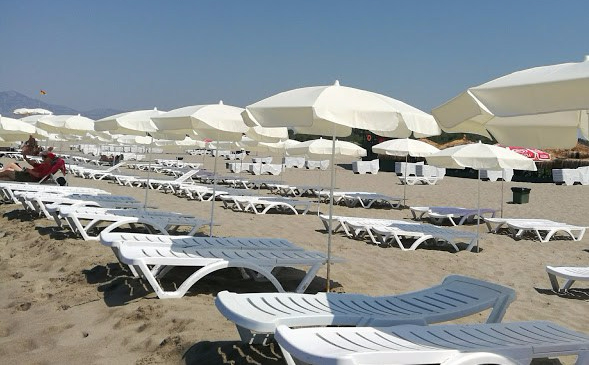
On this beach sound and sand we lay ourselves to rest:
an annual punctuation, a colon and breathing space,
kindling and basking delighted by overlapping waves
of welcome: a silver thread in tiredness’ tapestry.

Tourists and turtles take their turns digging to cool sand
for new generation; young engineers make their marks
and build playful fortifications without calculation,
fear or hope of castles not withstanding nature’s storms.

Backed by wholesome sun I chase my shadow along the shore.
The load lightens. My trace disappears. Crabs sidle home.
A stranger nods a Merhaba in my direction looking out
another place and pace: life less dash or need for colon.

A far cry comes from the harbour, long silted and stranded
in history and imagination. “Phoenicia bound?”,
the ship’s master’s call to those piering their next purpose
and horizon, and those otherwise beached and bedraggled.

Luke, a passenger, packs a gospel for this new ark
with his two by twos, his hims and hers, his young and old,
his Jew and Greek, and Paul, his complementary pair embark,
Turks off Patara beach, where the sun shines after storms.

PS. References:
Merhaba is the Turkish greeting “hello”.
Luke and Paul changed ships at Patara.

And so, with the tearful good-byes behind us, we were on our way. We made a straight run to Cos, the next day reached Rhodes, and then Patara. There we found a ship going direct to Phoenicia, got on board, and set sail. Cyprus came into view on our left, but was soon out of sight as we kept on course for Syria, and eventually docked in the port of Tyre. While the cargo was being unloaded, we looked up the local disciples and stayed with them seven days. (Acts 21:1ff)

A turnaround

And so we set sail from Patara. Well we flew home from our holidays actually.

We arrived in Patara fairly wrecked, but left refreshed and restored, thanks to the place, its people, many friends and a great climate. We thrived on the wonderful welcome and service we had (particular thanks to Nadi and Mehmet at Golden Lighthouse). Nothing is too much trouble for the lovely people of this quiet village. I wonder how deep rooted traditions of hospitality and generosity need to be to be effective. They certainly seem to be part of Patara culture, which traces its history back beyond the days when it was the capital city of the Lycian League. It is a place that does us good at so many levels.

Acts 21:1 refers to Paul’s journey through Patara. Paul and Luke came to Patara via Kos and Rhodes. They changed ship at Patara to sail to Syria. It was good to be following in Paul’s footsteps, coming into Patara one way, and leaving in an altogether better shape for the onward journey.

Çok tesekkur ederim, Patara.

Listful parading – a sermon for Pentecost

Love the Olympic cauldron. Well done Danny Boyle, well done London. What an opening ceremony.
In our worship we are joined by Christians from around the globe: Nigerian, French, Swedish, Canadians, Chinese. Our Diocese has links with the Melanesian Church and the Congolese Church. Your parish may have other links with churches as well. Some of you may have personal links. The Anglican cycle of Prayer invites us to join other Anglicans around the world in praying for the Dioceses of North Dakota and South Dakota, and their Bishops Michael Smith and John Tarrant.

In worship of our God we are as one. We are brothers and sisters, children of our heavenly father. Thanks be to God, through his work as father, Son and Holy Spirit.

That is the thrust of our reading from Acts as its author Luke recalls the power of God poured out by Jesus from the right hand of God as Holy Spirit on that Harvest festival in Jerusalem.

It was a power so powerful that about 3000 people were added to the other 120 disciples.

It was a power so transformative that “all the believers were together and had everything in common. Selling their possessions they gave to anyone who had need. Every day they continued to meet together in the temple courts. They broke bread in their homes and ate together with glad and sincere hearts, praising God and enjoying the favour of all people.” (Acts 2)

The prophet Joel looked forward to the day when God would pour out his Spirit on all people, young and old, men and women. He knew then that the young would see visions and the old would dream dreams.

I wonder whether the disciples’ commune was one of those dreams, one of those visions.

I wonder if the spirit of Luke’s writing is not wanting us to read this passage as a one-off day in history – for us many centuries ago, but as “today, of all days”, and “today and everyday”.

God showers (that’s the meaning of the Greek word behind out word “baptism”) people with his love, today of all days, and today and everyday.

And then he wants to help us to dream dreams about what is possible, to envision the world in which God’s kingdom comes, on earth, as in heaven. It’s about the future, not the past.

Our news headlines are grim aren’t they? Particularly for the poor.

This week’s news featured a grandmother who committed suicide because of the new bedroom tax, and welfare workers have been trained to recognize suicide risk.

The plight of vulnerable children was highlighted by the Oxfordshire rape case. There was a body discovered buried in a garden in Ellesmere Port. Violence in Iraq has escalated with days of bombings between Sunni and Shia.

Luke’s world was no less divisive. We know there were divisions between oppressed and free, colonized and colonizer, rich and poor, Jew and Greek, men and women.

Luke parades the differences before our very eyes.

In the gospel, he parades the poor, the blind, the prisoners, the lame and the oppressed.

Here, in this reading from Acts, he parades the nations represented at the Pentecost festival.

I’ve heard readers get to that list of nationalities that Luke has measured out for us. Instead of reading the list, they said “Parthians, Medes and Elamites etc etc” which totally misses Luke’s point.

We enjoyed the parade of athletes at the opening ceremony of the Olympics – we discovered countries we never knew existed, like Micronesia. What would it have been like if we were just shown the first three – Team GB, USA and China – with the rest reduced to a blur, as etcetera, while we fast forwarded to something more interesting, like the Queen sky-diving?

No, the list of nations is meant to be long. That is the point. All those people gathered on one place, and in spite of their differences, and their border conflicts, they all heard in their own language what the disciples were saying as they spoke in tongues.

And 3000 of them came together, sold everything, shared everything, met everyday, and enjoyed the favour of all people.

Is it a tall story, a vision or a dream?
Heatherwick's Petals
You saw the Parade of Athletes at the Olympics last year. For a moment I want you to use your imagination. I want you to parade Luke’s people before your eyes, to see their flags, and to also notice the petal each group is carrying.

Here come the (fanfare, dancing, drums, cheering and applause)

Parthians

The Medes

The Elamites

The residents of Mesopotamia

The Judeans

The Cappadocians

People from Pontus,

Phrygia

Pamphilia

Egyptians (why do they walk like that?)

Libyans from the region of Cyrene

Romans

Cretans

Arabs

They parade around, stake their flag in front of our eyes and place their petal in a stand.

Then come seven young boys and girls. They represent the promise of the future. They go to the petals, and they breathe fire on to them. One by one the petals catch a light until they are all ablaze. The flames come together as one cauldron.

Wasn’t it an amazing sight that Danny Boyle offered us? Isn’t it an amazing sight that Luke shows us.

In spite of our differences, all of us understood in our own heart of hearts the Olympic dream.

For the Dean of Durham we saw what we can be.

He wrote: “We saw some important things that spoke about Britishness in the 21st century … like care and compassion, inclusivity and diversity, flair and creativity, modesty and understatement, the confidence to be at ease with ourselves, our ability to question ourselves, our enjoyment of life.”

Likewise, Luke’s parade needs no interpretation and no explanation. Each of them knew the meaning of what was being said in tongues from within the tongues of flame.

We hear of people speaking in tongues and wonder what all that’s about.

But the message of these 120 men and women speaking in tongues was immediately understandable.

Nothing was lost in translation, because although they were speaking in tongues, they were speaking the Mother Tongue, the tongue of the Holy Spirit.

The Mother Tongue is not a difficult language. In the Mother Tongue there is only one word, which was in the very beginning and which will be spoken for ever.

Some chose to think that the disciples were drunk.

But others, 3000 of them, chose to see the power that is God’s, that overcomes difference, that reconciles enemies, that made one community of many interests.

We call that community “the church”.

This is the community that believes in the power of God to turn the world upside down.

This is the community in which members see a chaotic world before their eyes, but they realise their own responsibility to revert to the Mother Tongue in all their interactions.

This is the community which prays for the ending of division and the repair of broken relationships, which prays for Sunni and Shia in Baghdad, slaves, the poor, the abused and their abusers because we know what is possible, today and all days.

This is the community of men and women who dare to dream dreams and who see visions of kingdom come, on earth as it is in heaven.

This is the community that is being constantly licked into shape by the Mother Tongue. Today of all days, and today and every day.

This sermon was preached at Christ Church, Higher Bebington on May 19th 2013.

The photo of the Olympic Cauldreon is by Paul Watson. The Cauldron was designed by Heatherwick.