Hope Before Dawn: An Advent Imagination

Live for that day when God’s peace is all in all.
Love for that day when God’s light leaves no shadows.

These are the darkest days of our lives.
December draws a long shadow,
and we find ourselves longing for light.

These days seem to go on without end.

These are the days Isaiah fought through and hoped through
3000 years ago:
the same old, the same old.
the dark ages all over again.
This is the mean time.

This is the time to cherish those who’ve kindled hope,
those we’ve bound in scripture
who hoped in God when the world felt just as heavy as ours.
This is the time to pray.
This is the time to keep watch.
This is the time to live for another day,
to love towards another day
when the times will finally be a-changing.

These are very mean days
when nations make war on nations,
There may be no world war,
But there are too many wars
for us to call this peace.
The world is at war,
and we are all caught up
in a global propaganda war.

These are very mean days when dark forces
create a hostile environment for those seeking asylum and sanctuary,
days which leave so many children hungry
and too many families poor, 

when budget after budget
miss the opportunity to make things better.

These days, however bright the weather may be,
are dark days to too many people.

And so –
these are the very days to keep hope alive,
to pray for the day when God’s kingdom comes on earth, as it is in heaven,
to live for the day when God’s word settles disputes;
to love for the day when nation will not take up sword against nation,
and nor will we need to train for war any more.

Imagine that.
Imagine the difference
when the weapons of war,
the resources of war,
become tools for farming and feeding and healing.

Imagine the difference
if the resources of war were turned to farming.
Not just in the fields of our own villages,
but in Gaza’s broken orchards,
in Ukraine’s shelled wheatlands,
in every place where the soil has been scorched,
and the hands that sow can no longer harvest.

Isaiah’s dream has dirt under its nails.
It is a farmer’s dream,
a peacemaker’s dream –
swords hammered into ploughshares,
spears repurposed as pruning hooks,
the earth tended again.

And here’s another theme none of us can avoid,
if we care about justice and peace:
we need to be prepared in these days of darkness.
Advent comes with a wake up call.
The time has come for us to wake up, says Paul, (Romans 13)
and be ready for the Day of the Lord –
the day we live for,
the day we pray for,
the day we love for.

For Advent I’ve downloaded an app which notifies me of Fajr –
the prayer Muslims offer from dawn to sunrise.
So, this morning, at 6.05,
my phone buzzed to tell me it was time to pray,
and I was reminded of all those
who rise while the world is still dark
to end the night and hope for the day.

First they wash,
then raise their hands to acknowledge the greatness of God.
They then recite the Surah:

In the name of Allah – the Most Compassionate, Most Merciful.
All praise is for Allah – Lord of all worlds.
the Most Compassionate, Most Merciful,
Master of the Day of Judgment.
You ‘alone’ we worship and You ‘alone’ we ask for help.
Guide us along the Straight Path
the Path of those you have blessed
– not those You are displeased with, or those who are astray.


Then they bow
They stand and say, “God hears the one who praises him.”
They prostrate themselves, grounding their forehead, palms, knees and toes on the earth –
and from the ground they praise God.
They finish by turning their head
to the right and to the left
with a prayer of peace in both directions.
Then they are ready for the day
(and, dare I say, they’ve given themselves a good work out!).

There is something holy about any people
who pray before the sun comes up.
They remind us what Advent is for:
ending the night,
and hoping for the day.

And we are among those holy people
imagining that day which will end all days of wrongdoing,
when God’s word is truly heard.

That is why our time of prayer
is taken up with praying for the coming of God’s kingdom,
on earth, as it is in heaven.
Christians will always use their prayer time for that –
It’s what Jesus taught us.

It is a prayer of imagination.
It is a prayer for dawn in the dark.
It is a prayer for the day when ….
the day God’s peace is all in all,
the day God’s light leaves no shadows.

And so we live for that day —
when, as Revelation imagines,
there will be no more mourning, crying or pain,
the day that will see an end to night.

Until that day
we keep watch,
keep warm,
and keep hope alive
these dark days.

When prayer gets risky: what Abraham and Jesus teach us

There are lessons to be learned about how to pray in both readings appointed for the 6th Sunday after Trinity (Proper 12C). This sermon explores what it means to pray like Abraham and Jesus. The readings are Genesis 18:20-32 and Luke 11:1-13.

I want to begin, as I so often do, by saying how much I love preaching that brings the scriptures back to life. Surely that is the point of preaching — to let these ancient words breathe again, so they speak into our lives with all their surprising grace and challenge.

Today we have lessons in prayer.
One from Abraham and one from Jesus — both treasured in scripture,
both handed down through generations as pearls of love.

As I’ve grown older, I’ve become more and more aware of something about our scriptures.
They are not the comfortable writings of comfortable people.
They are the scriptures of a people who know what it’s like to be beaten,
to be hated, to be exiled and poor.

They are the treasures of those who have discovered the good news of a kingdom
so different from the kingdoms that rule over them —
kingdoms of injustice and indifference.

I had a small taste of that kind of indifference this week — two and a half hours on the phone with the TalkTalk supposed helpdesk, after an engineer had supposedly fixed our broadband the day before.
It was one of those maddening, circular conversations where no one seems able to help and your time seems to mean nothing.
And I found myself thinking: in the empires we live under today, it’s often shareholder profits that come first — and customers, ordinary people, come last.
It’s a small thing, a First World problem, but it reminded me how easily we’re made to feel powerless, unheard, even invisible.

The kingdoms of this world haven’t changed that much.

And that’s what makes the scriptures so precious.
They are not polite reflections from the powerful. They are the prayers and stories of those who know what it’s like to be last — and who dare to believe that in God’s kingdom, the last are first.
A kingdom that lifts up the last, the least, and the lost.
A kingdom that puts the bullies and tyrants last and sends the rich away empty.

It’s against that background that we hear Abraham’s prayer and the prayer we have always said Jesus taught us.


Think of Abraham’s life.
It was no easy road.
God singled him out and called him into migration — forced him to leave everything he knew for a future he could not see.
He endured famine.
He had to make his way, as many migrants still do, with deception and lies just to survive.
His faith was tested to its limits.

And here we see him in conversation with God about Sodom —
a violent and corrupt city, a city whose sins cry out to heaven.
Abraham could have said, “Yes, Lord, wipe them out. They deserve it.” But he doesn’t.
Instead, Abraham pleads for Sodom.
He bargains with God for the sake of any righteous people who might live there.
“What if there are fifty righteous? Forty? Thirty? Twenty? Ten?”
Each time God agrees to spare the city for their sake.

Do you see what’s happening?
Abraham stands in the gap for a city most would have written off.
He prays out of love — even love for an enemy city.
This is no detached, polite prayer.
This is bold, persistent intercession.

Abraham dares to hope that God’s mercy might outweigh God’s judgment. And God listens.

This is how the beaten, hated, and poor pray:
not from a place of superiority,
but from within the mess of the world.
They pray not only for themselves
but for their neighbours, even their enemies.


And then we come to Jesus.
His life, too, was marked by difficulty.
Born into a world ruled by empire,
he knew poverty, rejection, and violence.
When his disciples ask him to teach them to pray,
he gives them words shaped by that reality:
“Father, hallowed be your name.
Your kingdom come.
Give us each day our daily bread.
Forgive us … for we ourselves forgive.
Do not bring us to the time of trial.”


This is not a safe or sentimental prayer.
It is a radical act of trust and love.
It longs for a kingdom where tyrants no longer rule,
where the hungry are fed, where debts are forgiven,
and where the trials of this world are ended.

And notice: it’s not “give me my daily bread” but “give us our daily bread.”
This is the prayer of a people —
a community that knows its dependence on God and on one another.

This is the prayer of those who, like Abraham, refuse to give up on the world.

And Jesus doesn’t just teach this prayer — he lives it.
From the cross, he prays, “Father, forgive them; for they do not know what they are doing.”
Even in the moment of his own suffering, Jesus intercedes for his enemies.
He shows us that to pray in the midst of trouble is to love in the midst of trouble.


So what do we learn from Abraham and Jesus?
We learn that prayer is not for the strong and self-sufficient but for those who know their need.
Prayer is not an escape from the world’s mess but an entry into it.
Prayer is where we bring the beauty and the brokenness of the world before God and ask for nothing less than its redemption.

This is the radical love at the heart of prayer:
love that prays for the beaten and the poor,
but also for the violent and corrupt.
Love that does not give up on God’s mercy, even for Sodom.
Love that says, “Your kingdom come,”
even when the kingdoms of this world seem unshakable.


So today, as we join together,
lifting our voices in the prayer Jesus taught,
let us remember:
this is not a polite religious exercise.
This is the prayer of Abraham bargaining for Sodom.
This is the prayer of Jesus calling down the kingdom of heaven.

It is the prayer of those who dare to love their enemies and pray for those who persecute them.
It is the prayer of those who believe that God’s mercy is wider than we can imagine.

It is where we have a say, particularly those who come first in the kingdom of God –
those who otherwise have too little say in anything else to do with them.

These are the pray-ers we join when we dare to pray as Jesus and Abraham have taught us.

So let us pray boldly.
Let us pray persistently.
Let us pray with hearts full of love –
for the world, for our enemies, for the kingdom that is coming.
Let us be one with those Jesus counts first –
joining the last, the least and the lost in their prayer.
Amen.

For crying out loud, what do you want me to do for you?

A sermon for the Last Sunday after Trinity (Year B) encouraging us to join Bartimaeus in his loud prayer that helps him see. The readings for the Last Sunday after Trinity (B) are Jeremiah 31:7-9 and Mark 10:46-end.

October 27th 2024

Here’s the question. “What do you want me to do for you?” This is the question Jesus asked Bartimaeus. It’s exactly the same question he asked the two disciples who approached him in last week’s gospel. The sons of Zebedee, James and John, came forward to Jesus, saying: “we want you to do for us whatever we ask of you”, to which Jesus replied: “What is it you want me to do for you?”

It’s a question any helper might ask. “What is it you want me to do for you?” It might well be a question you imagine Jesus asking you. As you settle down in prayer you might imagine Jesus asking you, “What do you want me to do for you?” Our prayer may specifically answer that question as we lay open the heart of our concerns to God.

Not that we expect God to do all we ask. Remember James and John. They wanted Jesus to do for them wherever they asked, but what they asked for was so wide of the mark that there was no way Jesus was going to do it for them. They asked to sit either side of Jesus in his glory – there was no way Jesus was going to save the seats for them. As it turned out the gospel shows us in the crucifixion scene that those to the left and right of Jesus “in his glory” are those disgraced by society, those shamed and ashamed – all three of them convicted criminals.

But sometimes our prayers are answered. Sometimes what we ask to be done is done, as in the case of Bartimaeus. 

The beginning of his prayer is shouted out and is heard above the noise of the crowd. Often our prayer is a cry, and sometimes we cry out loud, as Bartimaeus does here: ‘Jesus, Son of David, have mercy on me!’ He goes against the crowd who mercilessly tried to shut him up. But he carried on shouting, ‘Son of David, have mercy on me!’ Jesus heard his prayer. He couldn’t help hearing him: he was shouting so loud. 

Mercifully Jesus called him to him asking that question. “What do you want me to do for you?” The blind man replied, “My teacher, let me see again”. Jesus recognises the faith of the blind man in what the blind man has called him. He’s called him “Jesus”, “Son of David” and “Teacher”. According to Mark, Bartimaeus has seen in Jesus what the disciples have so far not seen. He’s the one who’s seen. It’s the disciples who are blind. When we call anyone “Teacher” we’re already trusting them to show us the way. Jesus responds to such faith, insight and trust. To the blind man he says “your faith has made you well”. Jesus had helped him see again – and Mark leaves us with this spectacle of Jesus journeying to Jerusalem with this beggar by his side. We don’t very often see the procession into Jerusalem that way, do we? But that is the way Mark paints the picture.

We can’t get away from the blind in our worship. Our other reading is also about the blind and the lame. They are what’s left of Judah after generations of suffering at the hands of the babylonian empire six centuries before Christ. Babylon invaded Judah three times that century and occupied her for 50 years. Judah was ruined. There was very little left. So much had been destroyed – Jerusalem, the temple – everything that gave them a national identity was gone. And most of the people had gone as well – killed or deported. Those who were left lived with the humiliation of being beaten. They were refugees scattered far and wide.

This scripture from Jeremiah has been treasured because of the vision Jeremiah has for these people and the words he has for them – the blind, the lame and those scattered to the four corners of the earth. These are traumatised people. They are survivors of devastating disaster. Some of you will know what it is to be traumatised by what’s happened to you. You may have lost someone or you may have suffered a life-changing injury. The news these days is full of reports of whole communities destroyed and traumatised by war in Gaza, Beirut, Lebanon. We look into their faces. There are no words. We often frame our speechlessness with those very words. “There are no words”, we say.

Traumatic shock leaves us reeling disrupting our normal mental processes because we can’t work out what is happening to us. The mind shuts down and the memory of the traumatic events become fragmented. The wounds are unspeakable. There are no words. The mind automatically shuts down feelings and turns off human responses locking violent experiences away in a form of self-protection which often means we never get to understand our pain, our loss, our grief. Trauma disrupts the trust we have – whether that is in God, in others or in the future. The future we had in mind is simply no longer there – and many traumatised people are left feeling that there is no future. “I see no future.”

This is the context for Jeremiah. He is part of a people traumatised by events. They have lost everything. There are no words. They have no vision for the future apart from their ongoing pain. But Jeremiah gives them words. They’re words given to him by God. Jeremiah shares his vision. Our reading comes from a part of the book of Jeremiah which is known as “the Book of Comfort”. God through Jeremiah is restoring their faith and renewing their hope. They have a vision for the future. Jeremiah is helping them see again.

Our readings are related. In both people are being helped to see again. That’s the one thing Bartimaeus asks of Jesus in today’s gospel. “I want to see again.” In our Old Testament reading Jeremiah helps the whole people to see themselves again, something like the people they had always been.

I suggested that you might use Jesus’ question in your prayer. Imagine Jesus asking you, “What do you want me to do for you?” After all you’ve been through, whatever that is, what will your answer be? What will you ask for?

Remember that Jesus asked that question to James and John as well as to Bartimaeus. He wasn’t interested in answering James and John’s request for status and privilege. Jesus will never answer our thirst for power, wealth or prestige. It’s no good praying over our lottery ticket. He only answers the beggar’s prayer.

Our readings are related to inspire the church to join the beggar in his prayer (not James and John in theirs).
Do we turn to Christ to help us see – to help us see differently,
to help us see ourselves differently,
to help us see our neighbours differently,
to help us see strangers differently,
to help us see our enemies differently,
to help us see the future differently,
to help us see our past differently?

Anais Nin wrote: “We don’t see things as they are, we see things as we are.” Maybe we’ve grown old. Maybe we are jaded, tired, cynical. Maybe ….

Lord Jesus, help us to see.
Help us see the way you see so that we may follow you that way.

How do we pray?

My eyes were turned by the simplicity of Psalm 123, the psalm appointed for the 6th Sunday after Trinity (year B), prompting this brief exploration of how we pray.

Psalm 123

To you I lift up my eyes,
to you that are enthroned in the heavens.

As the eyes of the servants look to the hand of their master,
or the eyes of a maid to the hand of her mistress,

So our eyes wait upon the Lord our God,
until he have mercy upon us.

Have mercy upon us, O Lord, have mercy upon us,
for we have had more than enough of contempt.

Our soul has had more than enough of the scorn of the arrogant,
and of the contempt of the proud.

July 7th 2024

Can you smoke while you pray? No. Can you pray while you smoke? Of course you can. So goes one of the old jokes about prayer.

How do we pray? I googled “why we pray with our eyes closed”. The answer from Christian Stack Exchange: “For many, prayer is a private matter, an intercession between a person and another higher power. Closing your eyes as you do it is a way to block out distractions and focus on the conversation. Instead of using your eyes to communicate with others, you shut them and turn your thoughts inward.”

The psalm appointed for our worship today (Psalm 123) has been described as a “primer on prayer” (Richard Clifford) and as “one of the loveliest prayers in all of scripture, simple and direct, trusting and confident, spoken out of need and in much hope”. (Bellinger and Brueggemann)

The eyes of the prayer are very much open – and the prayer is very much a public matter.

How do we pray? Poet Naomi Shihab Nye explores Different Ways to Pray:

There was the method of kneeling,
a fine method, if you lived in a country
where stones were smooth.
The women dreamed wistfully of bleached courtyards,
hidden corners where knee fit rock.
Their prayers were weathered rib bones,
small calcium words uttered in sequence,
as if this shedding of syllables could somehow
fuse them to the sky.

There were the men who had been shepherds so long
they walked like sheep.
Under the olive trees, they raised their arms –
Hear us! We have pain on earth!
We have so much pain there is no place to store it!
But the olives bobbed peacefully
in fragrant buckets of vinegar and thyme.
At night the men ate heartily, flat bread and white cheese,
and were happy in spite of the pain,
because there was also happiness.

Some prized the pilgrimage,
wrapping themselves in new white linen
to ride buses across miles of vacant sand.
When they arrived at Mecca
they would circle the holy places,
on foot, many times,
they would bend to kiss the earth
and return, their lean faces housing mystery.

While for certain cousins and grandmothers
the pilgrimage occurred daily,
lugging water from the spring
or balancing the baskets of grapes.
These were the ones present at births,
humming quietly to perspiring mothers.
The ones stitching intricate needlework into children’s dresses,
forgetting how easily children soil clothes.

There were those who didn’t care about praying.
The young ones. The ones who had been to America.
They told the old ones, you are wasting your time.
  Time? – the old ones rayed for the young ones.
They prayed for Allah to mend their brains,
for the twig, the round moon,
to speak suddenly in a commanding tone.

And occasionally there would be one
who did none of this,
the old man Fowzi, for example, Fowzi the fool,
who beat everyone at dominoes,
insisted he spoke with God as he spoke with goats,
and was famous for his laugh.

How do we pray? As Jesus taught us so we pray. They’re the words that launch our prayer – “Our Father ……” But surely we want to join Jesus as he prayed. The book of Psalms was his prayer book as it is for all Jews as well as ourselves. The prayers of the Psalms came readily to Jesus’ lips, as we know from the time he was crucified when he directly used the words from Psalm 22. “My God, my God, why have you forsaken me” which, incidentally is a cry of trust, not a cry of abandonment. That prayer goes on:”All who see me mock at me, they make mouths at me, they shake their heads …… Dogs are all around me; a company of evildoers encircles me …… they divide my clothes among themselves and for my clothing they cast lots. But you, O Lord, be not far away! O my help, come quickly to my aid! Deliver my soul from the sword, my life from the power of the dog! Save me from the mouth of the lion!” The psalms and the tradition behind them is where Jesus and his fellow Jews got their prayers from.

Psalm 123 is one of a collection of psalms of ascent – prayer-songs of pilgrims on their way up to festivals in Jerusalem. It’s a personal prayer that becomes a shared prayer. It starts with “my eyes”. “To you I lift up my eyes” which becomes the eyes of the whole pilgrim community. Not “my eyes”, but “our eyes”. This is the prayer of a people matching stride for stride on their way to Jerusalem. Stride for stride, shoulder to shoulder – their eyes lifted to the one “enthroned in heaven, as the eyes of servants look to the hand of their master, or as the eyes of a maid to the hand of her mistress”.

Those of you who have dogs will know that look – as they wait for us to recognise their need, whether that is food, water or a walk. So the eyes of the pilgrims “wait”. They wait “until he have mercy on us”.

This is the manner of the prayer of the pilgrim community – the community who believes in God’s mercy and the people promised God’s blessing by Jesus: those who are poor, those poor in spirit, who mourn, who are meek, who hunger and thirst for righteousness, the merciful, the pure in heart, the peacemakers, the persecuted, the ones reviled and scorned – the “salt of the earth” (Matthew 5:1-13)

This is the prayer of those, who in their own words “have had more than enough”. They’ve had more than enough of contempt, more than enough of the scorn of the arrogant, of the contempt of the proud.

This is how we pray if we join Jesus – himself scorned by his own village and by the powers that be. We join Jesus as he joins others who have had enough, who have had enough of contempt, who have had enough of the scorn of the arrogant and of the contempt of the proud. The arrogant and the proud never look up. They don’t walk as part of the pilgrim community – because they don’t lift up their eyes to the one enthroned in the heavens. Their eyes look down. They look down their noses at the poor, the refugee, the unfit, the least, the lost and all those Jesus promises God’s blessing – the meek, the merciful, the persecuted, the scorned.

I don’t know about you but I’ve had more than enough. I’ve had more than enough of the scorn of the arrogant, I’ve had more than enough of the contempt of the proud. I’m ready to walk with them, stride for stride, shoulder to shoulder – our eyes looking up in hope and expectation to the one who answers our call for mercy, love and a new earth.

When we pray we lift up our eyes. Because of the hope that is in us, we refuse to be be downcast, with eyes cast down, self-defeated. We refuse to look down our noses – we defy the gaze of the proud who admire themselves and look down. 

We know the words of “we’ve had enough”. We’ve got the music of the psalms to articulate our prayer. Shall we answer the call to prayer, to join the prayer of Jesus who only joins the prayer of the scorned and those who seek mercy?

Are we going to join Fowzi in his prayer? Are we going to join his laugh? Remember, he’s the fool. Or, rather, he’s the one the proud call foolish. Like us, he’s had enough. He has had enough of the scorn of the arrogant. Shall we follow his eyes as he lifts them to the one enthroned in the heavens, fixed in his search for help and mercy – as the eyes of the servants look to the hand of their master, or the eyes of a maid to the hand of her mistress?

Note: Naomi Shihab Nye’s poem Different Ways to Pray is from Words Under Words: Selected Poems published in 1995.

A final judgement: the parable of the sheep and goats

The last Sunday of the Christian year (liturgically speaking, the celebration of Christ the King, the Sunday before Advent (Year A)). The readings from Ezekiel 34 and Matthew 25 (the parable of the sheep and goats) are printed below.

The liturgical year leads us to this. Today is the last Sunday before the new year starts next Sunday, the first Sunday of Advent, when we start a new round of readings, rediscovering the gospel for our dark times. The liturgical year with all its readings and reflections leads us to the kingdom of heaven, to the coronation of Christ the King and the admission that the love and mercy that makes his majesty should be the rule of our lives. It is our final judgement.

Jesus sees himself with those who are hungry, thirsty, stranger, naked, sick and in prison. They are his brothers and sisters. He calls them his family. “Just as you did it to the least of these who are members of my family, you did it to me”. (Matt 25:40). 

Many of us will be starting to write Christmas cards – some may be of the “holy family” but this passage shakes up our preconceptions of the holy family. The holy family, (the royal family if we accept Christ the King), is made up of those who are hungry, thirsty, stranger, naked, sick and prisoner. Jesus is a king like no other, his kingdom is like none other, his royal family is like no other royal family.

It is just like us to idealise the nuclear family – Mum, Dad, baby (and the pet, the wee donkey!), but Jesus “extends” the family. Matthew has already told us of the time when Jesus’ mother and brothers stood waiting to speak to Jesus while he was talking to the crowd. He was told that his Mum and brothers were outside but he said “who is my mother, and where are my brothers?”, and pointing to the disciples he said “here are my mother and brothers”. 

So, here we are in this parable of the sheep and the goats with the family Jesus has extended – with his brothers and sisters, those who are hungry, thirsty, naked, stranger, sick and prisoner and our final judgement is based on whether we have sided with them or whether we have walked by on the other side joining with those who won’t be bothered, or who are too busy, or who think they have enough to bother about, or who join those who scoff at the last and the least pretending that their state is a “lifestyle choice”.

Our final judgement is about our kindness to the last and least who Jesus claims as members of his long lost family. Jesus identifies with them all and it’s his gratitude which places those who follow him and his family on his right hand. 

You gave me food when I was hungry. You gave me drink when I was thirsty. You welcomed me when I was a stranger. You gave me clothes when I had nothing. You took care of me when I was sick. You visited me when I was in prison. 

It’s acts of kindness such as these that sorts the sheep from the goats, that puts some on the right hand of God – the right hand being the the hand of God’s power, the hand of righteousness, the hand that puts things right – and puts some on the wrong hand of God, the dismissive hand, the hand that discards, the hand that says ‘to hell with you’.

(A note on prisons. They served a different purpose in Jesus’ day. It’s where they put people waiting for trial – as with Jesus before his trial, as with Paul, Stephen and John and so many of his brothers and sisters.)

It is about kindness. Kindness appreciates our kinship, that we are one of a kind, humankind. We could say that this final judgement in this parable of the sheep and goats is about the KINDOM extended by Jesus – the kindom (without the g) of the kingdom of heaven. The KINDOM (no G) of God rescues the vulnerable. In the language used by Ezekiel, these too are like sheep and the Lord is their shepherd, searching out those who have become lost, who have strayed, who are injured and who are too weak to withstand the cruelty of the “fat sheep” who “push with flank and shoulder, and butt at all the weak animals with their horns until they have scattered them far and wide.” The kindom of God centres around the victims of the powers that be and those who suffer from the way things are.

Timpsons, the cobblers, is a business that organises itself around kindness. 10% of their workforce is recruited directly from prisons. There are just two rules for staff members: “look the part” and “put the money in the till”. James Timpson is the company’s CEO. He tweets @jamestcobbler, last week listing random acts of kindness of Timpson staff members. It gives some food for thought for those who hunger for kindness.

  • Nigel at Solihull engraved a memorial plaque for a grieving mother
  • Thom at Cambridge cleaned a suit for a customer attending their child’s funeral
  • Raymond at Ponders End donated bone marrow to a stranger
  • Dave at Loudwater gave an elderly couple a lift home with some heavy curtains
  • Darren in Henley bought someone a coffee who was sitting in the middle of the road
  • Terri at Paddock Wood stopped whilst dropping garments back to a branch to help save a person from jumping off a bridge
  • Etc etc

Then the righteous will answer him, “when was it that we saw you?”. It’s as if this final judgement comes as a total surprise to those who are counted as sheep, to those who find themselves on the right side. Nigel, Thom, Raymond and the rest may also be totally surprised to find themselves on the “right side”. “Just as you did it to the least of these who are members of my family, you did it to me.” What they did in kinship and kindness for the grieving mother, the parents who had lost their child, the stranger, the elderly couple, the one thinking of suicide, “you did it to me”, says Jesus.

I don’t know about you but the questions posed by the sheep (on the right side) and the goats (on the wrong side) weigh heavy with me. “When was it that we saw you hungry and gave you food, or thirsty and gave you something to drink?” I struggle to remember when I ever did any of those things, but I can remember so many times when I have walked by on the wrong side, avoiding their troubles.

How do I justify myself in the final judgement? I can’t and perhaps you can’t. Part of it may be that we are pre-occupied with ourselves. And part of it may be that we just don’t know what to do in the midst of so much trouble.

So what do we do?

We can put in plenty of practice. Practice seeing Christ at the heart of his extended family, a heavenly kin(g)dom on earth amongst brothers and sisters who, in the way of the world, are hungry, thirsty, stranger, naked, sick or in prison. Practice seeing Christ not at the heart of a nuclear family, the so-called “holy family”, but at the heart of the family he has extended by his search and rescue as the good shepherd of those scattered, lost and bruised.

Put in the practice of prayer. Grow your prayer from the love of your own nuclear family to this kin(g)dom of God and let the people of his extended family populate our prayers. 

Pray for those who go hungry, depending on food banks. Pray for your brothers and sisters who are parched and who don’t have easy access to water. Pray for your brothers and sisters who come amongst us as strangers, newcomers and refugees, that we may welcome them and that they feel at home. Carry on praying for those who are sick and for your brothers and sisters in prison. 

These are the people to populate our prayers – the brothers and sisters of Christ the king – his royal family. And give thanks for all those who join them, on their side, the right side, in their various practical acts of kindness.

We can never do enough. We are not asked to do enough to save the world. The kingdom of God, with Christ as king, is the kingdom where the last and the least are prized. We may be surprised that Christ makes so much of the little we do, even a cup of water for the thirsty, or a knitted blanket for the poorly clad, or just a smile, a word, or a touch. They are the seeds that grow.

Ezekiel 34:11-16, 20-24

For thus says the Lord God: I myself will search for my sheep, and will seek them out. As shepherds seek out their flocks when they are among their scattered sheep, so I will seek out my sheep. I will rescue them from all the places to which they have been scattered on a day of clouds and thick darkness. I will bring them out from the peoples and gather them from the countries, and will bring them into their own land; and I will feed them on the mountains of Israel, by the watercourses, and in all the inhabited parts of the land. I will feed them with good pasture, and the mountain heights of Israel shall be their pasture; there they shall lie down in good grazing land, and they shall feed on rich pasture on the mountains of Israel. I myself will be the shepherd of my sheep, and I will make them lie down, says the Lord God. I will seek the lost, and I will bring back the strayed, and I will bind up the injured, and I will strengthen the weak, but the fat and the strong I will destroy. I will feed them with justice.

Therefore, says the Lord God to them: I myself will judge between the fat sheep and the lean sheep. Because you pushed with flank and shoulder, and butted at all the weak animals with your horns until you scattered them far and wide, I will save my flock, and they shall no longer be ravaged; and I will judge between sheep and sheep.

I will set up over them one shepherd, my servant David, and he shall feed them: he shall feed them and be their shepherd. And I, the Lord, will be their God, and my servant David shall be prine among them; I, the Lord have spoken.

Matthew 25:31-end

When the Son of Man comes in his glory, and all the angels with him, then he will sit on the throne of his glory. All the nations will be gathered before him, and he will separate people one from another as a shepherd separates the sheep from the goats, and he will put the sheep at his right hand and the goats at the left.

Then the king will say to those at his right hand, “Come, you that are blessed by my Father, inherit the kingdom prepared for you from the foundation of the world; for I was hungry and you gave me food, I was thirsty and you gave me something to drink, I was a stranger and you welcomed me, I was naked and you gave me clothing, I was sick and you took care of me, I was naked and you gave me clothing, I was sick and you took care of me, I was in prison and you visited me.”

Then  the righteous will answer him, “Lord, when was it that we saw you hungry and gave you food, or thirsty and gave you something to drink? And when was it that we saw you a stranger and welcomed you, or naked and gave you clothing? And when was it that we saw you sick or in prison and visited you?”

And the king will answer them, “Truly I tell you, just as you did it to one of the least of these who are members of my family, you did it to me.” Then he will say to those at his left hand, “You that are accursed, depart from me into the eternal fire prepared for the devil and his angels; for I was hungry and you gave me no food, I was thirsty and you gave me nothing to drink, I was a stranger and you did not welcome me, naked and you did not give me clothing, sick and in prison, and did not take care of you?”

Then he will answer them, “Truly I tell you, just as you did not do it to one of the least of these, you did not do it to me.” And these will go away into eternal punishment, but the righteous into eternal life.”

Mission that ends ends: preaching from Ascension to Pentecost

This is a sermon preached at Holy Trinity, Leamington for Easter 7(A), the Sunday between Ascension and Pentecost. (I am hoping it will be the first in a series of reflections inspired by readings from the Book of Acts.)

The text is Acts 1:6-14.

When we were finding our way round, when we moved to Leamington nearly two years ago, people kept telling us, “you don’t want to go to Coventry”. 

Apologies to those of you who live in Coventry. Never mind. People will be flocking to Coventry if they beat Luton in the play off final next Saturday, possibly taking the place of my team in the Premier League.

It was a punishment to be “sent to Coventry*. Being sent to Coventry meant people turned their back on you, refused to talk to you, shunned you. 

The origin of the sentence probably dates back to the 1640’s to the English Civil War. Royalist troops captured in Birmingham were taken as prisoners to Coventry which was a parliamentarian stronghold. They were not received warmly by the locals. That’s what happened when they were sent to Coventry.

Samaria from this morning’s reading is the Coventry of its day. “You don’t want to go to Samaria” would have been the equivalent for the Jewish people who found a way round Samaria rather than going through it. Part of the power of the parable of the Good Samaritan is that the hero is a Samaritan and that there was a Samaritan that could be called good.

But Jesus puts Samaria on the mission map, along with everywhere else that was considered off limits.

According to Luke, these are the last words of Jesus before his ascension: You will receive power when the Holy Spirit comes on you; and you will be my witnesses in Jerusalem, and in all Judea and Samaria, and to the ends of the earth.

Yes – to Samaria, and to the ends of the earth!

Before this, the disciples ask Jesus this question: Lord, is this the time when you will restore the kingdom to Israel? Jesus refuses to give a direct answer. It was an old question, reflecting the old troubles of nationalism brought on by too narrow a view of God’s love. 

Instead of a direct answer to their question, Jesus gives them his last word: a promise of power as witnesses, not just in Jerusalem and Judea, but even in Samaria, and to the ends of the earth.

These last words of Jesus are the first words in the beginning of the church’s missionary journey, a journey which takes us further that we could ever imagine, and a journey which undermines any boundaries which prevent God’s love reaching where God desires, to the ends of the earth.

To the ends of the earth – that is beyond the boundaries, the borders and margins of our current imaginations, undermining any attachment to nationalism, undermining the certainties and conservatism of our belief systems. Guy Garvey of Elbow sings (in Come On, Blue), love transcends anything that ever ends. Love transcends anything that ever ends, including the ends, limits, boundaries set by our imaginations and culture. 

Jesus’s words, to the ends of the earth, would be far too one-dimensional if we were only to think geographically about the extent of God’s mission, as if the first disciples had a map of the world at their disposal.

To the ends of the earth is about love’s reach. Think sociologically, think psychologically, not just geographically, think musically, think any way you can – to the ends of the earth, as far as your eye can see, and further – that is where the love of God goes, that is where the love of God comes again and again.

Think psychologically about the ends of the earth, those who are on the very edge, those in the darkest places, those in self harm’s way, those bombarded with cruel internal voices – this is where God’s love goes.

Think as peacemakers – or, better, live as peacemakers. Who have we made enemies? This is where God’s love takes us.

Think socio-economically about the ends of the earth. Who are in the margins? Who’s all at sea unable to make safety on land? To the ends of the earth – encompassing all ages, including children and young people (and it was good to hear about our partnership with Thrive from Ryan last Sunday), including those in their dying days. To the ends of the earth – encompassing enemies, strangers and those we’ve thought beyond the pale. Think the extent from cradle to grave, from prison cell to hospice bed, from palace to hovel, this is where God’s love goes.

To the ends of the earth is the scope of God’s love and the measure of God’s desire. Love isn’t just for Israel but for everyone in God’s creation. Love reaches far beyond our borders and boundaries, undermining those borders and boundaries, challenging wherever we draw the line between who’s ruled in and who’s ruled out, who’s right and who’s wrong.

The Book of Acts is often described as a book of beginnings. Our reading comes from the beginning of this book of beginnings. They are Jesus’ last words which become the first words of mission. To the ends of the earth – anything less doesn’t do justice to the desire and power of God. These are Jesus’ last words which last till the end of time, to the ends of the earth.

Acts reports the early days of mission, on the troubles Jesus’ followers got into on this journey. In the beginnings of this mission Luke shows us all the old certainties being cast to the wind, to the violent wind of Pentecost. He excitedly shows us people of all sorts being joined by the Holy Spirit, their differences and disputes being resolved by the wisdom and love which constitute God’s mission. 

He shows us what these first words of mission means as he spotlights the boundaries undermined by God’s mission and those affected by them. These include boundaries of gender, sexuality, ethnicity, class and religion.

Love still struggles against the same borders and boundaries we see beginning to be undermined in Acts, which is why I suggest these days of our lives are still the first days of mission. 

This is the beginning where we have to cast our old certainties to the wind, one of the old certainties being that we aren’t fit for such a tall order of mission. Who am I for such a thing? We are bound by the voices which say we’re not good enough, we’re not clever enough and we know we’re not confident enough.

BUT. Luke tells the story of two men in white who ask the disciples, “why do you stand here looking at the sky”. The disciples had seen Jesus ascend, they’d seen him go. But they kept on looking where he’d gone, where he was no more. The two men in white redirect the gaze of the church. They’re saying, don’t look where he’s disappeared, look for where he comes again.

It’s seeing where he comes again which encourages us and heartens us. 

It is when we see him coming again as we break bread together, as we listen for his word in preaching, teaching and prayer, as we see the wonderful work of reconciliation that we become inspired for the joy of mission, and joined by

the Spirit who makes herself known as the strengthener, the encourager and the comforter, empowering us to reach beyond our comfort zone.

We never know how we are going to be turned out. There isn’t one way of joining mission. There’s no stereotype. 

Paraphrasing Paul, there’s a whole variety of gifts, there’s a whole variety of services, there’s a whole range of activities in the mission of God so some of us will turn out to be wise counsellors, others will become healers, others will have gifts for administration, some will become great encouragers, some will become teachers, or nurses, or the sort of heartening person we are always delighted to meet on our streets, or the shy person who thinks deeply and critically about the way things are. 

When praying in God’s mission none of us ever knows who we are going to turn out to be.

Going back to Coventry. The night of November 14th/15th 1940 must have seemed like the end of the world as 30,000 incendiary bombs were dropped on Coventry, destroying 43,000 homes, 71 factories, the city centre, 2 hospitals, 2 churches, killing 560 people and injuring over 1000 more. 

The Provost of the ruined cathedral, Richard Howard, witnessed Jesus’ words as he chalked his words Father, forgive them on the Cathedral’s sanctuary walls. 

He can’t have known how that would turn out to open up a whole ministry of reconciliation with what happened in Coventry as its capital. Nor could he have known that his words, (Jesus’ words) would be the first words of a missionary journey that has taken the Coventry Cross of Nails to the ends of the earth, to so many situations of conflict.

In those days, the days of prayer between Ascension and Pentecost, the disciples, the men and women gathered together, didn’t know how they were going to be turned out, and how their mission would turn out. Neither did Provost Howard. Neither do we as we wait and pray, with our eyes trained not on where Jesus has disappeared, but on where he comes again in the triumphs of love as well as our falls from grace.

Acts 1:6-14
So when they had come together, they asked him, “Lord, is this the time when you will restore the kingdom to Israel?” He replied, “It is not for you to know the times or periods that the Father has set by his own authority. But you will receive power when the Holy Spirit has come upon you, and you will be my witnesses in Jerusalem, in all Judea and Samaria, and to the ends of the earth.” When he had said this, as they were watching, he was lifted up, and a cloud took him out of their sight. 10 While he was going and they were gazing up toward heaven, suddenly two men in white robes stood by them. 11 They said, “Men of Galilee, why do you stand looking up toward heaven? This Jesus, who has been taken up from you into heaven, will come in the same way as you saw him go into heaven.”
12 Then they returned to Jerusalem from the mount called Olivet, which is near Jerusalem, a Sabbath day’s journey away. 13 When they had entered the city, they went to the room upstairs where they were staying: Peter, and John, and James, and Andrew, Philip and Thomas, Bartholomew and Matthew, James son of Alphaeus, and Simon the Zealot, and Judas son of[a] James. 14 All these were constantly devoting themselves to prayer, together with certain women, including Mary the mother of Jesus, as well as his brothers.

Note: Acts 1:1-11 is read in churches on Ascension Day and Acts 1:6-14 is read on the 7th Sunday of Easter (Year A)
Redressing the power of kings – a sermon for coronation weekend

A sermon for Easter 5 (A) for St Mark’s, Leamington. May 7th 2023.

The Gospel reading is John 14:1-14.

Who has seen the most coronations? (The maximum is going to be 3, dating back to 1936). I’ve seen two and remember just one. Like many families we got our first TV to watch Queen Elizabeth’s coronation.

Our scriptures are very sceptical about monarchy, probably because these scriptures come from the heart of a people who have been repeatedly traumatised by imperial power. There will be a whole range of positions on the monarchy represented here this morning, from those strongly in favour to those of you who would line up with the anti-monarchist protesters. That whole range of positions can be traced back as far as the time of the prophet Samuel.

The memory of the people of God always goes as far back as the time they were held in Egypt, to the prince known as Pharoah and the memory of how oppressed, exploited and persecuted they were by him. He was always demanding more from them. More bricks, more bricks, more bricks to build his pyramids of power. This Pharoah isn’t named but that doesn’t matter, because, as one wise scholar of these scriptures says, “when you’ve met one pharoah, you’ve met them all”.

The people of God remember injustice, their history of persecution, their repeated exile, their holocaust – and they/we rejoice that God joins them/us in their/our struggle.

There was a time when Israel was governed by prophecy. Israel wasn’t like the other nations, until the elders came to the prophet Samuel asking him to appoint a king because (and this sounds really childish) everyone else has one.

This is 1 Samuel 8

All the elders of Israel gathered together and came to Samuel saying: “you are old and your sons do not follow in your ways; appoint for us then, a king to govern us, like other nations.’

Samuel prayed about this, and he heard God saying, “don’t take this personally, they have not rejected you, they have rejected me from being king over them.” Then God told Samuel to warn the people about kings and their ways.

So Samuel warned Israel about kings – basically saying that they’re always on the take. “He will take your sons and appoint them to his chariots and be his horsemen … he will take your daughters to be perfumers, cooks and bakers. He will take the best of your fields, grain, vineyards and orchards. He’ll take 10% of your grain in tax. He will take your male and female slaves, and the best of your cattle and donkeys. He will always be on the take, and will always be taking the best.

“Never trust princes” says the psalmist in Psalm 146. Never trust princes, nor any human power, for there is no help in them, speaks the psalm. There are so many people across the world lost, displaced and hated by the powers that be who know the truth of the psalmist – who this morning, like us, on this 5th Sunday of Easter, will be breaking bread, defying their princes as they commit their lives, their trust and their hopes to God, simply because, in the words of Psalm 146, it is the Lord their God who:

  • gives justice to those who suffer wrong
  • Bread to those who hunger
  • Looses those who are bound
  • Opens the eyes of the blind
  • Lifts up those who are bowed down
  • Watches over the stranger in the land
  • Upholds the orphan and widow
  • Turns the way of the wicked upside down

These are all God’s people – those who suffer wrong, who are hungry, bound, blind, bowed down, strangers in the land, widows and orphans – learning from first hand experience, and guided by the wisdom of ages that princes can’t always be trusted even though they are often charming.

That is why what we saw in yesterday’s coronation was a redressing of the power of kings. We saw King Charles being undressed and then being dressed up with the regalia binding him to the kingship of God, and binding him (and us) to those who have been let down by kingdoms and empires.

Here’s how they hemmed him in, how they redressed his power with prayer.

First they gave him spurs, symbols of military honour and chivalry, praying that he may be a brave advocate for those in need.

Then they gave him the kingly sword that it be not a sign and symbol of judgement, but of justice, not of might but of mercy.

Then the bracelets of sincerity and truth, tokens of the Lord’s protection.

Then the robe, that he may be clothed in righteousness and garments of salvation.

Then the orb, set under the cross, that the kingdoms of the world may be seen under the rule of God in the cross.

Then the ring

Then the glove, praying that he will hold authority with gentleness and grace.

Then the royal sceptre

Then the crown that he may be crowned in gracious favour

The whole thing was a dressing prayer for the king, praying for the power of God in his life, so that he comes into his power not to be served but to serve.

The meaning of the word religion goes back to binding. Religion means to be bound. In the coronation service we saw the king being bound by those who are leaders of our religious communities. Our bishops and other faith leaders binded the monarch, as they have repeatedly done over the centuries.

I’m not a chess player but I know the rule of the game is that the king cis bound to only move one square at a time. In fact, he can’t even move as far as the lowly pawn. He relies on the defence of his queen, his castles, his knights, his pawns – and yes, his bishops. The game is set up with the bishops sandwiching the royal couple.

Bishops are anything but straightforward. The rule is that they move diagonally, criss-crossing the board. In yesterday’s service we didn’t see them moving diagonally, we saw them moving diaconally binding the king to the gospel, binding him and his kingdom to the broken hearted, captives, the bruised.

Today’s gospel hasn’t been chosen because it is coronation weekend, though it could well have been. It is the gospel appointed for this Sunday in Easter. In it Jesus addresses those troubled by the state of things and all that they are having to endure. He says, do not let your hearts be troubled, trust in me. He is not talking to the troublemakers. He’s talking to the troubled.

In my Father’s house, he says, there are many dwelling places. This he says to a people whose land is occupied and who have been continuously displaced by others who have wanted their lebensraum or living room. In my Father’s house there are many dwelling places. If it were not so, would I have told you that I go to prepare a place for you?

My Father’s house is the kingdom. It is the place of longing as we pray for the kingdom to come on earth, as it is in heaven, and it is the place where God longs for us, for our be-longing. Different versions of the Bible translate the many dwelling places as many rooms, or as many mansions. The meaning is the same – that there is so much room that has been prepared for the troubled in heart. It is positively palatial.

This is the metaphorical space we enter as soon as we submit to Jesus as the way, and the truth, and the life, when as his beloved disciples we lay ourselves close to his heart, when we join with him in communion. And this is the place we come to when we pray, when we are troubled by whatever is going on which has a different way, truth and life.

Just as they do in chess, so in yesterday’s service (and I presume in their daily prayer) the bishops were walking diaconally the many spaces, the many rooms, the many dwelling places made ready for us by Jesus for the broken-hearted, the wronged, the bruised.

Maybe one or two of you are more used to coronations then me but I admit to being very moved and surprised by the binding of the monarch, and I ask myself why I am so surprised.

Is it that we have neglected prayer for the queen or the king? Surely our scriptures teach us to pray for kings because their feet are feet of clay. It is because they can’t be trusted that we need to pray for them.

Have we neglected to pray for our bishops, to bind them to their diaconal ministry of gathering the prayers of the people, to hearing and resounding their cries?

Have we neglected to pray for others who have all the power in the world to ruin us? Have we become indifferent to the gross inequalities of this nation and kingdom, much of which is rather close to the home of our king and his family?

When we pray in Christ we pray in the dwelling places made ready for us by Christ. There we may know what is on the heart of the King of kings, what is the prayer of the King of kings. Surely it is this: that the only way, the only truth, the only life for any kingdom is the way of Jesus, and any other way, truth or life is a travesty of justice.

When we pray in Christ we build capacity and room for others to breathe. This is our service. When we serve one another we join with Christ who came to serve, not to be served. These are the very foundations of the royal house Jesus shows those who are troubled in today’s gospel: a palace fit for the King of kings and all those he loves, in which there is so much board, so many spaces, and more than enough room for everything except any other way, truth or life.

As in chess the king needs the binding protection of our prayer, so, for now and for as long as he reigns we pray for/with Charles, for/with his family, for/with his advisers and ministers, for/with those who suffer wrong, for /with those who go hungry, for/with those who are bowed down, for/with those who are refugees, that together we may be saved from the ways of the wicked and the wrongs of the kingdom.

I’m inviting prayer for those in their teens – particularly these days

I’ve invited prayer in the Chester Diocesan Cycle of Prayer with a bit of science.

It is hard to be honoured by people who have seen us grow up. Jesus recognized that. “Prophets are not without honour, except in their home town, and among their own kin.” (Mark 6:4). Is that partly because they have seen the difficulties we have had growing up?

So let’s pray for those in their teenage years.

There’s a lot happening in the teenage brain with the unused connections in the thinking and processing part of the brain being pruned away while other connections are being strengthened. The prefrontal cortex is still developing leaving teenagers to rely on the part of brain called the amygdala for their decision making.

The amygdala is all emotion, impulse, aggression and instinctive behaviour. This makes growing up through the teenage years very difficult and leads many to be ashamed and to self-harm. One way of reading Genesis 3 is to see Adam and Eve as teenagers, making impulsive decisions and growing in shame.

Growing up is difficult. Please pray for those living through their teenage years, including

  • those who are vulnerable, anxious or ashamed,
  • those who have made mistakes or are troubled or troubling,
  • those who have suffered mental health issues through the pandemic,
  • parents
  • and those in our communities who support and champion teenagers

Laban and Jacob have their say on the folly of borders and their control

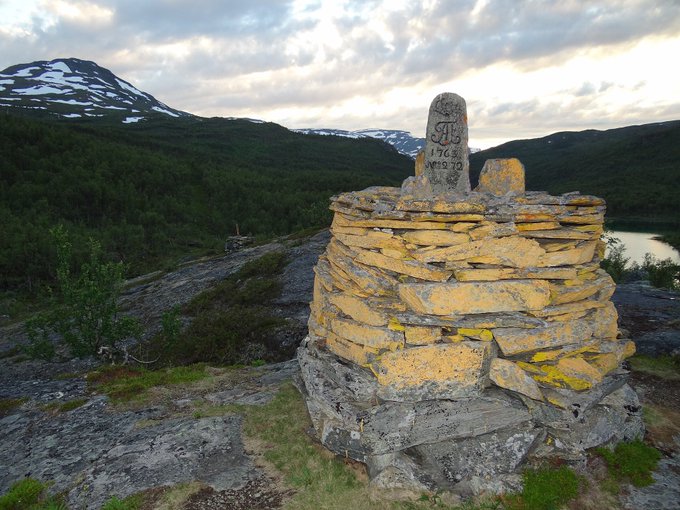
A cairn marking the boundary between Norway and Sweden in a remote area of the Arctic. Photo by Bjorn Christian Torrissen

The UK Government has announced plans to take “full control” of borders unveiling an Australian-style points system to overhaul immigration law and close our borders to unskilled workers and those who can’t speak English. When we talk about taking “full control of our borders” aren’t we just allowing fear and anxiety to take control of our borders? Are we forgetting that border controls escalate and will be reciprocated? Have we given any thought to who in the end will wipe our bums? Are we not just trading hostility?

This is all part of the deceit of government.

I have been intrigued by the stories about Jacob and Laban from Genesis 29-31. Jacob is the “leg-puller”, the “supplanter”, the “deceiver”. Jacob was born pulling the leg of his older twin brother Esau, trying to stop him being the first-born. Laban is the “white man“. Laban means white.

The story of Laban and Jacob is a saga of deception – the white man deceiving the deceiver, though was Jacob the outsmarter of the two?

The two of them come to terms with each other by building a “witness heap” of stones laid by their families as a commitment to peace. It marked the first bilingual place name recorded in the Bible – Laban called it Jegar Sahadutha and Jacob called it Galeed – the translations of “witness heap” in their respective languages.

Galeed, (we would perhaps call it a cairn) stood as a landmarked prayer. It provided a boundary to their hostility, an end to it. Significantly both Jacob and Laban refuse to take control of their new border. Instead they pray: “The Lord watch between you and me”. The Lord is the one they want to control their border and to watch their limits so that they never cross for harm but only cross for peace.

I wonder when we pray, when we put or hands together, whether we are building a cairn – a knuckle-boned physical structure to mark the limits of our hostility and anxiety, to say “beyond this only peace, beyond this only love”.

Are our churches also cairn-like landscaped prayers – places to confess our hostility, to find better ways to deal with our differences and markers within our communities beyond which we commit to “go in peace”? “This heap is a witness, and this pillar is a witness, that I will not go past this heap to your side to harm you and that you will not go past this heap and pillar to my side to harm me.” (Genesis 31:51f)

Borders are worse for our control when our export is fear. The boundaries of our Brexit mindset become brickset – walls built against others deconstructing differences, obstructing relationships, restricting trade and exchange.

Where are we building our witness heaps and our places of commitment? How are we replacing walls with cairns? How do we lament our nationalism?

Genesis 31:44-54
Come now, let us make a covenant, you and I; and let it be a witness between you and me.’ 45So Jacob took a stone, and set it up as a pillar. 46And Jacob said to his kinsfolk, ‘Gather stones,’ and they took stones, and made a heap; and they ate there by the heap. 47Laban called it Jegar-sahadutha:* but Jacob called it Galeed.* 48Laban said, ‘This heap is a witness between you and me today.’ Therefore he called it Galeed, 49and the pillar* Mizpah,* for he said, ‘The Lord watch between you and me, when we are absent one from the other. 50If you ill-treat my daughters, or if you take wives in addition to my daughters, though no one else is with us, remember that God is witness between you and me.’
51 Then Laban said to Jacob, ‘See this heap and see the pillar, which I have set between you and me. 52This heap is a witness, and the pillar is a witness, that I will not pass beyond this heap to you, and you will not pass beyond this heap and this pillar to me, for harm. 53May the God of Abraham and the God of Nahor’—the God of their father—‘judge between us.’ So Jacob swore by the Fear* of his father Isaac, 54and Jacob offered a sacrifice on the height and called his kinsfolk to eat bread; and they ate bread and tarried all night in the hill country.

Will we put our hands together to pray?

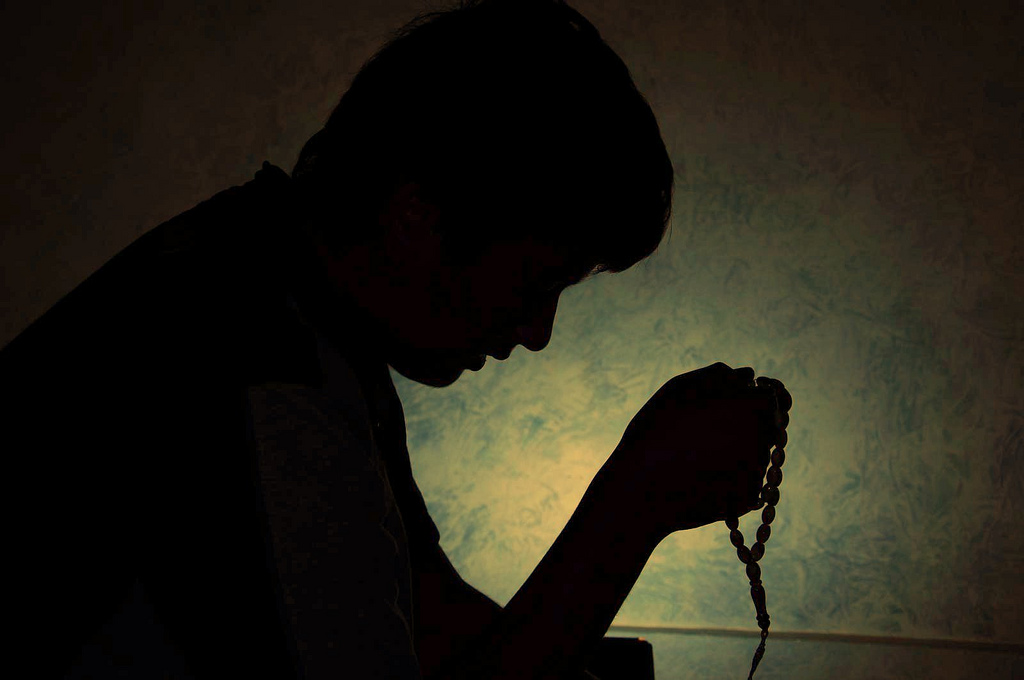
3455167464_f04814b6a6_b

Every morning I, David, pray with Jews,
my brothers, my sisters. Their scripture
fallen into my hands, fills my mind,
names me. I take their prayers,
the longing of their psalms,
I hear their pain, share their dreams,
my amen I join to theirs.

And I regret every morning
I can’t pray with more distant relatives,
my brothers, my sisters, children of Hagar.
A step too far. What are their longings,
what are their dreams?
I pray, that as I pray, they pray,
with me, for me, amen.


The photo is by mrehan, found at https://www.flickr.com/photos/mrehan00/3455167464