The Sound of Jesus: hearing his voice, following his call

Using scripture appointed for the 4th Sunday of Easter (YrC), Psalm 23 and John 10.22-30, here’s a reflection on what it means to hear the voice of Jesus in a noisy world.

I love preaching that brings Scripture to life—and that brings Scripture back to life, and I hope you do too. That’s a reminder that every time we open scripture together we are bringing it back to life. What matters today is what we call people, what we call ourselves and what we call God. Today is Vocations Sunday – a day to explore our calling, our calling of one another and God’s calling of us.

That’s the point Jesus makes when he is confronted by Jews at the Festival of Dedication at Jerusalem with the question showing their lack of understanding of him. “How long will you keep us in suspense? If you are the Messiah, tell us plainly.” I’m discovering that John is always telling us the time. In our gospel readings through this Easter season, all from John’s gospel, he has always told us the time. It’s morning, it’s evening, it’s early in the morning. Today, we hear that it is “winter”. Perhaps John wanted to introduce a shiver in his readers to indicate the coldness of these Jews towards Jesus and the frostiness of their relationship towards him.

Jesus replied to them to say “I did tell you, but you do not believe”. He draws the distinction between those who do believe and those who don’t. Those who do believe have listened to his voice and followed him. It’s his voice that makes us think vocationally. We are those who believe. We’ve heard his voice.

Vocation is not just about what we do – it’s about whose voice we listen to, and whose voice we speak with.

We live in noisy days. Everyone has something to say. Social media, politics, advertising, even the voices in our own heads – so many trying to define who we are, what we’re worth, and what matters. Those who follow Jesus make out his voice in all the hullabaloo. As Jesus said, My sheep hear my voice. They listen to my voice and follow me. Even surrounded by the sound of enemies, or even traumatised by suffering, or even as we walk through the darkest valleys overshadowed by death, there is the one call we listen out for. It’s the call that leads us to metaphorical green pasture and the still waters that refresh the soul.

And here’s the gift and challenge of vocation: those who follow Jesus begin to speak like him. They begin to sound like him. It’s not because they have perfect words, nor because they are fluent in the language of the kingdom, but because they speak in love. They echo his truth that so loves the world. They call people “beloved”. They become the kind of people whose words give life.

This is Jesus calling. His calling isn’t just for those who we say “have had a calling”. His calling is for the sake of the world. His calling is for the whole church – to hear, and to follow. On this Vocations Sunday, we’re not just praying for more priests or deacons (though some who hear his call might follow that course). We’re also praying for a church that listens to the voice of Jesus and follows his call, for a church that sounds like Jesus. We are praying for a Pope who sounds like Jesus, for an Archbishop who sounds like Jesus, and for one another, that we dare to follow the voice of Jesus even when it sounds strange in our world of noise.

So, let me ask you. Can you hear his voice?

Do you hear his voice,
the still small voice of calm,
the voice on the lake, in the storm?
Do you hear his voice
in the noise of your lives?
Do you hear his voice
above the voices of harm?
Do you hear his voice
singling you out
for the new rule of the kingdom?

What does he call you?
Are you Forgiven?
Are you his Friend,
freed, no longer slave?
Are you his Beloved?

And what of others?
Can you hear him calling them?
Can you hear him
calling the last first,
the first last?

Can you hear him
calling the stranger
closer as neighbour,
extending the family
by calling brother, sister,
even mother of those
quite unrelated?

His call goes far and wide,
as far as those who are called
“far from the kingdom of God”,
even to those who’ve grown rich
at the expense of others,
the proud and arrogant,
the self-righteous,
the self-satisfied, the guilty.

He calls the warnings of woe,
speaks of mercy to the guilty.
He calls the wayward home,
and calls the proud down.

Love’s call is strong, not mealy-mouthed,
exactly what is needed by those
who put themselves first,
those who are comfortable now.

This is the call of the shepherd
who loves his sheep
and raises his voice
for them to follow.

But the call of the shepherd
also raises the alarm
to disrupt the plans of wolves.

That is not a gentle voice we hear
nor does the shepherd
reassure us to stay where we are.
His is the leading voice,
leading us to fresh pastures,
calling us back, calling us out,
calling us up to the narrow way
that leads to life.

Can you see
how his voice might carry
in every breath of the church,
on the wind and wings
of the Spirit?

Do you know
the messages of your own lives
in your words and deeds?

And can you imagine
all your words being of
the one word that made you
and called you by name
Forgiven and Beloved?

Can you imagine your voice
reverberating his love and
amplifying his call?

Can you imagine
that being your only call?

There are those
who find it hard to hear
and difficult to believe
the voice that calls them
Forgiven, Beloved,
First, not Last
Friend, no longer Stranger,
Brother, Sister, even Mother.

What did he say?

They need the words
in love’s translation,
the amplification
of those who follow
the sound of his voice.

So listen well, church.

Get the sense of vocation.
We know his voice,
we hear his call.

Let us follow the sound
of his voice so truly
that we too call
strangers friends
and the last first.

Let us see how
the voice of Jesus
carries light
into the darkness
of the night.
Let us echo
the good news
that names us
and calls us
Beloved.

© David Herbert

A fierce gospel for savage times – reflecting on the Good Shepherd

A sermon for two rural churches without a “pastor”. The gospel for the day is John 10:11-18 (text below).

I am, I am, I am.

This is the name that rolls round the mind of the beloved community.
I AM, the very being of God as disclosed to Moses. Simply, I AM who I AM.
I AM, I AM, the name given even to Jesus by the community of beloved disciples as they explore the meaning of the God they find in Jesus.
I AM
This is what being is all about.

I am, I am, I am.
There are seven I AM sayings of the beloved community in John’s gospel.
Seven, as in the days of the week, as in the sign of perfection and completion.
This is how they loved Jesus. This is how they found God. This is how they saw salvation.
I am, I am, I am.

I am the bread of life,
the light of the world I am.
I am the door,
the good shepherd I am.
I am the resurrection,

the way, the truth and the life I am.
I am the vine.
I am.

This is how the beloved community singles Jesus out, in these seven sayings. Jesus is who we say he is. Jesus is who he says “I am”. This is who Jesus is to the beloved disciple – incidentally ruling out who he is not. 

Today is the fourth Sunday of Easter, known as Good Shepherd Sunday. These are the words ringing in the ears of the beloved community this morning. “I am the good shepherd”.

I know how important sheep and lambs are in your lives round here – how much you care for them and how you’ve worried for their welfare through these months of exceptionally wet weather. You know what good shepherding is all about.

I also know that you are waiting patiently for good shepherds to pastor you, and that you are praying that those the diocese appoints to these parishes will be good shepherds who will themselves have ruled out what the beloved community know Jesus isn’t – the opposite of the hired hand, the opposite of the one who leaves the sheep and runs away as soon as he sees the wolves coming, thinking only of themselves and abandoning the  sheep.

That’s not the Lord, our shepherd, who stays with his people even while they walk through the valley overshadowed by death, spreading a table before us so we can eat even while others trouble us.

I am the good shepherd. The Lord is my shepherd. These are the words at the heart of the people God makes his beloved community. And we, the beloved community know the truth of what makes a good shepherd. 

The good shepherd lays down his life for the sheep he owns and knows.

Have you thought about this? The good shepherd lost his life to the wolves. The wolves circled and he didn’t run.
The wolves licked their lips and he didn’t budge.
The wolves scented blood and he gave them his own.

These are metaphorical wolves. Actual wolves have virtues and they have their rightful place in our animal kingdom. Metaphorical wolves have none. They are devious and deceitful. They are around us and they are savage.

They can eat your grandma and then disguise themselves as grandma to little Red Riding Hood. “Grandma, what a deep voice you have!” “All the better to greet you with”. “Grandma, what big eyes you have!” “All the better to see you with.” “And what big hands you’ve got!” “All the better to embrace you with.” “Grandma, what a big mouth you have!” “All the better to eat you with.”

These metaphorical wolves are masters of disguise. The good shepherd sees their danger. He knows wolves come in sheep’s clothing and infiltrate his beloved community. Sometimes the wolf even takes on the shepherd’s clothing and grooms the metaphorical sheep, (beloved disciples) for his wicked ways. (I believe that is a storyline currently being explored in Eastenders.)

The wolves are around us in their many disguises. I don’t know where you’re at in your personal journeys. Some of you may be enjoying  a relatively easy path in your lives. Others may be on rockier roads, in the pits, even walking the valley in the shadow of death. 

For some, their road is very dangerous. They are particularly vulnerable to attack from those who would groom them, harm them, ridicule them, profit from them, even kill them. 

We must never forget the long and really difficult journeys refugees from around the world are having to take. Hounded from their homes by metaphorical wolves, they are prey to wolves in every twist and turn of their journey as they put their lives into the hands of one agent after another – each wanting their cut and their piece of flesh. And there are those living in the crossfire of wolves in warzones, such as Gaza and Ukraine.

I’m reading a book set in England in the middle of the 14th century – the time of the plague. Is plague one of the wolf’s disguises? Was Covid?

Good shepherds stand with their sheep. They don’t run away when they see the wolf coming. They sound the alarm. They take precautions. They stand firm.They take the front line. They absorb the shocks. They become shelter. And sometimes they lose their life.

Like Jesus. The wolves savaged him. They were disguised as religious leaders and political leaders. The following he was getting (the sheep and the size of the flock) frightened them. They came for him, so that they could get at them. They took him away. They accused him. They mocked him. They stripped him. They slashed him. They crucified him.

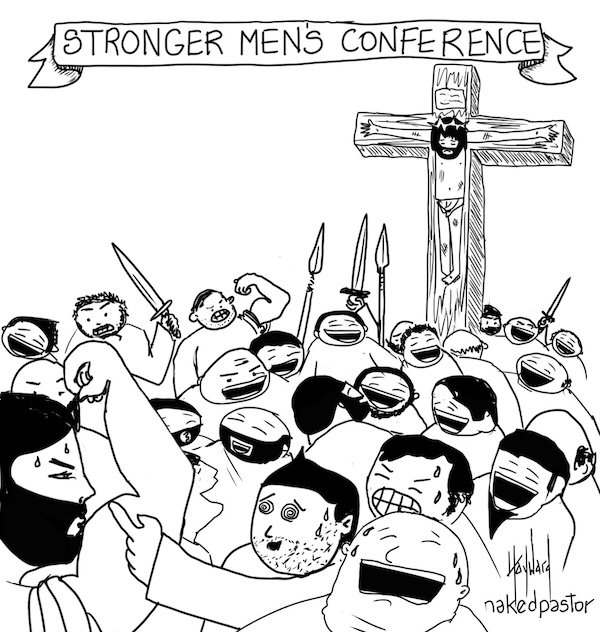
by David Hayward at http://www.Nakedpastor.com

The Naked Pastor draws many gospel cartoons. His name is David Hayward. This cartoon by the Naked Pastor is of the naked pastor. Pastor means shepherd, and here we see the good shepherd, the pastor stripped naked on the cross. In the foreground we see the wolves. They are taunting Jesus, making fun of him. They’re laughing at him, gritting their teeth at him, flexing their muscle against him, and raising their arms, their weapons of war, showing their killing teeth.

This is Jesus being savaged by a pack of wolves.

Over and over again we marvel. The good shepherd does not run away when the wolves come. He lays down his life for the sheep so that the wolves can’t scatter and snatch the sheep. I dare say we have sweetened this gospel over time – but what John is describing here is fierce. The opposition to the beloved community is fierce, but the attachment of the good shepherd to the flock is just as fierce. Blood is spilled and life is lost. But just as the good shepherd has the power to lay down his life, so he has the power to take it up again. And that places this gospel in our Easter liturgy – this fourth Sunday of Easter.

It’s a fierce gospel for savage times when metaphorical wolves roam our streets in their many disguises. It’s a gospel for our times – our mean time in which we need the protection of good shepherds – the sort who will give their lives for the sheep – the sort you wait to be pastor in your community.

At the moment, wolves and sheep remain enemies. The wolf continues to prey on the  sheep who rely on the protection of good shepherds – the sort who will give their lives for the sheep – the sort you wait for to be pastor in this community. But the time will come when there will be a peace way beyond our understanding and way beyond our imagination when the wolf will lie with the sheep. That’s what God lives for. The time will come when the wolf will live with the lamb, the leopard will lie down with the goat, the calf, the lion and the yearling together, and instead of tyrants and empire builders, a little child will be the leader. (Isaiah 11:9) Until that time we follow the call of the good shepherd as he leads us through the valleys and low points overshadowed by wolves and our fear of them.

John 10:11-18
‘I am the good shepherd. The good shepherd lays down his life for the sheep. The hired hand, who is not the shepherd and does not own the sheep, sees the wolf coming and leaves the sheep and runs away – and the wolf snatches them and scatters them. The hired hand runs away because a hired hand does not care for the sheep. I am the good shepherd. I know my own and my own know me, just as the Father knows me and I know the Father. And I lay down my life for the sheep. I have other sheep who do not belong to this fold. I must bring them also, and they will listen to my voice. So there will be one flock, one shepherd. For this reason the Father loves me, because I lay down my life in order to take it up again. No one takes it from me, but I lay it down of my own accord. I have power to lay it down, and I have power to take it up again. I have received this command from my Father.’

Nativity – He Qi

He Qi is a Chinese artist who spent the years of the Cultural Revolution painting pictures of Mao Tse Tung in the day time as an alternative to forced labour, and in the evening painting pictures of the Madonna inspired by his fascination with Raphael’s Madonna and Child.

He Qi’s Nativity is typical of his work in terms of colour and vibrancy. His painting resembles stained glass and always feel they have an element of fun. In this picture you can see the sheep virtually dancing in response to the angels. Listening is an important element of this piece. Of course, the sheep stand for all those who know the Lord as their shepherd.

The light in this Nativity comes from heaven and is far more intense than the light any of us can hold. The light Joseph holds is dim compared to the light that Mary holds. – but then Joseph is fading from the picture with his work well and faithfully done.

Mary is pictured in the pink. Normally Mary is dressed in blue, but here He Qi picks up pink as a symbol of marriage and shows Mary as the archetype of the church who holds and treasures Jesus. Jesus is offering a red apple to Mary and the church. This is a reference to the Garden of Eden signifying Jesus as a new Adam and Mary and the church as a new Eve. This is new creation.

The apple is blood red to indicate the nature of God’s offering. Is there also an ambiguity in the shape of the apple? Is it also heart shaped to indicate that this is the new heart promised by God to his disheartened people (Ezekiel 36)?

This is the Nativity. Christus natus est. This is Christmas. Happy Christmas.

So you want to be a sheep then: sermon notes for Christ the King (Sunday and church)

Sermon – Nov 23rd 2014

Christ the King, Birkenhead.

Christ the King Sunday

So you want to be a sheep, do you?

Do you remember PE at school – when teams were picked. “Pick me”. We prayed didn’t we that we wouldn’t be the last person chosen. There are two teams in today’s gospel (Matthew 25:31-end). On the one hand there are Sheep, and there are Goats on the other. The Sheep are the winning team, the Goats are the losers – although the team looks anything other than a winning team.  The Sheep are promoted by the Son of Man – they have a podium position. The Goats are relegated and put out of business.

Who do we want to play for: the Sheep or the Goats?

But then, there are good sheep and bad sheep, according to our OT reading (Ezekiel 34:11-16, 20-24). Ezekiel explains how we can tell them apart when he talks about God’s way of judging them apart. The fat sheep are accused of being violent, abusive and non-caring within their community, pushing their way around. “You pushed”, God says. “You pushed with flank and shoulder. You butted at all the weak animals with all your horns until you got your own way and had it all for yourself. You scattered them far and wide.”

Ezekiel is one of the “lean sheep”, pushed around, butted and scattered – forced into exile.

His complaint rings true through all ages. There always seem to be people who behave like this, like bad sheep. Back then, Ezekiel’s people have been scattered far and wide in a way that reminds us of what happens in our world today, when so many people are dislodged from their families, forced to flee their homes, communities, work and livelihood.

For Ezekiel and his fellow exiles, the problem has been poor leadership (the leaders are referred to as shepherds). The leaders have only been interested in themselves, feeding themselves at the expense of the people, failing to provide any welfare or benefit system. The sick were ignored. The injured were ignored – and the leaders ruled with a rod of iron. That is why the people were scattered. Ezekiel and his fellow exiles had no choice. They had to go. That is largely the case today as well. The villagers under attack by Islamic State have no choice but to flee. The victims of domestic violence who pluck up the courage to leave their situation say “we had no choice, we had to get out”, and others who can’t leave also say “we had no choice, there was nowhere to go.”

Life should have been uncomplicated for them. They should have led settled lives in straightforward communities, in close contact with parents, grandparents and grandchildren. Instead their lives were disrupted.

The calamity of weak and/or violent leadership catches up with people so quickly, at all levels of our lives. It’s the national tragedies which catch our eye in the news – but the tragedies are lived out small in our workplaces, in the playground (bullying) and in our homes (we are used to hearing about domestic abuse, elder abuse and child abuse). The victims are the lean sheep, pushed around, butted, battered, scattered, unfairly and cruelly treated.

We know what happens to them:

to the children who are neglected, who go unheard, who deserve better.

  • Some of our children are treated so badly – maybe their parents caring only for themselves in the manner of the bad shepherds that Ezekiel riles against. Some of the children manage to run away – scatter – and we all know that there are many adults preying on vulnerable youngsters. Why should they be denied a home? Why should they be denied safety? Why should they be denied care? These lambs deserve the care of a good shepherd – by their very nature. Any different and the natural order of things is turned upside down.
  • to those who become refugees, clinging desparately to their identities, crossing boundaries into lives where they’re still not wanted forced to do work which really was beneath their dignity. The skills of doctors being wasted as they become cleaners. Fully trained nurses having to take any job they could find – zero hours contracts. The dream is somewhere safe to escape to – somewhere you’ll be wanted for what you can offer, but then discover that you’re fenced in from making the border crossing. Some become desparate – casting out to sea with a vague hope that they might make it, but fearful of other wild creatures who lurk in the deep

There is a charity called Eaves which runs the Poppy Project. They report Ellie’s story (which I didn’t use in the sermon):

When Ellie, 32, describes the first part of her life, she races through the disturbing details in a neutral tone; the problems she experienced as a child and a young woman are not what makes her angry. She grew up in a slum outside Kampala in Uganda. She was sent to live with another family when she was seven and sexually abused by the head of the household; when she turned 15, she was forced to marry him. He was violent, so when a neighbour offered to help her escape to a new life abroad, she agreed.

She was taken by plane to the UK with a group of six other women. Ellie thought that she was going to work as a cleaner, but on the day she arrived, she was driven to the home of a white man who told her she would have to work as a prostitute to pay back her debts for the passport and air travel. For two years she was locked in a house with the other women, and periodically driven to customers’ homes.

She only escaped when a sympathetic client gave her £60 and explained how to get to London. In London, she met a man who allowed her to stay with him, but who quickly began to ask for sex in exchange for shelter. One night when he was violently abusive, she called the police.

This is the moment, in a life story of unmitigated misfortune, when you might expect that things would begin to improve. However, it marked the beginning of a new wave of difficulty, and this is where she begins to get angry. She was taken to hospital, but not treated; later the police took her to a police station, where she was fingerprinted and told she had no visa. Since she had only been given a passport to hold for a few seconds when she passed border control at the airport, she knew nothing about visas.

“They were asking each other: ‘Did she come here legally or illegally?’ The way they were talking was very intimidating. They didn’t ask about the attack. They were more interested in why I was staying in the country without a visa.” The man who hit her was not arrested, but she was taken to Yarl’s Wood detention centre. “I’d never been in detention before. It felt like a prison: being locked up, eating your food at certain times, sleeping at certain times. Most of the time you can’t go outside; you can barely see daylight.”

The other inmates laughed at her when they found out she had called the police, and told her she was stupid to have expected them to help her. She was quickly put on suicide watch because she told staff that she would kill herself rather than be deported back to a country where she would be in danger from her husband and her traffickers. “They wouldn’t let me buy tinned food in case I took the tin and cut myself; they watched me while I showered in case I hanged myself,” she says. For a while she regretted having escaped from her trafficker, and thought returning to her existence as a sex slave might be preferable.

It was only when she was in Yarl’s Wood that she realised she had been trafficked. “So many of the women I met in detention had been trafficked. I don’t think the police who interviewed me knew about trafficking. They were more interested in catching someone for being an illegal migrant than in helping someone who has called for help. All they were talking about was deporting me,” she says.

It was only when a sympathetic guard suggested that she put her name down for legal aid that she was put in touch with Eaves. Her asylum claim on the grounds of trafficking was rejected initially, but with Eaves’ help, this was overturned.

She wishes there was greater awareness of trafficking throughout the system. If border staff had been on the lookout for people-trafficking when she arrived in the UK, she would have been prevented from coming into the country. “If they had stopped me on the border, I would have been so much happier; I wouldn’t have done all the bad things that I was made to do. But I came here and I was turned into a prostitute.”

She is calm when we speak; very articulate and very angry about what has happened to her. “Putting trafficked people in prison – that is the worst part of it. You have gone through bad times, and then you find yourself in detention, told you are going to be deported back to the traffickers. That man is still there and he is still bringing in women. That’s why I’m so upset.”

Pushed around, butted, battered and scattered. In exile with a longing for the care of something like a good shepherd.

Tuesday is White Ribbon Day – a day for men to pledge to “never commit, condone or remain silent or remain silent about men’s violence against women” – tantamount to a commitment to playing a proper part in home, family and community.

Good sheep don’t push their way round. Good sheep aren’t selfish. Good sheep aren’t frightening.

Good sheep have good shepherds who they follow. The people of God have had many shepherds. Some have been good, many of them have been bad (Ezekiel is speaking from experience). Ezekiel looks forward to the time when the bad shepherd has had his day, looking forward to the time of good shepherding when the scattered sheep will be gathered in good grazing land.

Jesus shows himself as the good shepherd. It is how he describes himself as the good shepherd, and that is why he is interested in the sheep. His place is with them, not with the goats. At times, at the worst of times, his sheep look awful – and no wonder, because they are the ones pushed around, butted and scattered. They are hungry, thirsty, naked and sick. They are strangers and prisoners. Good sheep who have responded to the shepherd’s call.

If we are sheep, how do we play our part amongst them? Do we act big or play gentle? Are we one of them, or are we acting the goat?

Acknowledgements: