Surplus of meaning

a work of art in the Cheshire countryside

It has been good to be involved in the development of an Arts & Faith Network (for the Diocese of Chester), and to be “breathing space” at Stephen Broadbent’s studio yesterday with textile artists, stained glass artists, wordsmiths, dancers, painters, sculptors, actors, authors, poets, cooks, singers, preachers and “makers of pretty things”. Until yesterday the Network hadn’t been much more than an idea shared by a few people and it was difficult to put into words what it was about and what could happen. Now it has got legs, is on the road, and has its own story – “the day we met at Stephen and Lorraine’s, when our exploration of the interaction of arts and faith was facilitated by Simon Marsh with background percussion of water overflowing into a pond…..”

IMG_0759
The (overflowing) River of Life
sculpture by Stephen Broadbent
at Warrington at the site of a terrorist bomb explosion
which killed two children.

There were so many good things, including a wonderful rendition of The Rose by Simon (spoken, not sung), and, we discovered a “surplus of meaning” as we joined our own creative endeavours to those of others. Surplus of meaning doesn’t mean that there is too much – rather, there is so much. The meaning of our insulation block sculptures co-mingled with the meaning given to them by others, with meaning pinned to meaning. Of course, Ricoeur was right. There is a surplus meaning as one meaning gives itself to another, transforming itself in the giving. Nothing we can do, or create can provide an adequate container for our meaning. Meaning is so abundant it has to overflow. It overflows into convivial and meaningful community, good times, great company.

There are, though, those in whom there is no sense of meaning – including some in this emerging network who described the meaninglessness of past experiences. Is this where art and faith come together, making sense when we are oppressively or depressively crushed?

Simon Marsh and Sarah Anderson have both posted on the Arts and Faith launch.

from Max Warren

When we approach the man of another faith than our own it will be in a spirit of expectancy to find how God has been speaking to him and what new understandings of the grace and love of God we may ourselves discover in this encounter. Our first task in approaching another people, another culture, another religion, is to take off our shoes, for the place we are approaching is holy. Else we may find ourselves treading on men’s dreams. More serious still, we may forget that God was here before our arrival.
Picked up from Simon Marsh’s blog.

>Excuse the repetition

>

Seams like repetition
SEAMS LIKE REPETITION
a photo of a baseball from thesussman

I can’t remember where I saw it, but … I can’t remember where I saw it. It was a blog post reminding me that repetition is no bad thing, but, I am sorry that I can’t remember where. My repeating myself may be boring.

But repetition may be of a totally different order. Repetition may be re-petition, signifying the return to a subject (any subject) petitioning them to be …. subject and agent. Repeating a subject is re-petitioning that subject for fresh meaning, or insight, or a bit more give. Young children often pester grandparents and parents to repeat the same story. They want to re-petition the story, re-questing the comfort, excitement, romance …… Couples repeat the story of how they first met. Communities and families re-mind themselves of who they are by re-petitioning their past stories to yield something to re-store their memory and identity. I want to repeat reading some books (East of Eden, Wild), some films (Dogville), some music (always Paul Simon or Leonard Cohen) because I am confident that they will reveal new things for me.

But the repetitive strain of meaninglessness that saps our vitality I can well do without – or is there some special grace (or love) which allows people to cheerfully and tirelessly repeat the same routine and tasks time and time again?

Repetition is fundamental to prayer. Repetitive rhythms (the prayer wheel), rosaries, postures and words are all reminders of our re-petitioning. Some give themselves to re-petitioning God through one line prayers for their whole lives. The Jesus Prayer – “Lord Jesus Christ, Son of God, have mercy on me a sinner” – is a one line prayer repeated over and over again. For some it is a life long re-petition. It is lifted from the story of the Pharisee and the Publican. According to the 19th century Russian spiritual writer, Theophan the Recluse, the prayer’s repetition begins as something on the lips and external to us, travels inwards by focusing the mind till it becomes the heart of who we are.

I wonder. Does genuine and sincere re-petitioning result in us taking the person, the thing, the story to heart? Is that how we come to care so much that we can bear the repetition?

>So beautiful …. so what

>Yesterday’s Fathers’ Day brought new sounds. Laura Marling’s I speak because I can, and Paul Simon’s latest album.

Paul Simon poses the interesting question about life. It can be “so beautiful”, or it can be “so what”. And that is the title of the album. Life is what you make it.

I’m just a rainbow in a bucket a coin dropped in a slot 
I am an empty house on Weed Street
across the road from the vacant lot
You know life is what you make of it
so beautiful or so what.
Ain’t it strange the way we’re ignorant
how we seek out bad advice
how we jigger it and figure it
mistaking value for the price
and play a game with time and love
like a pair of rolling dice.

Elvis Costello has done a review at Huffington Post. It’s all well worth a listen – with great surprises throughout, including Paul singing through excerpts from the Golden Gate Gospel Train recorded in 1938 on the beautiful Love and Blessings, and a sermon from Revd J M Gates (including call and response) from 1941 in Getting Ready for Christmas Day.

Thanks lads. Now for the concert.

Ah Bisto! Conspiracy Theories of Pentecost and Community

>

People who breathe together, stay together. People who can smell one another create community. The person who holds his nose because he doesn’t like the air that he is breathing is excluding himself from that community.

Ivan Illich reminds us of an old German saying: ich kann Dich gut reichen, “I can smell you well”. It captures well an apect of openness we often miss. We have our eyes and ears open, but rarely do we talk about having our nose open. I can smell you well. For me that adds another sense to the story of the Good Samaritan. Did the victim in the ditch smell so badly that people could not tolerate his smell, and had to walk by on the other side, holding their nose against the stink. With nose open, the Good Samaritan had his arms free to manhandle the victim to safety and recovery.


There is a custom in Christian liturgy called the “kiss of peace“, or osculum pacis – only recovered relatively recently in the Church of England. These days the kiss of peace isn’t so much a kiss as a handshake – very British – but at least it’s touching. Apparently in some places, until the 3rd century, the kiss was “mouth to mouth”, and was a sharing and mingling of breath. John’s story of Pentecost reminds us that Jesus breathed on his disciples, saying “receive the Holy Spirit” (John 20:22). They smelt each other well. They shared their breath in con-spiracy. The church formed conspiratorially to be a conspiracy. Illich writes:

“Peace as the commingling of soil and water sounds cute to my ears; but peace as the result of conspiratio exacts a demanding, today almost unimaginable, intimacy.”

Pax board, Early 16th century, in a frame from 19th century
16th century Pax Board from Budepest

The intimacy didn’t last as some regarded the practise as scandalous.  For example, Tertullian (in the third century) was rather worried about possible embarassment to “a decent matron”. The practice got well watered down. By the 13th century, the Catholic Church had substituted a pax board which the congregation kissed instead of kissing one another!

“Don’t imagine you can be friends with people you can’t smell.” That was the advice Illich was given. Friendships and communities develop amongst people who smell each other well, who can breathe in the air and the smell of their friends and neighbours, and who allow their own air and smell to be breathed by others. Friendships and communities are conspiracies – threatened in our de-odourised times of Lynx, Colgate and Ambi-pur where we struggle to smell anyone, or anything, well.

The playground cry “you stink, you stink” marks a cruel exclusion by those who won’t smell a person well – it is often accompanied with the gesture of the nose being held or up-turned. The person excluded has to find their friends who are prepared to smell. Above every friendship, every community, every conspiracy, there is a nose.

>Rhyl in Panorama

>

Rhyl
photo from Postcard Farm

It was friend +Tim Ellis who made me aware that poverty has been exported from our cities to our coastlands. For Jeanette and myself, Rhyl is a “day out”, refreshment and time for ourselves. We enjoy the wide spaces, and the walk from Rhyl to Prestatyn along the beach.

Jim Pickering outside 
Rathbone’s Rhyl Taste Academy

Panorama presented a very different picture of Rhyl. Apparently in West Rhyl nearly half of the people are unemployed and on benefits, and these are the people the Government has in its sites in its welfare to work programme. We followed Adam, Steve and a few others. Adam did work experience at Morrison’s, which eventually resulted in his being all smiles over landing a job there for 18 hours a week. Steve described a hopeless situation of long term unemployment. It seems so sad that these people are “targets” and that they are seen as fraudulent malingerers. There are imaginative programmes aimed at helping some from welfare to work, including the work done by Rathbones in projects such as the Taste Academy and Rhyl Football Club “Strikers”.

Rathbone is a UK-wide voluntary youth sector organisation providing opportunities for young people to transform their life-circumstances by re-engaging with learning, discovering their ability to succeed and achieving progression to further education, training and employment.

The dark underside of the Government programme though is that those who can work but who don’t are going to be severely penalised (loss of benefit for three years). The little given now is going to be even less unless they accept the jobs they are offered – whether they like it or not. I don’t know where the boundary between work and slavery is, but maybe we are getting pretty close. Fitness for work assessments sound fine, so long as they are fair. MIND – the mental health charity – claims there are many problems with them.

I feel like DWP want to send me back to a workplace where I don’t have the skills necessary for coping. Whenever I deal with a government agency I feel pretty bad afterwards – it is like nobody takes me seriously and that because I don’t have a physical disability, I am somehow a malingerer or scrounger. This is not the case. (from MIND)

IMG_0188
Rhyl beach – on the North Wales coast

I am glad I have a job I am nearly fit for. I would not want a job that didn’t fit.

For us Rhyl is a day out. We can afford to get there and we can afford to eat there (and we will be going to the Taste Academy). I’m afraid reduced incomes aren’t going to buy any days out for the people of our coastlands. It is no wonder that there are drug and alcohol issues – drugs and alcohol bring opportunities of days out – (not of place, but of mind), away from the frustration, anger and hopelessness.

>supervision

>

Interesting discussion on supervision at yesterday’s training session for those who are going to be “supervising ministers” for newly ordained clergy.

Peter Chantry offered insights from his experience as he looks forward to welcoming a new curate to his Nantwich parish. They safeguard space each week for a supervision session. One hour every Thursday morning. That is impressive. One of the impressive aspects of his presentation – besides his low-tech mind-map handout – was his emphasis on the quality of the relationship and the way that he is obviously facilitating a collaborative/community approach to formation. There is evidently a care-full building of trust for the relationship “centred on loyalty and commitment, characterised by gentleness and honesty, sharing humanity, respecting confidentiality, meeting & praying regularly.” Good stuff.

It begged the question from friend Julian of what supervision is for. Or, what does successful supervision look like?

I wonder. We spend so much time talking about supervision, insisting that it is a good thing – but what is it for? Is it about “seeing things for ourselves”, “seeing through things” (where there were blind spots), and “seeing things through” (sustainability)?

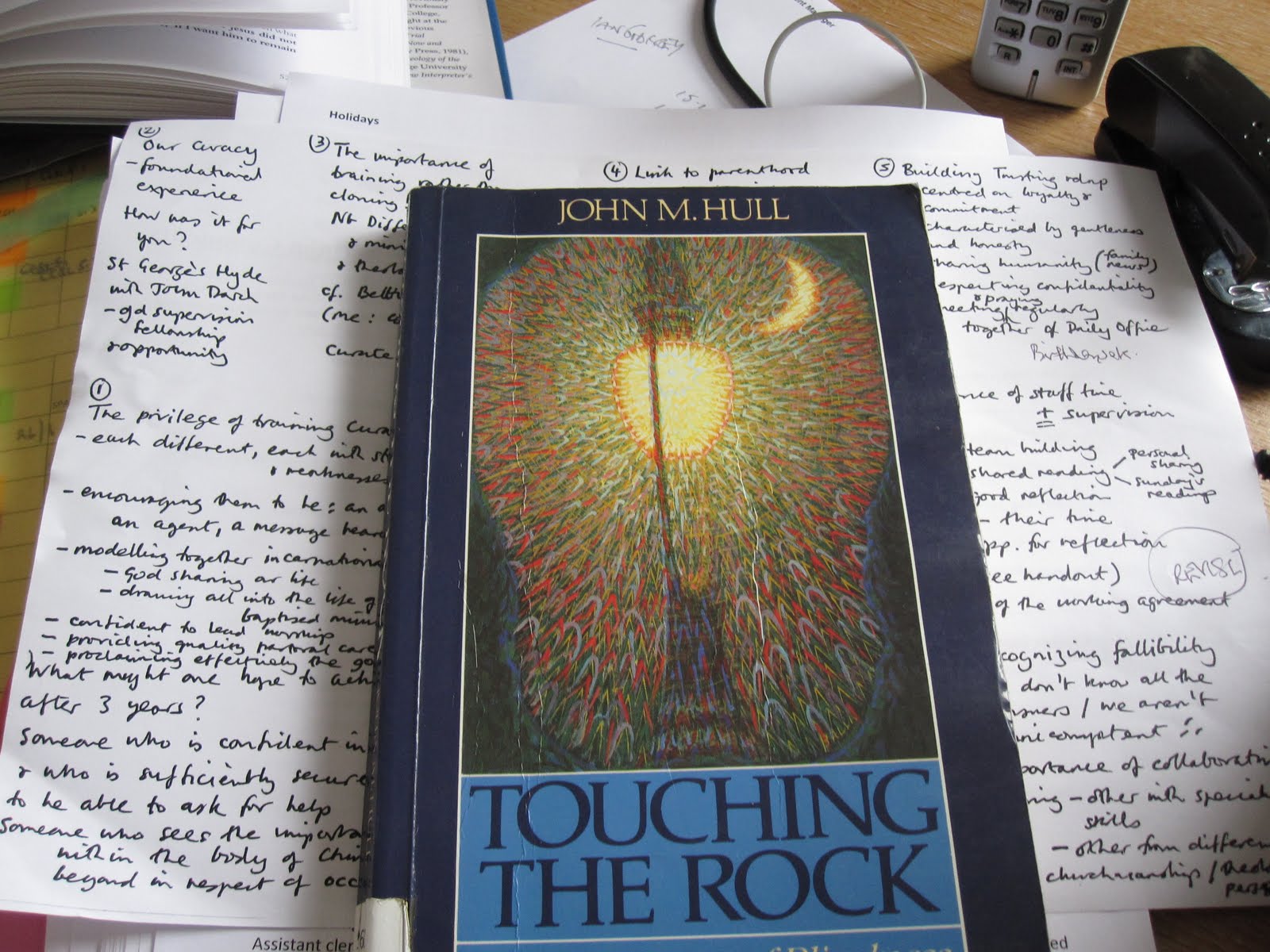
I have been reading John Hull‘s incredibly moving and honest account of the onset of his blindness, Touching the Rock. He refers to the “thousands of tiny accidental happenings” which led him along the path to blindness. According to Hull faith transforms such accidental happenings into the “signs of our destiny”, by “retrovidence” rather than “providence”.

He describes his stumbling on the altar at Iona Abbey during his stay there in 1986, through which he became a WBS a “whole-body-seer”. Here he sees things for himself, sees through his blindness, and discovers how he can see things through. His seeing is full of feeling and emotion as he touches the rock.

Altar at the Iona abbey
Altar at Iona
photo by Calypso Orchid

“After several nights, I discovered the main altar. I had been told about this, and I easily recognised it from the description. It was a single block of marble. Finding one corner, I ran my fingers along the edge, only to find that I could not reach the other. I worked my way along the front and was amazed at its size. The front was carved with hard, cold letters. They stood out baldly, but I could not be bothered reading. The top was as smooth as silk, but how far back did it go? I stretched my arms out over it but could not reach the back. This was incredible. It must have a back somewhere. Pushing myself upon to it, my feet hanging out over the front, I could reach the back. I did this again and again, measuring it with my body, till at last I began to have some idea of its proportions. It was bigger than me and much older. There were several places on the polished surface which were marked with a long, rather irregular indentations, not cracks, but imperfections of some kind. Could it have been dropped? These marks felt like the result of impact. The contrast between the rough depressions and the huge polished areas was extra ordinary. Here was the work of people, grinding this thing, smoothing it to an almost greasy, slightly dusty finish which went slippery when I licked it. Here were these abrasions, something more primitive, the naked heart of the rock.” (P 163).

As a post-script, he writes: “God is many and yet one, and in God there are many worlds yet one. God does not abolish darkness; God is the Lord of both light and darkness. If in God’s light we see light, then in God’s darkness we see darkness. If a journey into light is a journey into God, then a journey into darkness is a journey into God. That is why I go on journeying, not through, but into.” (p165)

PS Simon Marsh has a different slant on this and has an interesting post on teaching the world to listen – with a video of profoundly deaf musician Dame Evelyn Glennie.

>pointless disappointments

>

Camp Disappointment Historic Marker
historic marker for Camp Disappointment
(photo by Jimmy Emerson)

That is not the sort of review you would like to see on TripAdvisor if you were the owner of a campsite. There are many places called “Disappointment” –  it must be hard for those who live in those places. “What’s it like where you live?” “You mean disappointing?” “I thought so”.

By a strange quirk of the Church of England, my most recent appointment meant that I was listed in the “resignations” rather than the “appointments” in our  mailing. I presumed that this was therefore a “dis-appointment” rather than an appointment! 
Fresnel, Cape Disappointment
old Fresnel lens from the Cape Disappointment Lighthouse by Grace Fell

I have been struck recently by the high expectations we have of one another, and that appointments can often lead to disappointments. Once we are a disappointment to someone we are always then seen through that lens of disappointment, and our own self-perception can be coloured by that as well. When it comes to disappointment, it is often the solo leaders who are disappointed, and those they appoint who are disappointing. Belbin points this out. According to him (Team Roles at Work (2003) p98),

  • A solo leader “plays unlimited role” (and interferes), whereas the team leader chooses to “limit role” (and delegates).
  • A solo leader “strives for conformity”, whereas a team leader “builds on diversity”.
  • A solo leader “collects acolytes”, whereas a team leader “seeks talent”.
  • A solo leader “directs subordinates”, whereas a team leader “develops colleagues”.
  • A solo leader “projects objectives”, whereas a team leader “creates mission”.
Life is hard in the land of Disappointment. The only escape is into a a different world of team leadership.
Talking of disappointments, I just love Nilsson’s “The Point” – a story about a round headed boy called Oblio, who lives in the Land of Point with his dog Arrow. Its moral – everything has a point, and nothing is pointless.

Integrity and teaching

>

organic growth
“A complex web of connections”
Organic Growth from the Internet Mapping Project
posted by jurveston
These lines from May Sarton indicate something of the integrity of the “good” minister, teacher or human being:
Now I become myself.
It’s taken time, many years and places.
I have been dissolved and shaken,
worn other people’s faces … (the rest of the poem is here)
I have worn other people’s faces because it’s safe to be in the crowd. I have worn other people’s faces but they have never fit. I have tried to be clever. I have tried to be funny. I have even tried to be effective. But these faces never fit. We live in a world where standards are imposed and where we are trained from the outside in to conform to certain standards. When Jesus breathed new life into his disciples (John 20:19-23) he seemed to be giving them a very different inside-out spiritual direction for their lives. Parker Palmer, who quotes the above lines from May Sarton, talks about the divided self and the undivided self. A self divided is a self dis-membered and lacking integrity. For Palmer “good teaching cannot be reduced to technique; good teaching comes from the identity and integrity of the teacher.” They “join self and subject and students in the fabric of life.”
Palmer goes on to say that good teachers are “able to weave a complex web of connections among themselves, their subjects, and their students so that students can learn to weave a world for themselves. … The connections made by good teachers are held not in their methods but in their hearts – meaning heart in its ancient sense, as the place where intellect and emotion and spirit and will converge in the human self.”
When I reflect on the good teachers I have had I find that they are people who refused “other people’s faces”, who committed time to me and gave me their undivided attention. I also reflect that they have been a rather rare breed, but then I may not have been the right student to help great teaching happen with all the others I have known. The good teachers, though. have been more than enough – thank God.

>never marry, but for love

>The Big Fat Gypsy Royal Wedding, Kate and William – weddings galore. But for me today, the privilege of being present at Dave and Shelley’s wedding – a secular affair (and in the sight of a generous God) – at which I have been asked to read “Never marry but for love”, by William Penn – a 17th century Quaker whose face is said to be the face of Quaker Oats. Like Kate Middleton, William Penn was from Reading (Twyford) – or as they say of Kate – “a village in Berkshire” (Bucklebury). Penn, himself, was one of the many missionaries who travelled to America – he founded Pennsylvania, and his experiment there was influential in the development of the American Constitution.

I have sat lightly to the Royal Wedding – and the media interest in it. I did catch sight of David Starkey’s programme, Romance and the Royals – which did underline the importance of romance in marriage as something that has been influenced by royal marriages down the ages where feelings have been the basis of marriage (including lust) – cf various Henrys, Edwards and Georges – as opposed to royal weddings in many other countries, which have been about political alliances.

And congratulations and best wishes for all getting married today – Kate and William, Dave and Shelley – and Irish travellers, Mary and Paddy (married two weeks ago). Never marry but for love.

Never marry, but for love; but see that thou lovest what is lovely.
He that minds a body, but not a soul
has not the better part of that relationship,
and will consequently lack the noblest comfort of a married life.

Between a man and his wife nothing ought to rule but love.
As love ought to bring them together,
so it is the best way to keep them well together.

A husband and wife that love one another
show their children that they should do so too.
Others visibly lose their authority in their families
by their contempt for one another,
and teach their children to be unnatural by their examples.

Let not joy lessen, but augment affection;
it being the basest of passions to like what we have not,
what we slight when we possess.

here it is we ought to search out our pleasure,
where the field is large and full of variety, and of an enduring nature;
sickness, poverty or disgrace being not able to shake it
because it is not under the moving influences of worldly contingencies.

Nothing can be more entire and without reserve;
nothing more zealous, affectionate and sincere;
nothing more contented than such a couple,
nor greater temporal felicity than to be one of them.

William Penn 1644-1718.