Hope Before Dawn: An Advent Imagination

Live for that day when God’s peace is all in all.
Love for that day when God’s light leaves no shadows.

These are the darkest days of our lives.
December draws a long shadow,
and we find ourselves longing for light.

These days seem to go on without end.

These are the days Isaiah fought through and hoped through
3000 years ago:
the same old, the same old.
the dark ages all over again.
This is the mean time.

This is the time to cherish those who’ve kindled hope,
those we’ve bound in scripture
who hoped in God when the world felt just as heavy as ours.
This is the time to pray.
This is the time to keep watch.
This is the time to live for another day,
to love towards another day
when the times will finally be a-changing.

These are very mean days
when nations make war on nations,
There may be no world war,
But there are too many wars
for us to call this peace.
The world is at war,
and we are all caught up
in a global propaganda war.

These are very mean days when dark forces
create a hostile environment for those seeking asylum and sanctuary,
days which leave so many children hungry
and too many families poor, 

when budget after budget
miss the opportunity to make things better.

These days, however bright the weather may be,
are dark days to too many people.

And so –
these are the very days to keep hope alive,
to pray for the day when God’s kingdom comes on earth, as it is in heaven,
to live for the day when God’s word settles disputes;
to love for the day when nation will not take up sword against nation,
and nor will we need to train for war any more.

Imagine that.
Imagine the difference
when the weapons of war,
the resources of war,
become tools for farming and feeding and healing.

Imagine the difference
if the resources of war were turned to farming.
Not just in the fields of our own villages,
but in Gaza’s broken orchards,
in Ukraine’s shelled wheatlands,
in every place where the soil has been scorched,
and the hands that sow can no longer harvest.

Isaiah’s dream has dirt under its nails.
It is a farmer’s dream,
a peacemaker’s dream –
swords hammered into ploughshares,
spears repurposed as pruning hooks,
the earth tended again.

And here’s another theme none of us can avoid,
if we care about justice and peace:
we need to be prepared in these days of darkness.
Advent comes with a wake up call.
The time has come for us to wake up, says Paul, (Romans 13)
and be ready for the Day of the Lord –
the day we live for,
the day we pray for,
the day we love for.

For Advent I’ve downloaded an app which notifies me of Fajr –
the prayer Muslims offer from dawn to sunrise.
So, this morning, at 6.05,
my phone buzzed to tell me it was time to pray,
and I was reminded of all those
who rise while the world is still dark
to end the night and hope for the day.

First they wash,
then raise their hands to acknowledge the greatness of God.
They then recite the Surah:

In the name of Allah – the Most Compassionate, Most Merciful.
All praise is for Allah – Lord of all worlds.
the Most Compassionate, Most Merciful,
Master of the Day of Judgment.
You ‘alone’ we worship and You ‘alone’ we ask for help.
Guide us along the Straight Path
the Path of those you have blessed
– not those You are displeased with, or those who are astray.


Then they bow
They stand and say, “God hears the one who praises him.”
They prostrate themselves, grounding their forehead, palms, knees and toes on the earth –
and from the ground they praise God.
They finish by turning their head
to the right and to the left
with a prayer of peace in both directions.
Then they are ready for the day
(and, dare I say, they’ve given themselves a good work out!).

There is something holy about any people
who pray before the sun comes up.
They remind us what Advent is for:
ending the night,
and hoping for the day.

And we are among those holy people
imagining that day which will end all days of wrongdoing,
when God’s word is truly heard.

That is why our time of prayer
is taken up with praying for the coming of God’s kingdom,
on earth, as it is in heaven.
Christians will always use their prayer time for that –
It’s what Jesus taught us.

It is a prayer of imagination.
It is a prayer for dawn in the dark.
It is a prayer for the day when ….
the day God’s peace is all in all,
the day God’s light leaves no shadows.

And so we live for that day —
when, as Revelation imagines,
there will be no more mourning, crying or pain,
the day that will see an end to night.

Until that day
we keep watch,
keep warm,
and keep hope alive
these dark days.

Hope Has Hooves: Keeping Faith When the World Feels Mean

This sermon was preached for the Second Sunday before Advent — sometimes called Kingdom Sunday, and this year also marked as Safeguarding Sunday.
It begins with the prophet Malachi’s vision of a day when “the sun of righteousness will rise with healing in its wings,” and when God’s people “will go out and frolic like well-fed calves.”
It’s a vivid, earthy picture of freedom — hope that doesn’t float above the world but thunders joyfully across it.
Hope, as it turns out, has hooves.


‘Surely the day is coming; it will burn like a furnace.
All the arrogant and every evildoer will be stubble,
and that day that is coming will set them on fire,’ says the Lord Almighty.
‘Not a root or a branch will be left to them.
But for you who revere my name,
the sun of righteousness will rise with healing in its rays.
And you will go out and frolic like well-fed calves.’ (Malachi 4:1-2a)

I thought I’d let Malachi do the talking this morning. 

He did his talking 450 years before Christ after the Jewish community had returned from exile.
They thought everything was going to be hunky-dory.
The Temple had been restored, the worship re-established,
and people hoped – and expected – that Israel would be great again.

But the glorious renewal never materialised. It rarely does.

The community Malachi is speaking to is one that had expected to be spared the ways of the arrogant and the evildoers.
Instead they found themselves small, struggling and disillusioned.
They are weary. They are disappointed. They’ve had enough.

And into that discouragement, Malachi tells them not to give up.

In my last parish we lived next door to a dairy farm.
The farmer knew how much we loved the moment when the cows were released into the fields after winter – those first few minutes when they leap and dance and frolic before settling down to graze away their days.
On our final day there, as a goodbye, he freed the cows (earlier than he normally would) just so we could watch them. A little gesture of joy and encouragement.

Watch the moment when these animals are released and leap into life.
This is the kind of hope we’re talking about — wild, earthy, triumphant (From the Funky Farmer)

That’s the image Malachi gives us: “You will go out and frolic like well-fed calves.”
Imagine that, he implies.
Feel it.
Let that joy into your bones.

The day is coming,
the day to end all days,
the day we’ve prayed for,
the end of wrongdoing, the end of misery, the end of oppression,
the end of the arrogant, the end of the evildoer.

But between the promise and its fulfilment, they still had to live through some very tough times indeed.
They still lived between a rock and a hard place.

He’s speaking to a community who’ve given up waiting for times to change,
who’ve lost hope.
And he may as well be speaking to us.

Things haven’t changed that much. His times are still our times.
The arrogant and the evildoers still seem to carry the day,
and we too can feel like a struggling and disillusioned generation.
We get weary. We get disappointed.

This is one of the readings appointed for today.
And its words speak, with beautiful conciseness and clarity, of the day we all pray for –
the day when everything broken will finally be set right.

And what Malachi offers is not a vague or floaty hope.
Not a “pie in the sky when you die” kind of hope.
Not the sort of hope that shrugs and says,
“Well, it won’t happen in my lifetime—maybe someday, somewhere else.”

No.
Malachi’s hope is earthed.
It has muscle and movement.
It has sun-warmed skin and strong legs.
It leaps. It runs. It frolics.

Hope, in Malachi’s vision, is not an idea.
It’s an animal set free.

Hope has hooves.

And because hope has hooves, it doesn’t wait politely for the world to improve.
It doesn’t sit still until things get better.
It doesn’t retreat into a dream or escape into the clouds.

Hope is not about leaving this world behind;
it’s about this world being set right.

The freedom Malachi imagines does not happen “up there” or “somewhere else”
but here—in the fields of our own lives,
in the soil beneath our feet,
in the communities that have grown tired and heavy with disappointment.

Hope is grounded.
Hope is embodied.
Hope is movement.

And that is why those who have given up hope
so often spiritualise it, soften it, postpone it.
They make it so distant that it no longer touches the earth.
They reduce it to wishful thinking or to a future reward
instead of a promise that breaks into the present.

But real biblical hope always has dirt on its feet.
It always has skin in the game.
It always demands something of us.

It is a hope with hooves—
a hope that will not stand still
because God will not stand still.

And so we pray for that day.
Every time we say the Lord’s Prayer — “your kingdom come” — we are praying Malachi’s prayer.
We’re praying for the day when wrong is ended, when justice rises,
when the oppressed stand tall,
when the broken are made whole,
when healing breaks out like sunlight over a cold field.

But praying for that day is not passive.
It is not waiting-room spirituality.
It is preparation.
It is participation.
It is permission for God to rearrange our lives as well as the world.

Paul, writing to the Thessalonians, puts it plainly:
“Never tire of doing good.”

Never tire.
Not when we get weary.
Not when hope feels heavy.
Not when the world seems to resist every effort toward kindness, justice, truth.

Because if hope has hooves, we need to keep ours moving.

Doing good is not an extra.
It is not the garnish on Christian faith.
It is the shape of hope lived out.
It is the daily, steady work of aligning our lives with the world God is bringing into being.

And Jesus, in the Gospel reading, speaks of upheaval—
nations in uproar,
wars and rumours of wars,
the ground trembling beneath our certainties.

But then he says something deeply strengthening:
“Do not be afraid.”

Not because everything is fine — it isn’t.
Not because everything will suddenly get better — it may not.
But because God is with us in the meantime,
and it is precisely in these mean times
that our hope matters most.

The world being turned the right way up is bound to be unsettling.
Those who profit from cruelty won’t like it.
Those who cling to power will resist it.
Those who prefer darkness will fear the light.

But discipleship has always been lived with courage.
Courage to do good when others give up.
Courage to tell the truth when lying is easier.
Courage to protect the vulnerable when it costs something.
Courage to embody hope when cynicism is fashionable.

And that brings us to Safeguarding Sunday.

We haven’t mentioned it until now —
and that’s intentional —
because safeguarding isn’t a special theme for one Sunday,
or a box to tick,
or a duty we dust off once a year.

Safeguarding is simply hope in practice.
It is the grounded hope Malachi speaks of,
the persevering hope Paul commends,
the courageous hope Jesus prepares us for.

Safeguarding says:
in this community,
in this place,
every person matters.
The vulnerable are protected.
The wounded are listened to.
The frightened are safe.
This is a place where harm is named, not hidden,
and where healing is made possible.

Safeguarding is part of the way we pray “your kingdom come.”
It is part of the way we “never tire of doing good.”
It is part of the way we “do not be afraid.”

It is hope with hooves —
hope that moves,
hope that watches over,
hope that makes room,
hope that keeps all God’s people safe
until that promised day dawns
and we go out and frolic like well-fed calves.

So today we keep our hope alive,
we keep our feet moving,
and we keep one another safe.

Hope doesn’t just have feathers,
as Emily Dickinson writes in her poetry.
Hope has hooves.

The calling of God’s people in every generation
is to keep faith in these mean times,
to never give up hope in these mean times,
to never stop loving in these mean times.
These are the things we need to keep going forever,
faith, hope and love,
until the day comes which sees the end of the arrogant and the evildoer,
the day the sun of righteousness will rise
with healing in its wings.

Until then, we keep faith.
We keep hope.
We keep love.

Our call is to live for that day.

A motley crew of cheerleaders

Sometimes one sermon leads to another. The focus here is Hebrews 11:29-12:2, very much picking up from last week’s sermon commending those who never give up and never settle for the way things are, always hoping for justice and love. Here we join the author of Hebrews in looking more closely at who these people are because they really are our cheerleaders. The gospel reading is Luke 12:49-56.

This morning I want to bring to your attention the great cloud of witnesses who surround us.
It is such an evocative image that the author of this letter to the Hebrews has brought to the church.
It is a piece of art.

(The authorship of Hebrews has been kept a mystery.
There is a strong case that the author is a woman – perhaps Priscilla, named as a church leader in Paul’s letters.
Her authorship may have been suppressed because she was a woman.
To avoid repeatedly saying “the author” I’ll be using the pronouns, she/her.
I think it’s helpful to picture the hand of the person writing this letter.
It may well be a woman’s hand.)

Last week we heard from her letter the closest the Bible comes to defining faith:
“Faith is confidence in what we hope for and assurance about what we do not see” (Hebrews 11:1).

She then gave us a list of people who lived faithfully in hope and love, never settling for anything less that what God had promised.
She commends them for their faith.

She lists some by name:
Abel, the first of many victims of resentment and murder,
Enoch, the first of “the disappeared” – those who vanish without a trace,
Noah, the first of many victims of flooding and climate change, and
Abraham, the archetypal migrant, forever moving from place to place, a stranger and foreigner wherever he went, refusing to settle for the world as it was, forever following a call into a future he could not yet see.

They’re the patriarchs of faith.

But she goes on to name others, and, in today’s reading (Hebrews 11:29–12:2),
to hold up a whole host of unnamed witnesses.
These, too, are the people she commends for their faith.

The technology she has at her disposal was words, and she uses them like a camera lens – zooming in so we see them vividly.
She populates the crowd. They are not faceless.
She wants us to see them for who they are.
She has given us a series of close-ups of them.

Here they are.
They faced jeers and flogging, even chains and imprisonment.
They were put to death by stoning, they were sawn in two, they were killed by the sword.
They went about in sheepskins and goatskins,
destitute, persecuted and ill-treated,
They wandered the desert and mountains, living in caves and in holes in the ground.

These are the people commended for their faith.

Have a look at them. They won’t mind you taking their photo.
See the man in the torn sheepskin,
and the woman whose wrists still bear rope marks.
See the exile who carries home only in memory
and the young man with a limp and joy in his eyes.

Take those photos to heart. Treasure them.
None of them are ever going to make the front cover of Vogue.
They are the last people anyone would think of.

But this is the kingdom of God we are talking about,
where there is one rule
that the first shall be last, and the last first.

And this is sacred scripture,
the treasure of those who are last, lost and least in the kingdoms of this world,
whose hope is stubborn, resilient, never-say-die,
and will settle for nothing less
than the justice and mercy of God’s kingdom.

This cloud of witnesses surrounds us:
not a polished gallery of saintly portraits,
but a motley crew — scarred, weathered, unkempt, unruly.

They are our cheerleaders.
Imagine them as the author of Hebrews wants us to.
Imagine each and every one of them cheering you on.
Come on Margaret, Come on Niki.
“Don’t give up”, “Don’t get downhearted”, “Don’t beat yourself up”, “Keep hope alive”.

We look after our grandchildren two days a week.
One of them is soon to be 5, the other is 2.
The days are long and hard.
These days highlight my weaknesses, especially as we all tire towards the end of the day. 
Patience wears thin. I can feel mean, and I hate myself for feeling like that.
But there are other times when I see how good I can be and how helpful I can be to them.
I love that, and they love that.

I suspect many parents, grandparents and carers know what I’m talking about, especially in the long summer holidays.

In moments like those, moments of temptation, weakness and vulnerability we need the right voices in our heads and ears.
We need to hear these cheerleaders who’ve come through their trials.

But there are other cheerleaders too, if we can call them that,
The voices of dog whistlers and fearmongers
egging us on in a different race altogether:
the race to be anxious about everything,
to fear the stranger,
to protect our own at the expense of others,
to trade trust for suspicion and love for self-preservation.

They sound persuasive because they speak the language of fear — and fear is loud.
But it is not the language of the kingdom.

Hope is the language of the kingdom.
Mercy is the language of the kingdom.
Love is the language of the kingdom.

The gospel ends with Jesus asking a question, more or less wondering to himself,
“How is it that you do not know how to interpret this present time?” (Luke 12:56)

It may be that we have got it wrong, that we are seeing things the wrong way,
through the wrong eyes.
The author of Hebrews has given us a different picture,
a picture of the last and least who lived for hope, mercy and love.
They’re the eyes through which we need to see the present time,
the mean time that we are called to live through with faith.

They’re the cheerleaders who love us,
who want us to run well the race that is set before us,
who cry out “Don’t give up! Keep hope alive!”

Don’t give in to those who put themselves first.
Don’t give in to those who want to lose you and confuse you.
Don’t give in to those for whom you matter least.

They are the ones who have come last, been least, and got lost,
who were beaten, broken and jeered,
but who persevered, running their race,
and are commended for their faith.
They never gave up, and they don’t want us to either.
They want us to keep running forward
till mercy, justice and love become the rule of the day.
Theirs are the cheers we need to hear.

What Have We Settled For?

The scriptures we read this Sunday are not the comfortable writings of a comfortable people. They are the testimony of the beaten, the displaced, the silenced, and the overlooked. Abel, Enoch, Noah, Abraham — each bears the marks of suffering and hope. They lived by faith in what they could not yet see, refusing to settle for the way things were. This is a sermon about refusing to accept the world as it is. The readings for the day (8th Sunday after Trinity, Proper 14C) were Hebrews 11:1-3, 8-16 and Luke 12:32-40.

This is not about “pie in the sky when you die.” It is about a kingdom promised by Jesus to his “little flock” — a kingdom of justice and mercy breaking into the here and now. The question is: have we settled for something less?


What Have We Settled For?

Faith, the kingdom of God, and refusing to accept the world as it is.

“Faith is confidence in what we hope for and assurance about what we do not see.”

That’s how our reading from Hebrews begins — with what is perhaps the nearest the Bible comes to a definition of faith.
And it’s not about having everything figured out, or clinging to beliefs with gritted teeth.
It’s about confidence in what we hope for — trust in a promise we can’t yet see, but which shapes our steps today.

The kingdom of God is Jesus’ promise to his “little flock” in our gospel reading: “Do not be afraid, little flock, for your Father has been pleased to give you the kingdom.”
It is a kingdom for the poor.
A kingdom for those ready for service.
A kingdom for those who refuse to settle for the way things are.
It’s a kingdom for those who keep watch for what is not yet seen, but has already been promised.

Amongst them, ones like Abraham —
ones like those who refuse to settle for the way things are —
it is amongst them that Jesus promised to come with his kingdom rule where the first comes last and the last first.
For here, amongst the faithful,
the poor, the beaten, the stranger,
Jesus becomes their servant.


This is one of the texts we have been given this morning to bring to life.
This is the text we have been given by the church which has treasured this and so many other texts of scripture for the sake of blessing and encouragement.

How are we going to bring this scripture to life?

The appointed reading from Hebrews today skips over some verses.
We don’t actually hear the parts about Abel, Enoch, and Noah,
the writer’s first three examples of faith before Abraham appears.
And yet those missing verses matter, because they set the tone.

Abel — the first murder victim in scripture,
killed by his own brother Cain.
Jealousy, resentment, and violence snuff out his life.
In Abel we see the first in a long line of victims,
the first of the murdered, whose blood cries out to God.
In our own day, Abel stands with every innocent life taken by violence —
the child caught in crossfire,
the protester beaten in the street,
the woman killed in her home.
In the world’s eyes, the murdered are the last,
powerless, silenced, gone.
In the kingdom of God, they are heard, remembered, and brought first into God’s justice.

Enoch — about whom we know almost nothing, except this:
“he walked faithfully with God” and
“he could not be found.”
That’s all we’re told.
In Enoch we see the first of the “disappeared”,
those who are taken away,
who vanish without a trace because the powers that be do not want them around.
In our own day, Enoch stands with the journalist who never came home,
the political prisoner taken in the night,
the asylum seeker lost in the system.
The disappeared are the last, erased from the record.
In the kingdom of God, they are remembered by name,
and God himself will bring them into the light.

Noah — survivor of the flood that swept everything away.
He prepared for what he had not yet seen.
He built in hope while others laughed.
He came through the storm,
but he knew what it was to live in a ruined, water-washed world.
In our own day, Noah stands with the flood refugee,
the survivor of earthquake or wildfire,
the one starting over in a land that is not their own.
Survivors are often treated as last, dependent, unwanted, pitied.
In the kingdom of God, they are the first to be comforted and restored.

And Abraham — the archetypal migrant.
He left his land and his people to follow a call into a future he could not yet see.
He lived his whole life as a nomad,
moving from place to place,
pitching his tent, always a foreigner, never arriving.
He died still looking for the better country.
In our own day, Abraham stands with those who cross borders for safety or hope,
the refugee, the economic migrant, the traveller family moved on again and again.
Migrants are often treated as last: outsiders, intruders, burdens.
In the kingdom of God, they are welcomed as first,
citizens of the better country from the moment they trust God’s promise.

Those who are commended for their faith are a murder victim, one of the disappeared, a flood survivor, and a migrant.
They are commended because they settled for nothing less than what God had promised.
They refused to accept the world as it was.
They longed for a better country.
And God is not ashamed to be called their God.


And so here’s the question the text presses on us:

What have we settled for?

Have we made peace with the world as it is – the injustice, the exclusion, the false comforts?
What compromises have we made?
Have we been lulled into a sense of false security?
Have we settled for something less? Have we become people without hope?
Is there anything we hope for, or have we written it all off as “wokery”?
Have we become cynical rather than hopeful?
Tired rather than faithful?
Have we come to terms with what we see around us — and settled for that?

The faithful of Hebrews never settled for the world as it was.
They walked as strangers and foreigners, refusing to be at home in injustice.
They pitched their tents in hope.
They died still longing for the better country.
And because they longed for it, they glimpsed it, and lived as if it were already here.

That’s what Jesus promises his little flock:
“Do not be afraid… your Father has been pleased to give you the kingdom.”
Not the kingdom as pie-in-the-sky when we die,
but the kingdom as God’s liberating rule breaking in here and now:
justice for the last, welcome for the stranger, honour for the poor, mercy for the sinner.

The faithful, when they gather around the table, give thanks for the service of Jesus,
the servant king feeding his watchful people
and giving us a taste of the better country,
the better foundations for our lives,
ever-present to those who will settle for nothing less than the justice and mercy of the kingdom of God.

The faithful please God by walking with God.
They never stop.
They keep on walking, always looking for what they don’t yet see in terms of justice and mercy.
They never settle for anything less.


An afterthought:
What do you think faith is? Do you agree with this definition from Hebrews 11 —
“Faith is confidence in what we hope for and assurance about what we do not see”?

That’s a very different thing from thinking of faith as a set of doctrines: “I believe this, I believe that.” That sort of faith can easily become an intellectual exercise, something for those who can get their heads around abstract ideas — which, because of educational privilege, often favours the first and the foremost, not the last and the least.

But the faith that waits for justice and mercy, and will not settle for anything less, is not about abstract ideas. It comes from the heart of who we are. It’s the faith of those who have endured, who have kept walking, who know what it means to hunger for the better country God has promised.

How do we pray?

My eyes were turned by the simplicity of Psalm 123, the psalm appointed for the 6th Sunday after Trinity (year B), prompting this brief exploration of how we pray.

Psalm 123

To you I lift up my eyes,
to you that are enthroned in the heavens.

As the eyes of the servants look to the hand of their master,
or the eyes of a maid to the hand of her mistress,

So our eyes wait upon the Lord our God,
until he have mercy upon us.

Have mercy upon us, O Lord, have mercy upon us,
for we have had more than enough of contempt.

Our soul has had more than enough of the scorn of the arrogant,
and of the contempt of the proud.

July 7th 2024

Can you smoke while you pray? No. Can you pray while you smoke? Of course you can. So goes one of the old jokes about prayer.

How do we pray? I googled “why we pray with our eyes closed”. The answer from Christian Stack Exchange: “For many, prayer is a private matter, an intercession between a person and another higher power. Closing your eyes as you do it is a way to block out distractions and focus on the conversation. Instead of using your eyes to communicate with others, you shut them and turn your thoughts inward.”

The psalm appointed for our worship today (Psalm 123) has been described as a “primer on prayer” (Richard Clifford) and as “one of the loveliest prayers in all of scripture, simple and direct, trusting and confident, spoken out of need and in much hope”. (Bellinger and Brueggemann)

The eyes of the prayer are very much open – and the prayer is very much a public matter.

How do we pray? Poet Naomi Shihab Nye explores Different Ways to Pray:

There was the method of kneeling,
a fine method, if you lived in a country
where stones were smooth.
The women dreamed wistfully of bleached courtyards,
hidden corners where knee fit rock.
Their prayers were weathered rib bones,
small calcium words uttered in sequence,
as if this shedding of syllables could somehow
fuse them to the sky.

There were the men who had been shepherds so long
they walked like sheep.
Under the olive trees, they raised their arms –
Hear us! We have pain on earth!
We have so much pain there is no place to store it!
But the olives bobbed peacefully
in fragrant buckets of vinegar and thyme.
At night the men ate heartily, flat bread and white cheese,
and were happy in spite of the pain,
because there was also happiness.

Some prized the pilgrimage,
wrapping themselves in new white linen
to ride buses across miles of vacant sand.
When they arrived at Mecca
they would circle the holy places,
on foot, many times,
they would bend to kiss the earth
and return, their lean faces housing mystery.

While for certain cousins and grandmothers
the pilgrimage occurred daily,
lugging water from the spring
or balancing the baskets of grapes.
These were the ones present at births,
humming quietly to perspiring mothers.
The ones stitching intricate needlework into children’s dresses,
forgetting how easily children soil clothes.

There were those who didn’t care about praying.
The young ones. The ones who had been to America.
They told the old ones, you are wasting your time.
  Time? – the old ones rayed for the young ones.
They prayed for Allah to mend their brains,
for the twig, the round moon,
to speak suddenly in a commanding tone.

And occasionally there would be one
who did none of this,
the old man Fowzi, for example, Fowzi the fool,
who beat everyone at dominoes,
insisted he spoke with God as he spoke with goats,
and was famous for his laugh.

How do we pray? As Jesus taught us so we pray. They’re the words that launch our prayer – “Our Father ……” But surely we want to join Jesus as he prayed. The book of Psalms was his prayer book as it is for all Jews as well as ourselves. The prayers of the Psalms came readily to Jesus’ lips, as we know from the time he was crucified when he directly used the words from Psalm 22. “My God, my God, why have you forsaken me” which, incidentally is a cry of trust, not a cry of abandonment. That prayer goes on:”All who see me mock at me, they make mouths at me, they shake their heads …… Dogs are all around me; a company of evildoers encircles me …… they divide my clothes among themselves and for my clothing they cast lots. But you, O Lord, be not far away! O my help, come quickly to my aid! Deliver my soul from the sword, my life from the power of the dog! Save me from the mouth of the lion!” The psalms and the tradition behind them is where Jesus and his fellow Jews got their prayers from.

Psalm 123 is one of a collection of psalms of ascent – prayer-songs of pilgrims on their way up to festivals in Jerusalem. It’s a personal prayer that becomes a shared prayer. It starts with “my eyes”. “To you I lift up my eyes” which becomes the eyes of the whole pilgrim community. Not “my eyes”, but “our eyes”. This is the prayer of a people matching stride for stride on their way to Jerusalem. Stride for stride, shoulder to shoulder – their eyes lifted to the one “enthroned in heaven, as the eyes of servants look to the hand of their master, or as the eyes of a maid to the hand of her mistress”.

Those of you who have dogs will know that look – as they wait for us to recognise their need, whether that is food, water or a walk. So the eyes of the pilgrims “wait”. They wait “until he have mercy on us”.

This is the manner of the prayer of the pilgrim community – the community who believes in God’s mercy and the people promised God’s blessing by Jesus: those who are poor, those poor in spirit, who mourn, who are meek, who hunger and thirst for righteousness, the merciful, the pure in heart, the peacemakers, the persecuted, the ones reviled and scorned – the “salt of the earth” (Matthew 5:1-13)

This is the prayer of those, who in their own words “have had more than enough”. They’ve had more than enough of contempt, more than enough of the scorn of the arrogant, of the contempt of the proud.

This is how we pray if we join Jesus – himself scorned by his own village and by the powers that be. We join Jesus as he joins others who have had enough, who have had enough of contempt, who have had enough of the scorn of the arrogant and of the contempt of the proud. The arrogant and the proud never look up. They don’t walk as part of the pilgrim community – because they don’t lift up their eyes to the one enthroned in the heavens. Their eyes look down. They look down their noses at the poor, the refugee, the unfit, the least, the lost and all those Jesus promises God’s blessing – the meek, the merciful, the persecuted, the scorned.

I don’t know about you but I’ve had more than enough. I’ve had more than enough of the scorn of the arrogant, I’ve had more than enough of the contempt of the proud. I’m ready to walk with them, stride for stride, shoulder to shoulder – our eyes looking up in hope and expectation to the one who answers our call for mercy, love and a new earth.

When we pray we lift up our eyes. Because of the hope that is in us, we refuse to be be downcast, with eyes cast down, self-defeated. We refuse to look down our noses – we defy the gaze of the proud who admire themselves and look down. 

We know the words of “we’ve had enough”. We’ve got the music of the psalms to articulate our prayer. Shall we answer the call to prayer, to join the prayer of Jesus who only joins the prayer of the scorned and those who seek mercy?

Are we going to join Fowzi in his prayer? Are we going to join his laugh? Remember, he’s the fool. Or, rather, he’s the one the proud call foolish. Like us, he’s had enough. He has had enough of the scorn of the arrogant. Shall we follow his eyes as he lifts them to the one enthroned in the heavens, fixed in his search for help and mercy – as the eyes of the servants look to the hand of their master, or the eyes of a maid to the hand of her mistress?

Note: Naomi Shihab Nye’s poem Different Ways to Pray is from Words Under Words: Selected Poems published in 1995.

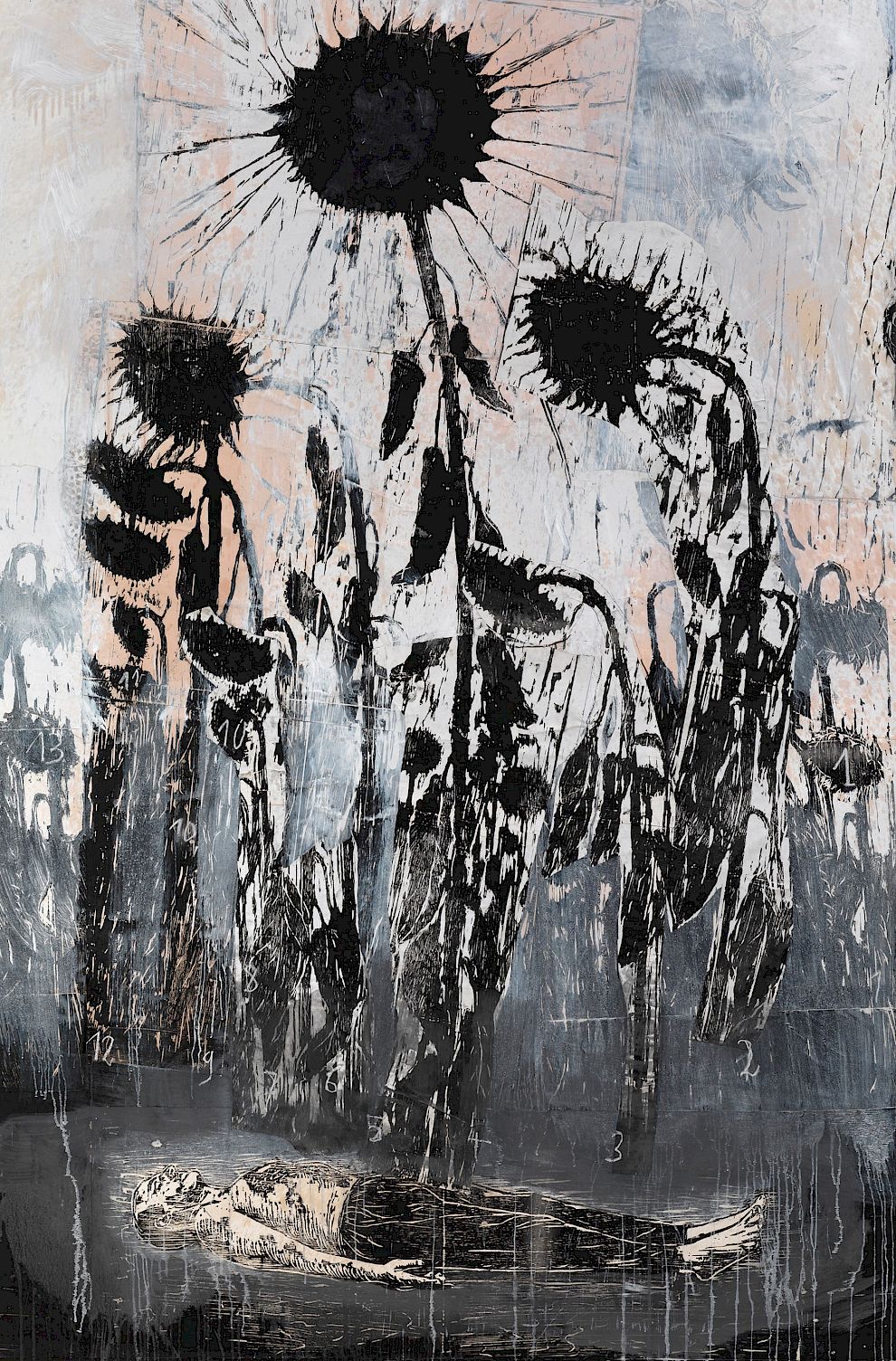
Sunflowers weeping

kiefer_hortus_conclusus.990x0

The sunflowers weep. Anselm Kiefer has done several paintings of sunflowers. He was born in 1945 in Germany, two months before the end of the war. It is hard to imagine the state of mind of the German nation at that time – on the edge of a shameful defeat, confronting the horrors of their totalitarian regime and, of course, the Holocaust. How does a society ever recover from sinking that abysmally low?

Anselm Kiefer has been determined to confront  his culture’s dark past. Here, the sunflower weeps. The sunflower looks so different in Kiefer’s work to the glory of its portrayal by Van Gogh. In Kiefer’s work, the sunflower stands for the national shame. Once proud and tall, the sunflower hangs its head in shame and disgrace – and weeps.

We can see the tears falling – they are the sunflowers going to seed. The seed is watering the earth for a new cycle of life – for a better season.

I was hoping to use this picture in a sermon – (particularly appropriate for Holocaust Memorial Day). I asked myself, “is Kiefer a Christian?”. Then I thought, “what is the point of that question?”, and “what an ugly question to be asking”. In that question there is a “as opposed to what?” – as in “if he is not a Christian then what is he?”. It becomes “Is he a Christian – (as opposed to a Jew)?” See what I mean. It’s an ugly question, particularly on Holocaust Memorial Day.

Kiefer is an artist in the business of lament and hope. There are plenty of others – largely inspired by the Jewish artists and prophets of the Hebrew scriptures.

Notes heard above The Noise of Time

The Noise of TimeI don’t read that much but every now and then I come across something that takes my breath away. Julian Barnes, through his book The Noise of Time, has me intrigued with the noise of time. This is a poetic book that is well crafted and beautifully composed. It tells us the time and the time is telling. It is a short book in which a lot of time is told in a short time. It is a time of terror.

I read this book for the first time at the end of Holy Week, through the three days known as the TriDuum, Maundy Thursday through till Holy Saturday – the short time it took to tell so much of time. I was attentive to the noises of that other time told through three days: the crushing noise of religious and political authority almost overpowering a more faithful and resilient strain.

There are three main characters in The Noise of Time. There’s the “author” who is the one who remembers. There’s Shostakovich, who is the one who hears. And there is the one less than human, Power deformed. Arguably there is a cast of three in the Triduum. There’s the one who remembers (the witnesses), the one who hears (on the cross) and the ones Power deformed (who know not what they do).

Running through my mind while I read this book were lines from a poem by Anna Lightart called The Second Music:

Now I understand that there are two melodies playing,
one below the other, one easier to hear, the other

lower, steady, perhaps more faithful for being less heard
yet always present.

The Noise of Time is a book full of threes – if you like, there are three hands: an hour hand, minute hand and second hand. The three chapters measure three movements: On the LandingOn the Plane and In the Car. 

There are three brands of cigarettes (Kazbeks, Belamors, Herzegovinas). There are three vodka glasses for three vodka drinkers (the perfect number for vodka drinking). There are three wives (Nina, Margarita and Irina). There are three ways to destroy your soul: “by what others did to you, by what others made you do to yourself, and by what you voluntarily chose to do to yourself”. (p.181)

There are three Conversations with Power and there are three leap years twelve years apart from each other (1936, 1948 and 1960). This is the time frame of a crushing history. It is a history which crushes the human spirit and twists arts and artists to the ends of empire, turning them into cowards – which threatened to be a life’s work (being a coward, just to survive).

“It was not easy being a coward. Being a hero was much easier than being a coward. To be a hero, you only had to be brave for a moment – when you took out the gun, threw the bomb, pressed the detonator, did away with the tyrant, and with yourself as well. To be a coward was to embark on a career that lasted a lifetime. You couldn’t ever relax. You had to anticipate the next occasion when you would have to make excuses for yourself, dither, cringe, reacquaint yourself with the taste of rubber boots and the state of your fallen, abject character. Being a coward required pertinacity, persistence, a refusal to change – which made it, in a way, a kind of courage. He smiled to himself and lit another cigarette. The pleasures of irony had not yet deserted him.” (p.171)

Dimitiri Shostakovich was one of the major composers of the twentieth century. I’m no musician but I do know that there are usually four movements to a symphony. That is music’s shape. In his threes, is Barnes describing the way in which totalitarianism deforms truth and beauty? There is the hint of a fourth movement in the opening and closing of the book in epigraph and coda. In these there are the three characters on stage (it’s a station platform). There’s one who remembers, there’s one who hears and there’s one who is a vulgar “half man” (reduced by the noise of time to being less than himself, a mere “technique of survival”. The one who remembered, remembers the vodka and remembers how the one who heard pricked up his ears as he heard the notes of the clinking vodka glasses.

This is what was remembered:

“They were in the middle of Russia, in the middle of a war, in the middle of all kinds of suffering within that war. There was a long station platform, on which the sun had just come up. There was a man, half a man really, wheeling himself along on a trolley, attached to it by a rope threaded through the top of his trousers. The two passengers had a bottle of vodka. They descended from the train. The beggar stopped singing his filthy song. Dimitri Dmitrievich held the bottle, he the glasses. Dimitri Dmitrievich poured vodka into each glass …

He was no barman, and the level of vodka in each glass was slightly different …

But Dimitri Dmitrievich was listening , and hearing as he always did. So when the three glasses with their different levels came together in a single chink, he had smiled, and put his head on one side so that the sunlight flashed briefly off his spectacles, and murmured, “A triad”.

And that was what the one who remembered had remembered. War, fear, poverty, typhus and filth, yet in the middle of it, above it and beneath it and through it all, Dimitri Dmitrievich had heard a perfect triad… a triad put together by three not very clean vodka glasses and their contents was a sound that rang clear of the noise of time, and would outlive everyone and everything. And perhaps, finally, this was all that mattered.” (p.196)

So the tragedy is told in The Noise of Time. There is a lot of time told in a short time. In one moment there is a note of beauty, a sound of music ringing above the noise of time, testimony to the human spirit, crushed, humiliated for so much of the time. There is the sounding of hope.

“Art belongs to everybody and nobody. Art belongs to all time and no time. Art belongs to those who create it and those who savour it. Art no more belongs to the People and the Party than it once belonged to the aristocracy and the patron. Art is the whisper of history, heard above the noise of time.” (p.97)

The gateway where hope and history rhyme

Migrant Mother - Dorothea Lange 1936
Migrant Mother – Dorothea Lange 1936

In her beautiful blog, Maria Popova describes Reverend Victoria Stafford’s meditation in The Small Work in the Great Work (in the collection The Impossible Will Take a Little While: Perseverance and Hope in Troubled Times) as “gorgeous”. Stafford is “interested in what Seamus Heaney calls the meeting point of hope and history, where what has happened is met by what we make of it. What has happened is met midstream by people who are … spiritual beings and all that implies from creativity, imagination, crazy wisdom, passionate compassion, selfless courage, and radical reverence for life.” Here is how Heaney puts it in The Cure at Troy where hope and history rhyme:

Human beings suffer,
They torture one another,
They get hurt and get hard.
No poem or play or song
Can fully right a wrong
Inflicted and endured.

The innocent in gaols
Beat on their bars together.
A hunger-striker’s father
Stands in the graveyard dumb.
The police widow in veils
Faints at the funeral home.

History says, don’t hope
On this side of the grave.
But then, once in a lifetime
The longed-for tidal wave
Of justice can rise up,
And hope and history rhyme.

So hope for a great sea-change
On the far side of revenge.
Believe that further shore
Is reachable from here.
Believe in miracle
And cures and healing wells.

Popova frames her post with Dorothea Lange’s iconic photograph of Migrant Mother. The woman moved by Lange is possibly a Californian pea picker in the Great Depression. Perhaps Popova has been prompted to turn to this photo by Stafford’s anecdote:

“I have a friend who traffics in words. She is not a minister, but a psychiatrist in the health clinic at a prestigious women’s college. We were sitting once not long after a student she had known and counselled,  had committed suicide… My friend, the doctor, the healer, held the loss very closely in those first few days, not unprofessionally, but deeply, fully – as you or I would have, had this been someone in our care.

At one point (with tears streaming down her face), she looked up in defiance (this is the only word for it) and spoke explicitly of her vocation, as if out of the ashes of that day she were renewing a vow or making a new covenant (and I think she was). She spoke explicitly of her vocation, and of yours and mine. She said, “You know I cannot save them. I am not here to save anybody or to save the world. All I can do – what I am called to do – is to plant myself at the gates of Hope. Sometimes they come in; sometimes they walk by. But I stand there every day and I call out till my lungs are sore with calling, and beckon and urge them toward beautiful life and love.”

Michael Sadgrove also claims the “gate” as the standpoint for Christian ministry. Considering Job in his book Wisdom and Ministry, Sadgrove asks about the piety required of those who are called to be friends and comforters to those who have to endure pain, and says that we don’t stand apart from suffering humanity, but face the world as it is. “We must often sit among the ahses where Job is, and must always go outside the gate to the place of the skull, where Jesus is.”

Opening the gate of Hope at the meeting point of  hope and history begins with holding a moment (as in Lange’s photo) closely and deeply, and meeting that with all that we are. For me, this is a passionate rendition of all the pastoral cycle seeks to do in theological reflection and pastoral practice. The final word goes to Victoria Stafford: “Whatever our vocation, we stand, beckoning and calling, singing and shouting, planted at the gates of Hope.” There we see the world “as it is and as it could be; the place from which you glimpse not only struggle, but joy in the struggle” Dorothea Lange’s Migrant Mother is in the public domain.

Giving hope and changing lives

“This task [of giving hope and changing lives] moves beyond what the city council or national government can do, not least when budgets are being reduced drastically. It will require the combined energy, resources and wisdom of everyone to address some of the fundamental economic and social issues we face, and to protect those who are most vulnerable in our communities.

“I am aware that I am taking a leap of faith that we want to promote another’s fulfilment at the same time as our own. As we seek the welfare of the whole city, may we know that we are committed to Giving Hope and Changing Lives when, in our relations with our fellow human beings, distant respect moves to deep appreciation and mere tolerance becomes full participation.”

David Urqhuart, Bishop of Birmingham, writing in the report Giving Hope Changing Lives on the future development of Birmingham, as reported in the Chamberlain Files. Jenny Gillies brought this to my attention in a tweet @revjennyg.

O come, Wisdom

This is what wisdom looks like. It is not as we have come to know wisdom which so often comes dressed in cap and gown. Wisdom so often looks serious, powerful and distant. But here, wisdom looks personal, merciful, charitable and child-like. This icon of Our Lady, Seat of Wisdom is by Slovenian artist and theologian Marko Rupnek, and was commissioned by Pope Paul II. This is what wisdom looks like for those who feel betrayed by those who have impersonated Wisdom and for those whose only hope is in a Wisdom, the likes of which we have never seen before.

The prayer for Wisdom is the first of the Advent Antiphons. They are for those who live in lamentable times. There are seven of them, and they are part of Common Worship Daily Prayer for the seven days starting today.

The prayer goes:

O Wisdom, coming forth from the mouth of the Most High,
reaching from one end to the other mightily,
and sweetly ordering all things:
Come and teach us the way of prudence.

Malcolm Guite has composed an appeal for Wisdom as part of his reflections on the Advent Antiphons. This is part of his collection of Sonnets, Sounding the Seasons.

O Sapientia

I cannot think unless I have been thought,
Nor can I speak unless I have been spoken.
I cannot teach except as I am taught,
or break the bread except as I  am broken.
O mind behind the mind through which I seek,
O light within the light by which I see,
O Word beneath the words with which I speak,
O founding, unfound Wisdom, finding me,
O sounding Song whose depth is sounding me,
O Memory of time, reminding me,
My Ground of Being always grounding me,
My Maker’s Bounding Line, defining me,
Come, hidden Wisdom, come with all you bring,
Come to me now, disguised as everything.

When we pray for Wisdom we recognise that we are still seeking her. We know Folly sure enough, but Wisdom is yet to be found. In Matthew’s story of Jesus’ birth we are reminded just how elusive Wisdom is. There, the so-called Wise Men got their directions so wrong that they travelled to Jerusalem before realising their mistake. Worldly wise they expected the special birth to be at the seat of power, and not in a stable. As Brueggemann says, they were nine miles wide of the mark.

But we act as if we are “spot on”.

I am heartened by the attention being given to how we can share concerns about how we are failing (the Harvard Business Review has published its Failure Issue). We tend to protect ourselves by saying what a good job we are doing, and how we are meeting our targets, like Little Jack Horner sat in his corner. Too often we just list our successes to promote ourselves and our organisation. This is hiding the truth. This is foolish. Further questions need asking such as “in what ways are we (am I) failing to do what we feel we should be doing?” That question is far more likely to uncover the truth. Realising the lamentable truth of our lives is the start of our quest for Wisdom. Wisdom’s absence makes our hearts grow fonder for her.

Here is a link to a general post I wrote about the Advent Antiphons which you may like to read.