LimpLight

This one’s for all who wrestle in the dark and rise, blessed but limping, inspired by reading Genesis 32:22-31 and Luke 18:1-8 – the Revised Common Lectionary readings for October 19th 2025.

How shall we describe the state of Israel today?

The state of Israel today begins with both our readings —
from Genesis 32, the story of Jacob whose name means twister;
and from Luke 18, the story of the widow struggling for justice.

The state of Israel begins at the end of a night of struggle for the twister,
a night of struggle in which Jacob never discovers
the name of the one he’s wrestling with,
but finds himself called by a new name — Israel.

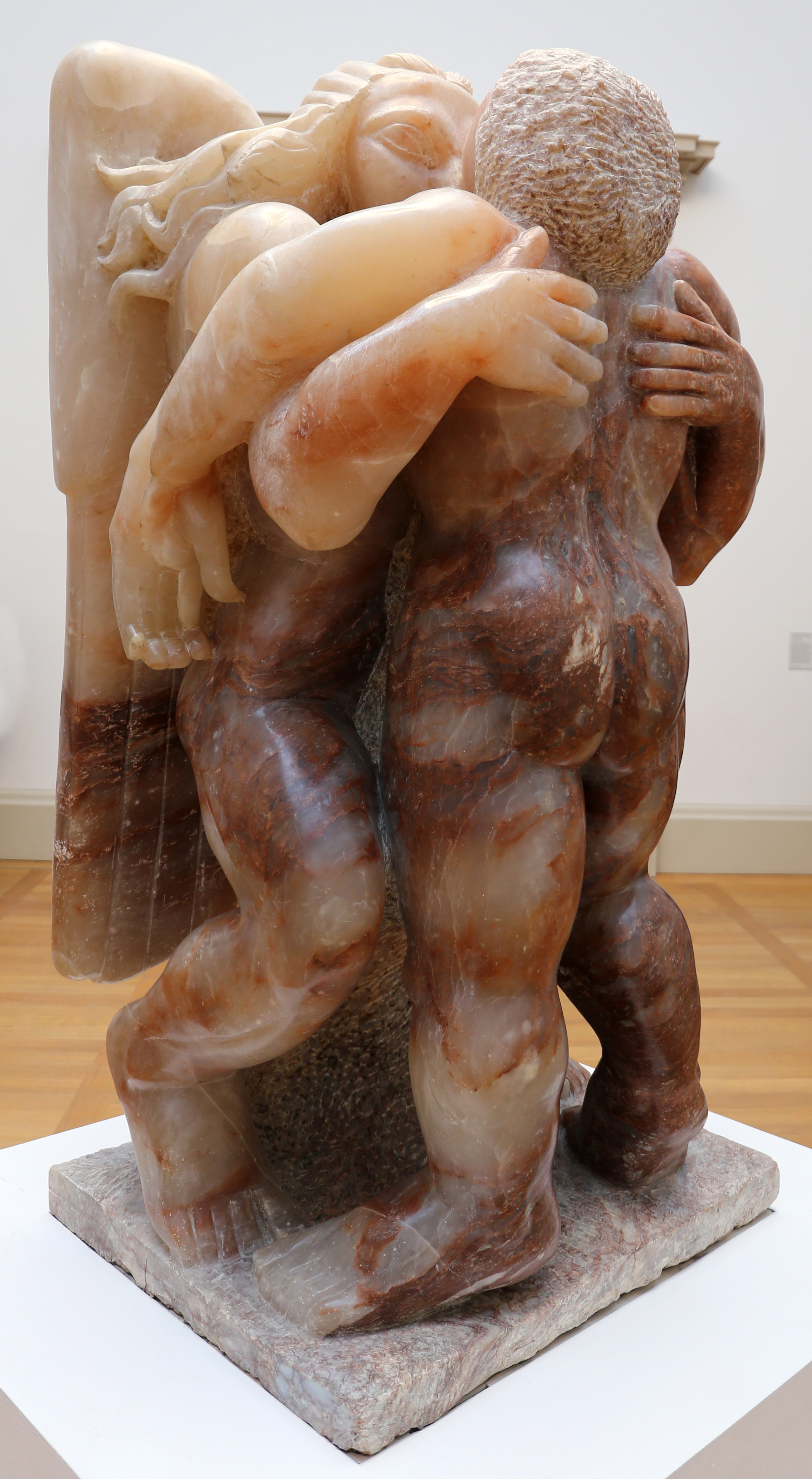
Jacob’s struggle as portrayed by Sir Jacob Epstein (shown in Tate Gallery, London)

Israel struggles with God,
and God struggles with Israel.
That is the very meaning of Israel.
If Israel means anything,
it means struggling with God.

Jacob is the first to be called Israel,
and he is called (renamed) that by the one he struggled with
because he “struggled with God and with people”
and withstood the whole night.

It is the calling of Israel to struggle faithfully through the night.

Jacob is the patriarch of Israel —
the patriarch of those who struggle with God and with people,
and who carry on wrestling through long nights and times of darkness
without being overcome,

people like the widow singled out by Jesus —
a victim of some injustice.
In the face of an utterly unjust justice system,
personified by a judge who neither feared God
nor cared what people thought,
she struggled.

For some time she struggled.
She kept coming at that lousy judge.
She wouldn’t let go until he gave in.

Those who struggle through the night,
with God and with people —
those who struggle to see the night through,
for whom the night is very dark,
and for whom there is little daylight,
those who won’t give up whatever the night brings —
they are the ones whose hope is rewarded.

They carry a blessing for all who wrestle with God
and with the wounds people inflict.

It’s the blessing of God
who himself wrestles through the darkness of the world,
who struggles with people and the suffering they cause,
but who, in spite of all that,
wrestles the whole night long.

This is the love that shines in the darkness
to the break of day.

And yet, the night is long.
Not just one night in Jacob’s life,
not just one night in ours,
but the long night of the world —
a night as long as history.

Through that long night we wrestle,
and God wrestles with us.

There are three struggles woven into this story,
and all three belong to Israel:

We struggle with God.
We struggle with people —
and people struggle with us.
And through it all,
God struggles with us.

That’s what it means to be called Israel:
to live the long night of wrestling,
and to trust that, at the end of it,
there will still be blessing.

The struggle with God

Sometimes it’s the long silence of prayer —
when we ask and wait and hear nothing.
Sometimes it’s the ache of loss,
or the questions that faith won’t easily answer.
We wrestle with God when life doesn’t fit the promise,
when love feels hidden,
when blessing comes only after a wound.

But still we hold on.
Faith is not certainty —
faith is the grip that will not let go until morning.

The struggle with people

And we wrestle with people too.
Not just those who hurt or wrong us,
but in all the difficult ways love tests us —
learning to forgive, to be patient,
to stay kind when we’d rather give up,
to bear with one another’s weakness.

People struggle with us too —
our faults, our sharp words, our stubbornness.
We are all part of each other’s wrestling.

These are the struggles that form the fruits of the Spirit —
the quiet strength that grows only in the dark:
patience, gentleness, self-control,
love that endures through the night.

The struggle with ourselves

And maybe there’s a fourth struggle too —
the one Jacob knew best —
the struggle with ourselves.
The fight to face what we’ve twisted,
to tell the truth about who we are,
and to accept the new name that grace gives us.

Before we can meet God face to face,
we have to face ourselves in the dark —
the parts we’d rather not see,
the wounds we’ve caused as well as borne.
Even that struggle can become blessing.

The struggle of God

And through it all, God struggles too —
not against us, but for us.
God wrestles through the night of the world,
bearing our pain,
refusing to give up on us.
The cross itself is the mark of that struggle —
God’s own wound,
the divine limp that still bears the weight of love.

This is the love that shines in the darkness
to the break of day.

Jacob wanted to know the man’s name,
but the man would not tell him.

Maybe that’s the mercy of God —
that we never get to hold the name too tightly.
The namelessness keeps the struggle open.
It reminds us that this wrestling is for everyone,
that God stands with all who struggle through the night —
beyond borders, beyond certainty, beyond control.

It was not for ease that prayer shall be.
The story of Israel is not the story of the untroubled.
The story of Israel is the story of the very troubled —
the story of slavery, exile, persecution,
the horrors of history, the nightmare.

Amos got it right three thousand years ago.
He condemned the complacent,
those who are at ease in Zion.
He said they put off the day of disaster
and bring near a reign of terror.
They are not fit to be called Israel.
They duck the fight and ignore the struggle.

But Jacob did not.
The widow did not.
And the God who wrestles through the night does not.

Jacob’s blessing comes with a wound.
He carries it into the dawn,
every step a reminder of the night he endured
and the God who would not let him go.

Perhaps this is the mark of the blessed —
not the ones who have had an easy time of it,
but the ones who have been wounded and changed.
The ones who know that life is not straightforward,
that faith is not certainty,
and that love costs something real.

Israel limps into the sunrise,
blessed and broken.

And still, the night is long —
as long as history,
as wide as the world.
Still, God wrestles with us,
still struggles with his people,
still bears our wounds,
and still blesses us.

And when the dawn comes —
as surely it will —
the blessing will not erase the limp,
but redeem it.

For the love that shines in the darkness
will shine until the whole world
limps into the light.

Afterthoughts
What might it mean for a people, or for a church, to be known by its limp – to be blessed not in strength but in struggle?
If God still wrestles through the long night of the world, where do you see that struggle – and that love – happening today?

Who do we see on our way to worship? A reflection on Acts 3:1-10

This is part of a series of reflections inspired by readings from the Book of Acts. This time the focus is on a scene at the Beautiful Gate of the Temple in Acts 3:1-10. The text is included at the end of the reflection. You might want to read that first because, after all, this is just a reflection. This is the part of the passage where I started:

One day Peter and John were going up to the temple at the hour of prayer … And a man lame from birth was being carried in. People would lay him at the gate of the temple called the Beautiful Gate so that he could ask for alms from those entering the temple.

And this is the question my reading left me with:

Who do we see on our way to worship? Who don’t we see?

The beggar isn’t named but I want to find a name for him. He is sitting at the Beautiful Gate and has his eye on all those going into worship, including Peter and John. They recognise him though they might not already know him. They see him as he looks at them.

Who do we see on our way to worship? Who don’t we see?

Willie James Jennings, in Acts, writes “At the doorway to worship are those whose very presence should discipline praise and guide hope. Before praises go up to God the poor and lame, the sick and pained must be seen.” (p41). Luke has already given his readers the story of the Good Samaritan featuring the pious hypocrites who fail to notice the needs of the wounded in the gutter.

Who do we see on our way to worship? Who don’t we see?

There is a lot of seeing in this passage. The lame man “saw Peter and John”, Peter “looked intently at him” and said “look at us”. Those in need need to be seen. So many in need remain invisible in corridors of power – being seen by those on their way to worship is their hope.

Who do we see on our way to worship? Who don’t we see?

The lame man, the beggar, probably didn’t know that he too was on his way to worship. Peter and John tell him to look at them. And Peter said to him: “I have no silver or gold, but what I have I give you; in the name of Jesus Christ of Nazareth, stand up and walk”. (Acts 3:6). His feet and ankles became strong and he was able to jump up, stand and walk, entering the temple with Peter and John, “walking and leaping and praising God”. (Acts 3:8)

Who do we see on our way to worship? Who don’t we see?

Jesus sees himself in the prisoner, the hungry, the stranger and the sick. In a parable the king curses those who gave him no food, no welcome, no clothing and no companionship. Those guilty ask the king, “When was it that we saw you hungry or thirsty or a stranger or naked or sick or in prison and did not take care of you?” He answers them: “Truly I tell you, just as you did not do it to the least of these, you did not do it to me.” (Matthew 25:31-46). Do we see Jesus in and with the vulnerable or do we overlook them?

Who do we see on our way to worship? Who don’t we see?

Perhaps we see Israel. From the beginning Israel walked with a limp. It might not be stretching imagination too far to see here those who inherited the name Israel from the patriarch Jacob who was called Israel because he wrestled with God. Israel is the Hebrew name that stands for those who wrestle with God. Israelites are bound by the injury and blessing of that wrestling and struggle. Jacob’s hip was put out of joint and he always limped after that. (Genesis 32:24-30). Is this who Peter and John saw? Perhaps significantly, we’re told that the man is more than 40 years old (Acts 4:22). 40 years is always the length of time that Israel waits. Did Peter and John see this man as Israel, limping and lame from the start, and now standing and leaping and praising God? If this is Israel, is this the Jewish people so often overlooked by Christians on their way to worship?

Who do we see on our way to worship? Who don’t we see?

Or, is this the church (or us), lying there lame in our excuses for mission and our attempts at Jesus begging for the power of the Holy Spirit.

Who do we see on our way to worship? Who don’t we see?

I said I wanted to find a name for the man born lame – we have a choice: he is the man born lame, he is Christ, he is Israel, he is church, he is us – all needing to be seen on the way to worship. Whatever his name, he is one who has been lame from the beginning and he is vulnerable. He begs to be seen and he begs to be seen by us, even on our way to worship. We need to make peace with him and take him with us in our hearts and imagination into our worship. If we don’t then our worship is hollow, hypocritical and unacceptable to God.

Who do we see on our way to worship? Who don’t we see?

Here’s the passage:

Acts 3:1-10
One day Peter and John were going up to the temple at the hour of prayer at three o’clock in the afternoon. And a man lame from birth was being carried in. People would lay him at the gate of the temple called the Beautiful Gate so that he could ask for alms from those entering the temple. When he saw Peter and John about to go into the temple, he asked them for alms. Peter looked intently at him, as did John, and said, “Look at us.” And he fixed his attention on them, expecting to receive something from them. Peter said, ” I have no silver or gold, but what I have I give you; in the name of Jesus Christ of Nazareth, stand up and walk.” And he took him by the right hand and raised him up, and immediately his feet and ankles were made strong. Jumping up, he stood and began to walk, and he entered the temple with them, walking and leaping and praising God. All the people saw him walking and praising God, and they recognised him as the one who used to sit and ask for alms at the Beautiful Gate of the temple, and they were filled with wonder and astonishment at what had happened to him.

New Revised Standard Version, Updated Edition. Copyright © 2021 National Council of Churches of Christ in the United States of America.

Coin sides and the shape of peacemaking processes

How many sides has a coin? When we toss a coin we call “heads” or “tails” because we assume that a coin just has the two sides. On the toss of a coin we are divided into winners and losers. The winners are able to claim that they won fairly (even though only by chance) and the losers have to suck it up. There are two sides now and both know whether they are on the side with greater chance or lesser chance. The losers’ last chance is to overturn privilege – and the odds are always stacked against them.

The 12 sided thrupenny bit was first minted in 1937

But there aren’t just two sides to a coin. There is another smaller side which nobody calls because it so disproportionately small that the chance of it landing on its edge are virtually zero. But then, who hasn’t spent time standing coins on their edge, and who of us of a certain age hasn’t enjoyed making the old thrupenny bit take its stand on one of its twelve sides (as opposed to its two large sides).

Just imagine twelve sides. That is precisely what our scriptures imagine – with the twelve tribes of the twelve sons of Jacob finding and founding society in the land they were caused to occupy. The early church shared that imagination, counting twelve apostles and replenishing that number when one fell out. The thrupenny bit represents a design to facilitate concelebration, conversation and dialogue – remembering that there are rarely only two sides to any question and that to resolve conflict many sides have to be considered. Sitting round a circular table is to adopt this design. Each person has their point of view, their side, in a facilitative process which intends to iron out the abuses of positional power.

Polyhedron 20 from yellow

Pope Francis, in Fratelli Tutti (2020), suggests the image of the polyhedron as the shape of better things to come. Promoting a “culture of encounter” he writes:

“The image of the polyhedron can represent a society where differences coexist, complementing, enriching and reciprocally illuminating one another, even amid disagreements and reservations. Each of us can learn something from others. No one is useless and no one is expendable. This also means finding ways to include those on the peripheries of life. For they have another way of looking at things; they see aspects of reality that are invisible to the centres of power where weighty decisions are made.”

Fratelli Tutti 2020

Colum McCann underlines how tricky it is to get beyond binary thinking about winners and losers and right and wrong in his novel Apeirogon. The title is a mathematical term for an object of an “observably infinite number of sides” – a shape that reflects that conflict can never be reduced to simple opposed positions. Apeirogon is based on the real life friendship between Rami Elhanan and Bassam Aramin, two fathers (one Israeli, the other Palestinian) united in their grief for their daughters – both killed in conflict. They both join the Parents Circle Families Forum – a group of people similarly bereaved who unite in their sorrow to press for a peaceful resolution to the conflict.

Apeirogon: a shape with a countably infinite number of sides. Countably infinite being the simplest form of infinity. Beginning from zero, one can use natural numbers to count on and on and even though the counting will take forever one can still get to any point in the universe in a finite amount of time

from The Apeirogon

And there’s another shape – the circle. The shape of things to come if ever we come to the time of resolution – when there are no sides to join or oppose, when the corners we tend to cling to are rounded off by our encounter with the various truths of any situation. The earth is well rounded as if prepared for peace making.

Laban and Jacob have their say on the folly of borders and their control

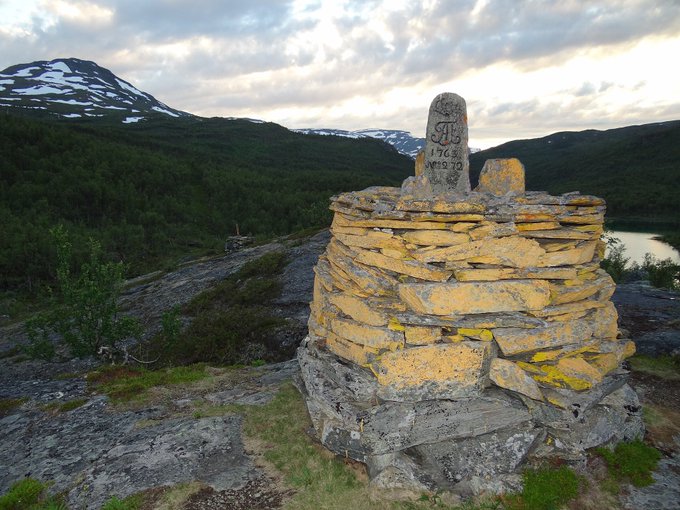
A cairn marking the boundary between Norway and Sweden in a remote area of the Arctic. Photo by Bjorn Christian Torrissen

The UK Government has announced plans to take “full control” of borders unveiling an Australian-style points system to overhaul immigration law and close our borders to unskilled workers and those who can’t speak English. When we talk about taking “full control of our borders” aren’t we just allowing fear and anxiety to take control of our borders? Are we forgetting that border controls escalate and will be reciprocated? Have we given any thought to who in the end will wipe our bums? Are we not just trading hostility?

This is all part of the deceit of government.

I have been intrigued by the stories about Jacob and Laban from Genesis 29-31. Jacob is the “leg-puller”, the “supplanter”, the “deceiver”. Jacob was born pulling the leg of his older twin brother Esau, trying to stop him being the first-born. Laban is the “white man“. Laban means white.

The story of Laban and Jacob is a saga of deception – the white man deceiving the deceiver, though was Jacob the outsmarter of the two?

The two of them come to terms with each other by building a “witness heap” of stones laid by their families as a commitment to peace. It marked the first bilingual place name recorded in the Bible – Laban called it Jegar Sahadutha and Jacob called it Galeed – the translations of “witness heap” in their respective languages.

Galeed, (we would perhaps call it a cairn) stood as a landmarked prayer. It provided a boundary to their hostility, an end to it. Significantly both Jacob and Laban refuse to take control of their new border. Instead they pray: “The Lord watch between you and me”. The Lord is the one they want to control their border and to watch their limits so that they never cross for harm but only cross for peace.

I wonder when we pray, when we put or hands together, whether we are building a cairn – a knuckle-boned physical structure to mark the limits of our hostility and anxiety, to say “beyond this only peace, beyond this only love”.

Are our churches also cairn-like landscaped prayers – places to confess our hostility, to find better ways to deal with our differences and markers within our communities beyond which we commit to “go in peace”? “This heap is a witness, and this pillar is a witness, that I will not go past this heap to your side to harm you and that you will not go past this heap and pillar to my side to harm me.” (Genesis 31:51f)

Borders are worse for our control when our export is fear. The boundaries of our Brexit mindset become brickset – walls built against others deconstructing differences, obstructing relationships, restricting trade and exchange.

Where are we building our witness heaps and our places of commitment? How are we replacing walls with cairns? How do we lament our nationalism?

Genesis 31:44-54
Come now, let us make a covenant, you and I; and let it be a witness between you and me.’ 45So Jacob took a stone, and set it up as a pillar. 46And Jacob said to his kinsfolk, ‘Gather stones,’ and they took stones, and made a heap; and they ate there by the heap. 47Laban called it Jegar-sahadutha:* but Jacob called it Galeed.* 48Laban said, ‘This heap is a witness between you and me today.’ Therefore he called it Galeed, 49and the pillar* Mizpah,* for he said, ‘The Lord watch between you and me, when we are absent one from the other. 50If you ill-treat my daughters, or if you take wives in addition to my daughters, though no one else is with us, remember that God is witness between you and me.’
51 Then Laban said to Jacob, ‘See this heap and see the pillar, which I have set between you and me. 52This heap is a witness, and the pillar is a witness, that I will not pass beyond this heap to you, and you will not pass beyond this heap and this pillar to me, for harm. 53May the God of Abraham and the God of Nahor’—the God of their father—‘judge between us.’ So Jacob swore by the Fear* of his father Isaac, 54and Jacob offered a sacrifice on the height and called his kinsfolk to eat bread; and they ate bread and tarried all night in the hill country.

The leadership and ministry of fools (and other outsiders)

The Fool (1944) by Cecil Collins
The Fool features in much of Collins’s art. The Fool represents saint, artist and poet – the saviours of life, according to Collins. He always portrays the fool as an innocent figure who, although finding no place in the modern world, has the vision to find fulfilment and eventual reward. Here the Fool is carrying a heart (for love) and an owl (for wisdom and freedom)

When it comes to power and leadership in the church are we confused by worldly perceptions of power and success?

Recently I have heard about arguments amongst leaders about who sits in the “best seats” in the chancel, and there’s real power politics at play in ecclesiastical processions!

If we are entitled (Rev, Reader etc) what are we entitled to? Cases of abuse show how wrong some of us so entitled have been.

What are the qualifications for leadership? And what is our unconscious bias about those qualifications – and how much potential is wasted by those biases?

Justin Lewis-Anthony makes the case that our understandings of leadership are qualified and conditioned by Hollywood and the leadership of those on the “wild frontier” as portrayed by decades of “westerns”. (Donald Trump fits that well.) Lewis-Anthony talks about “the myth of leadership” and describes the way the myth is told.

Someone comes from the outside, into our failing community. He is a man of mystery, with a barely suppressed air of danger about him. At first he refuses to use his skills to save our community, until there is no alternative, and then righteous violence rains down. The community is rescued from peril, but in doing so the stranger is mortally wounded. He leaves, his sacrifice unnoticed by all.

This is the plot of Shane, Triumph of the Will, Saving Private Ryan and practically every western every made. It is the founding myth of our politics and our society. It tells us that violence works, and that leadership only comes from the imposition of a superman’s will upon the masses, and preferably those masses “out there”, not us.

The new archbishop of Canterbury should be a disciple rather than a leader in The Guardian, 4 February 2013

The Bible is very critical of worldly systems of power and leadership. Walter Brueggemann (in Truth Speaks to Power) makes the point that the pharoah is never named in Exodus, but that he is a metaphor representing “raw, absolute, worldly power”. He is never named “because he could have been any one of a number of candidates, or all of them. Because if you have seen one pharoah, you’ve seen them all. They all act in the same way in their greed, uncaring violent self-sufficiency.” Samuel is scathing about the Israelites’ insistence that they be led like the other nations. He knew (1 Samuel 8:11-17) that those sort of leaders are always on the take (sons, daughters, chariots, horses, fields and livestock – everything).

The ways of God are very different to the ways of preferment and career advancement. Paul is amazed when he surveys his fellow disciples. He wrote to the church of Corinth: “Consider your calling. Not many of you were wise according to worldly standards, not many were powerful, not many were of noble birth. But God chose what is foolish in the world to shame the wise. God chose what is weak in the world to shame the strong; God chose what is low and despised in the world, even things that are not, to bring to nothing things that are, so that no human being might boast in the presence of God.” (1 Corinthians 1:26-29).

Similarly Jesus praised God that she had hidden the things of heaven from the seemingly well qualified. “Jesus, full of joy through the Holy Spirit said, “I praise you Father, Lord of heaven and earth, because you have hidden these things from the wise and learned, and revealed them to little children.” (Luke 10:21).

What difference would it make to our CVs if we focused on our foolishness and our weakness? Would it prompt us to realise that power and leadership is found in some very strange places and surprising people? What difference does it make when we recognise that leadership qualifications are the gift of God and that the leadership qualities are love, joy, peace, forbearance, kindness, goodness, faithfulness, gentleness and self-control (Galatians 5:22-23) by which measures pharoahs look hopelessly unqualified.

I have recently had the privilege of reading The Bible and Disability edited by Sarah Melcher, Michael C Parsons and Amos Yong. I quickly realised how pervasive disability is and how important a lens it is to view Christian leadership. Under their prompt it is easy to see how “disabled” the people featured in scripture are. Moses was chosen in spite of his speech impediment. Jacob bore his limp with pride that he wrestled with God (and Israel takes its identity and name from that fight). Jesus’ crucifixion was the ultimate disability.

I asked the question on Twitter, “would it make a difference in leadership if we focused on disabilities and vulnerabilities rather than just abilities?” Friend Mark Bennett replied: “In Matthew’s gospel Jesus uses parables so that people hear, “see”, understand anew, overcoming disabilities of preconception, prejudice and fear.” Friend Jenny Bridgman replied: “”What are my blind spots?” is a tough but necessary #leadership question. Some more are: What can someone else do better that I can? How can I free them to do that well? Or even – how do my/our disabilities and vulnerabilities make my/our leadership more effective?”

I suspect that as long as we ignore these questions there will always be “us” and “them” – a few privileged by the powers-that-be working “for” (or even “against” as some sort of pharoah) rather than working and living “with” and in love with others.

PS. I didn’t include the title of Justin Lewis-Anthony’s book because it is so flippin’ long – It is You are the Messiah and I should know: Why Leadership is a Myth (and probably a Heresy) .

Changing the order of things

It is a privilege to be supporting newly ordained ministers: a group of people in short-term posts on their way to taking on posts of greater responsibility. They are a people in transition who manage remarkably well to avoid being anxious about what might or might not happen to them. They are going through the appointment process, which is also, of course, often a disappointment process. The process of appointment and disappointment is a confusing one. There is not always an apparent justice.

I have always been intrigued by the element of surprise in (dis)appointments and the more exciting appointments I have been involved with have had an element of surprise. Ruth was overwhelmingly surprised when she was appointed churchwarden. Jack was surprised when he wasn’t, though to his credit, he came to terms with his disappointment with great grace.

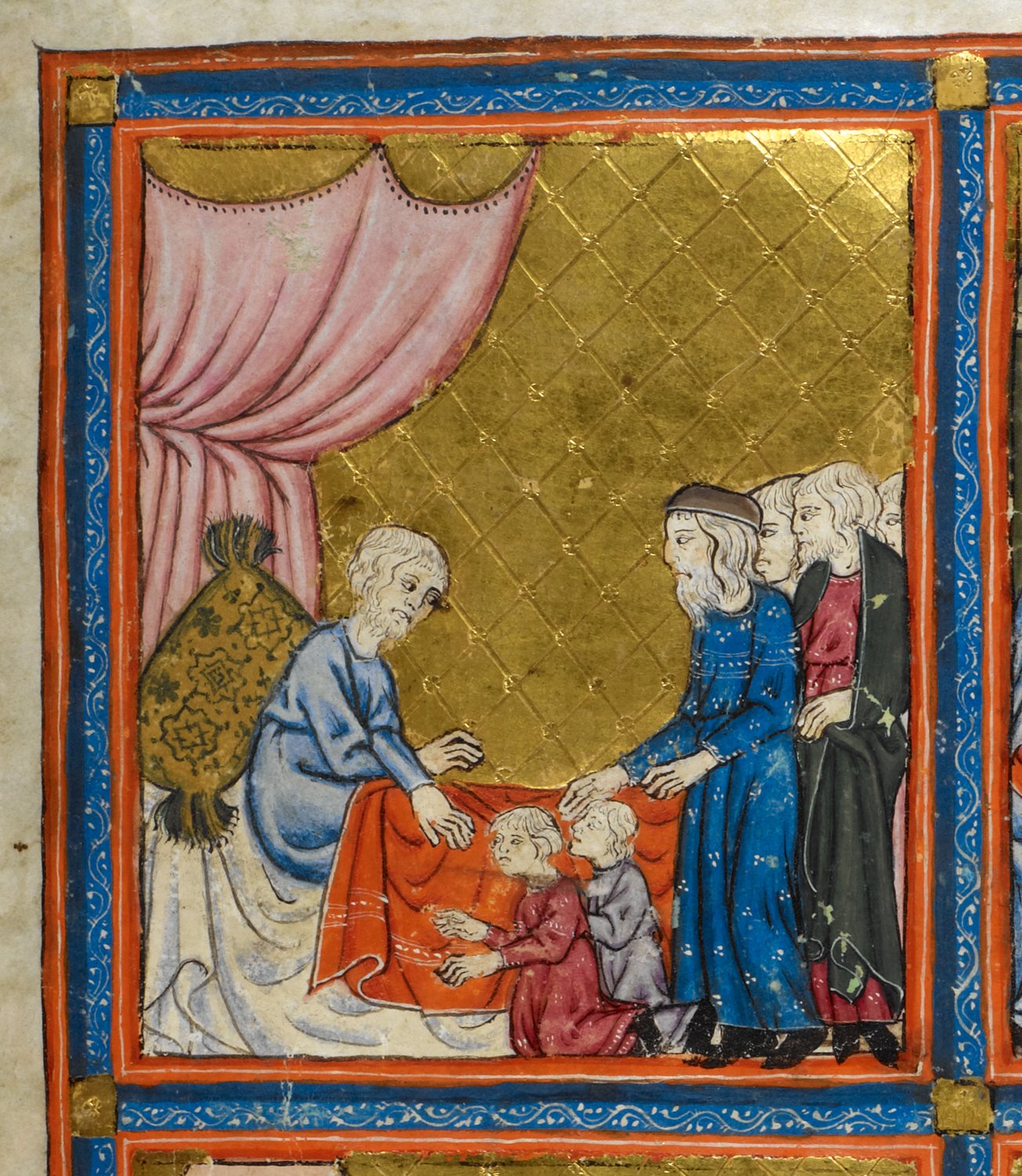
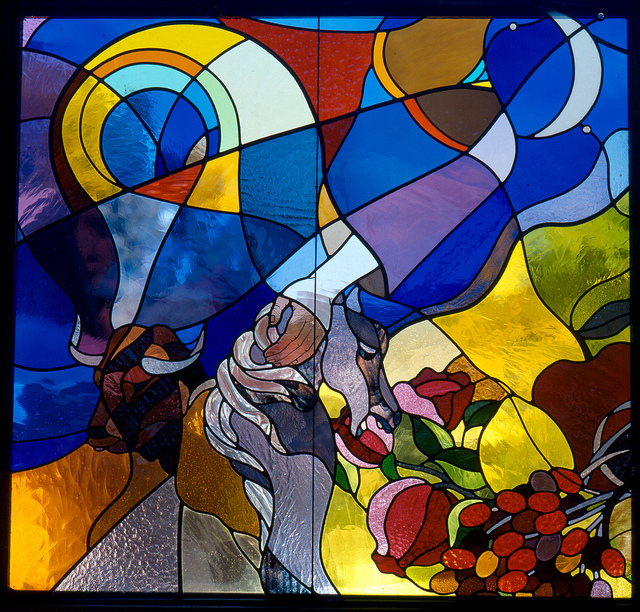
Ordinarily, there should be justice in appointments, and succession planning should follow well understood procedures. But there needs to be processes of disruption. I have been reading the story of Jacob’s blessing of Joseph’s two sons Manasseh and Ephraim (Genesis 48). They were born in that order and should, by rights, have been blessed in that order. Jacob himself “stole” his father’s blessing from his older twin Esau. Of Jacob’s twelve sons, Joseph was the last in line, inspiring murderous resentment amongst his brothers. (The stained glass pictured above shows Joseph’s blessing). Disappointments abound in the Bible. The choice of David by the prophet Samuel was a surprise to David’s father. David was not the first-born, but the last-born – and still so young. Each of his older brothers was presented to Samuel. Each was dis-appointed as Samuel turned the line of succession on its head (1 Samuel 16:1-13).

The New Testament takes up the theme. Everything is in the wrong order. Even the birth of Jesus is in the wrong place. The wise ones went for Jerusalem and finished up nine miles wide of the mark. (Matthew 2). Jesus, himself set the cat among the pigeons by describing the disappointment process. He said “The last will be first, and the first will be last” (Matthew 20:16) before being challenged by the Mum who claimed her two sons had the right to the best seats in the house (Matthew 20:20-24).

All these stories are a reminder that there has to be room for manoeuvre and that there have to be processes of disruption. Prayer before appointments is an invitation for the Holy Spirit to confirm or disrupt the natural order of things. Sometimes the order of things has to change if things are going to change. The story of Manasseh and Ephraim, (or is it Ephraim and Manasseh?) is a reminder of that. It represents the hope of a new order, in which those whose appointment comes as a surprise live for the sake of others and not for themselves. That is why the order is changed.

A new order is one in which all those who come last in things come first – a great disappointing for some.

The stained glass is by Maria Stolz of Renaissance Glassworks Howard Lake, MN 55349

Here is another post on the theme of disappointment and leadership.

Preaching for a change

Sermon for today – in which I have chosen to go with theappointed Old Testament text (Exodus 33:12-end) for preaching this morning. The OldTestament is often neglected in our thinking – but I hope you will see whytoday’s reading is important to us, and not only to us, but to all the peopleof God.

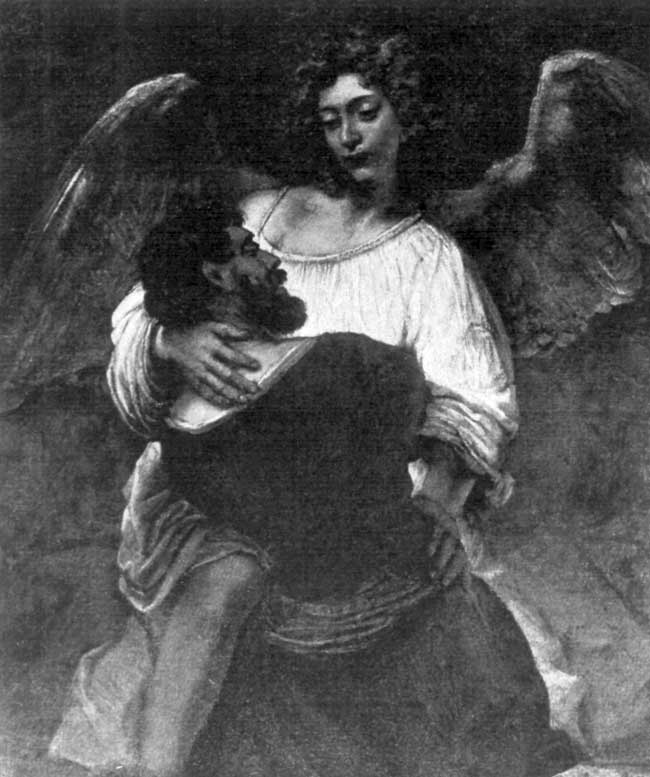
Jacob wrestling with angel by Rembandt
Can I remind you that thepeople of God were named Israel, by God after Jacob’s sleepless night of wrestling with the angel of God (or withGod)? After that match Jacob is called ISRAEL – and the name Israel means “onewho wrestles with God”, or “one who is straight, direct with God.”


The people of God wrestlewith him, struggle with him, and are straight and direct with him. This line ofthought suggests that we are not called to be mildly submissive to God, butthat God actually wants us to struggle with him, be direct with him, and begrown up with him. He wants us to get to grips with him.

This straightness anddirectness is reflected in the prayer of the People of God – which might aswell start with “I want to be straight with you God”, in a spirit of challenge. Our reading from Exodus showsMoses engaged in this sort of conversation which consists of challengingdemands.

We are told that “the Lordused to speak to Moses face to face, as one speaks to a friend.” In our readingwe have the privilege of overhearing that conversation in which Moses isnegotiating with God.
We may take it for grantedthat God answers prayer – but in this passage we have the foundation of thatfaith which Scripture wants us to take for granted.

Black Moses

Speaking face to face, as onespeaks with a friend, God hears Moses’ prayer and answers it in the mostpositive way. He doesn’t just answer Moses’ prayer, but gives more than Mosesdares even to imagine – and it isintended that we get used to that, and take it for granted, so that we may toowith trust let God get to grips with us so that he can know our mind and whatis on our heart.

Thebackground to Moses’ demands is that God had told him that he wouldn’t go withthem to the Promised Land because he was so angry with the people for breakingthe agreement that they had.
“Go up to a land flowing with milk andhoney; but I will not go up among you, or I would consume you on the way, foryou are a stiff-necked people.” (Exodus 33:3).
Mosesinsists that God must accompany his people. He recognizes that the relationshipwith God is more important than the real estate of the Promised Land.
Theanswers to Moses’s prayer in these chapters of Exodus are outrageouslygenerous. He is prepared to start again and offers new tablets of commandmentsto replace the agreement and commandment that the people had broken.
Mosesand the Lord stood together on Mount Sinai – as friends so that Mosesunderstands just how God is going to fulfill his part of the bargain, hispromise to his people.
Thisis how God summarized the characteristics of his behavior with his peopleduring that conversation with Moses:
The Lord passed before him, andproclaimed, “The Lord, the Lord, a God merciful and gracious, slow toanger, and abounding in steadfast love and faithfulness, keeping steadfast lovefor the thousandth generation, forgiving iniquity and transgression and sin,yet by no means clearing the guilty, but visiting the iniquity of the parentsupon the children, and the children’s children, to the third and fourthgeneration.” (34:5-7).
Whilethere is mention of punishment the emphasis is on God’s forgiving love. Theguilty aren’t cleared, but the consequences of their guilt only reach to thethird and fourth generation, while steadfast love reaches to the thousandthgeneration – in other words – forever. This is how God is going to be forever:merciful and gracious, slow to anger, abounding in steadfast love andfaithfulness, keeping steadfast love to the thousandth generation.
We have to remember howdifferently God is promising to behave. He had been so angry with his people(and justly so, according to the text) – but now, in response to the demands of his people, he isgoing to be so slow to anger. In response to one of us humans, God changes hismind about his behaviour. In future his behaviour is going to be governed bysteadfast love and faithfulness.
In the section of the storywhich we read this morning we have the summary of God’s response to Moses. “Mypresence will go with you, and I will give you rest.”
All of us can find rest inthe knowledge of the manner of God’s promised presence, particularly when thatpresence is governed by steadfast love and faithfulness. This is how God iswith us. We don’t need to worry that he is any different. We can trust in hisforgiving love. We don’t need to be afraid – the Lord is here, unconditionally.
Moses makes one request toGod that God does not agree to.  Moseswants to see God face to face. God’s response: “You cannot see my face; for noone shall see my face and live.” (33:20)

Instead, we have a ratherpuzzling response.
“Thereis a place by me where you shall stand on the rock; and while my glory passesby I will put you in a cleft of the rock, and I will cover you with my handuntil I have passed by; then I will take away my hand, and you shall see myback.”

WakeSeeing the back of God israther strange. Most people see this as “the WAKE of God” – just as we see theripples and waves in the wake of a boat, so we are given sight of the effectsof God’s love. Seeing the back of God is seeing where God is and has been.

So far, I have mentioned onlyhow God is governing his behaviour in covenant with his people. I haven’t mentionedwhat he promises to do. He said “before all your people I will perform marvels,such as not have been performed in all the earth or in any nation. (34:10).

Seeing the back of God isseeing the wake of marvels, seeing the work of God. And the work of God ismending the broken – the broken in this case, being the very heart of therelationship between God and his people.

Seeing the wake of God isseeing where God is going. Seeing the wake of God is being able to follow hiswork of mending. Seeing the wake of God is being able to follow him and joiningin his most marvellous work of remaking broken relationships, and SHALOM.

Even in this way, Godresponded to Moses request, but gave him, once again, more than he could everdream of. Which is better? To see God face to face, or to be able to followhim, in his wake, and love him for all his ways?